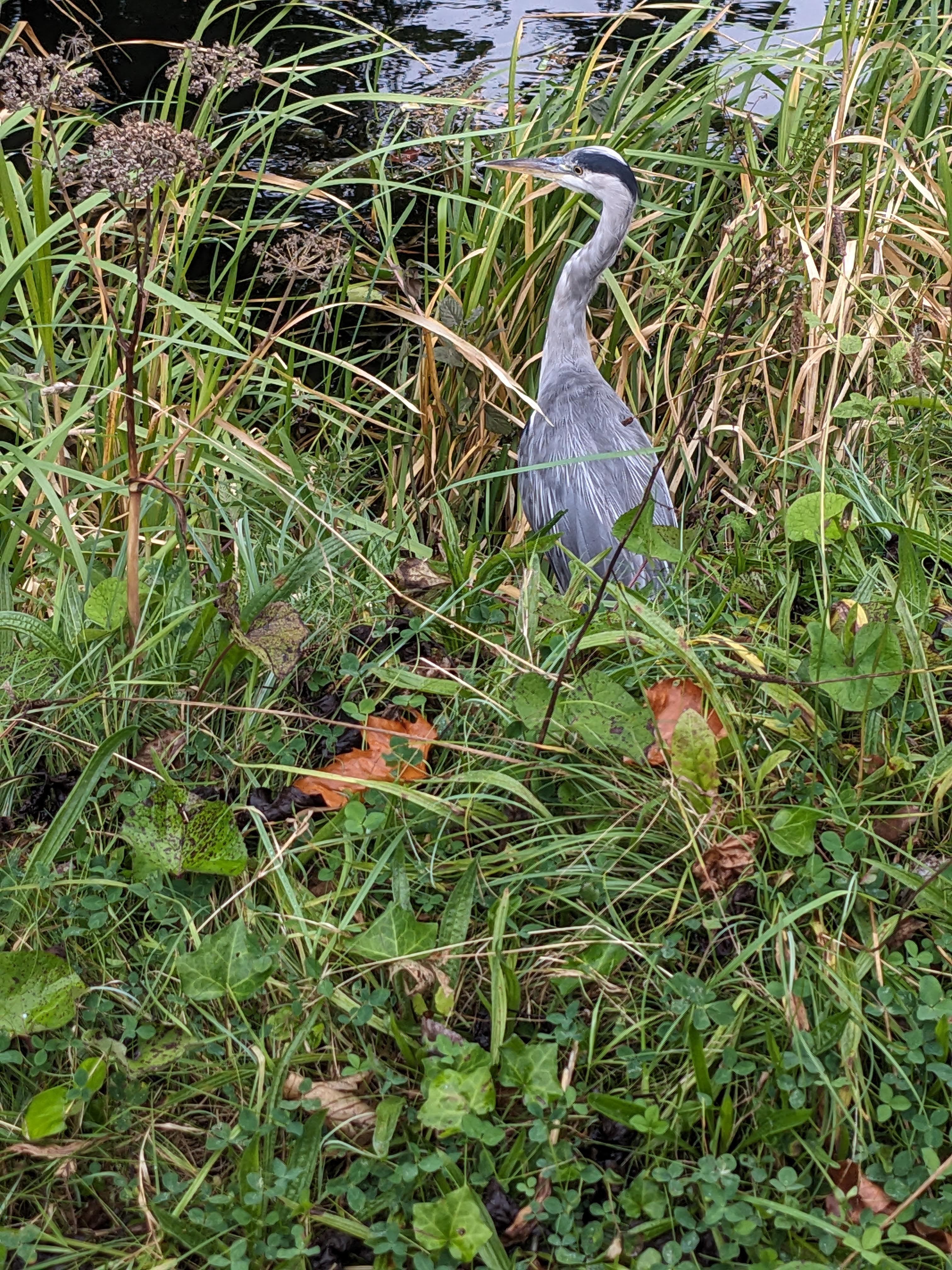
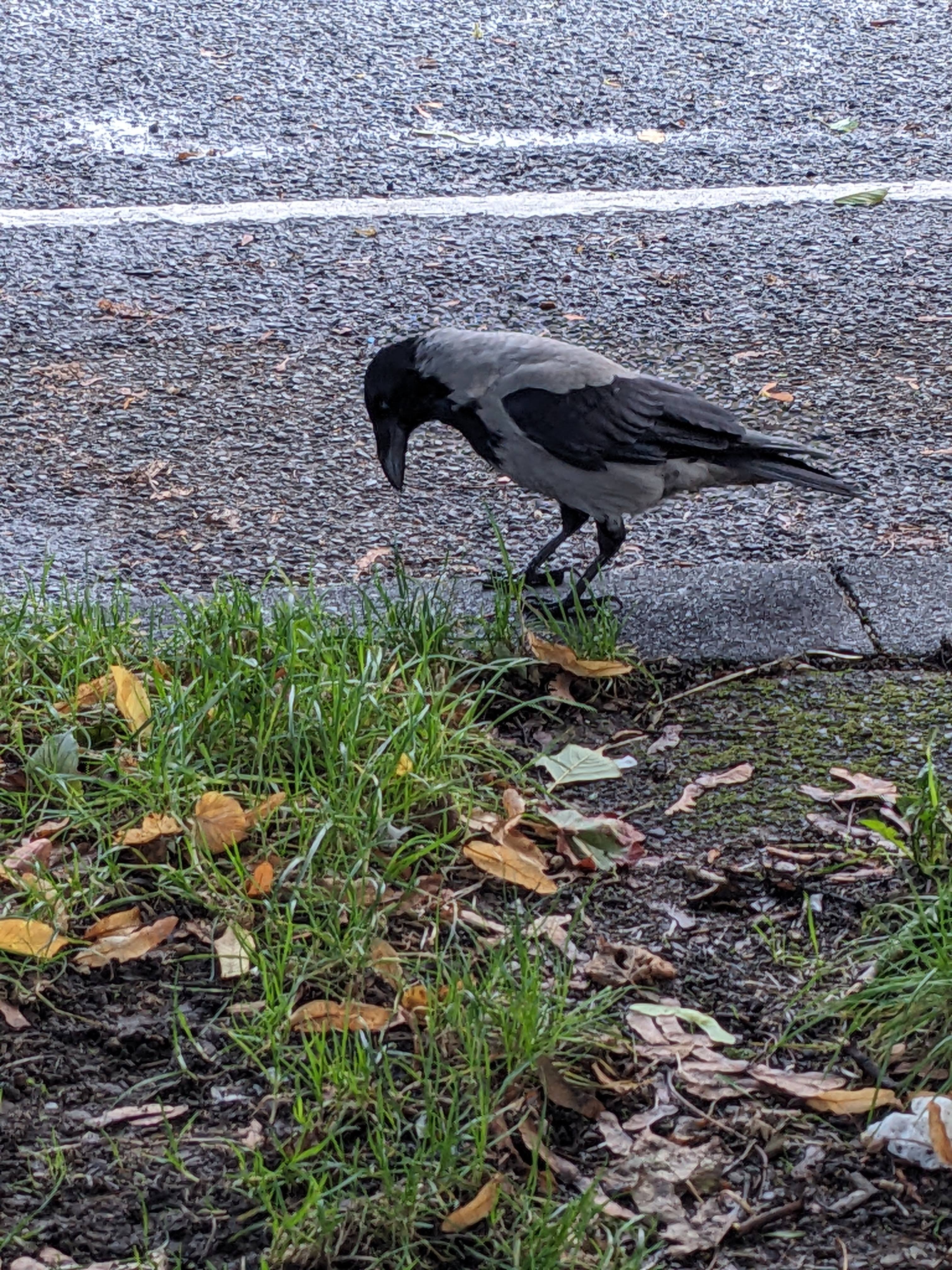
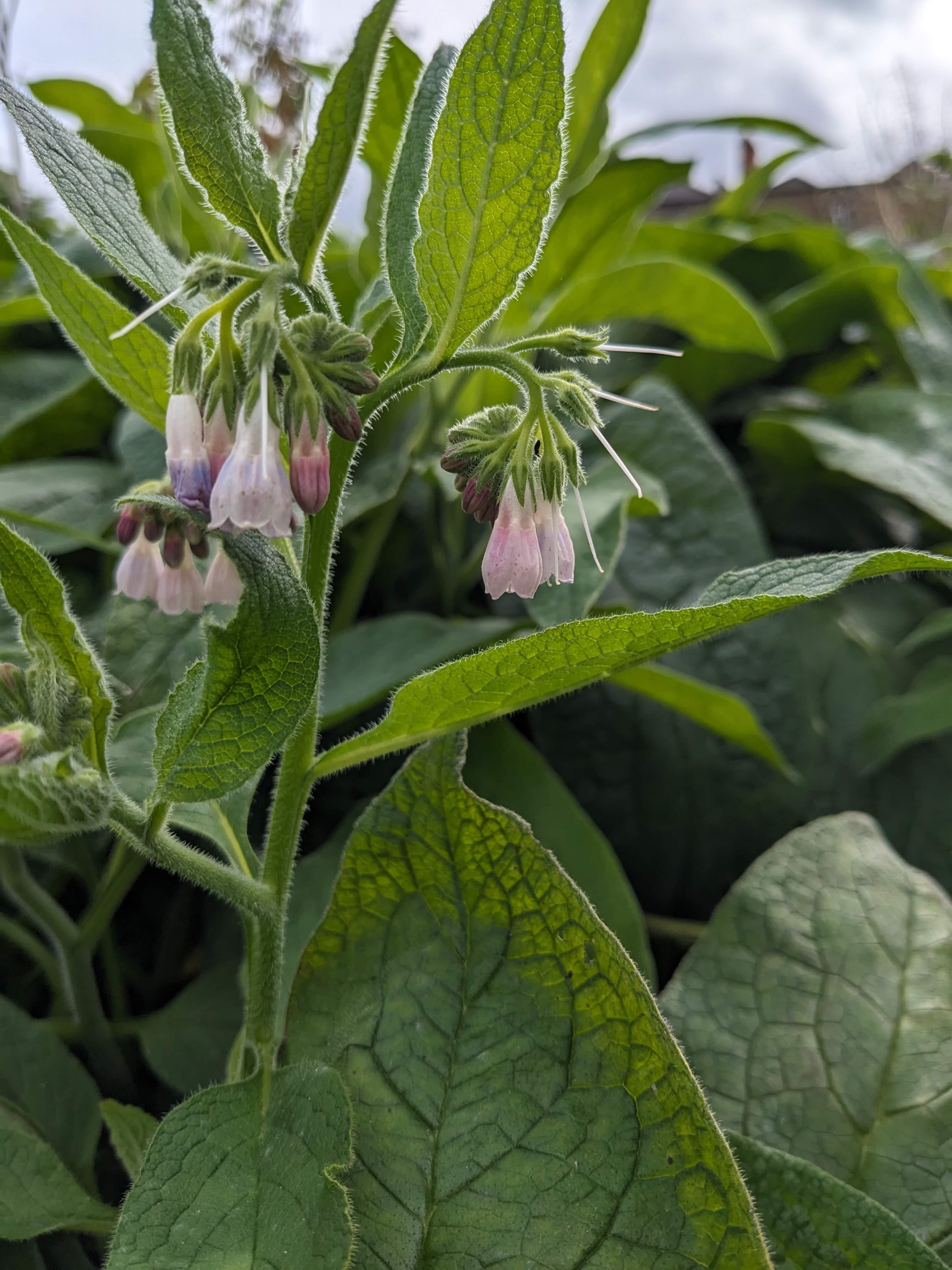
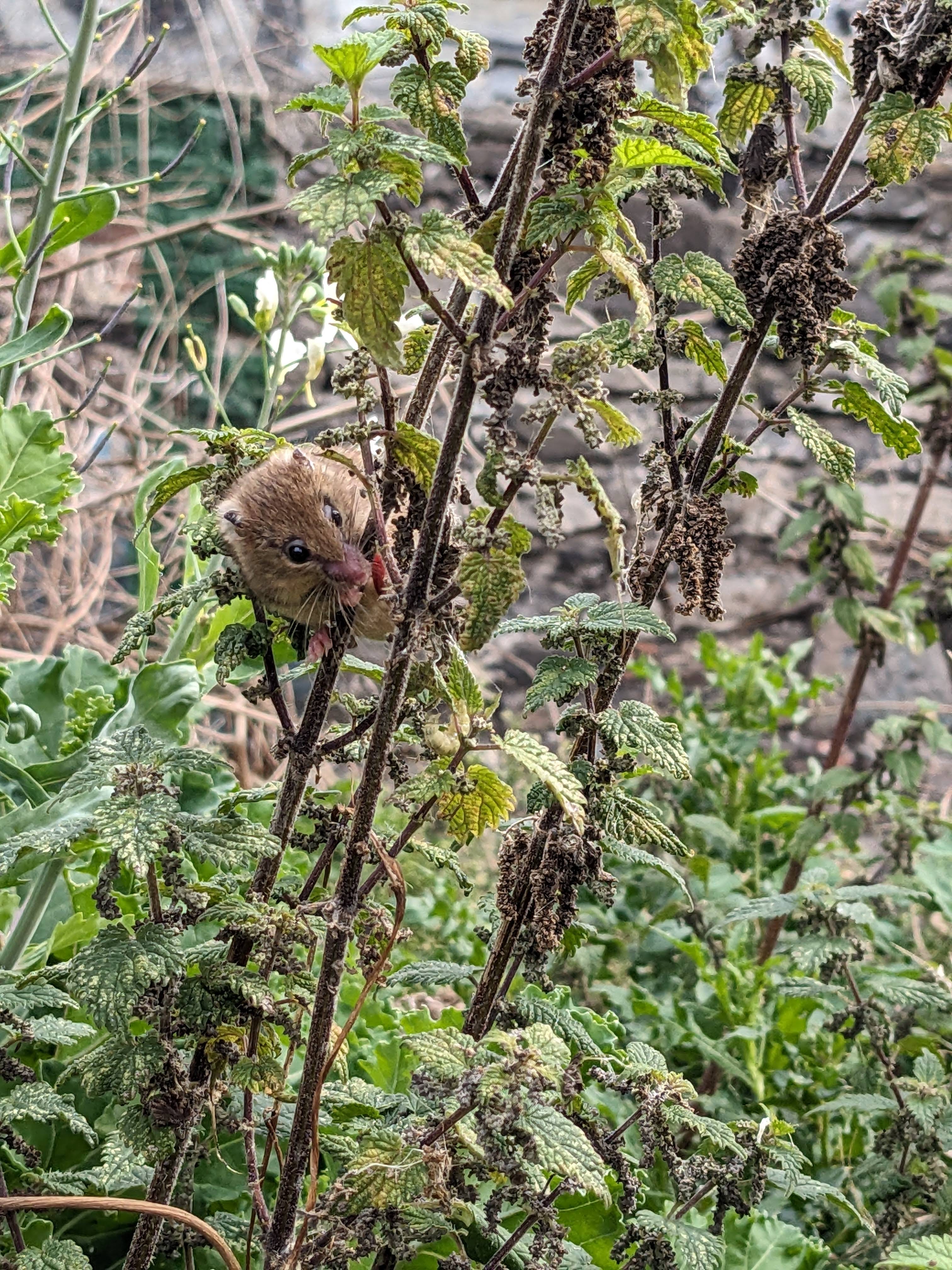
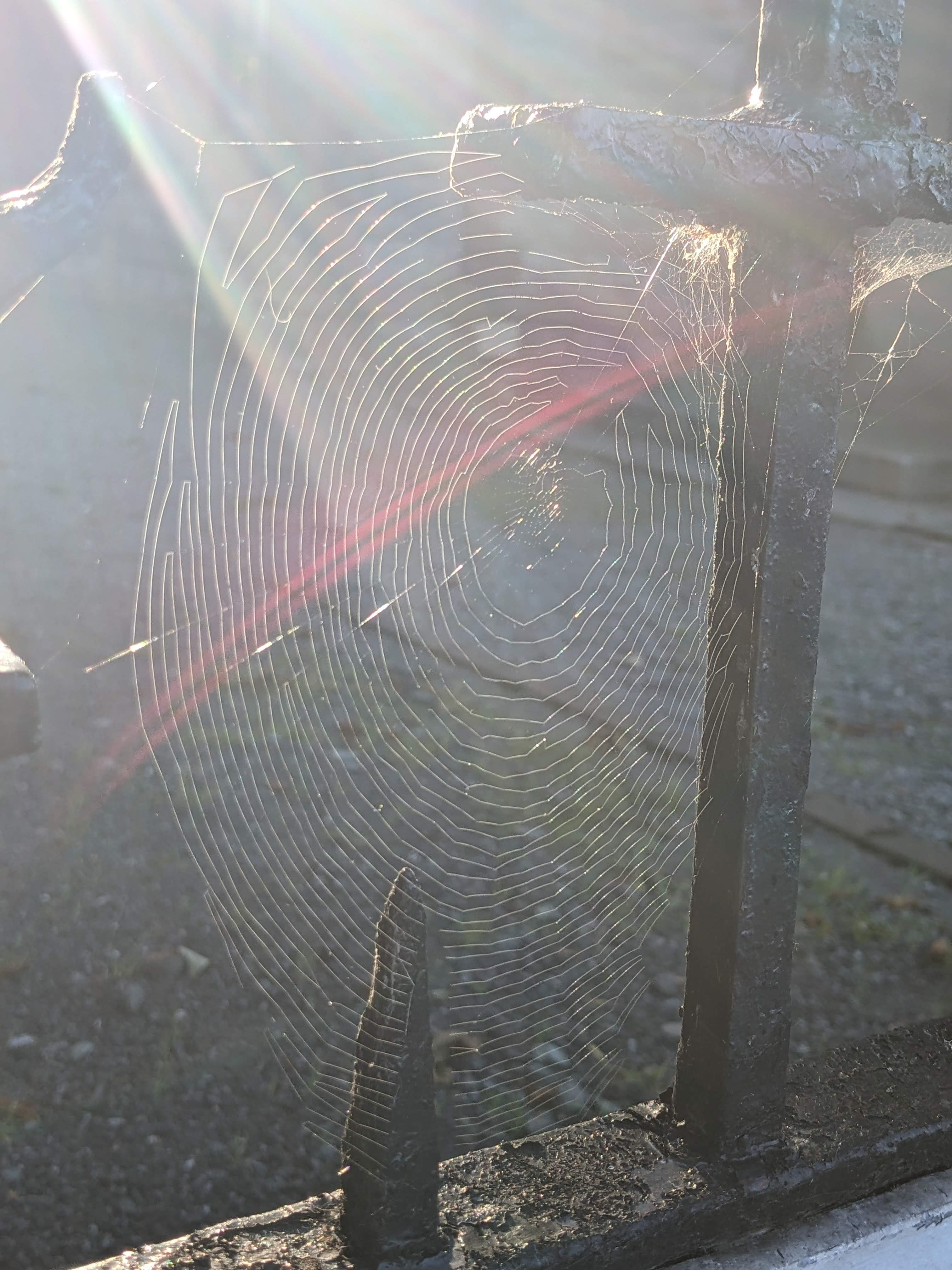
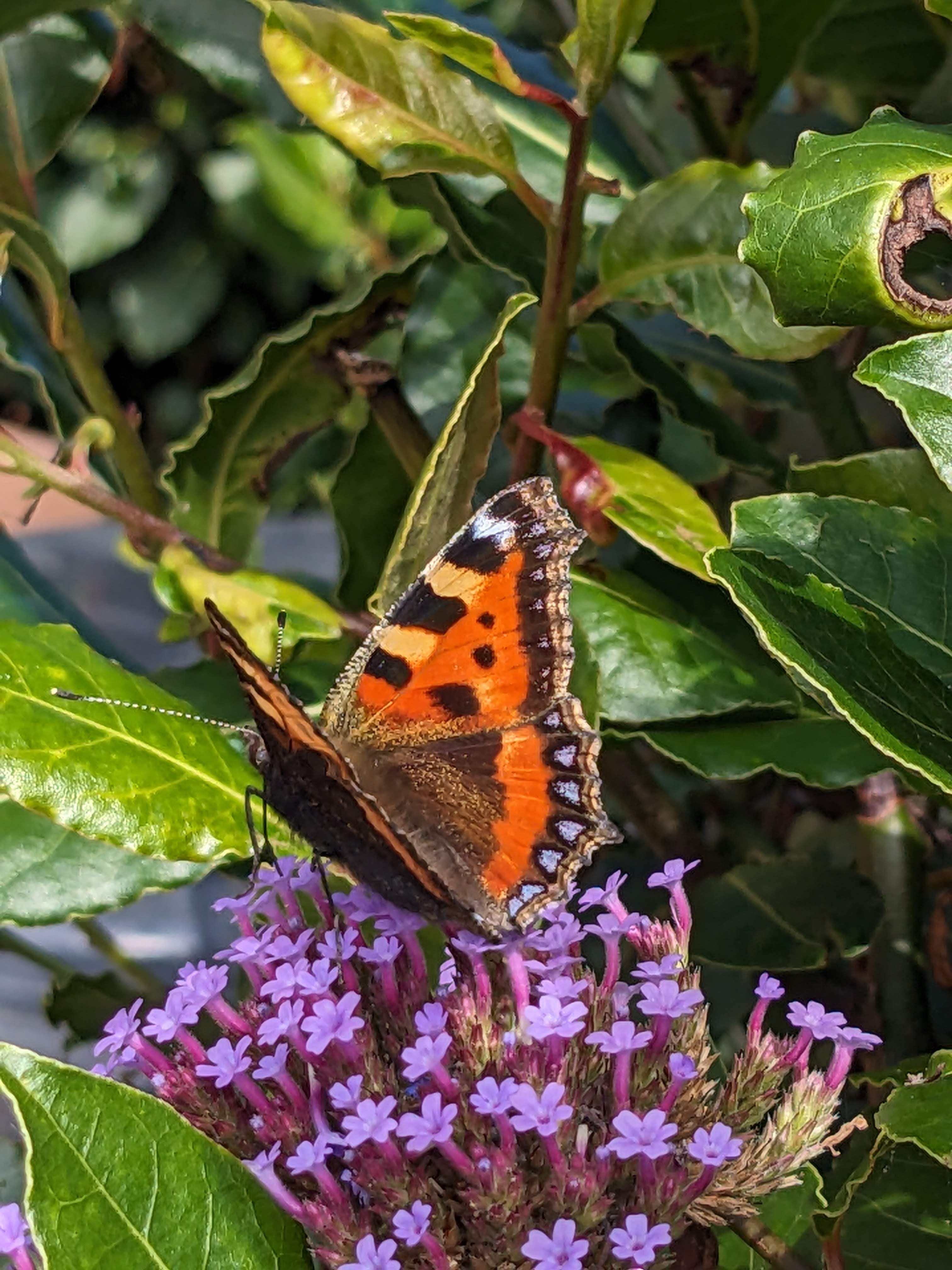
September is just over. I am back to my commute walk now, a roughly 45-minute walk that takes me long the Grand Canal. To my right is a busy two-way street that is clogged with traffic at peak hours. To my left is the canal, and across it a walking path, two cycle lanes, and a narrow street for one-way car traffic. Not a bucolic place at all. The world of the living is present there, though. I was maybe five yards from this heron. There are always swans. Lots of crows, jackdaws, magpies. Seagulls. Starlings. If I moved more slowly or sat longer I know I’d see smaller birds. The variety of plant life is huge. If I knew better what to look for and how to look I’m sure I would see more insects. I have seen fish in the canal, which surprised and delighted me—I had assumed it was too dirty for fish. And there are all the humans around the canal, too: the ones who drive by, the ones who cycle by, the ones who walk, and the ones who sit by it to smoke or drink or hang out with friends because there is no private space in their houses or just sit on the benches for some quiet in the green shade. And there are the ones of us who live in tents along the canal banks.
You don’t have to go away, is what I’m saying, to see ‘nature’. It’s right here, and we are in it—we are it. The faraway nature preserve one might voyage to to spend a day in nature feels to me like a way of pretending we aren’t implicated in it, permeated by it, always with it, in fact like a way of pretending we can even say it instead of saying, more properly, we, us. Embedded in the world of the living, we live along with it, as it. When we die we become it thoroughly. When we breathe, it becomes us. But prior to any conception, it is us, we are it. It ises us, the us of all the living.
When I told some people I’d just met that I’ve walked about 1200 miles this year, nearly all of that in my neighborhood, two questions came up. Did I go out for ‘better’ walks, i.e. did I travel away to See Things, and was I doing anything with the walks. I don’t go away to see things because I am seeing things all the time. I haven’t walked the streets where I live enough to be tired of them and I don’t think I could. When I go a week without checking on the trees, flowers, brambles, gates, paths I feel a pang of regret for all the change I’ve missed. Time is fleeting. What better thing than to be a deep-space telescope of one’s most local surroundings, sending oneself image after image of the same view over time?
The question of doing something with is such a gound-in question in art life.
Such a ground-in question in the lives we live inside of capitalism.
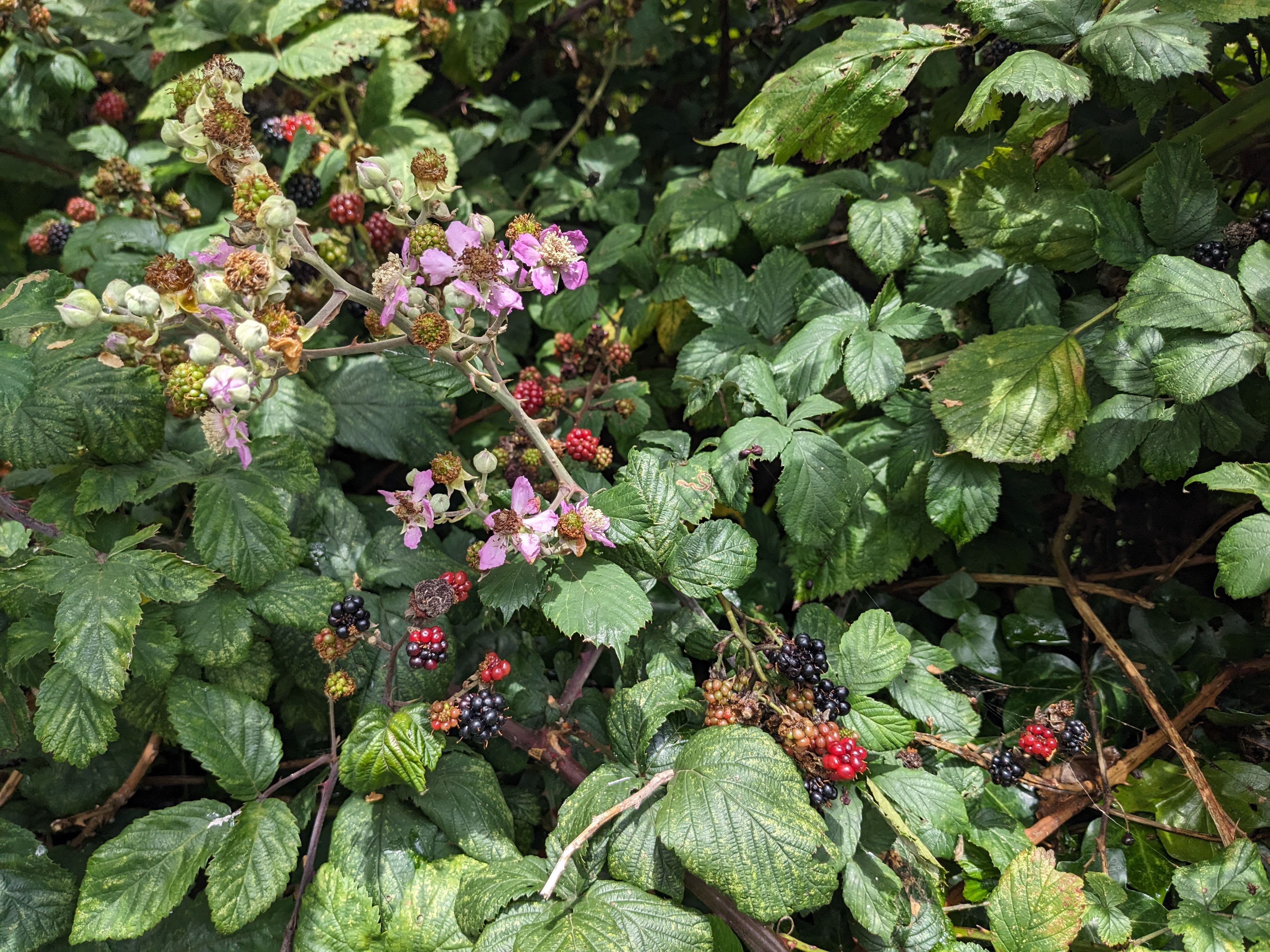
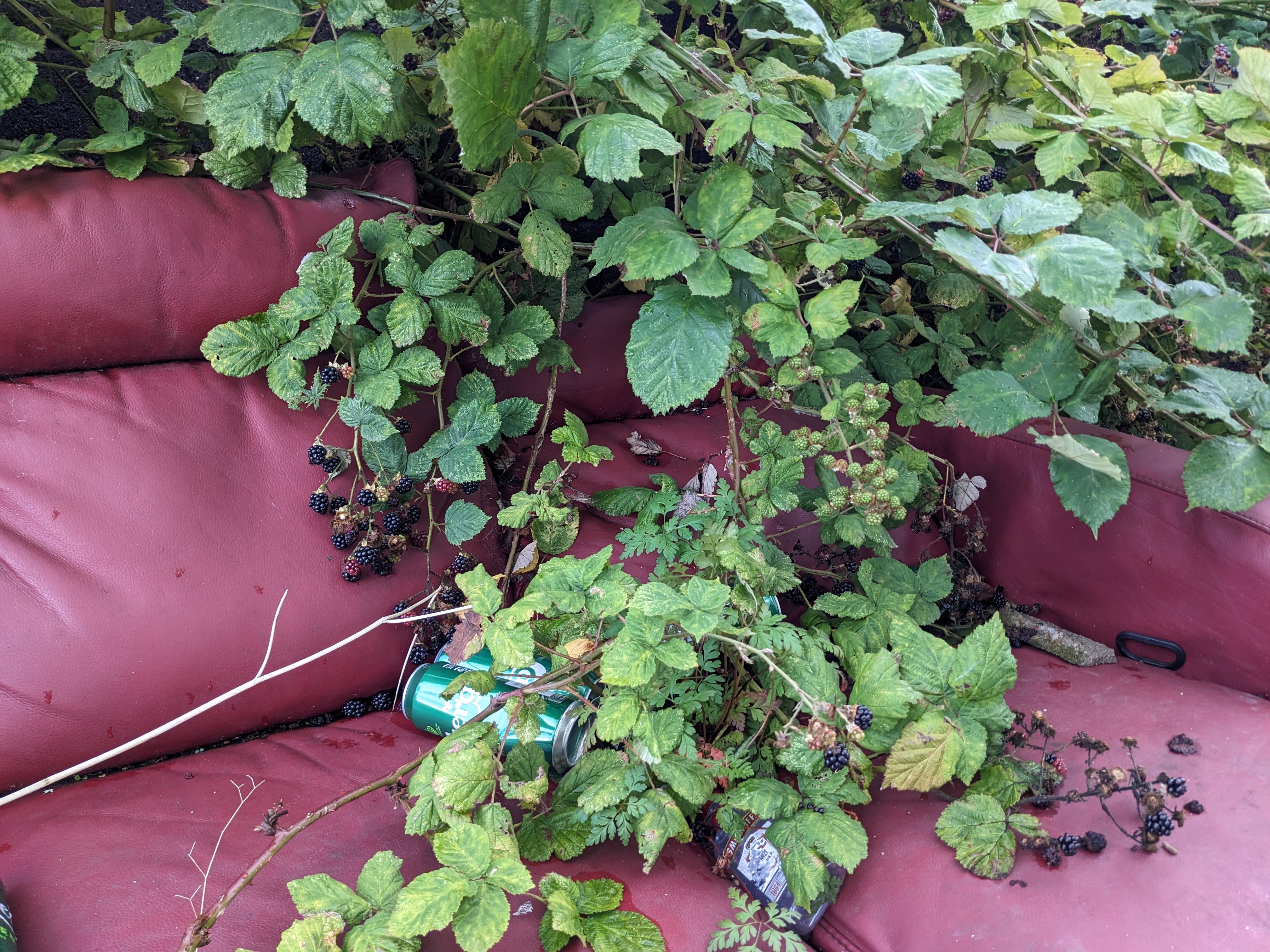
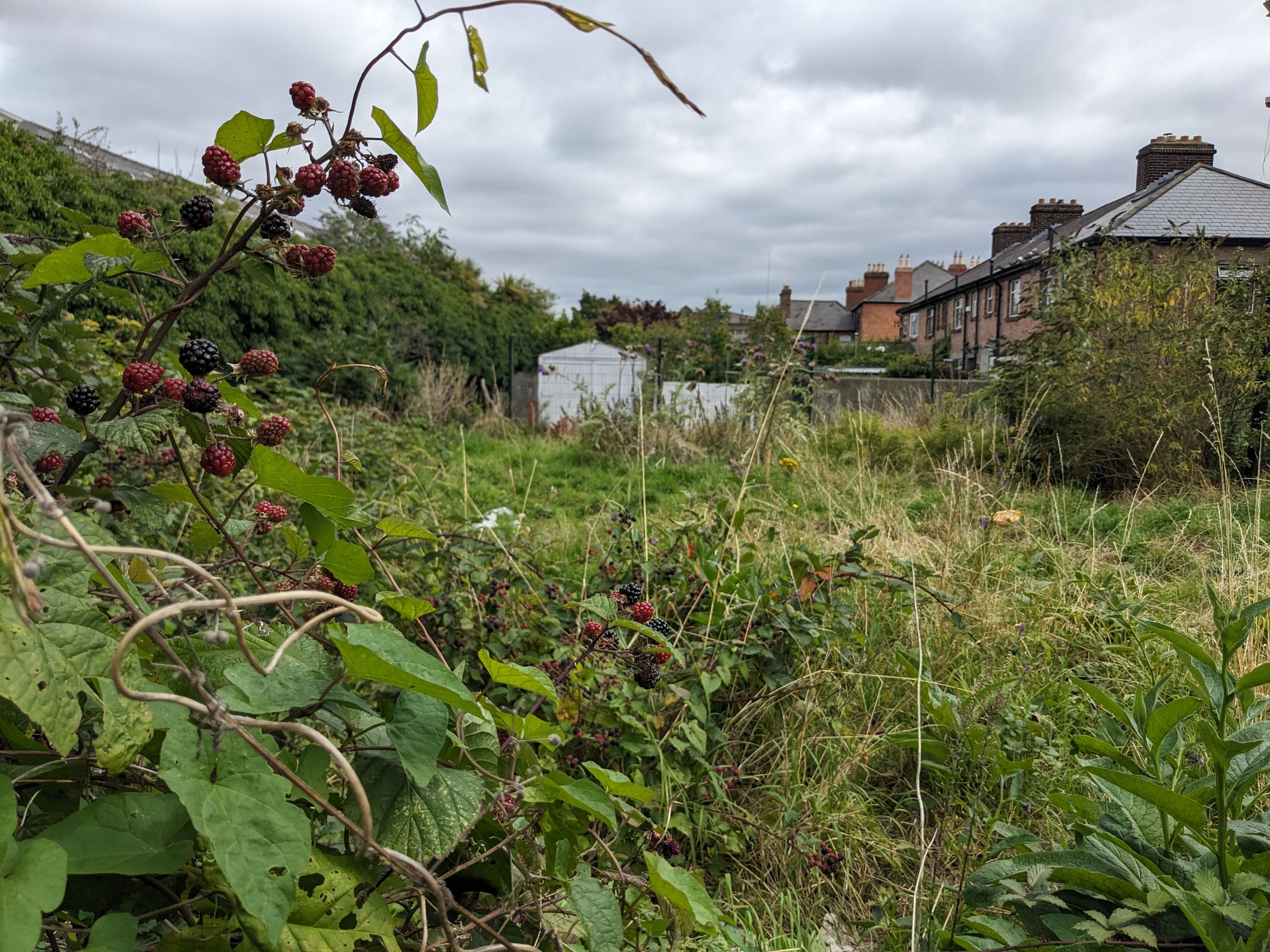
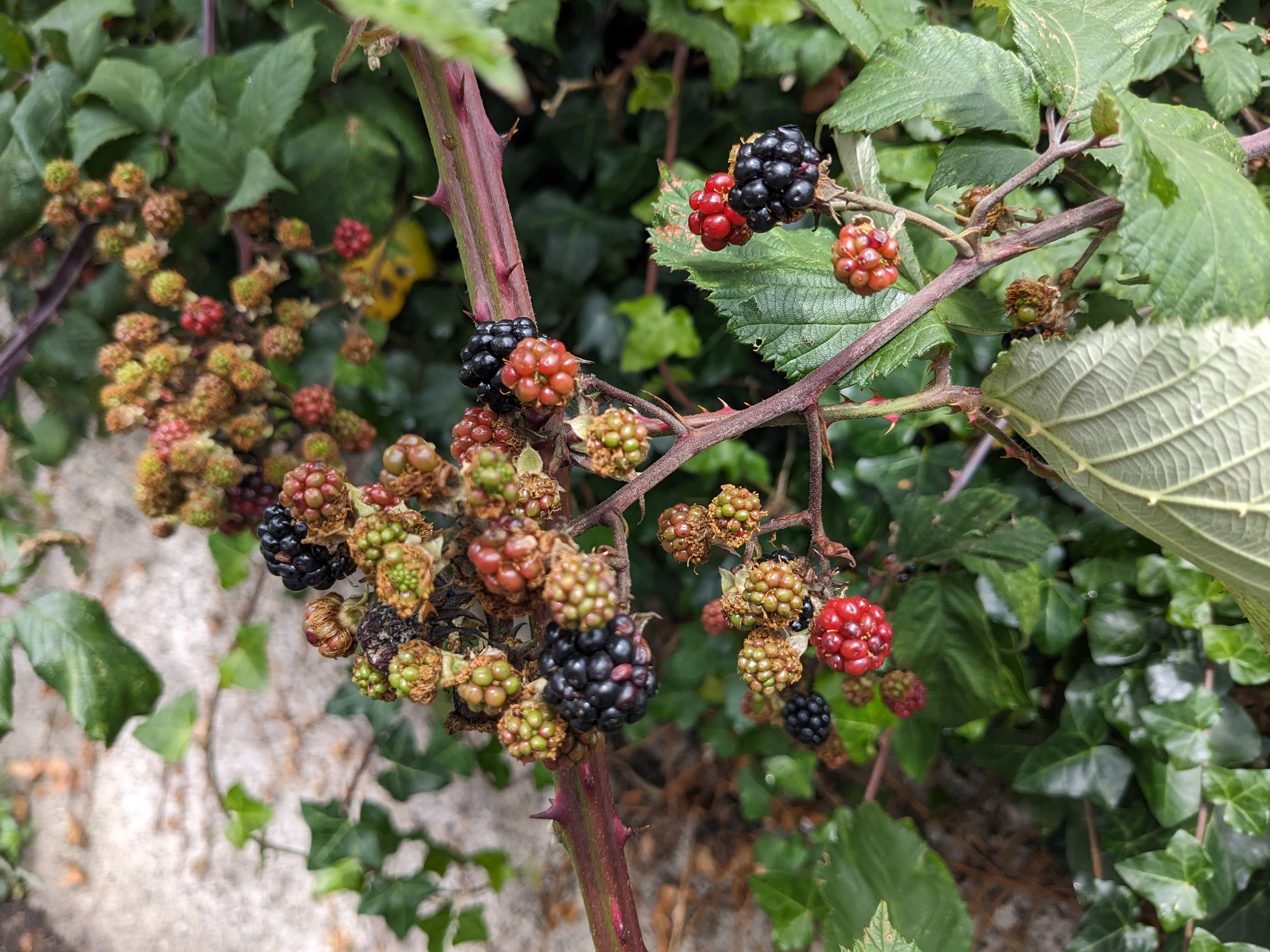
I take these walks because I want to be related to the place I have arrived. I owe it real looking; otherwise my relation to it would be assumption on my part. I am still assuming things despite my walks—because I just can’t see, sense, understand the all of it all. I don’t want to assume, or I want to assume as little as possible. I want to be light on this place. I want to see how things are, be puzzled by them, figure some of them out over time. I want to learn to draw connections in this place. I also want to know where things are, practically: both the best place to get bread in my neighborhood and the places where blackberries are thick hanging over walls in August. My walks, though this isn’t the reason I take them, keep me aware of my nonbelonging by teaching me what it might be to belong here. I value that.
The pleasure of walking and looking is also sufficient reason for walking and looking.
We are here, the world of the living says, including us in the we. That’s what pleasure means, I think.
Walking can be a reply to the speech of the living world, because the scale of walking is on the scale of living things. By walking I mean moving at the pace of a walk. It doesn’t entail the use of one part of one’s body in a particular way. It is about tempo, not anatomy. It’s also about finitude. You can’t walk limitlessly. There has to be an end to it—because your body is tired, or because you need to eat a meal, or to go to the bathroom. Walking reminds us we are alive by insisting on the things living beings need: rest, food, water, an end.
My walks do something with me—they put me among and in. They change my eyes and my language, my sense of smell, my leg muscles. Alive and not alone. What will you do with this is not the question of the world of the living. The questions are, at least but not only, where are you? and who else is with you?
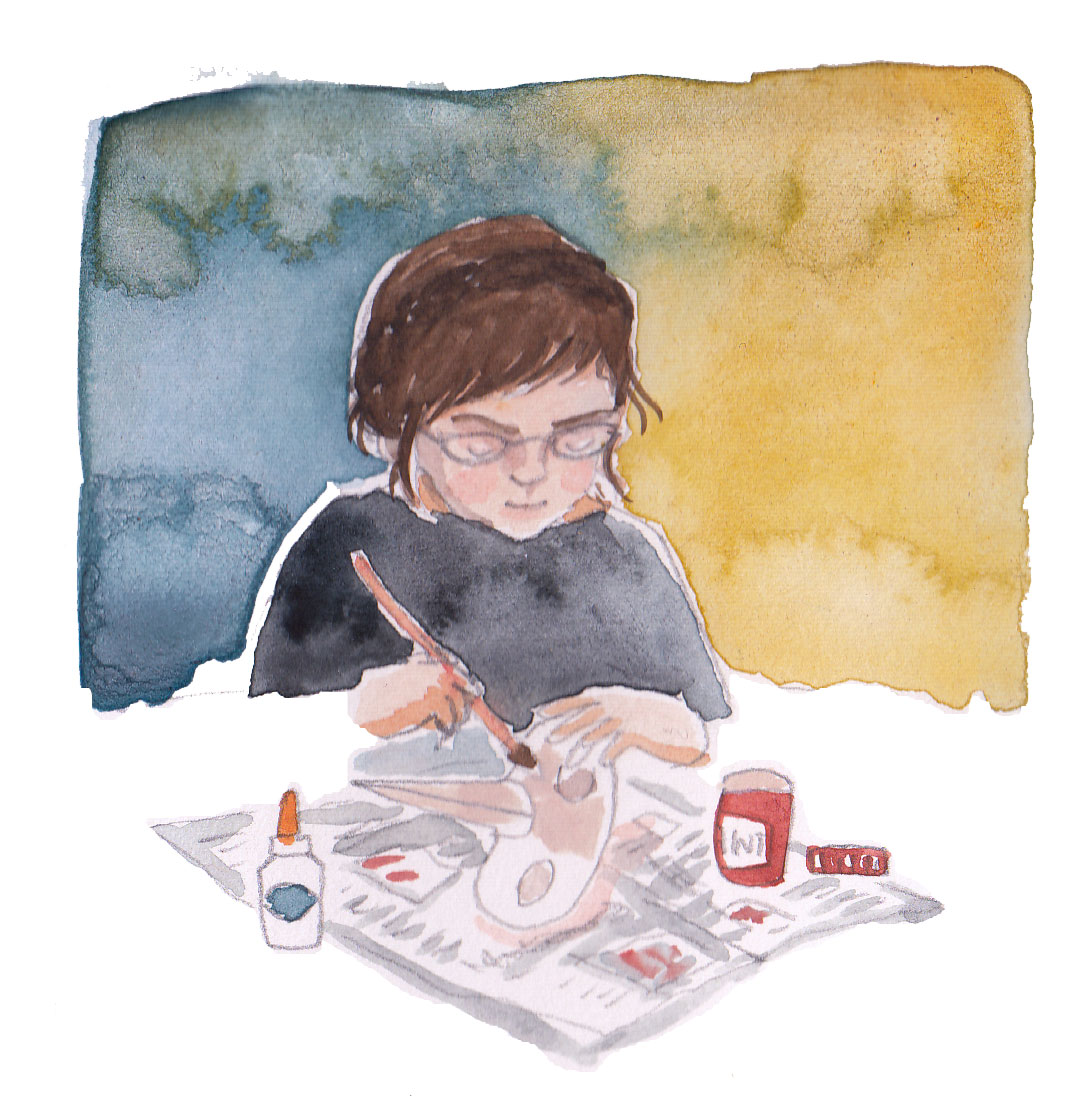
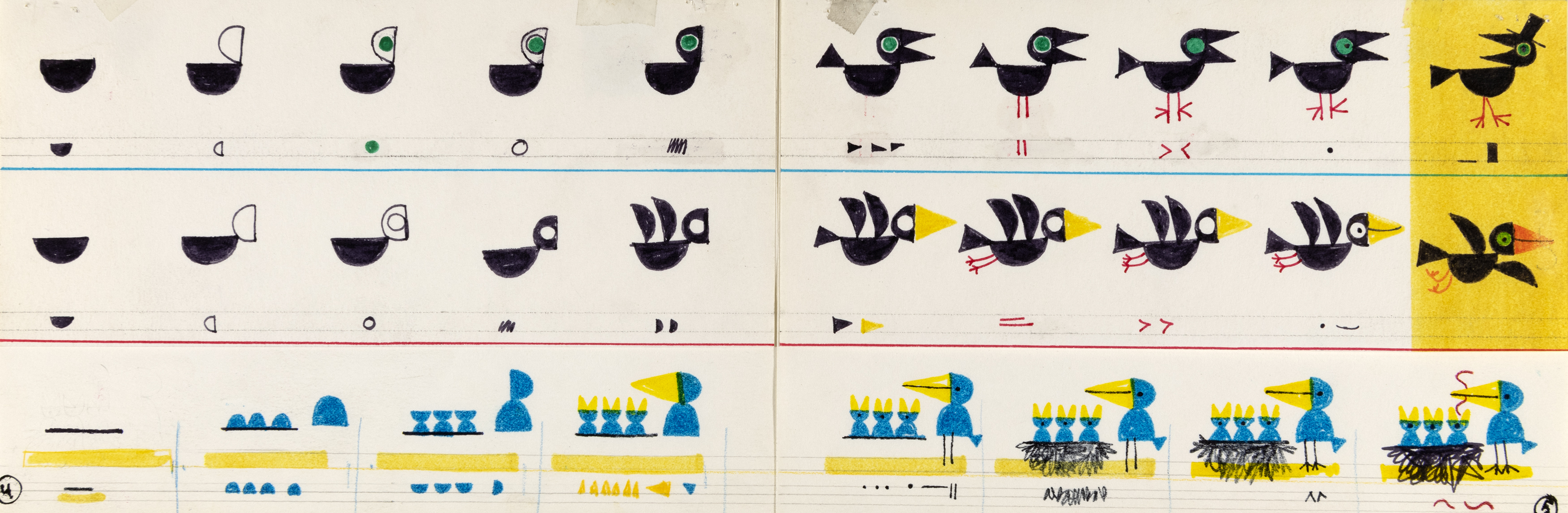
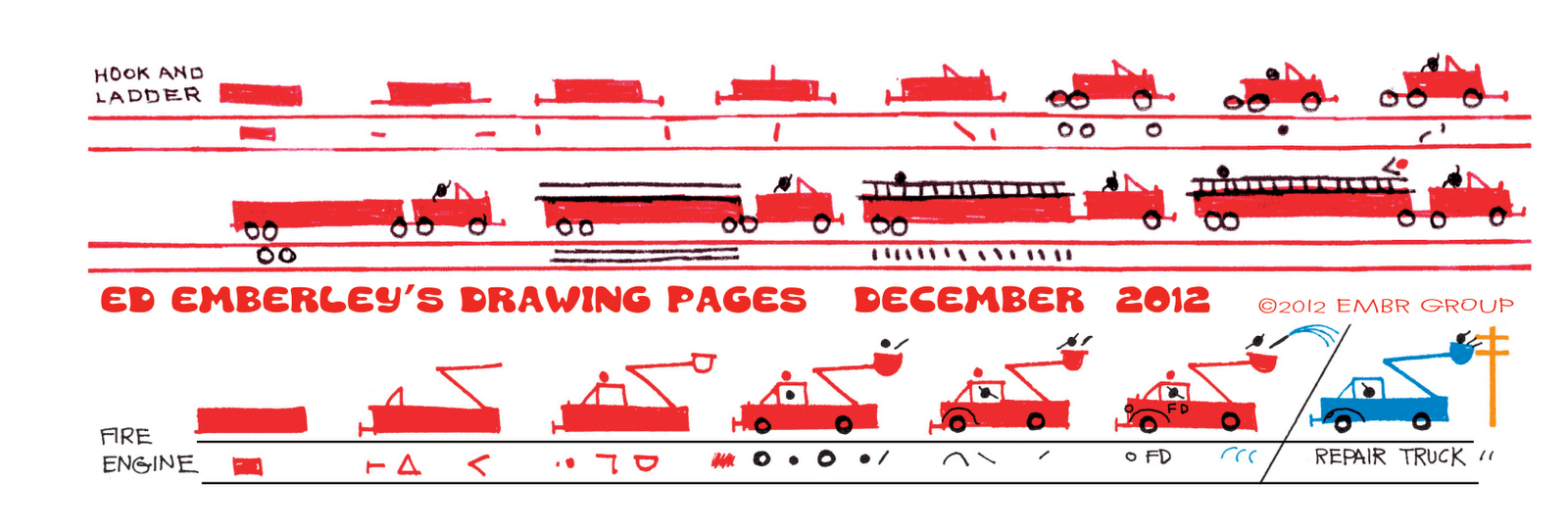
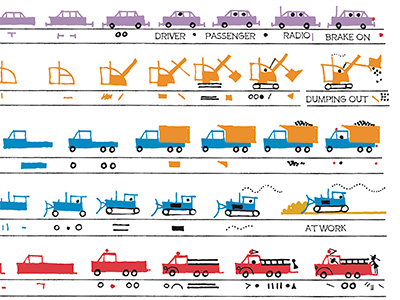
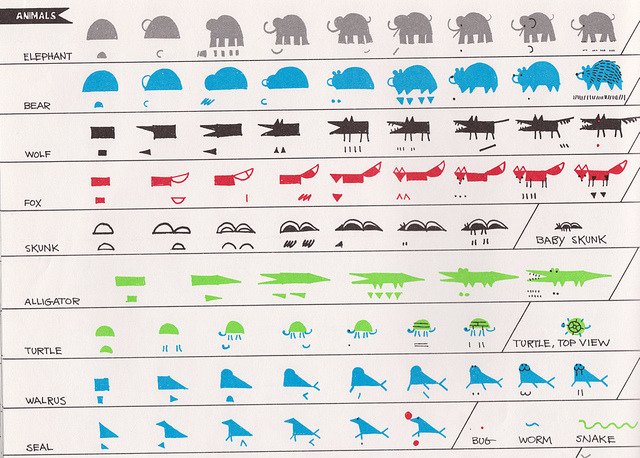
Did any of you have an Ed Emberley drawing book called Make a World as a child? (You can see someone flip through it on YouTube here.) Emberley broke down hundreds of everyday objects, animals, plants, buildings, and bodies into component parts beginning with the simplest shapes. By paying attention to each part and its relation to the other parts, you could learn to draw all kinds of things. I loved this book. I loved looking at all the orderly grids of shapes becoming animals or castles or furniture. And I loved that I could go to the book with something I didn’t know how to draw and learn to see it as pieces, put those pieces together, and then know how to draw its basic form. Ed Emberley’s book taught me to improvise, and it taught me about seeing, and it also taught me that images are made by people. As a person, that was an important lesson: there is no image made that isn’t made by a person, and so you, too, can make images. It never felt, using Make a World as a reference, that I was intended to make a perfect copy of Emberley’s drawings, although I sometimes tried (because those neat little rectangular deer were so charming). Instead it felt like Emberley was just showing me that it was possible to draw things, that drawing wasn’t something out of my hands and reserved for Real Artists but was instead very much in my hands, in every sense.
Every page in the Ed Emberley drawing book was covered in dozens, even hundreds of drawings, all of which I could make myself (and make my own), as many times as I wanted. And every other reader could, too: the adult across the table, the sibling to my right. Firetrucks and cows, apple trees and suspension bridges: we drew them all, and multiplied the world at our fingertips across sheet after sheet of mimeograph paper my dad brought home from work.
On the other side of the table, where the adults sit with their newspaper and their notebook, there is a different kind of accounting, and the world does not present itself as quite so multiple. For example, there is only one set of Pulitzer Prizes given each year. One set of Ruth Lilly Awards. One set of Guggenheims. Getting onto the New York Times bestseller list is both unlikely and byzantine, and the spots are limited each week. The NEA goes to twenty or twenty-five writers each year. The Cullman Center Fellowships, the Whiting Awards, the Stegners; Arts Council awards from your state, region, or nation; the Pushcart Prizes, all go to just a few writers each year. The most competitive MFA programs take five or ten or fifteen people a year and give them two or three funded years to learn to write. In the first quarter of 2020, Publishers Marketplace reported a total of 14 ‘deals’ (sales of manuscripts to publishing houses) over $500,000. The math of that side of the table is a math of slim chances. It’s the math of the lottery ticket, but a lottery ticket costs a dollar and a life as a writer costs a whole life, however you spend it. Those statistics about what success looks like in the commercial world of literary publication are quite a lottery to hitch a writing life—meaning a human life, a life of making things, asking big questions, thinking with others and alone, being in the world—to. But how else?
It takes a lot of concentration and a lot of attention to what’s in front of us to make what only we can make. It takes a lot of time and patience to take in the world around us—the world of shapes and forms, traditions and norms and habits—and to make something of it that really does what we are; that, in Hopkins’ words, “selves—goes itself”, that “speaks and spells” itself.
The world of public acclaim and awards, the world of pressure to publish poems and stories and essays and books and and and (wait—can we ask why, first?)—the world of status as a Writer, or as a good writer or as the Best Writer, is like a sun. It is so massive that its gravitational pull acts on us even, maybe especially, when we aren’t aware of it. And, like the sun, sometimes it gets between us and the thing we are doing, the human thing we are meant to do—make art, write—and because it is so large and bright it’s hard to see around it. Publishing and awards are out there at the center of the solar system, and we float around them, drawn by their gravity, until what we produce finds a way toward the center, often along well-established routes of access, privilege, power, and money. And so it can seem like the thing we are meant to do is to publish, or to win awards, or to receive acclaim.
But wait—that’s not what Ed Emberley’s hand says.
What Ed Emberley’s hand says is: you can make a world, not you’re going to get a book deal, and what it says is look at what you’re doing—there’s real pleasure there! Maybe it says, Shakespeare said “present mirth hath present laughter” or maybe it says, Robert Herrick said “gather ye rosebuds while ye may” and hey, here’s how you draw a rose. It definitely doesn’t say your life is a game of chance and you should only make bets that look like winners from the start. But okay, it’s a talking hand; you might be disinclined to take its advice.
Sometimes I forget that at the end of the line of shapes on the page (let’s say these basic drawn shapes can be a metaphor for all the ways we learn about writing—the practice we get with received and organic forms, how we learn about style, what we receive from a tradition in this or that genre, our awareness of the kinds of books that make money or get reviews in the New Yorker) there is a drawing that could only have been made by Ed Emberley. And when I make those shapes, no matter how carefully I look to his model, naturally my hand transforms what I make into something only I could make. And that that is the right outcome: not a replica, a transformation.
Something else I loved about the pages of Make A World—actually, I still love this—is that they were full. There is no page where there are not a dozen things happening. Often there were little visual jokes, like the moment the seal gets a red ball, or the top view of the turtle, or the baby skunk, or the backhoe dumping out gravel. You can almost see Emberley having an idea in those drawings. Those moments of play seem to me not like invitations to copy but invitations to invent and imagine, and models for how to have ideas that don’t end with a copy that can be checked off but end with me drawings things that aren’t even in the frame. The drawing doesn’t end at the end of the row of shapes; it begins there, because that’s the point where your hand takes over and figures out what comes next. I loved that the pages were so full of possibilities and that the possibilities all seemed to point to more off the page. There is no end to imagination. You just keep going, all your life, and that’s how you make a life, and an art. It’s kind of the opposite world, if you think about it, to the world of waiting for awards and prizes and acclaim and publication with a Big Five house (or with Faber, or with Graywolf, or whoever is your ideal publisher).
The world of Ed Emberley’s Make a World is open. You take a running jump off the end of the page, and there you go, making your own world. You start by learning to draw a seal, and then you imagine the rocks, the ocean water, the seaweed, the barnacles, a sea kayaker, their helmet, gannets or oystercatchers or puffins, weather blowing in from the west….
Now what could a writing world like that look like? Starting with the things you learn to make by reading but that, in making, is so transformed it could only be your own, and growing from the word toward the world—not the publishing world, grateful as we may be for its existence, but the world of our invention and our shared relation with everything that lives? What would a writing world look like where we could see writing (a poem, a book) not as the end of our imaginative work but as the start, a point from which to begin making everything that touches a poem or a book?
I think such a writing world would be full and busy, not scarce or scanty. It would have to feel endless in the way the drawings made as a child felt endless—more always possible. It would occupy our time and hands and minds as well, and in doing so I think the very doing would make us happy, the kind of happiness one gets when one is making something with thought and care. It would probably have to be close to home, in full or in part, and be of a scale that could involve us directly. It would have to be relatively small—not in idea or in scope or in imagination but in terms of production and material, because things need space. It would have to be made of materials we could get our hands on, with equipment we could use ourselves.
There are very real pressures to take part in the public side of the literary world (by which I mean the system of prizes, fellowships, awards, and publication that is for the most part driven by an economics of scarcity, made precious by how few make it to the center). And even those of us who have been published or won awards still experience the discomfort that comes about when those awards or publications enact their gravitational pull on us: wondering what the point is of writing, or why we do this work when finding readers is so hard and the odds are so slim. In my line of work it’s basically de rigeur to publish, and I wouldn’t have gotten my job if I hadn’t published books with a major literary nonprofit press in the US. I’m very grateful to a professor in the final year of my MFA program who took me at my word that my “publishing strategy”, which we had to outline for a class project, was to print a dozen copies of my MFA thesis and leave them on buses around the city; that professor sent my manuscript to Milkweed, and that resulted in the publication of my first book. Without that professor and that kindness and that book, I would not be where I am.
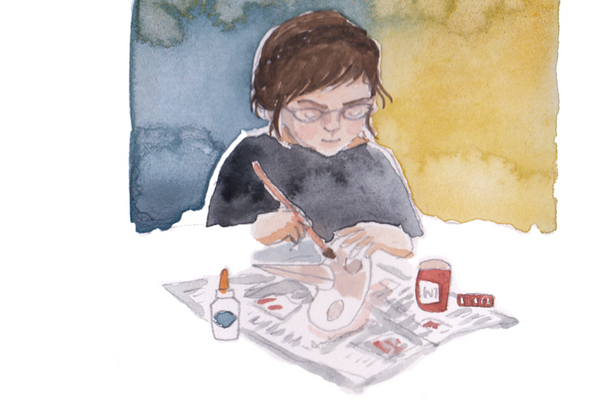
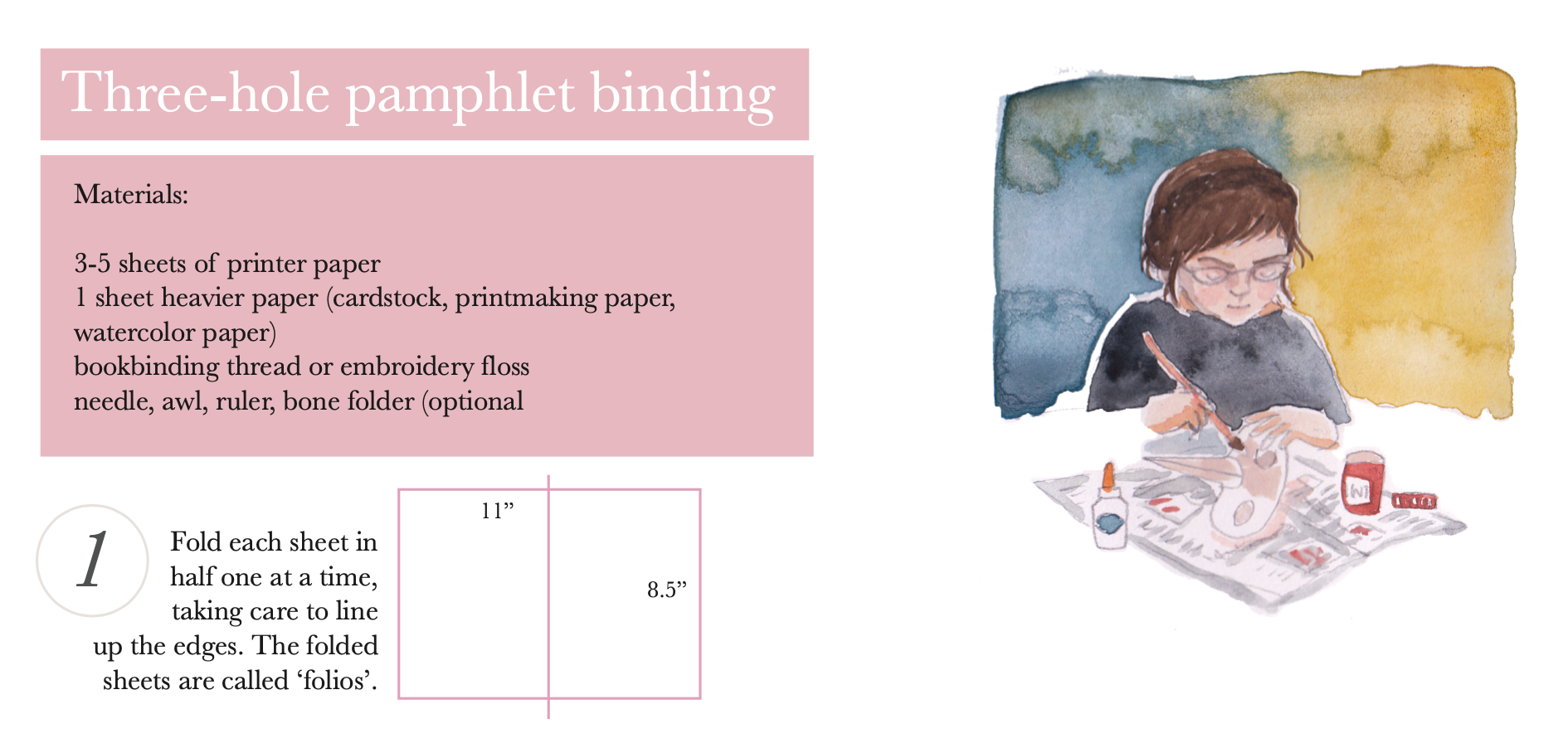
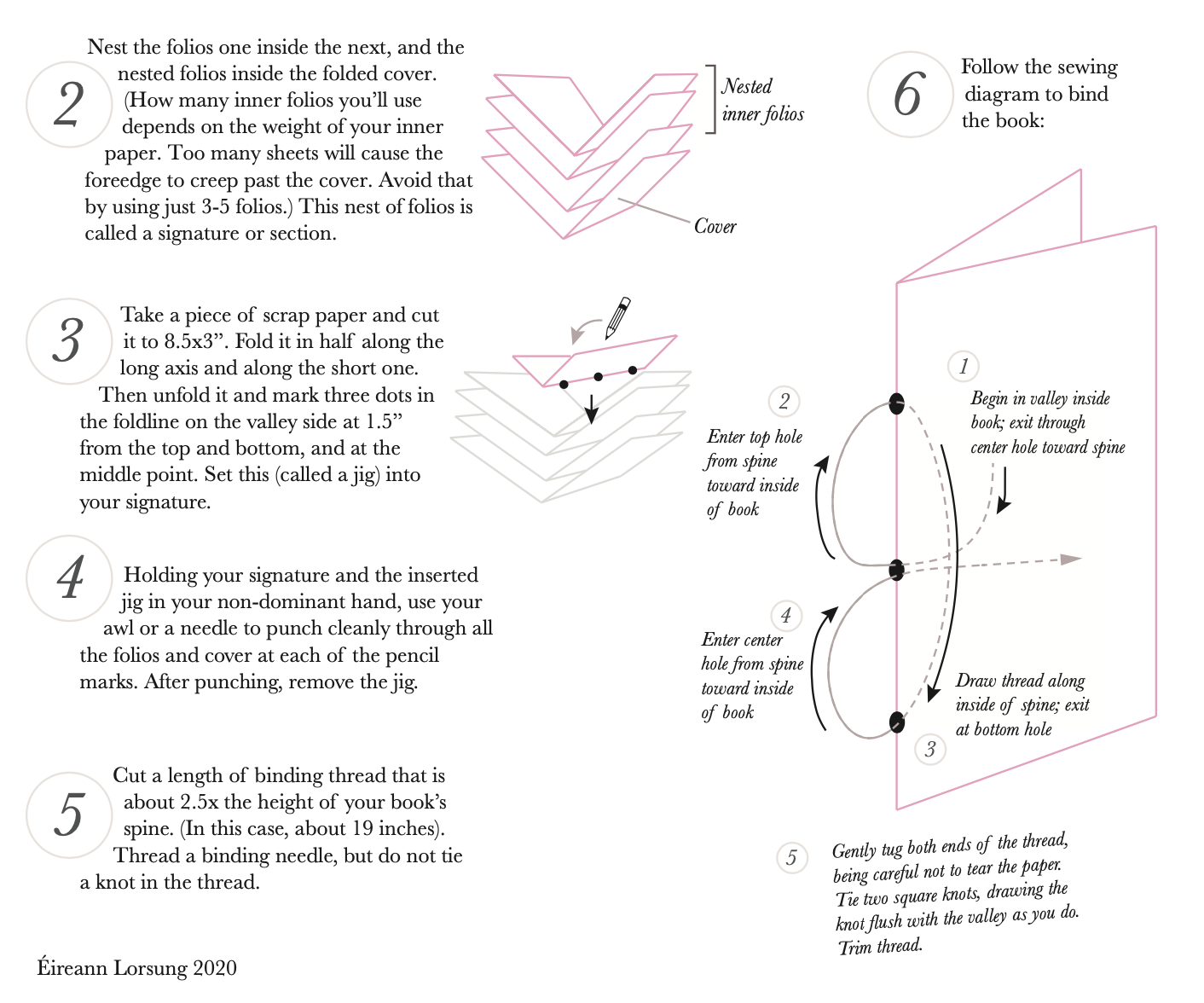
But I would still, I am absolutely sure of it, be writing. And I would definitely be making books, because making books is something I’ve done since I was a very little person, looking at Ed Emberley’s drawings and making my own. Making books is something we can all do, right here at the table between us, and it’s a first step toward a second, third, millionth world made by hand to live alongside the world of commercial publishing and to remind us that writing is not the end but the beginning—that writing teaches us, step by step, to make a whole world.
To me bookmaking is also one of the most immediate ways to remember that we can refuse to compete; we can treat the logic of the competitive system we live within as optional. We can divert, invent something else. After all, aren’t we ‘creative’ writers? Doesn’t that mean, to make something up? If we can make a poem, we can make a book; if we can make a book, we can make a room for that book and others’ books; we can make a reading or an event series. We can begin to see and name the structures and norms we live inside, and we can follow that other ordinary writer in saying, sometimes, that we would “prefer not to”. Making the text is just the first shape on the page, and then our imagination can say—go!
Publishing is a joy; it’s a pleasure and a real honor to join with others who think and have thought about writing and who write or wrote; with those who read and those talk about ideas. It’s a pleasure and an honor to be read. It is so, so special and it is also so, so normal—it is so human to want to make things, including language-things, and to share them with other people. The trick, to me, is remembering that the people whose work is made visible within mainstream publishing and prizegiving’s economy of scarcity are not the only people who write, talk about ideas, think about books. We all can. And the people who can make publishing possible are not only in the well-known houses in New York or London; they are also right here, sitting across the table from us. Pass the scissors. Pass the thread.
If we want to see one another, let’s see one another. If we want to be seen, ourselves, let’s make a space in which—it doesn’t matter if it is small or humble; that seems very natural and neutral to start and also to go on—we can be seen by one another, and in which to see others’ work.
Redirect. To your fingertips. My fingertips.
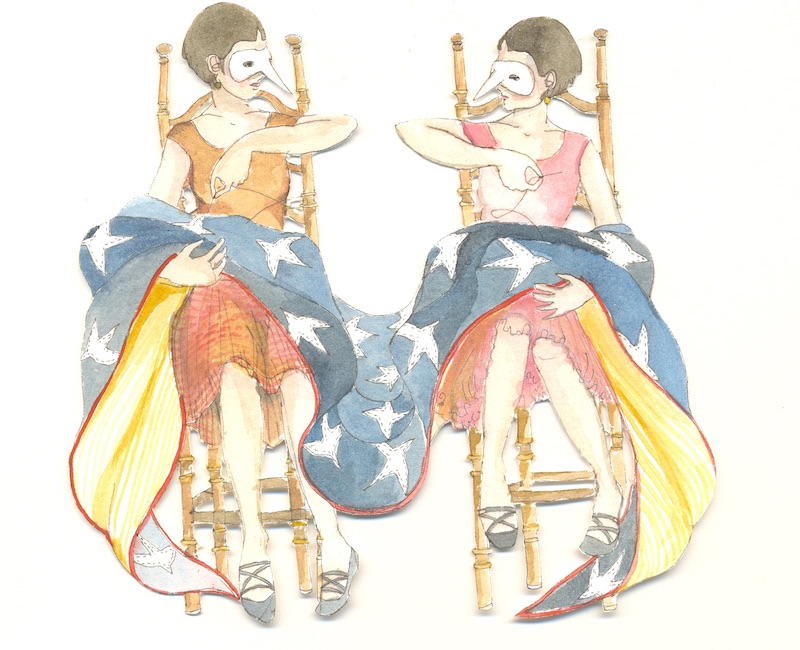
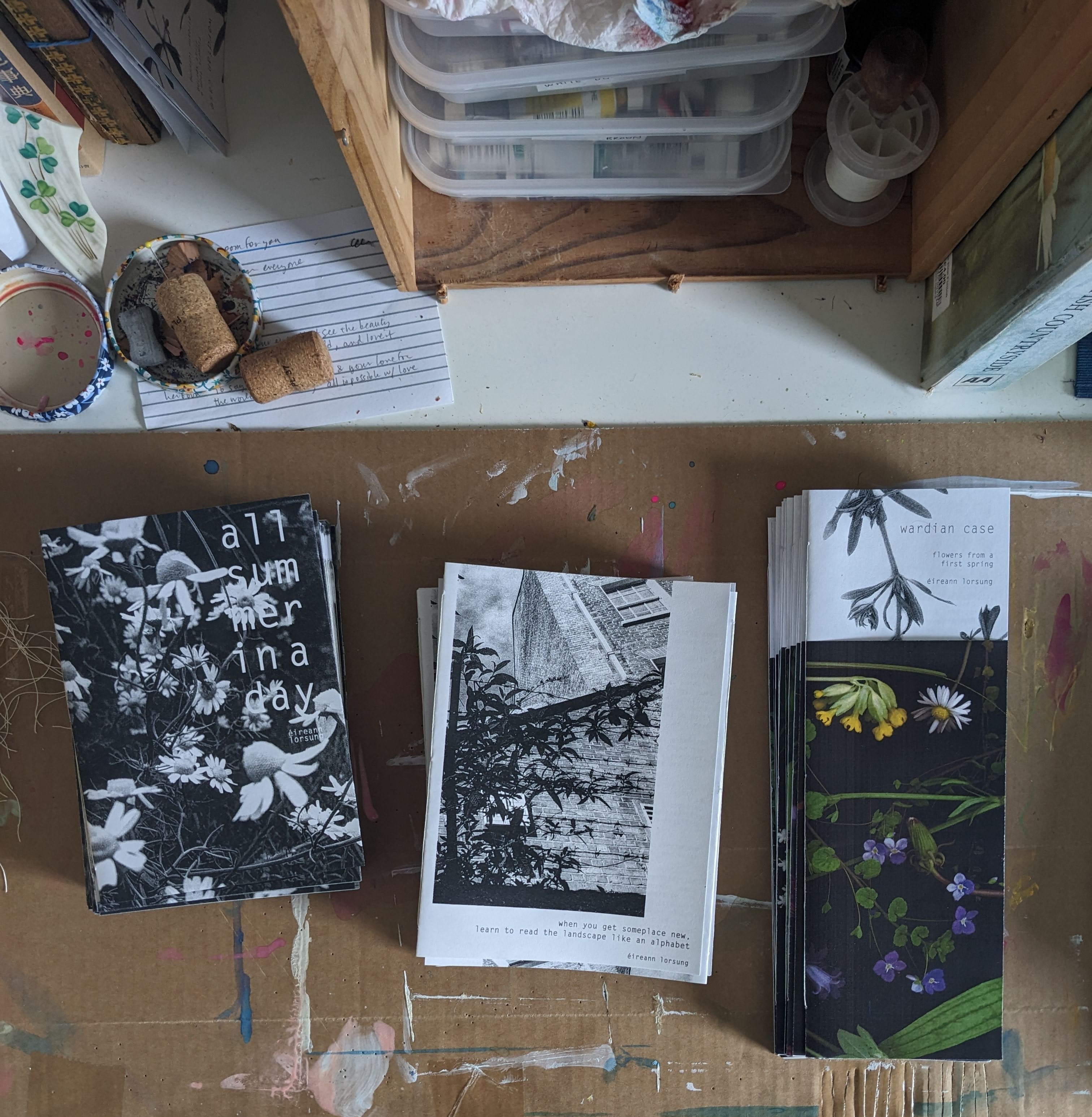
If scarcity is the engine that orients our imaginations toward structures that mostly leave most of us out, then muchness must be part of the reply. Availability. Right-here-ness. The images above are a right-here technique I often use, that I’ve been using since 2007 or so and that has alleviated much of my worry and also much of my loneliness in writing. Make a book of your own. Right now. With whatever is to hand, about nothing much at all. Then make one of your friend’s work. Then make a dozen copies of your friend’s book: now you have a press. Now there’s one more place that can publish other people.
You want to be published? You want your friends to be published? Make the world in which that’s possible. Use the copy machine after hours. Save up and buy a printer. Get friendly with your local offset and digital shop (they probably do a lot of ad printing and will enjoy taking your jobs on). Get a few friends in on it if you don’t want to or don’t have the skills to do it all alone. You don’t have to wait for Hachette or The Song Cave or anything in between to see you, though they may well and how wonderful if they do: in the meantime, which is your life, you can see you. You can see the ones you love. You can make the books to hold the things you’re thinking and seeing. You can make them now, with your own hands: as pamphlets, or as posters wheatpasted to the sidings of construction sites, or as postcards mailed to anyone who’ll pay for a stamp, and, doing so, you’ll be in a rich tradition, stillongoing, of people who’ve looked at a book and thought, well, I can do that. And it’s not one or the other, if you make a book of your own: who knows what else is possible for that writing? But right now, if you have the choice between longing to be published by someone else and making a book of your own or a friend’s yourself, I’d say make that book.
You can make a world.
About as often as a nonfiction teacher reminds their students that “essay” comes from the French verb “essayer”, which means “to try, to attempt”, a poetry teacher reminds their students that the word “poem” comes from the Greek verb for “to make”. And that’s the point, isn’t it? In the end? Not to win, but to make; to be part of the made and making world, to make things? To refuse, even, the terms by which some of us might be ‘winners’ and the others—not? The point of writing poetry is that the poem leads us, as Ed Emberley’s drawings do, not to a single end but to the edge of the page which we are meant to leap off of, toward the whole world, also ours to make alongside everyone else. Make poems, yes. Make books, make magazines, make newspapers; make postcards and posters, make classrooms and residency spaces, make kitchen table conversations and make walks where anyone can join. A world. The poem doesn’t end at the end of the line; the ‘aim’ of writing is not the bestseller list. It’s here: your hand holding the pencil as your mind suggests the horse’s mane not hanging but flowing, and the legs, then, not standing but running. And the grasses, then, and the wind bowing the grasses down so that they resemble the mane of the horse; and the flowers among the grasses, and the pollen invisibly flying from them, and the wide open sky under which everything is possible.
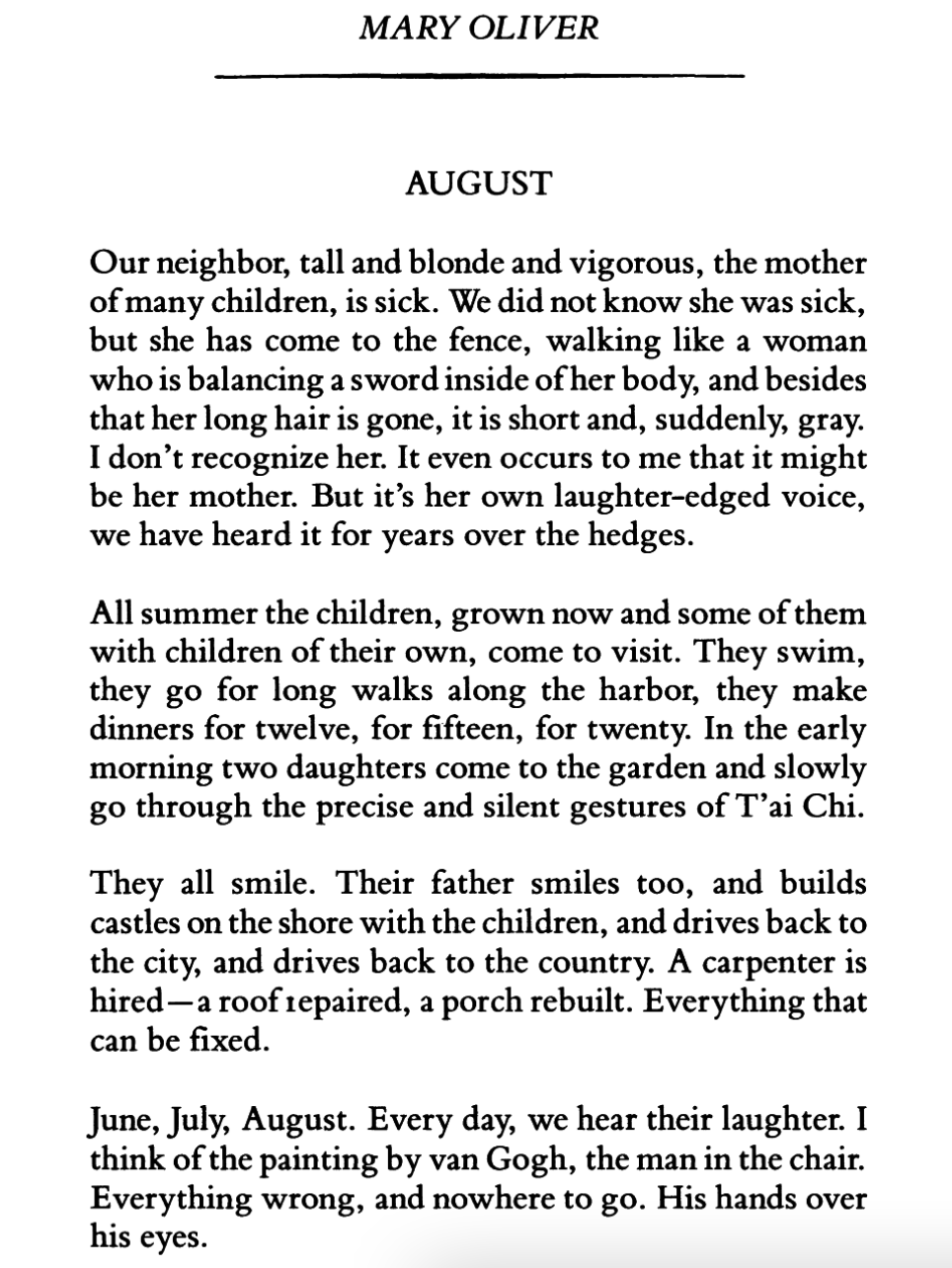
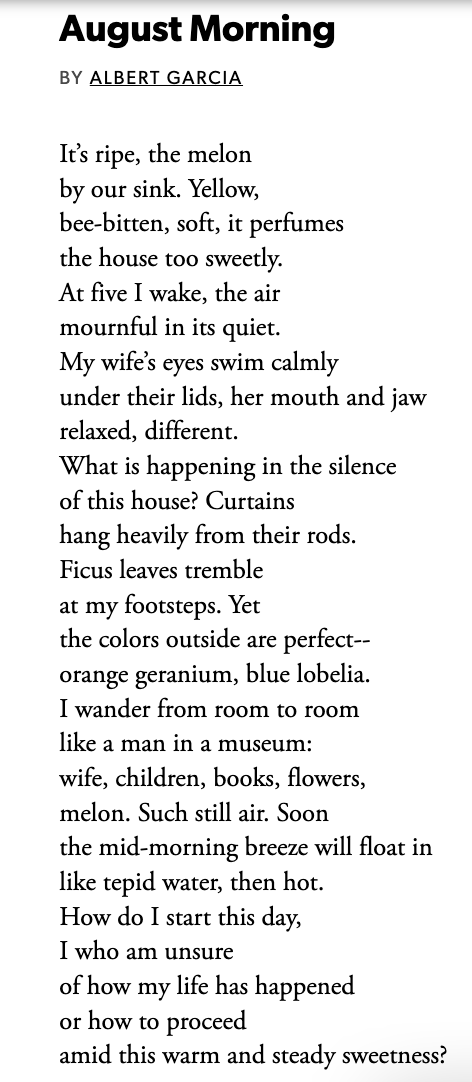
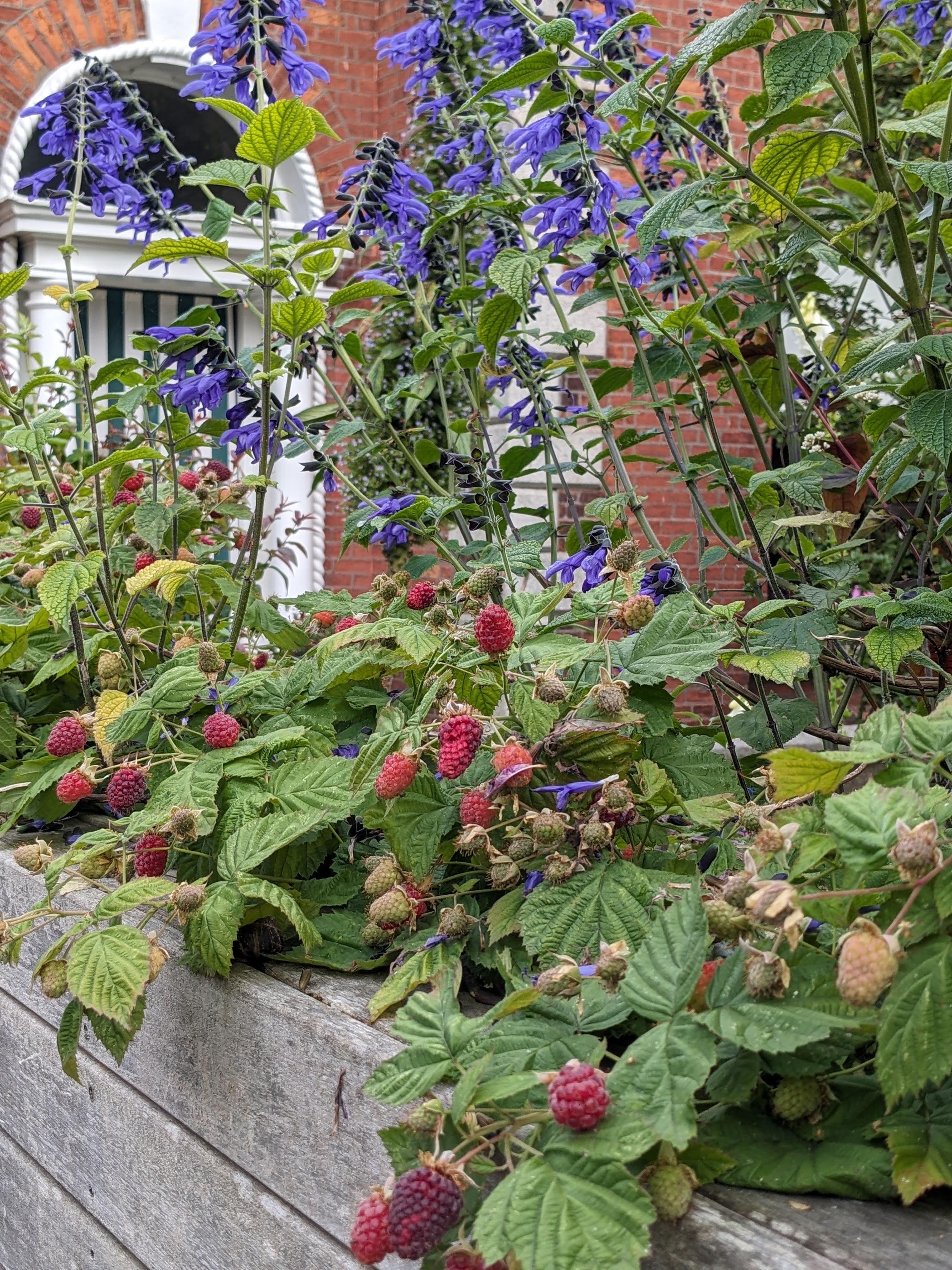
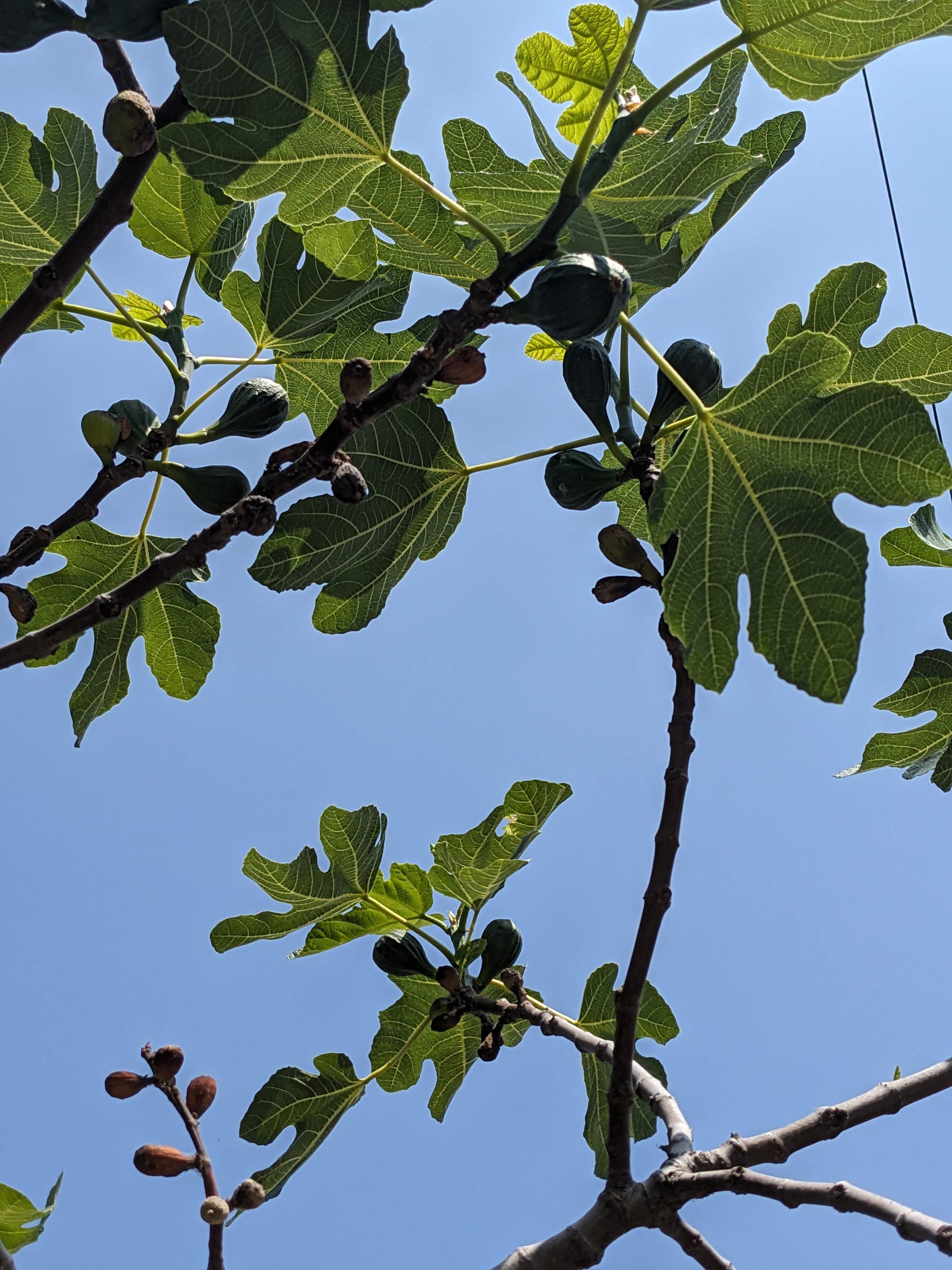
August. Almost autumn. Hardly feels like “August” here in Dublin, but whatever I feel like “August” should be, this has been the August it is: more or less cool and more or less damp, after a July that was the rainiest July on record. Most days have been whitely overcast. There has been fine rain, heavier than mist but not heavy enough to drench. There are ripe figs on trees behind stone and brick walls, and blackberries reaching from behind white-painted metal fencing. Most days have had a period of fair weather in them.
I have been reading poetry every day, a kind of training. I’m trying to learn about poetry. I have been learning about poetry for more than thirty years, twenty years in formal ways, and I feel more and more bewildered by it. How does it do it? How can some people be so sure about it? What would it be like, to be one of those people who is sure about poetry? I feel like I am always just asking about poetry: what, what, what, what, what; how, how, how? I spent a week in July with other poets and every morning the teaching poet gave the group a single poem to read closely. We spent about forty minutes on it, usually, and I could have spent three hours—or the whole day—doing just that close reading. I love this thing called poetry, even though I don’t understand it, I love to do it with other people, and I have no idea how I would go about understanding something so big. So August has been poems and blackberries for me, the latter catching my clothes on their thorns as I reach in to pick ripe fruit. The former always already caught on my clothes.
While walking through this cool and damp summer I have had the syncopated knowledge that in so many places this summer has been terrifyingly hot. I’ve felt sick with the knowledge of heat and drought and fire, floods and crop losses, fear and suffering and death—human and nonhuman beings, and the land and the ways of living on and being in those places. When I am afraid I often feel immobilized by that fear and by the immensity of things like the catastrophes of capitalism, imperialism, settler colonialism, plastic, petrochemicals, ‘forever’ chemicals—the ruin of whole worlds, ways of being, possibilities for relation, already in action. The sense of my smallness and the problems’ largeness quickly spirals in two directions. What could I possibly do? What do I have to offer? My life feels very tiny, short, and ineffectual then. And yet life is what we have, each of us and all of us. Not only our individual lives, but our shared one, too. When I remember this I feel immense gratitude for labor unionsandworkers (and students!) who arestriking or have usedstrike threats to get fairer contracts and safer workingconditions—and to remind us what we can ask for and must ask for, and to remind us that we cannot do it alone, and we are not alone.
A model for the present and the future, strikes teach me that we can make sacrifices together that, when we do make them together, feel like joy. Strikes remind me we are together. Our daily lives have to change. That’s a fact. And we can only make that change together—the details may differ from place to place, but the fact remains that we can only do it with other people. We need, we cannot live without, a change that insists that those who cheapen and discard all of life and all the land, water, air desist: militarized nations, massive corporations, massive tech. Our lives are not cheap—none of them, not the lives of the ones who face buoys made of saw blades in border rivers; not the lives of the ones who embark on unbearable journeys in insufficient crafts; not the lives of the ones snipping threads in clothing factories that run day and night, or of the ones carrying ore from a mine, or of the ones packing boxes under the eye of a computer timer in a warehouse. Not the lives of the ones who fly or of the ones who photosynthesize.
We can change our lives together, for one another. The urgency is huge. We are faced with the facts—the exclusionary, unjust, entrapping facts—of landlords’ hoarding and of billionaires’ death-driving. But we don’t have to accept these facts. There is no outside to the circle if we insist there is not. We can set down our tools, close our laptops, park our cars, and walk into the street together, hand in hand, arm in arm, shoulder by shoulder, singing. We can strike from our everyday lives. (I am still in awe and wonder at the self-immolation of Wynn Bruce. How do I live as committedly as that?) What happens if we do strike from our everyday lives, our habits of knowing and doing and being? What happens if we step, for a moment, together, into a new possibility? (Ruby Dee: “[The songs of the civil rights movement] became almost as common as love songs. And also—direction songs.”) Direction songs. We aren’t the first people doing this. If we sing together? Sing instead of shopping? Sing instead of working?
A strike is holy. That’s why it’s hard—holy things feel impossible on the one hand, and maybe almost silly on the other. But looking one other person in the eye and joining them—we will find it is not silly at all, or difficult, at all. There we are. Together.
I think that sense of holiness is a name for what happens when people do something together that departs from the “just how the world is” of the world in order to insist on beauty, dignity, care for the world and its beings, the value-as-such and -in-such of land/water/air/all life. Invention and daring in service to shared life. I haven’t figured this all out but that feeling of holiness is part of why I want to pay attention to poetry—its how more than its why or even its what—and to blackberries and all the other ‘minor’ (not minor!) indices of time and place. The closer I look the more I know: we are here together. Meaning happens amid the smallest movements and by the most minuscule differences. Everything is precious. I’ve said that before, I’ll surely say it again, because it is the simple thesis of the world as I’ve encountered it. There is no living thing that is not bound up in our shared existence. If we mean, we mean together.
What have I learned, reading poetry and walking, looking at and picking blackberries in neglected lots this August? Thinking takes place over time—I knew it, but I have to learn it again and again. A poem is sometimes the accretion of meaning across a duration rather than the crystallization of an image within a form that can be held in the hand. The most basic, incontrovertible fact of life is that we are bound up together in it, and that one thing that poetry, music, art can do—not necessarily, and not always, but it’s possible—is remind us of that fact, and of our responsibility to one another. (Need something to carry you there? Here’s Sister Rosetta Tharpe with a lesson. And here’s Pete Seeger, Sonny Terry and Brownie McGee with another version of the same.)
Beauty is the lesson we can never finish learning. Whole, open, for everyone. Like poetry, we can spend our lives on it. It’s not simple—it’s deeply complex. It’s not reserved; it’s for everyone, always. It’s not esoteric, it’s here, right here, at our fingertips, again and again, every day. It’s the fact of our intense, intricate co-relation, unfolding.
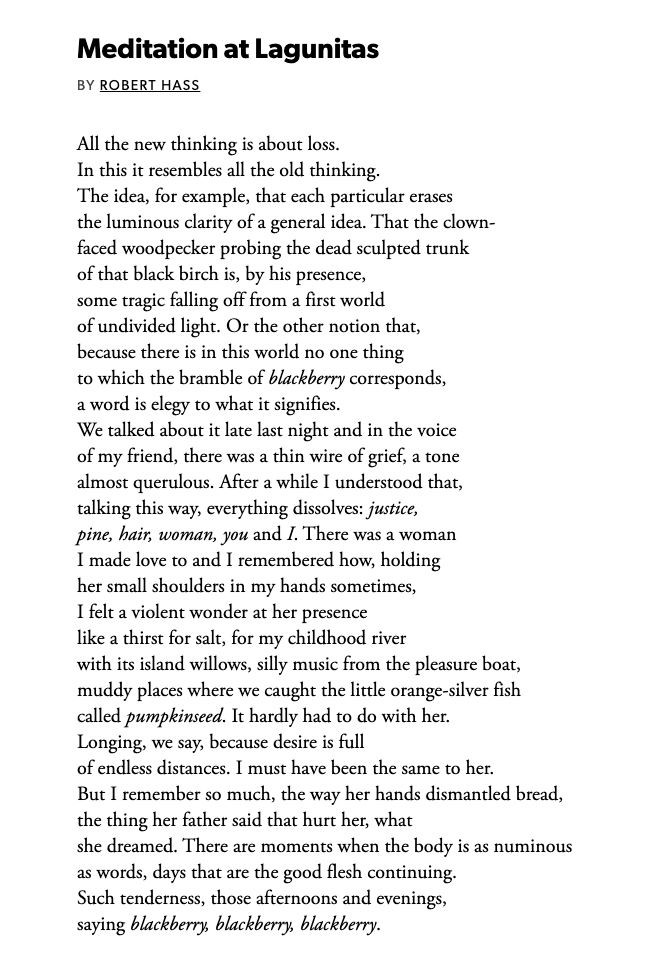
I’ll leave you with one of my favorite poems, one I think is probably on a lot of people’s list of favorites. It’s a poem I was given by a teacher when I was about 22 and it is still mysterious to me. In every season it’s given me something new. I still don’t fully understand how it does what it does, or all that it does. But it does remind me that the world is a shared one—the world of blackberries and beloveds—and that one thing poetry can do is try to speak and spell exactly that complexity, one letter at a time, one poem at a time, until, along with the everything-elseness of the world, we have made and continue to make the world in which we can all live.
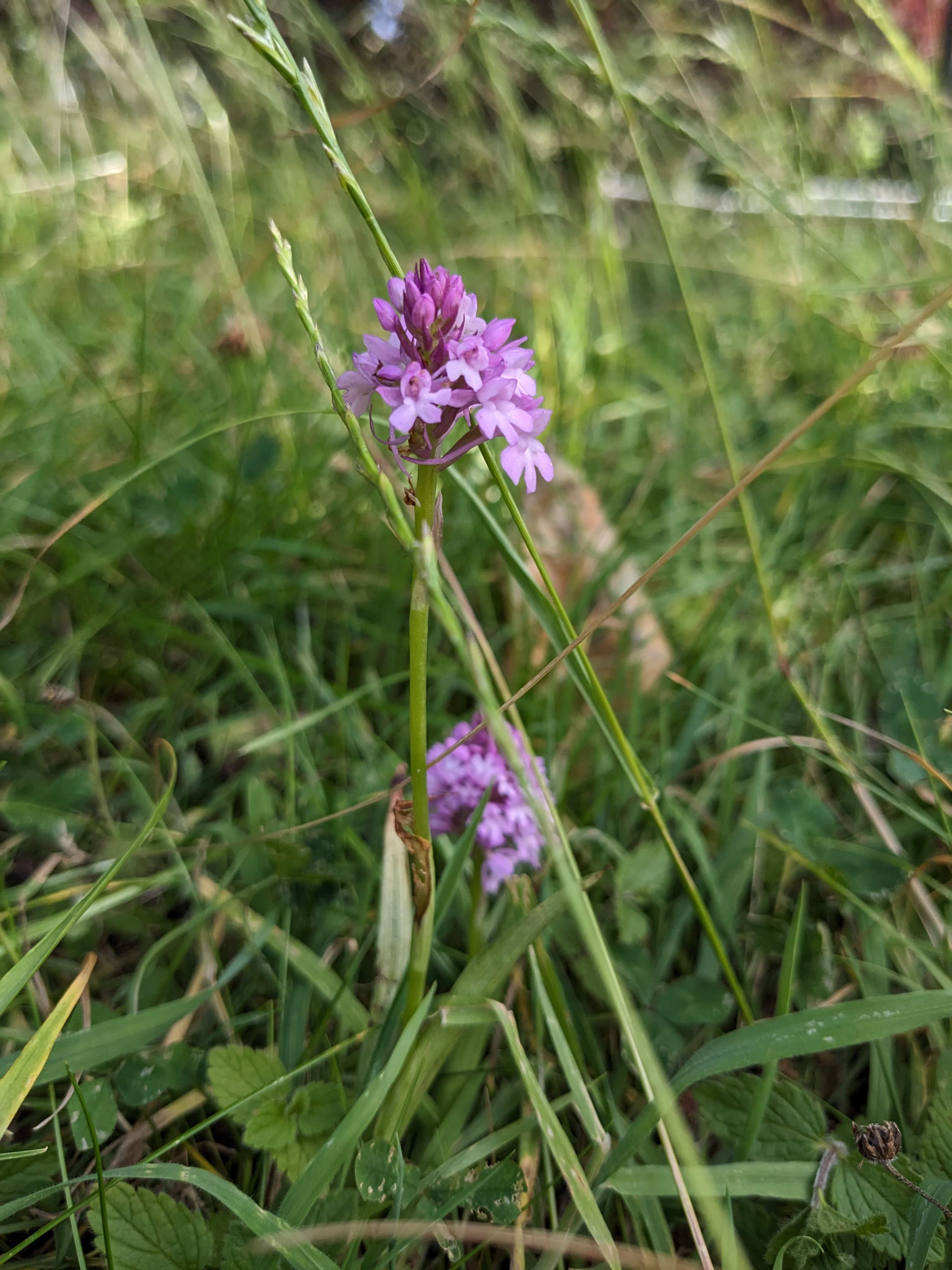
At the start of July I saw a pyramidal orchid for the first time in real life. At the place I work the groundskeepers have left swathes uncut between mown areas for walking and in those places I’ve seen so many wildflowers over the past three months. When you get down by the ground what might have looked homogenous when rushing or even just walking by fractures into incredible diversity of kind, color, size, form. And it doesn’t take a ton of space for this, either. I often think about the breadth of a street, and how many gardens, how many fruit trees could be made in that space. Imagine walking out your door to a vegetable and fruit garden of your own (imagine a redistribution of massive wealth such that having the time to care for and work in such a garden were not a ‘luxury’ but a part of everyday life). In my imagined city there are bike and pedestrian paths down the center, fruit and nut trees shading the paths, gardens between there and the houses. Bus and tram lines too but I’m not an urban planner, here; I’m just a dreamer, kneeling in front of a pyramidal orchid. But look what huge things can happen in such a little space.
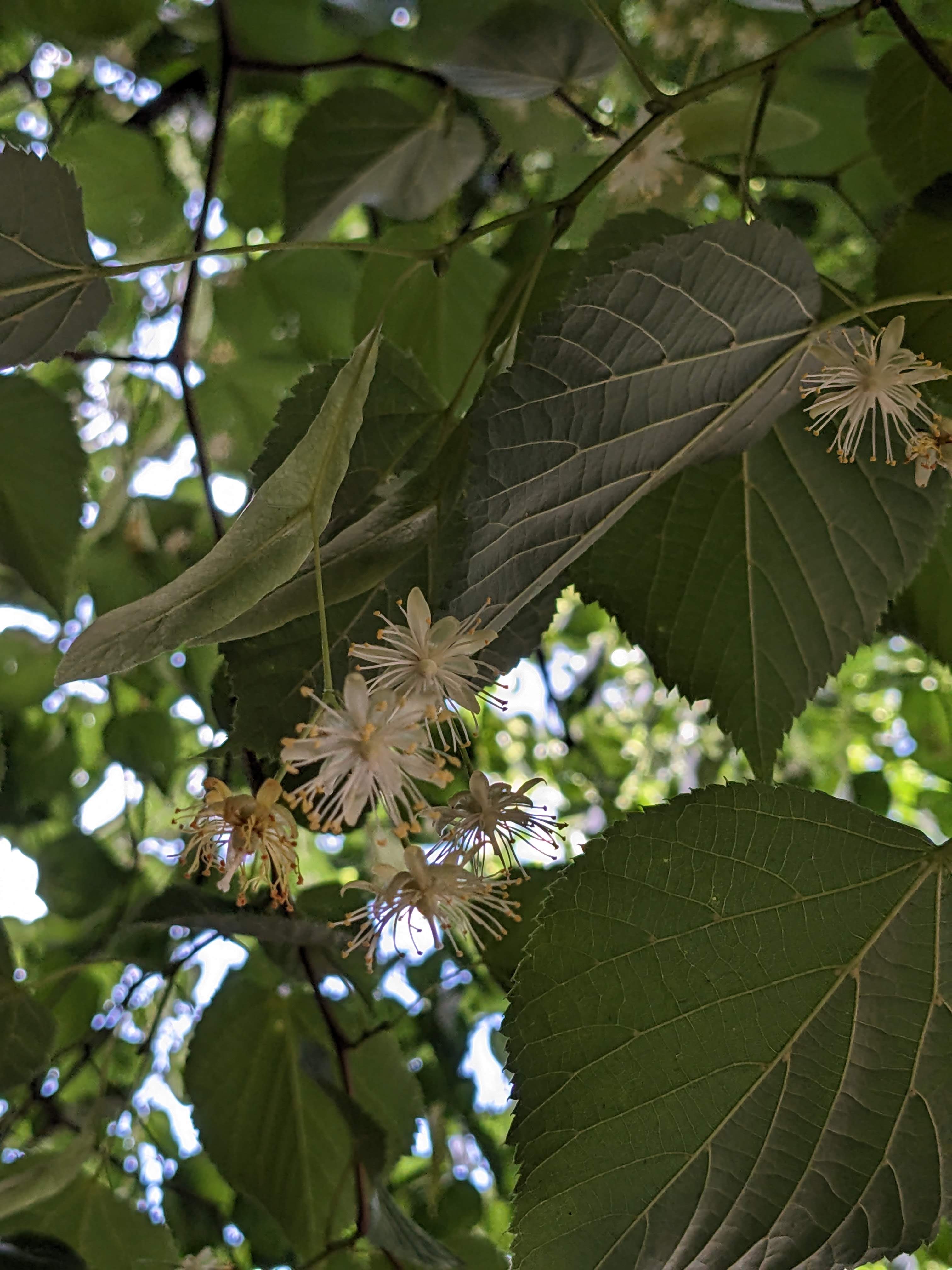
Did your nose lead you through the streets until you found the source of July’s perfume? It is the linden (lime) trees in flower. Only for a short time—a week or two; shorter if it was unseasonably hot. For everyone, freely available, without cost: their scent is a shower of softness.
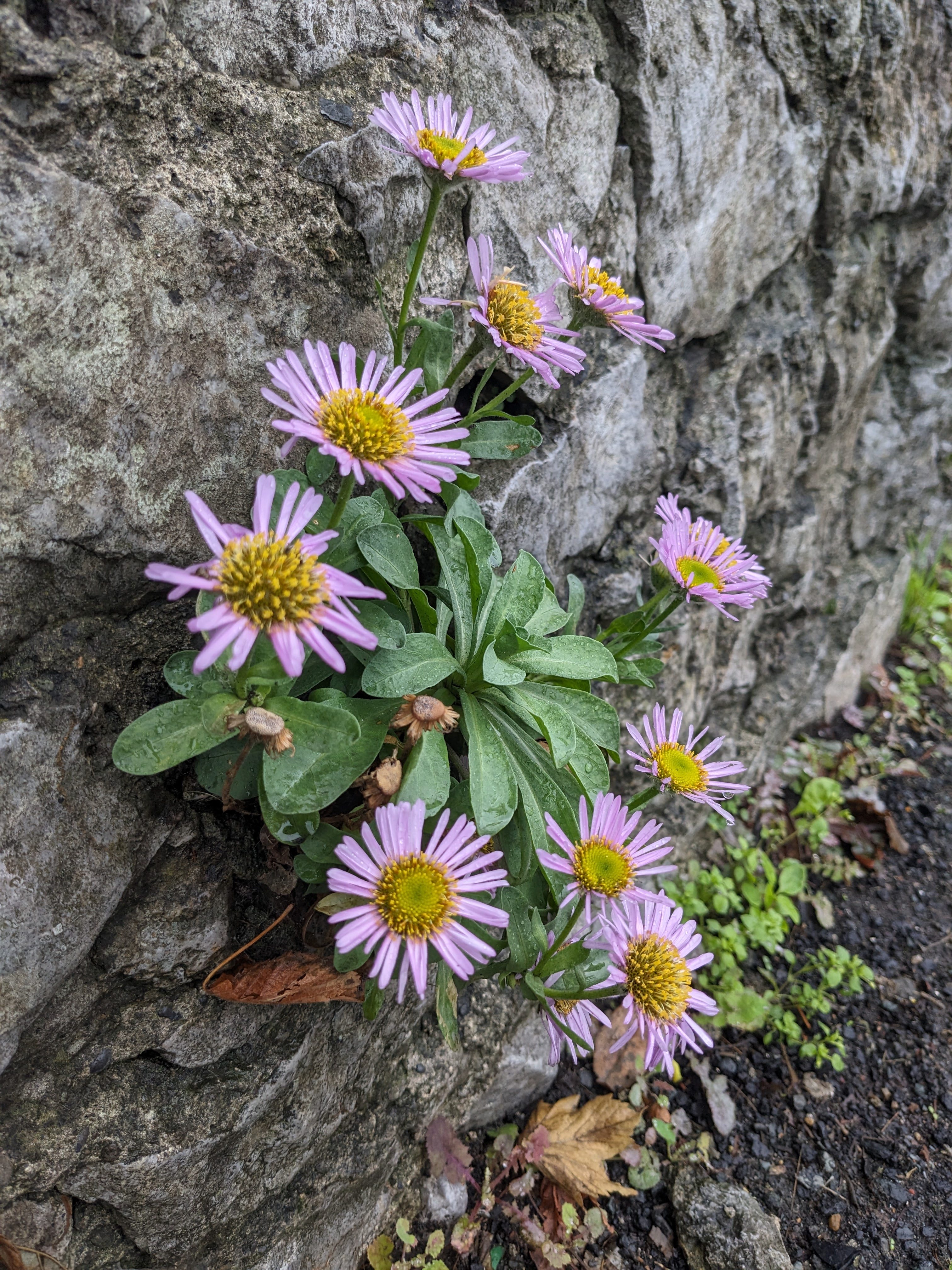
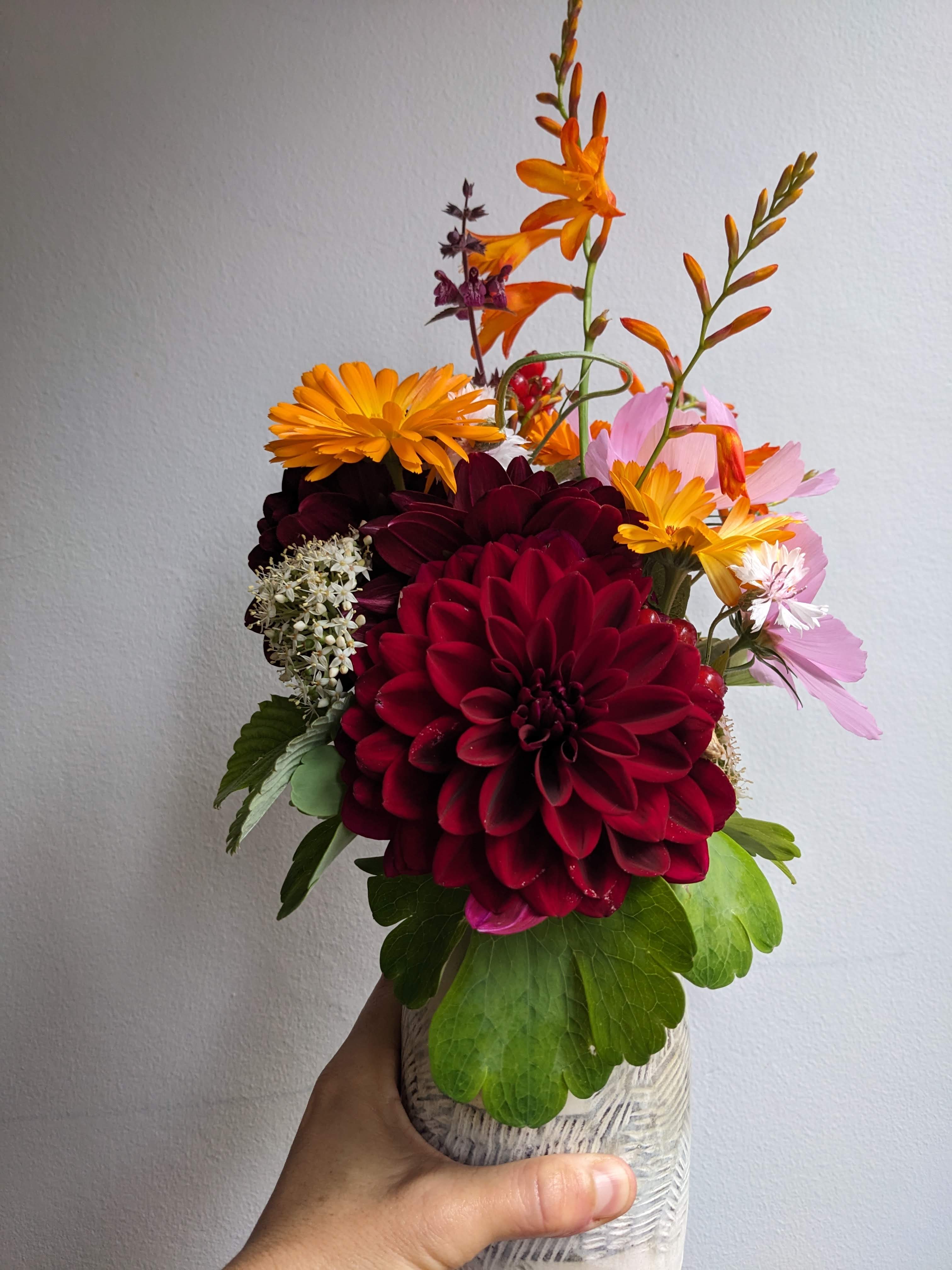
In gardens we may not own but rent or borrow, in friends’ gardens, in the places where plants escape the borders of the private yard and spill onto street or public path; on the grounds of banks and private equity firms; in the crack between pavement and wall: we can find and gather the riches of summer. (If you are in Minneapolis/St. Paul, and you want someone to find and gather these riches for you, Night Owl Farm has a beautiful flower CSA. It’s not cheap but what a gift—flowers every week for the price of a lunch out that week. Elsewhere, look for farms that do this. Great way to support smaller farms and to give presents that don’t need to be manufactured.)
What do the beings of the world say but that borders are fictions and that everything is precious? That life is always going on, all around us, and is infinitely interesting and complex; that the work of making meaning and of coming to understanding is endless and for everyone—could not be achieved by one person alone, or in one lifetime. These border-crossers know that ‘nation’ is a lie enforced by militarization and in service not to life but to wealth. They know that the networks of mutual dependence and reliance are everywhere and nothing living or unliving is outside of them.
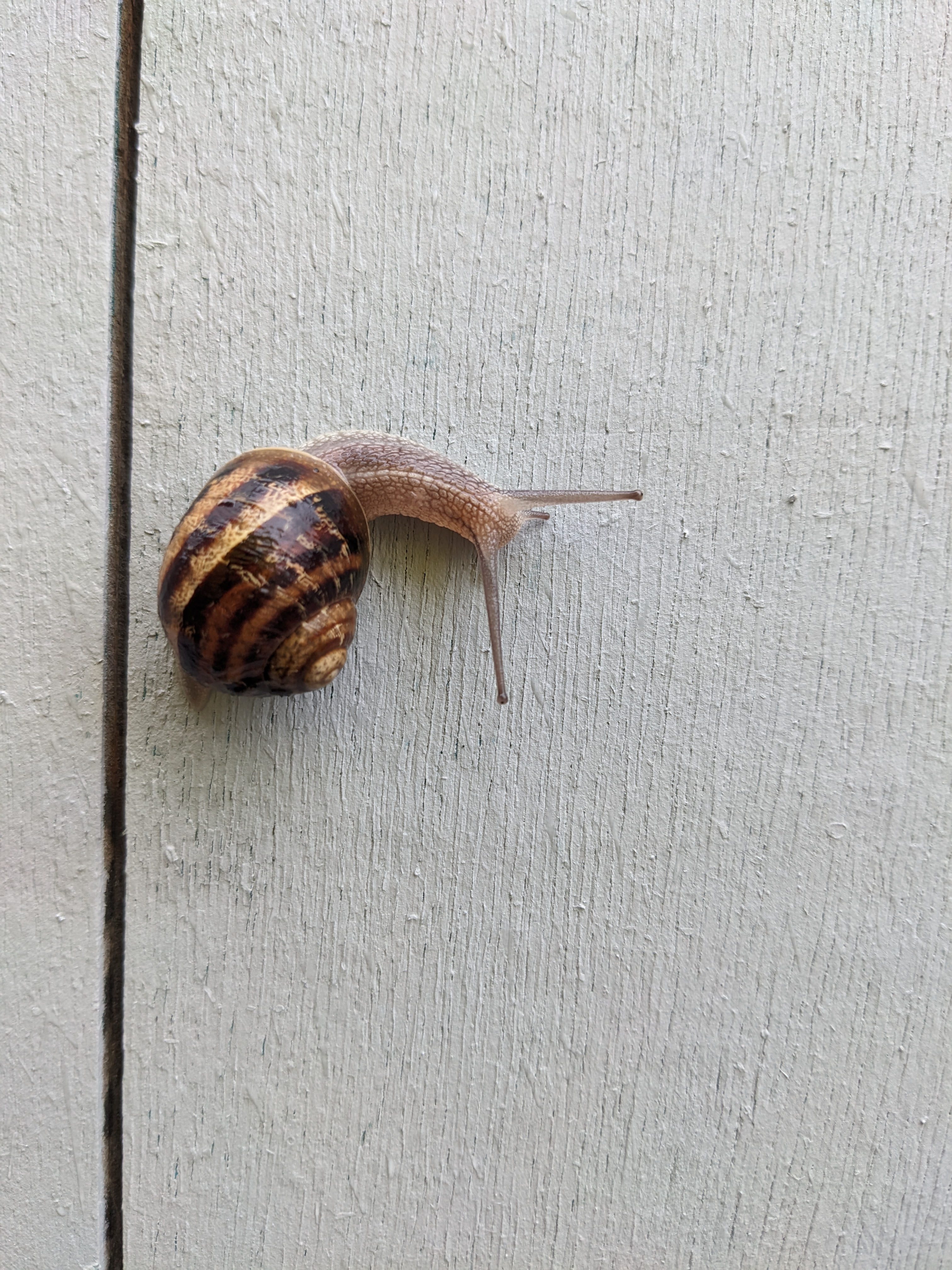
The beings who live alongside us (including the human beings) also tell us that grace inheres in each thing, as it is, in the ways that it is, a grace that is not theological but intrinsic, theology being only one way to interpret what is always already there. Hopkins’ theology brings him to this conclusion—“Each mortal thing does one thing and the same:/ Deals out that being indoors each one dwells:/ Selves—goes itself, myself it speaks and spells,/ Crying Whát I dó is me: for that I came”. The beauty of geometry and the unlimited curiosity it can teach us! “Euclid alone has looked on beauty bare”—would I go that far? Maybe not, but I know the poet uses hyperbole to effect an argument, and I take her point. (Also, I learned this week that snails are left- or right-‘handed’.)
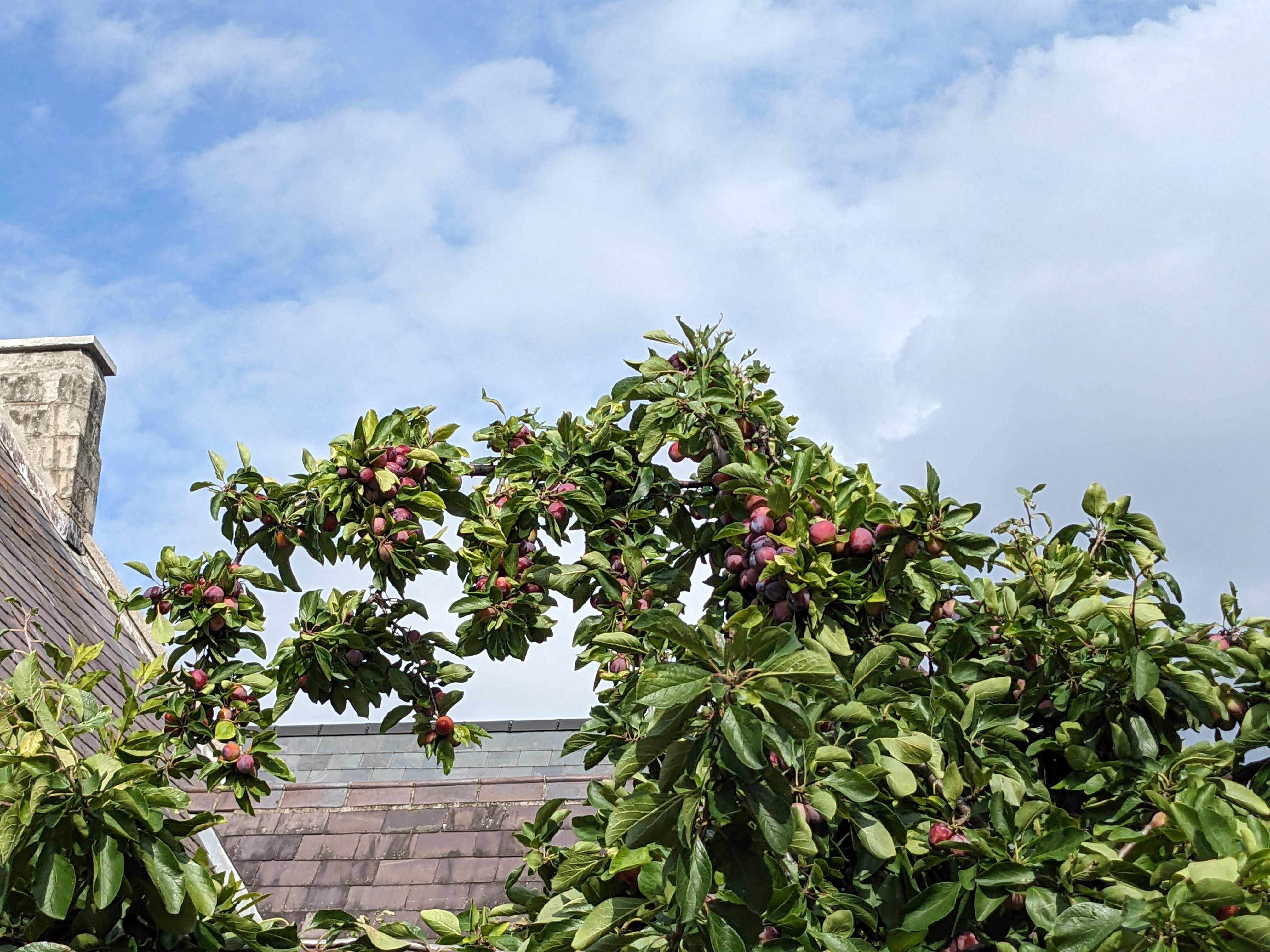
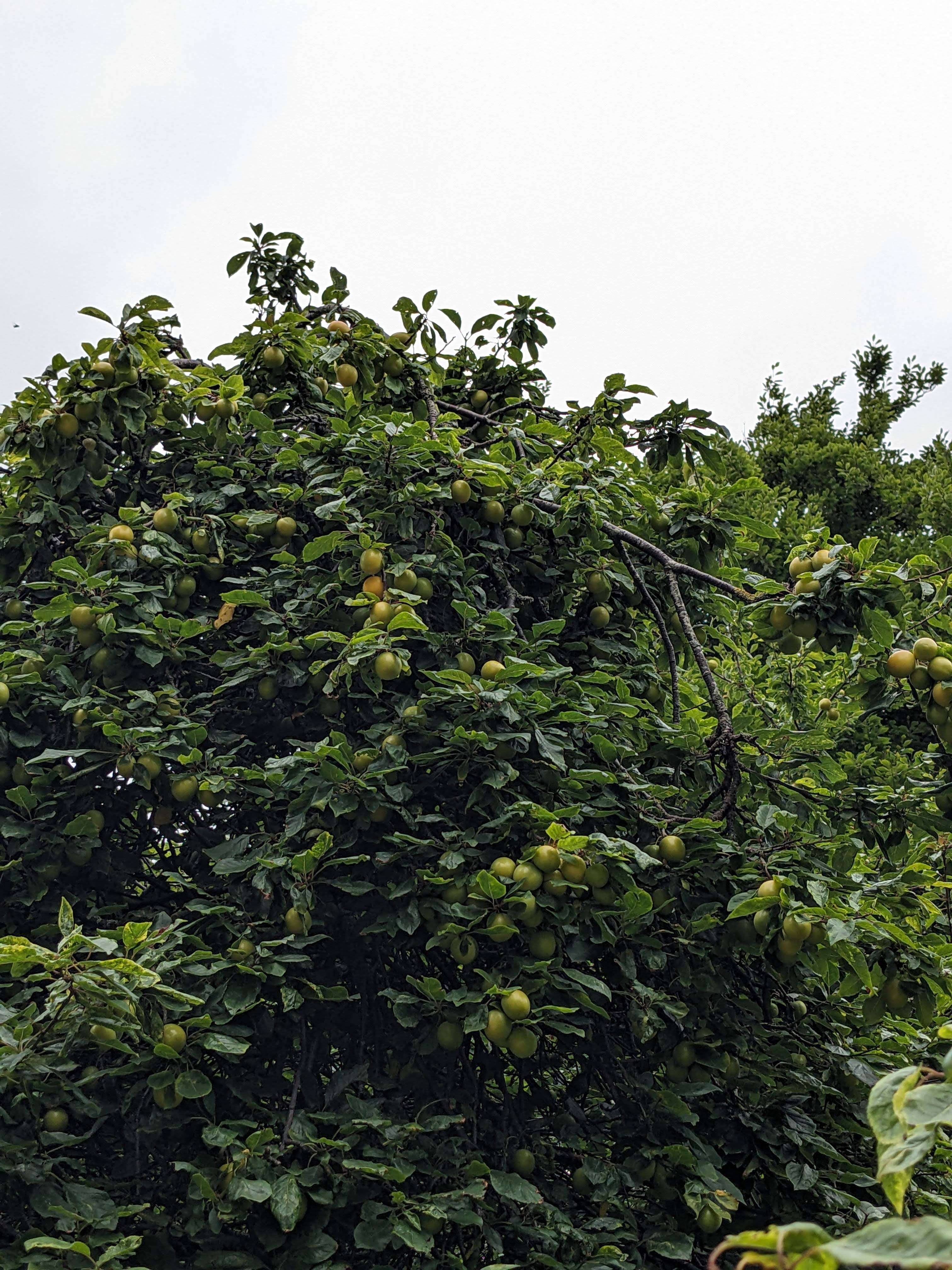
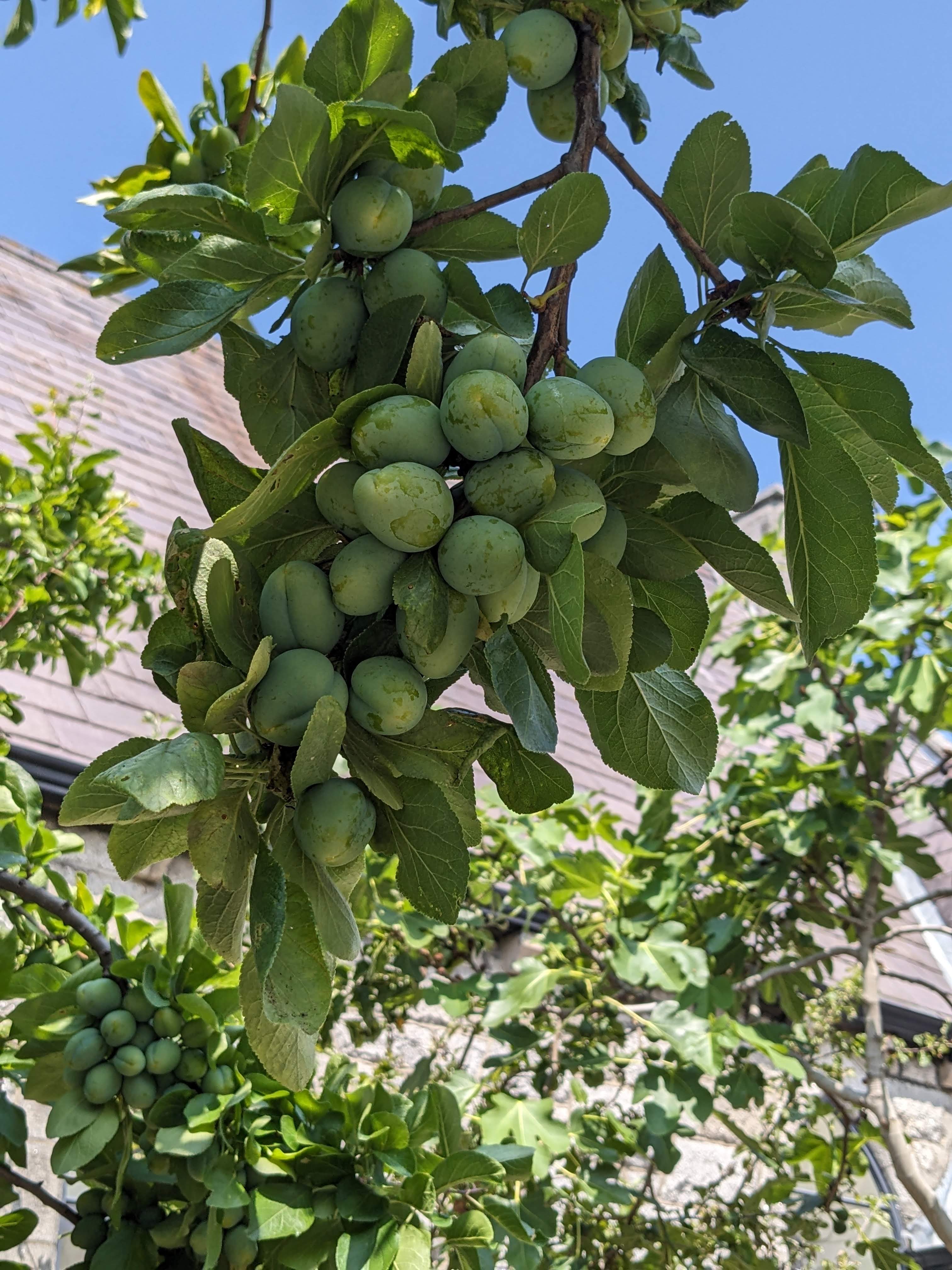
This city is a city of fruit trees: public plantings of plum, cherry, pear and hazelnut all drop their bounty to smash on the sidewalk and be crushed under the tires of cars. As I have walked over the past eleven months I have noted the places where fruit and nut trees are and mapped them, and in July I returned to plum trees—already covered in ripe fruit—to gather what fell. (I only take windfalls from trees that are private, or I ask at the door if there is fruit on the ground whether I could pick from the tree. And I shake public trees to adduce them to drop fruit for me.) From windfall plums and mirabelles I made four small jars of jam. I have to push back against the scarcity feeling when I gather this public fruit—telling friends on purpose where the trees are. It has to be for everyone and if I’m against its enclosure I have to be against my own desire to enclose it. There is more than any one person can use. And imagine if all the plum and apple and cherry trees in the back gardens of derelict buildings could be harvested? Imagine a jam kitchen for anyone to use. Imagine a café that served meals or treats on a pay-as-you-can basis, made with food grown in back gardens and on city streets. The world of plenty and of solidarity is already here, we just have to act as though it is. This world in which we could live by the dictum of sufficiency-and-no-more rather than by more-and-more-and-more is possible and we are part of it.
It seems impossible to me to walk without thinking about riches: in Dublin this is so because of what the financialization of housing has done, and also because there are banks and finance corporations and tech corporations and the trappings of extreme wealth, and because property is so prominently present as well as the dehumanization and abandonment of the poor. But it’s also so because the world itself is riches. Not marble nor the gilded monuments—what “lives in lovers’ eyes”, what is lasting and meaningful to me is the way that looking and walking makes me alert to ever more complex detail, the way observation teaches me to see that detail and its relations and to metaphorize and generalize from this, to understand structures and concepts in new ways, which again direct me to the world of things, material and phenomenal.
August is almost here; September is coming. I’m planning to write, loosely, in the region of learning to write and teaching writing. If you’re reading this and there was a moment you can remember where a teacher changed your mind/your life/your practice about/of poetry or writing, or a reading you remember that broke your mind open in important ways, would you be willing to tell me in the comments?
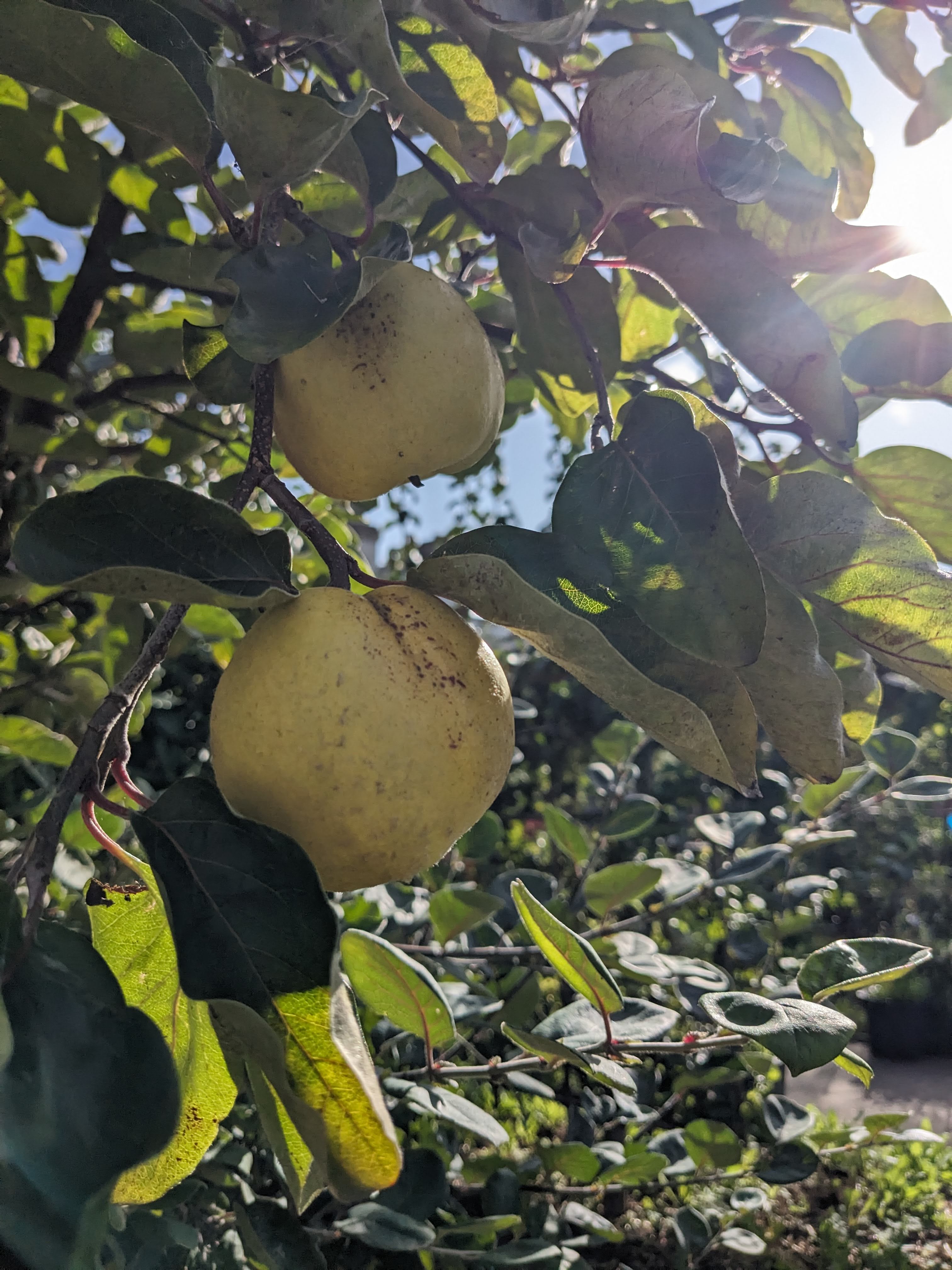
June is fruit, humidity, the return of rain although not sufficient rain in some places and far too much in others. I’ve been watching the gardens with fruit trees and bushes all spring and now that it’s full summer I’m watching them with covetousness. I did sneak one raspberry from a cane that overhung the sidewalk. There are apples, quince, pears, raspberries, blackberries, plums, and figs on my usual loop. There is a greengage tree at the university that was absolutely covered in white blossom early this spring.
June has also held the lingering awareness of the Canadian fires: smoke arrives here off and on as haze. Only once so far has it been a low haze, and even then nothing like what I experienced in summer 2021 when we moved from Maine to Iowa and drove through smoke so thick the sun was a small, red disk in the west. But enough to trigger sinus infections and breathing problems and simply to keep the maritimes and Québec in my mind. When the rain comes here I think of it also arriving on those burning and smoke-filled cities and forests. The horror of the fires are what they contain. Hard to think of the trees, plants, animals, birds—and also of the buildings, oil, plastics, insulation, heavy metals, people’s houses and objects, all burning.
All this beauty. It is not ordinary: it is so precious. I talk to a woman in a town outside of Dublin where I’ve gone to look at a house and she says, but of course you will get a car. I laugh, because this is what you do when people confront you with your own ‘silliness’. Well, no, I say. I’ve never had a license. But you’ll surely have to get a car, she says again. And I demur and we go on to talk about something else, and I am not quite brave enough to say, I won’t get a car because I’ve been thinking about this for almost thirty years. I won’t get one because that would tether me to oil fields and military occupations and a couple of tons of machinery and insurance agencies. I won’t get one because I’ve been walking for more than forty years now and have yet to exhaust the possibilities of foot, bicycle, bus, tram, and train. There are fires all over North America. Online a scientist posts a graph of the Greenland ice melt from this season: I’ve never seen anything like this, he writes. The temperature of the ocean around this island is shockingly warm right now, and every time I see one of those diagrams with the years represented as a red or blue line I feel sick to my stomach. There is very little I can do. It isn’t a one-person problem. It isn’t solveable by my decision to do one thing or another. But I can go by foot and bicycle and public transit. I get something out of that—it changes me (what I can imagine, how I use time, what I see…), expands me, feeds me and makes me happy. I try to constrain my desires and my consumption just that much but it doesn’t feel like a loss. One way—one way I’ve found for my life—of yielding to the bog orchid and the corncrake, the ladyslipper and the loon. Your ways may be different to mine.
But I don’t say any of this to the woman.
Going by foot has benefits, just not speed. But I’m not sure that speed is a benefit in any case apart from when one needs to get to a hospital or similar. The midpoint of the year has gone by now but the academic (teaching) year here is just beginning to slow down. I can’t help but think how much better and more humane it would be if we kept to a much slower pace all through our teaching year. I pick flowering weeds as I walk from the bus stop to my office on campus and put them on the photocopier, week after week. I’ve been able to see the empty lots and byways transform over the past months, day by day, on this short walk.
This week there were more flowers in bloom than easily fit on the platen and the image is packed with them. The colors now are yellow, white, red. Yellow has been a constant through the spring and summer; poppies showed up around the start of June. Blues and purples, the delicate speedwells, have receded. The yellow of late June is a change from the butter-yellow of cowslips and the almost fluorescent buttercups; it is slightly warmer, almost ambered. Now along the canal is meadowsweet, and in waste ground I see chamomile, yarrow, tall oxeye daisies and the ever-present marguerites, white clover. Calendula still overruns garden walls and the creeping purple bellflowers do, too. Do you enjoy color charts? You may enjoy this.
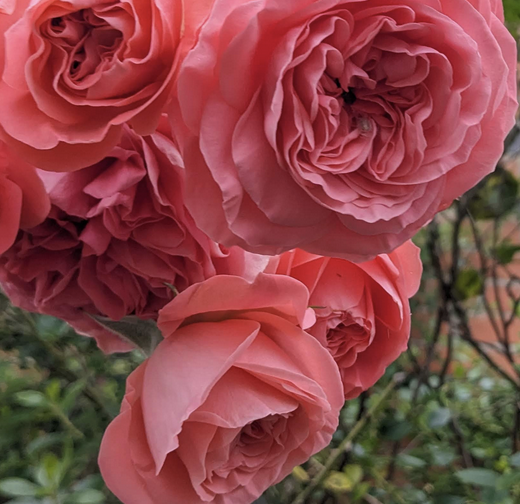
Summer is also the season of house sales. Every week a new sign pops up in the neighborhood. I’ve gone to see a few houses, in part out of curiosity, in part out of longing. There is nothing nearby that we could afford; the average two-bedroom house sells for more than €400,000. I watch bids online and see houses go for €70,000 or €100,000 over asking. How long will it continue like this? The houses are “tastefully redecorated” or “a perfect starter home”. One I visit sells for almost €430,000 and has no heat or floors. One near us sells for €690,000 and has been gutted down to the studs, needs wiring, plumbing, and heat. Another, a house with a beautiful old rose garden in the front, sells for more than the first and will need total renovation. Twenty families have lined up to see the house at that viewing, which was the third of four the agent had scheduled.
Here is richness. The fruit in the neighborhood—cherries in high-pruned street trees, these plums in the paved courtyard of an apartment building. I imagine a city that is a shared garden: boulevards planted with fruit trees. A department of arborists and gardeners. Civil service in companion planting, mulch, and weeding. I would sign up to work in that service. Walking in the shade of these trees, I think, I will never take a garden for granted. Green space, the ability to plant things and care for them, the ability to plant trees, especially—it feels so fundamentally necessary. We make gardens for ourselves but also for the everyone of the passers-by, and also for the future. Who planted this plum tree in the garden of what was once a Methodist chapel? They surely did not imagine me, but here I am watching their labor bear fruit.
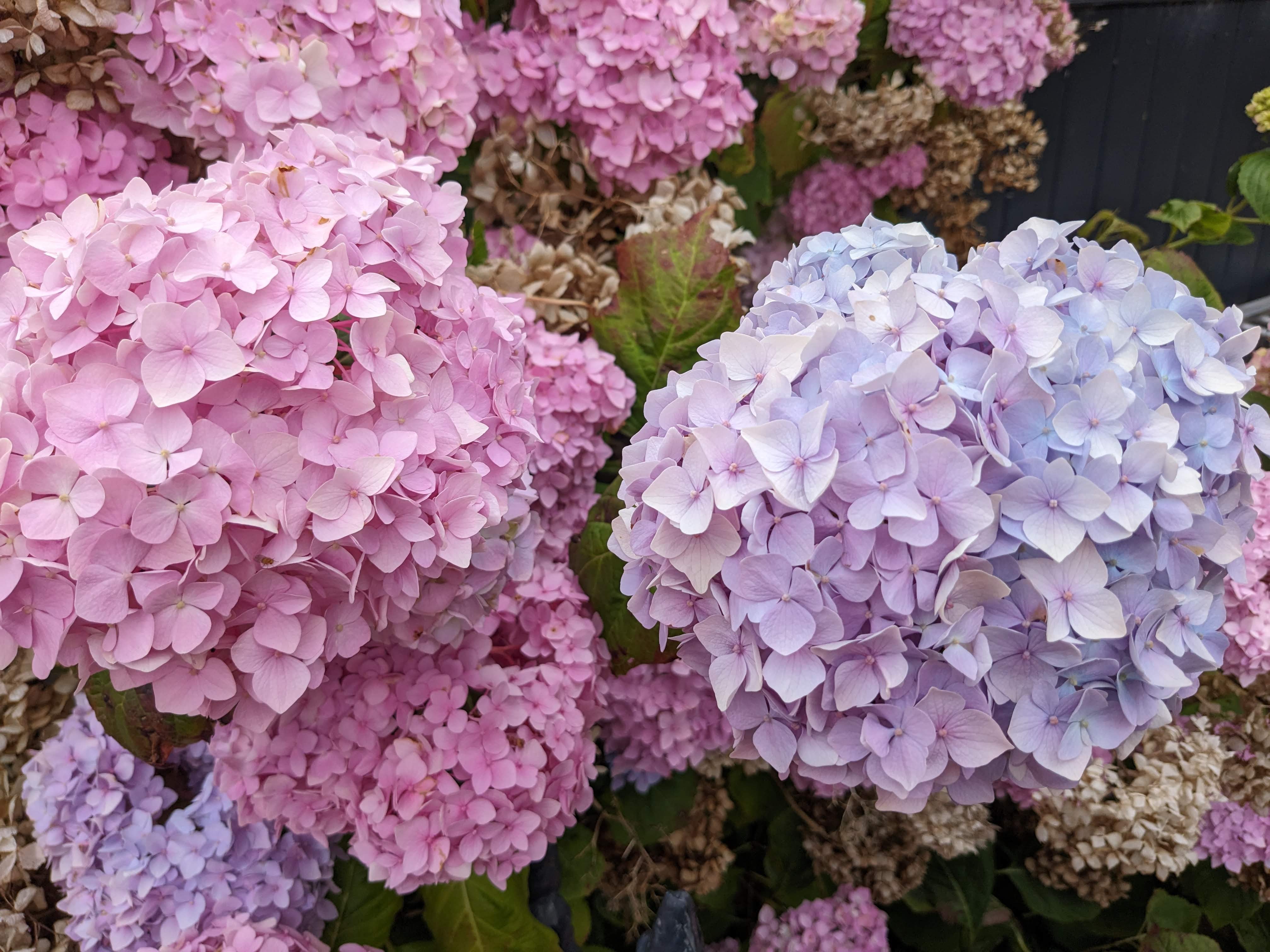
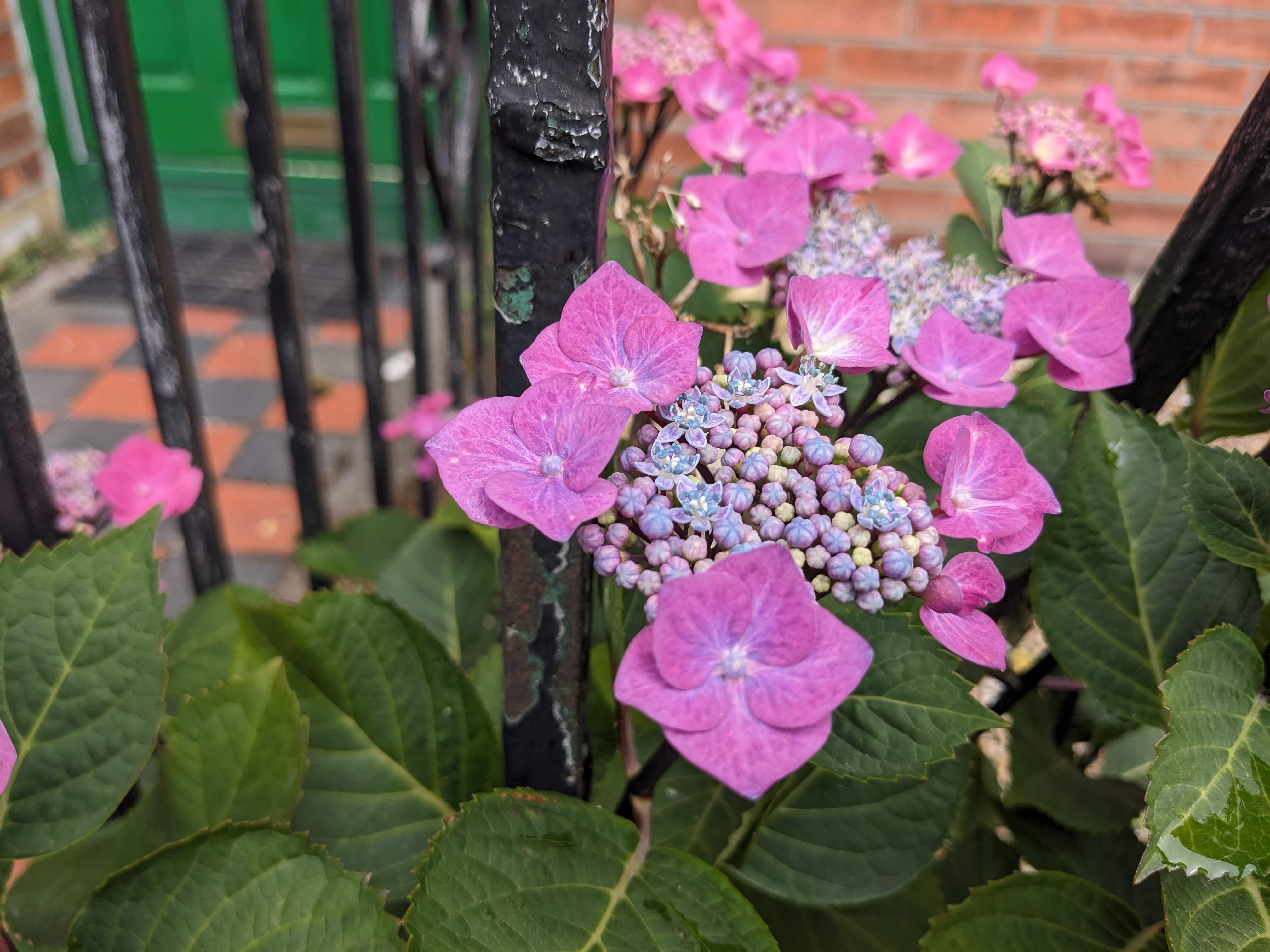
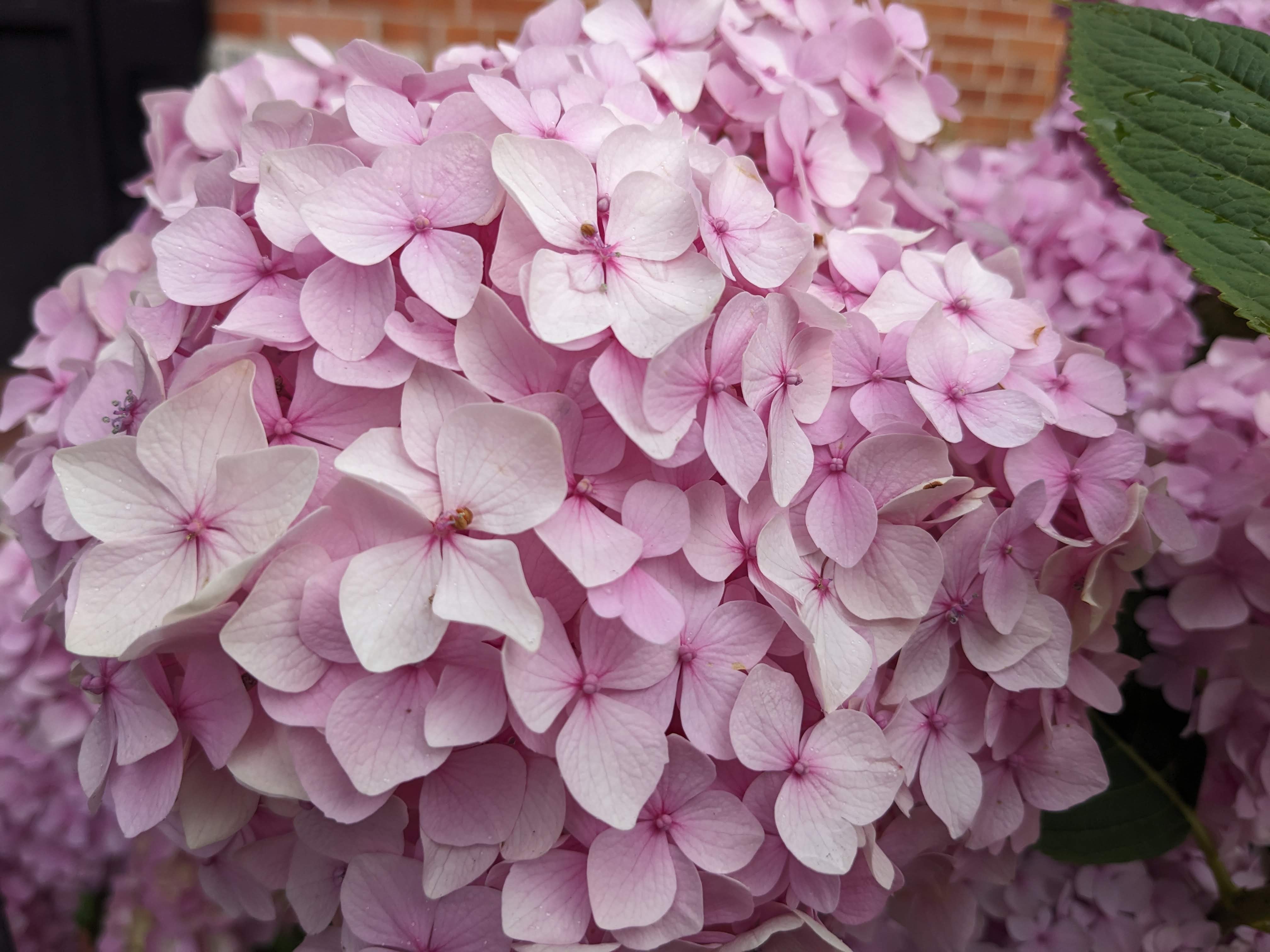
Late June is the time of the hydrangea. Most beautiful, generous, luxurious flowers. Down the street from us a house is being converted from a single-family to apartments, and the owner has (I think?) removed a massive hydrangea plant covered in a gradient from bright blue through purple and all the pinks. I saw it every day this spring, watched it carefully to catch the flowers emerging. I fantasize about knocking on the door to ask the builders whether the plants are gone or I hallucinated them. The garden I hallucinate is never gated from me.
seid umschlungen, Millionen / diesen Kuß der ganzen Welt!*
Refuse not to see it. See it, see it, see it, see it. In the vacant lots, in neighbors’ yards, in the cracks in pavement, in overgrown front gardens, in gutters on abandoned buildings, around the neglected city trees’ bases, at bus stops, in public planters, along the highways: see it, see it, see it.
Beauty is here. Joy is here. Neither may last but: here they are. They’ll be again. Right there. In the most ordinary places. Real. For everyone. For every, every, every, every one of us.
the direction of time is continue: sumer is icumen in
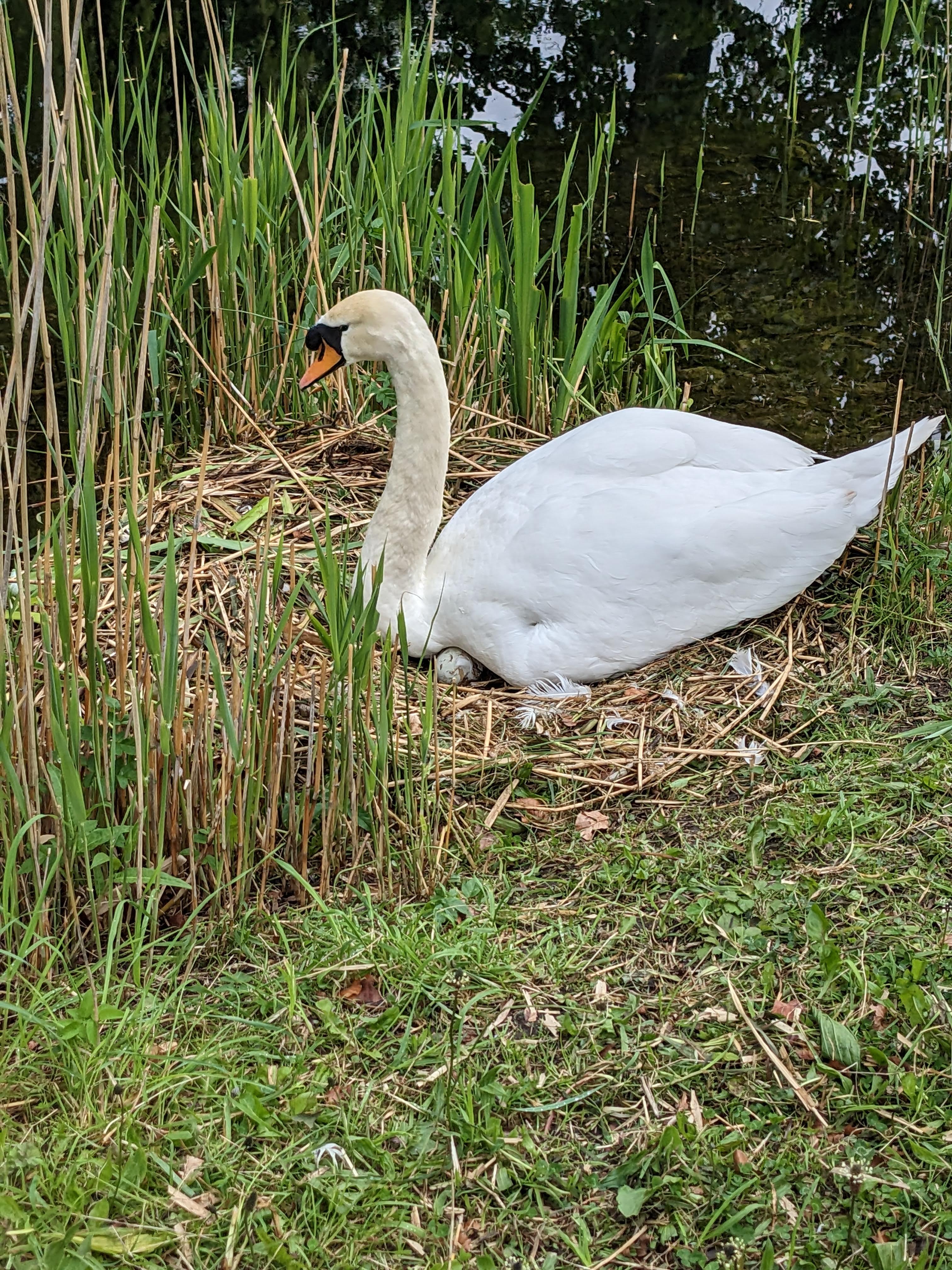
Lhude sing cuccu. A brief catalog of early summer: its speed is instant. It arrived pretty much in whole cloth around the first of May, with bluebells everywhere and the sword-shaped leaves of the irises in the canal. And now the irises are open and the swans are on their eggs. I drop peanuts onto our windowsill in an attempt to coax the magpies to befriend me, and they do come, but are not tame. The humidity drops, the rain comes in sudden heavy bursts, the humidity rises, the uilleann pipers’ school lets out for the long school holiday, and friends text me their travel plans. Teaching ends.
The form of the song “Sumer is icumen in” is a round. A round is a kind of composition where voices sing the same melody but begin at different times, so that the different parts occur at the same time in their different voices. Singing a round tells time both cyclically and overlappingly: it tells time by cycling through it (singing the entire melody from beginning to end, and beginning again) and it tells time when one voice crosses another (here, here, here; here, here, here, says the overlapping melody). Things come back, they cross and recross, and they resonate with one another over time, and they repeat wholesale. Like seeing flowers in one place and another, summer in one place and another.
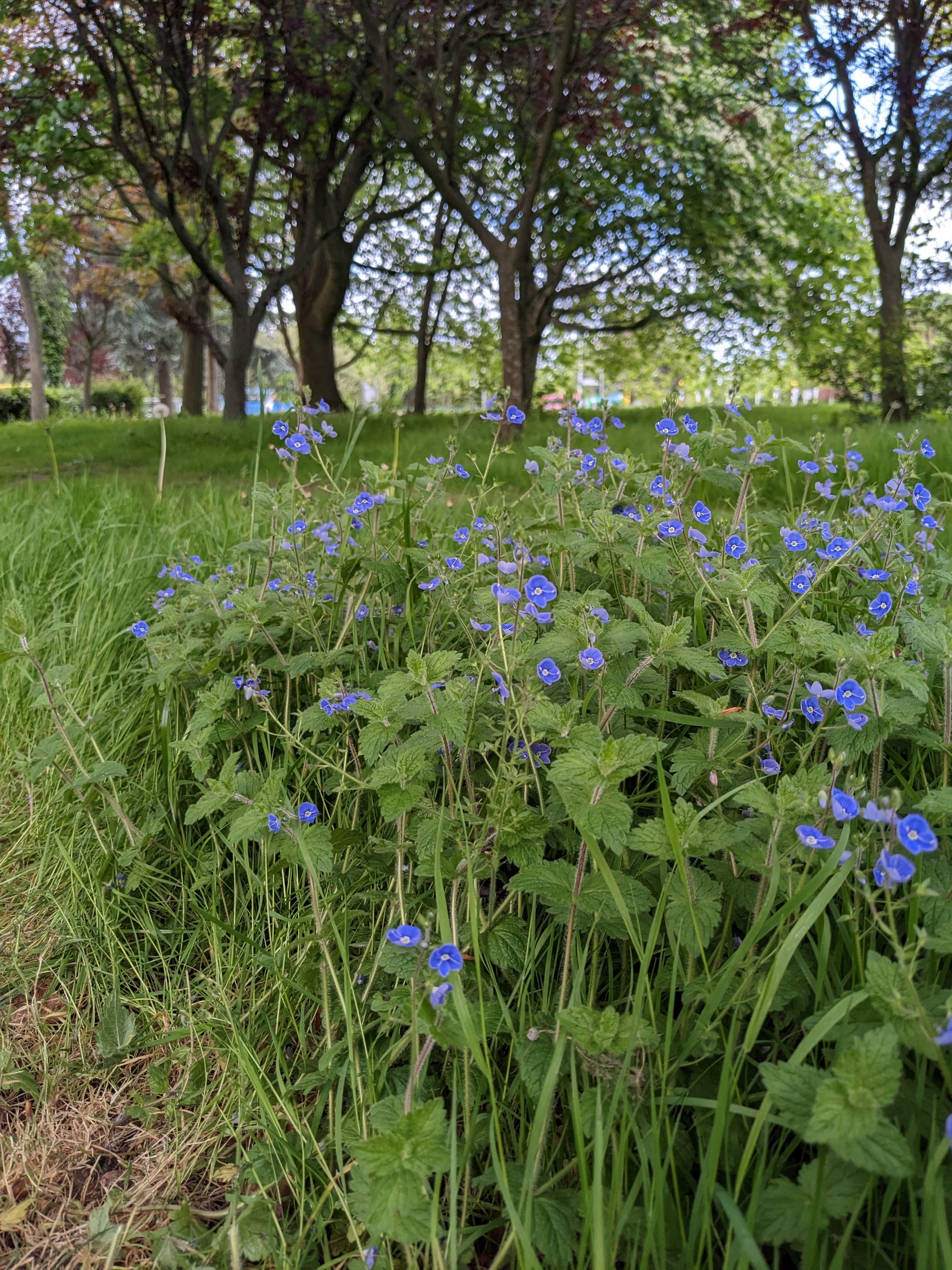
This haze of speedwell catches my eye from a dozen yards off. At the university where I work the groundskeepers mow only part of the grass, which means that all kinds of plants flourish in the uncut sward. We are now in the season of greenness, of expansion, of lengthening, of lightning and thunder.
(In the part of Iowa, where I lived last year, I felt a visual drought when faced with the weedlessness of that place. There were so few plants in general, and almost none “out of place”. There was a lot of grass, cut uniformly short. Along fences, where weeds are hard to control manually, there were swathes of dead plants that it took me a while to realize had been sprayed with weed killer. To be surrounded here by the variousness of the plants here feels restorative.)
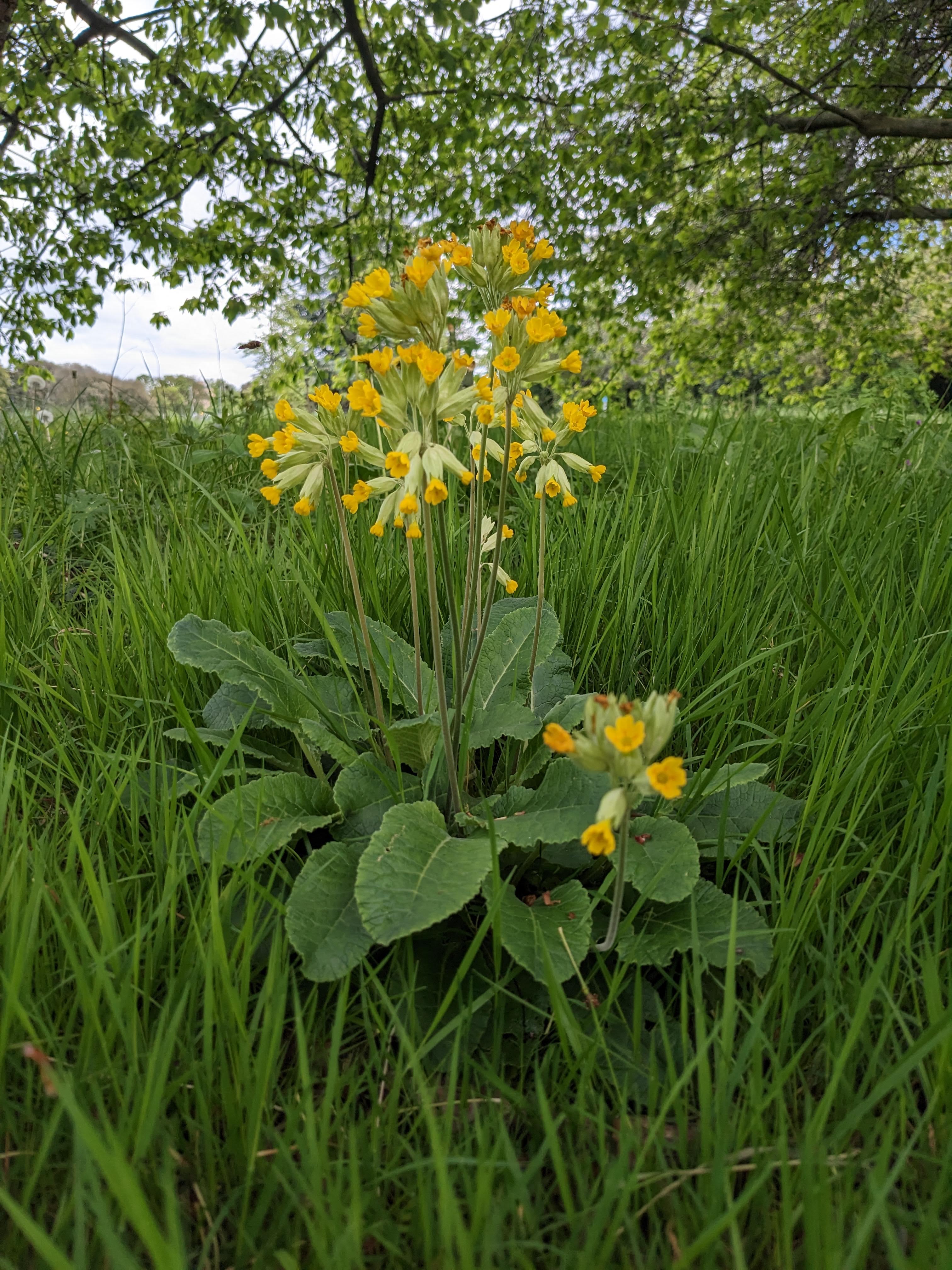
I love the flower shape of the primulas, especially the tall primulas. Traveling in Japan in 2017 I noticed many candelabra primulas in pots outside houses, especially in cities. Cowslips are the closest I’ve come to them on this island. Apparently these flowers are protected in Northern Ireland, but not here, where they still appear in the landscape. The captive primulas in Japan were mostly magenta, pink, orange-pink, and white, and stood upright on slender stems. Some had their flowers arranged in spheres; others (the candelabras) in wheels, one above the last. I do not have a garden—not even a city garden like the Tokyo gardeners who made excellent use of the narrow space at their doorsteps with pots and risers of all kinds—but when I do I would like to grow primulas. So the flower is in three kinds of time for me: the present (where I see the cowslips in the grass); the past (where it sends me to the synonym-formed Primula beesiana); and the future (where I imagine, one day, being able to grow these flowers myself).
Summer in the cowslip and the iris, the brassica escaped from field plantings, and the tiny ball-shaped creeping clover flowers. Everything is going upward and outward as quickly as it can.
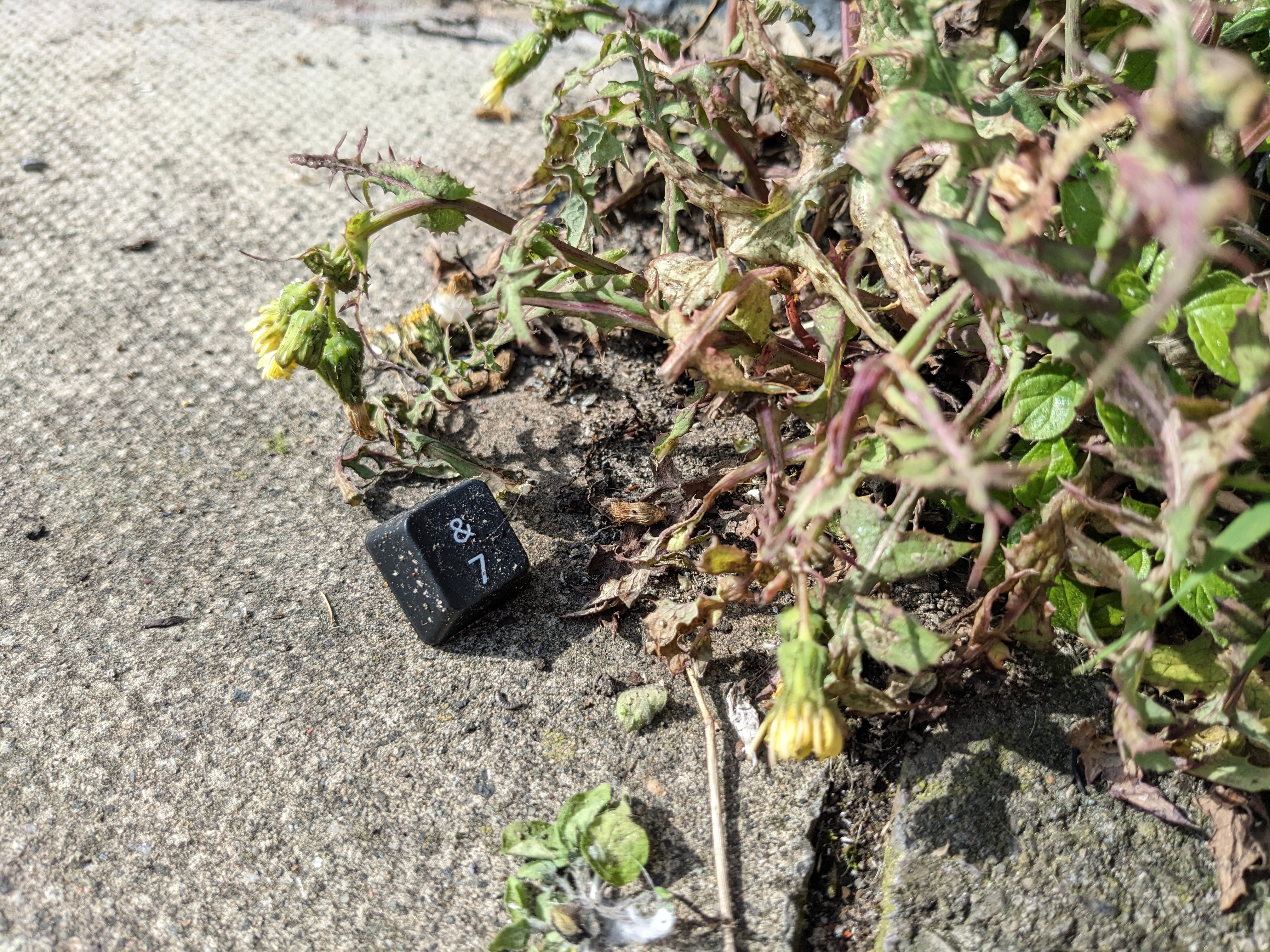
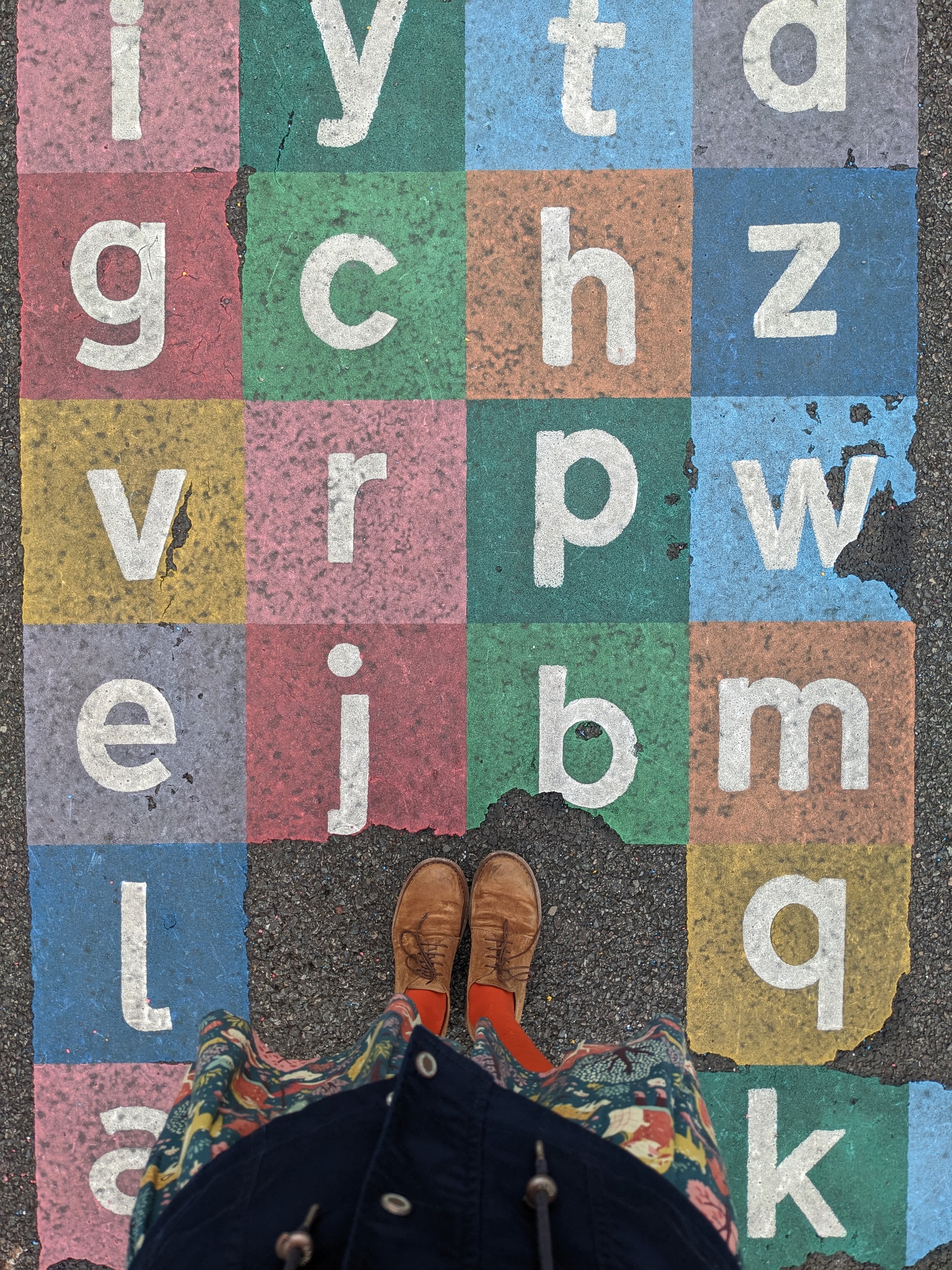
Also seen while walking recently: parts of the world-alphabet. An and and a seven. And a groundsel and an and and a seven.
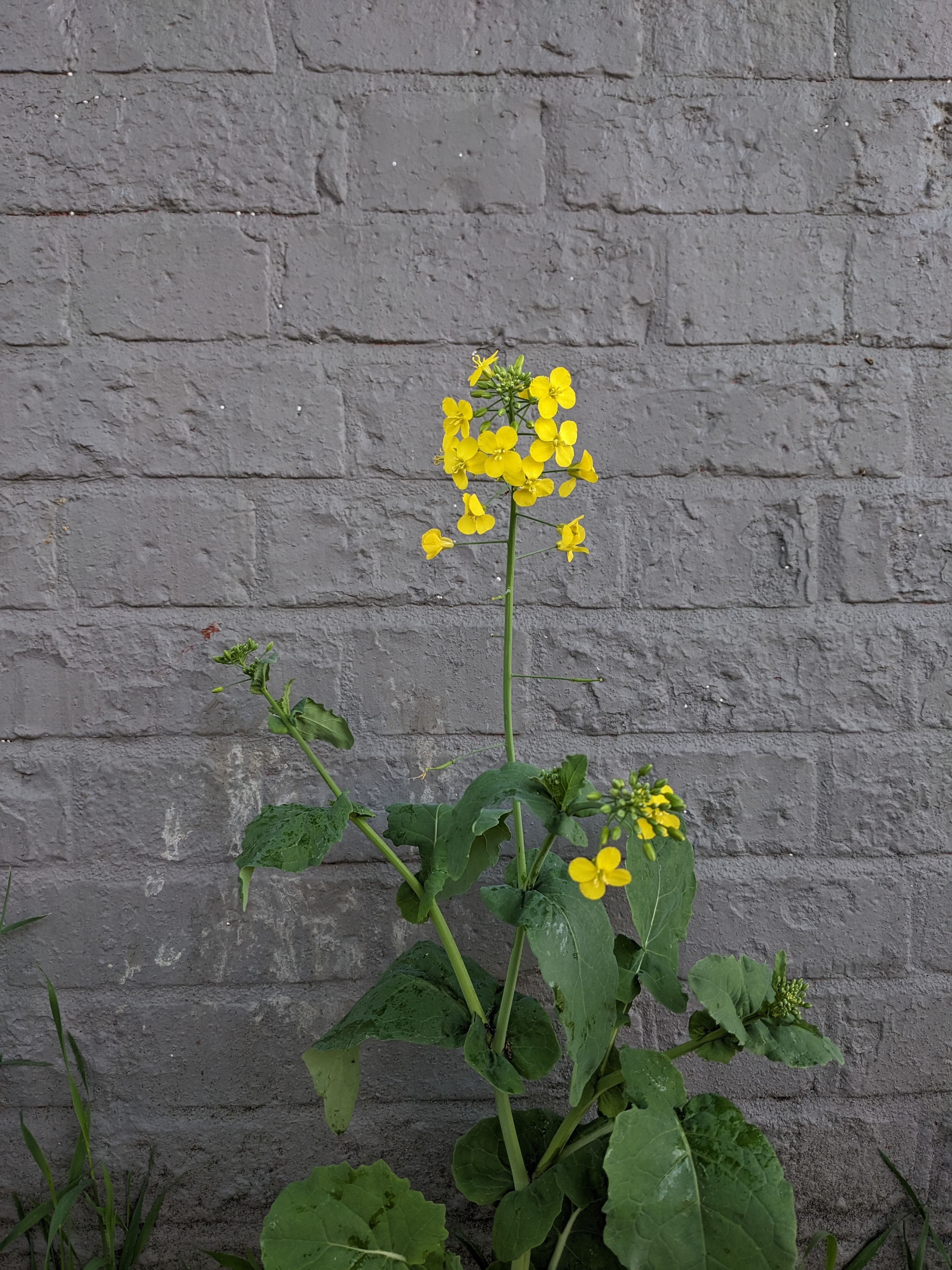
And a glorious brassica against a gray wall—that electric yellow. These are everywhere. I don’t know for sure what they are called because I haven’t bothered to get really close and look at the flower structure. I think it could be Brassica nabus, which would make sense—there are fields of it in flower now.
When I write about the world I walk through, I am conscious that the movement of my thoughts is sometimes “one thing after another”, rather than how I think it ought to be (in order to be ‘real thinking), which is “one thing, and then another, and then a return to clarify the relationship between one thing and the next”. Sometimes I realize this difference from my internal picture of “good writing” or “real thinking” with shame or self-doubt (“am I doing this correctly?” “why can’t I do this correctly?”). But first of all, difference from a norm is the mark of the voice or hand. That’s a characteristic of artmaking. And second of all, there are many shapes for thinking, like there are many kinds of tempo, movement, direction. We step into the arrangement of things and take note.
The title of this space comes from Fanny Howe’s essay “Bewilderment”, in The Wedding Dress: Meditations on Word and Life. In this essay, Howe writes that bewilderment is “an ethics and an aesthetics”, or “a way of entering the day as much as the work”. Bewilderment has been a guiding question for me since first encountering Howe’s essay almost twenty years ago. A process that interrupts established ways of navigating, bewilderment inverts value systems, breaks our compasses—not only in writing, but in our daily lives (as if we could ever really separate the two). Bewilderment is also an effect: for me, the effect of close attention that can result in a radical subversion of my assumptions about what matters, what can interest me, how I’m connected to what’s around me, and what “around me” even means.
I have always been a person for whom writing is one thing among others: a part of life that goes on, like breathing, during the everything else of my days. Washing dishes, walking to the bus stop, buying groceries, being with others, teaching and other paid work, sewing, doing philosophy, caring for my family—all these are threaded through the part of me that writes, and the writing part is threaded through all of these. Howe’s idea of bewilderment has led me to think about writing and living (making clothes, meals, rooms; working for pay; relating to other beings, to ideas, to objects and texts and images, and to places) as processes where questioning my received understandings—my pictures of a world that “just is”—is primary, the groundwork for both writing and living.
So in this space, I’ll think about—and invite others to think about—what Frank Bidart means when he writes that “being is making: not only large things, a family, a book, a business: but the shape we give this afternoon, a conversation between two friends, a meal”. Our ordinary lives, where the biggest questions of meaning—what justice looks like; what liberation is; how to live together; what art means—show up in patchwork ways. Our work: to live them and to make art of them, to bewilder ourselves in the living of them, to make (in Toni Cade Bambara’s words), “revolution irresistible”.
Posts will go up on Sundays, beginning March 5, 2023. Here’s what you can expect:
Once a month, a new piece of writing from me: thinking about art, writing, ordinary life.
Once a month, an older piece of writing from me, sometimes republished from elsewhere, and sometimes drawn from a stock of drafts.
Once a month, a feature called [while washing the dishes]: notes on things I’ve encountered that you might like—music, images, bits of text, objects, places. Short reviews, possibly.
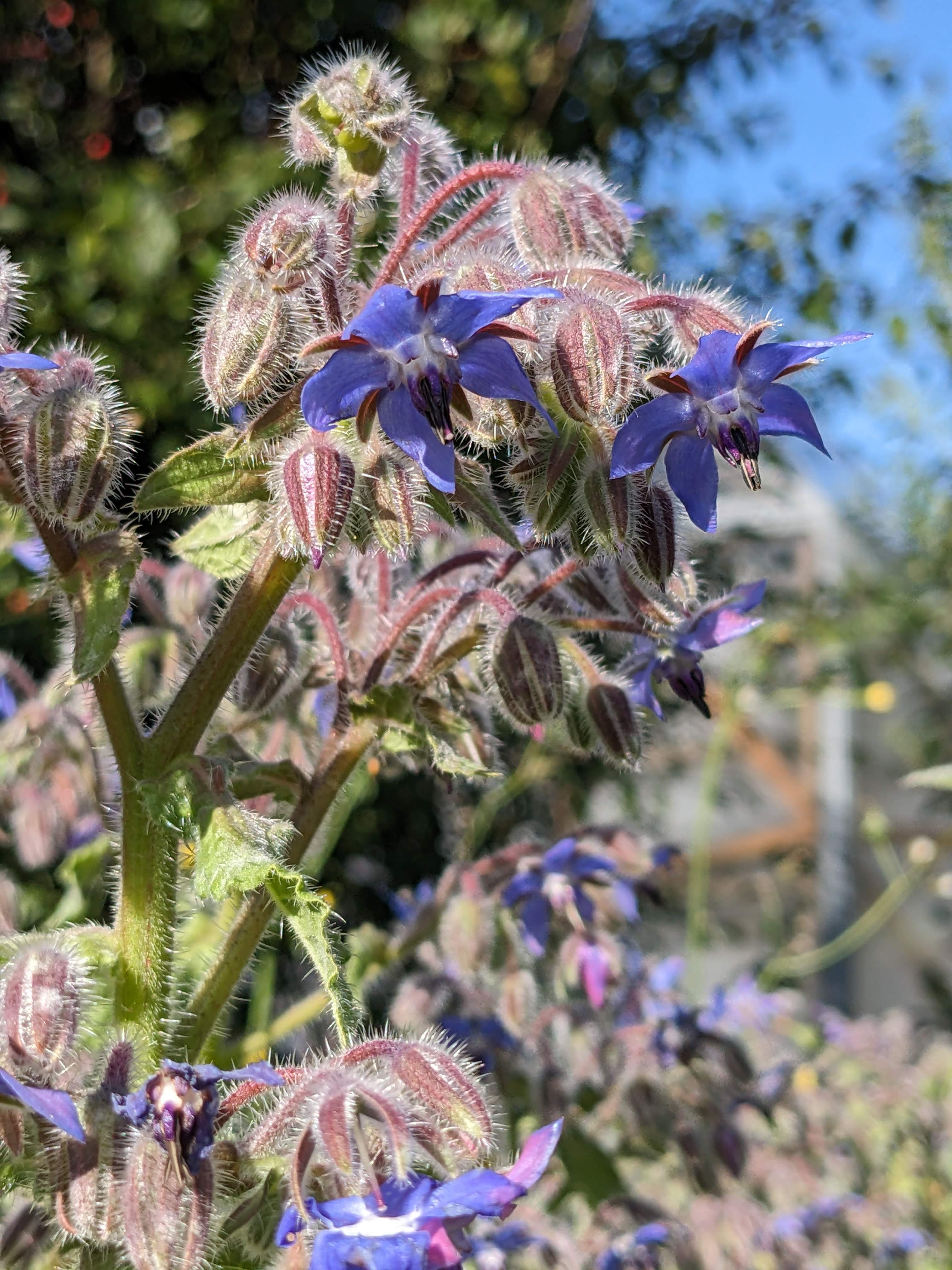
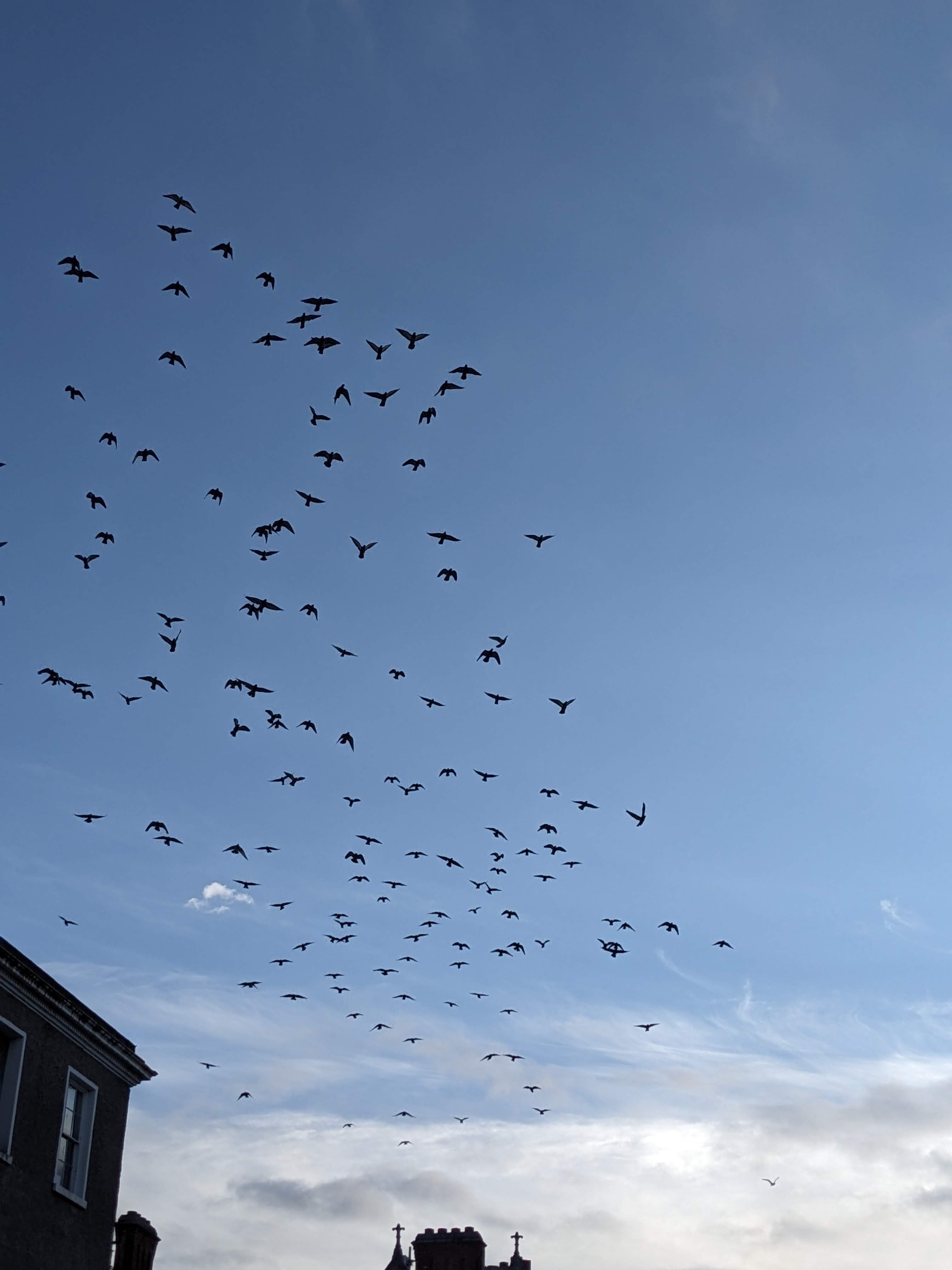
Once a month, a feature called [while walking], a collection of photos from my transit through Dublin on the way to work and my passage through our neighborhood while doing errands or just walking.
Every so often, an essay from a guest contributor. More on that soon.
Bewilderment (every sense of that word!) is free. Eventually, what’s posted here will be available as a print quarterly, and older essays will be hidden as they appear in print. Information about the print quarterly (cost, subscription details) will be available later this year. If you enjoy what you read, please feel welcome to share it with others.
And finally, a little about me: I’m a writer and an artist working across performance, installation, and social practice, all of which draw on a longstanding practice of observation and drawing. I’m especially interested in time: duration, seasonality, repetition and cycle, and time itself (what it is, how it’s made or measured, how we know, how time and culture cross). My work is attentive to and deeply curious about form—social form, literary form (received and invented), botanical form (plant structures). I link both time and form to place, especially hyperlocal place, and the way patterns of time and form can lead us to knowledge and wonder in our most near-to-hand places. Finally, I’m interested in the human scale: the hand, the foot, the eye, and how this scale can teach us about living with one another and in the world.
![[while walking]](https://bewilderment.ohbara.com/wp-content/uploads/2023/10/Screenshot-2026-03-13-at-17.01.13.png)
![[while walking]](https://bewilderment.ohbara.com/wp-content/uploads/2023/08/Screenshot-2026-03-15-at-09.24.27.png)
![[while walking]](https://bewilderment.ohbara.com/wp-content/uploads/2023/07/Screenshot-2026-03-15-at-09.26.59.png)
![[while walking]](https://bewilderment.ohbara.com/wp-content/uploads/2023/07/Screenshot-2026-03-15-at-09.30.51.png)
![[while walking]](https://bewilderment.ohbara.com/wp-content/uploads/2023/06/Screenshot-2026-03-15-at-09.33.39.png)
![[while walking]](https://bewilderment.ohbara.com/wp-content/uploads/2023/05/Screenshot-2026-03-15-at-09.36.09.png)