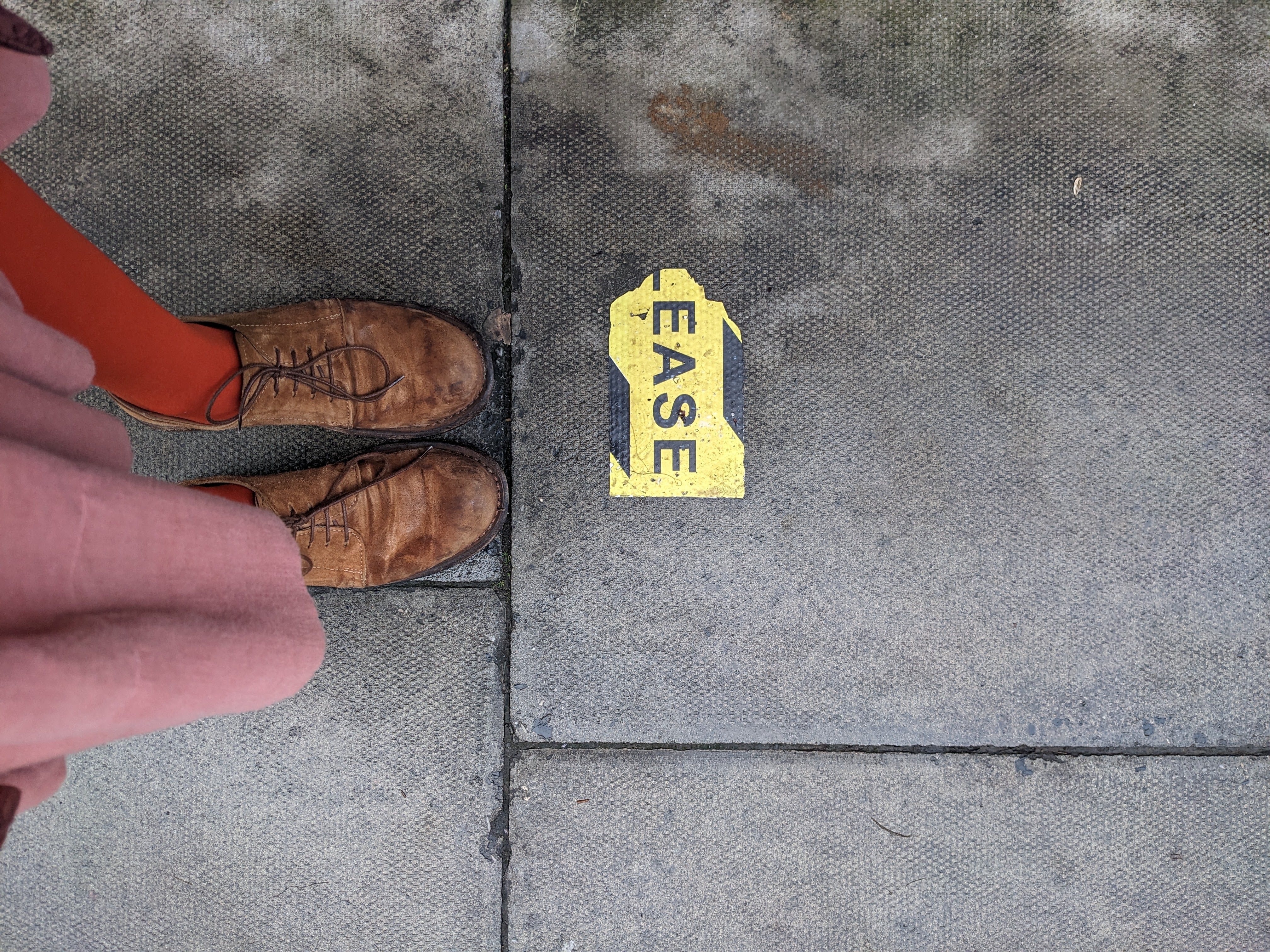
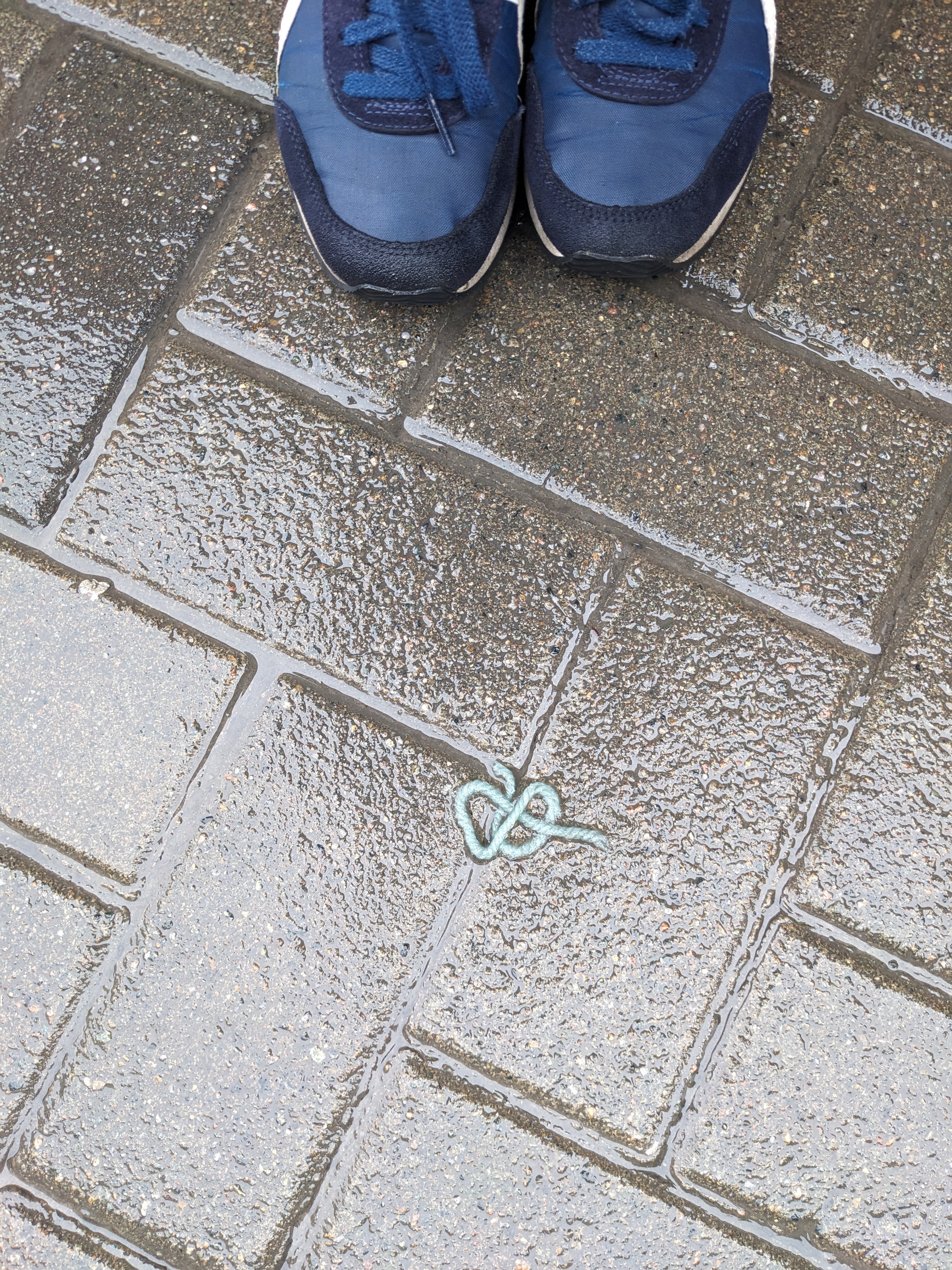
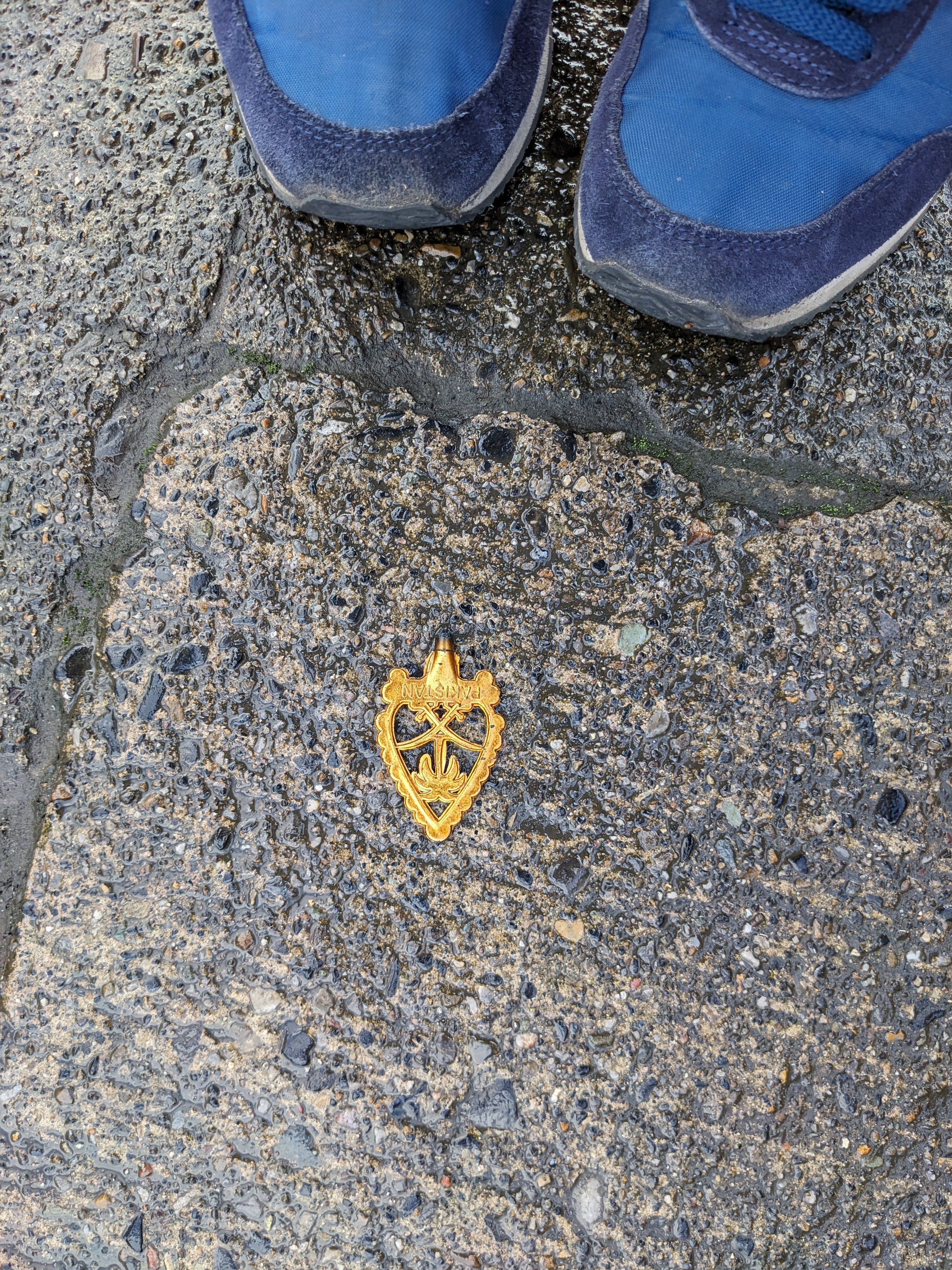
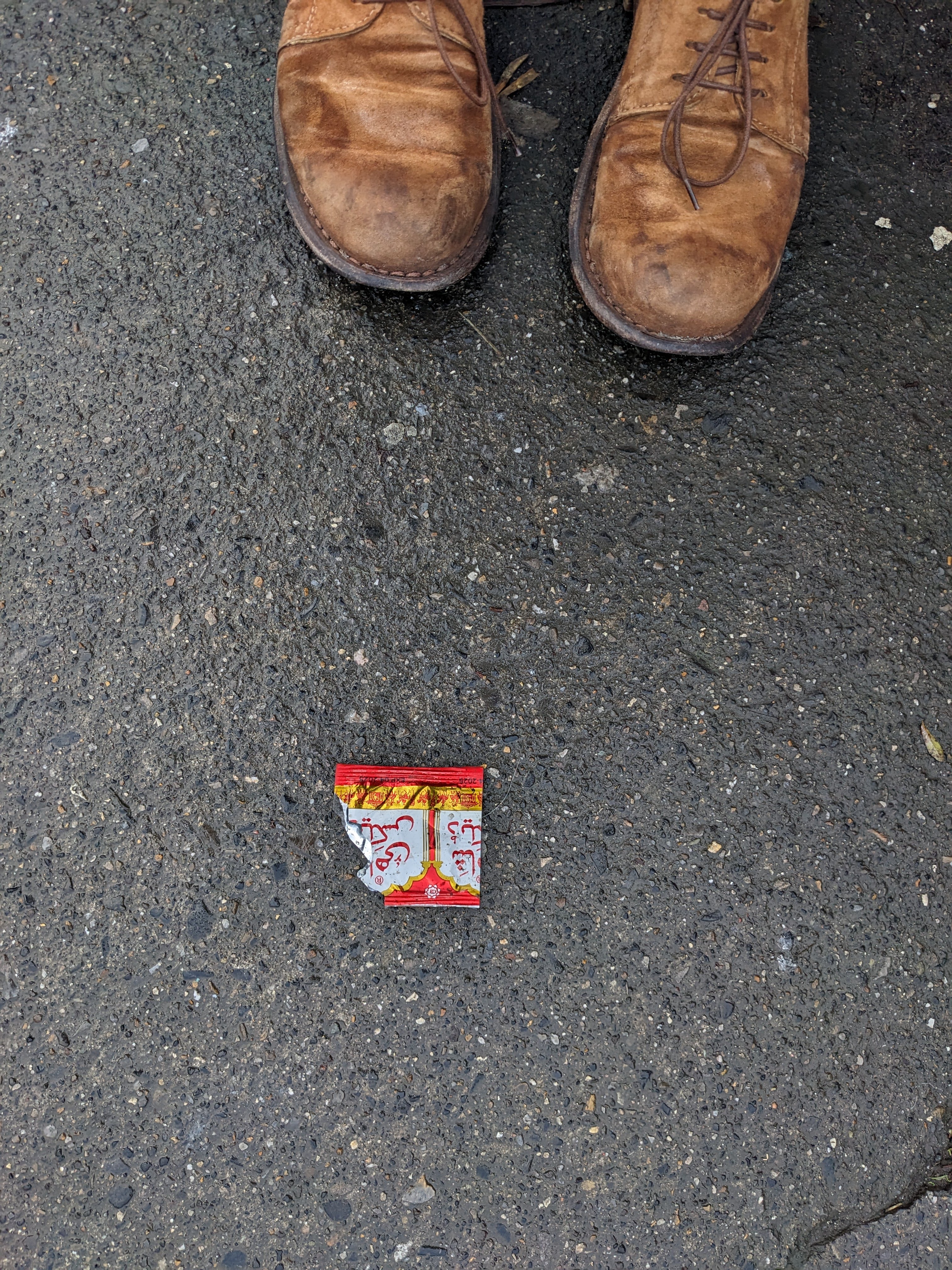
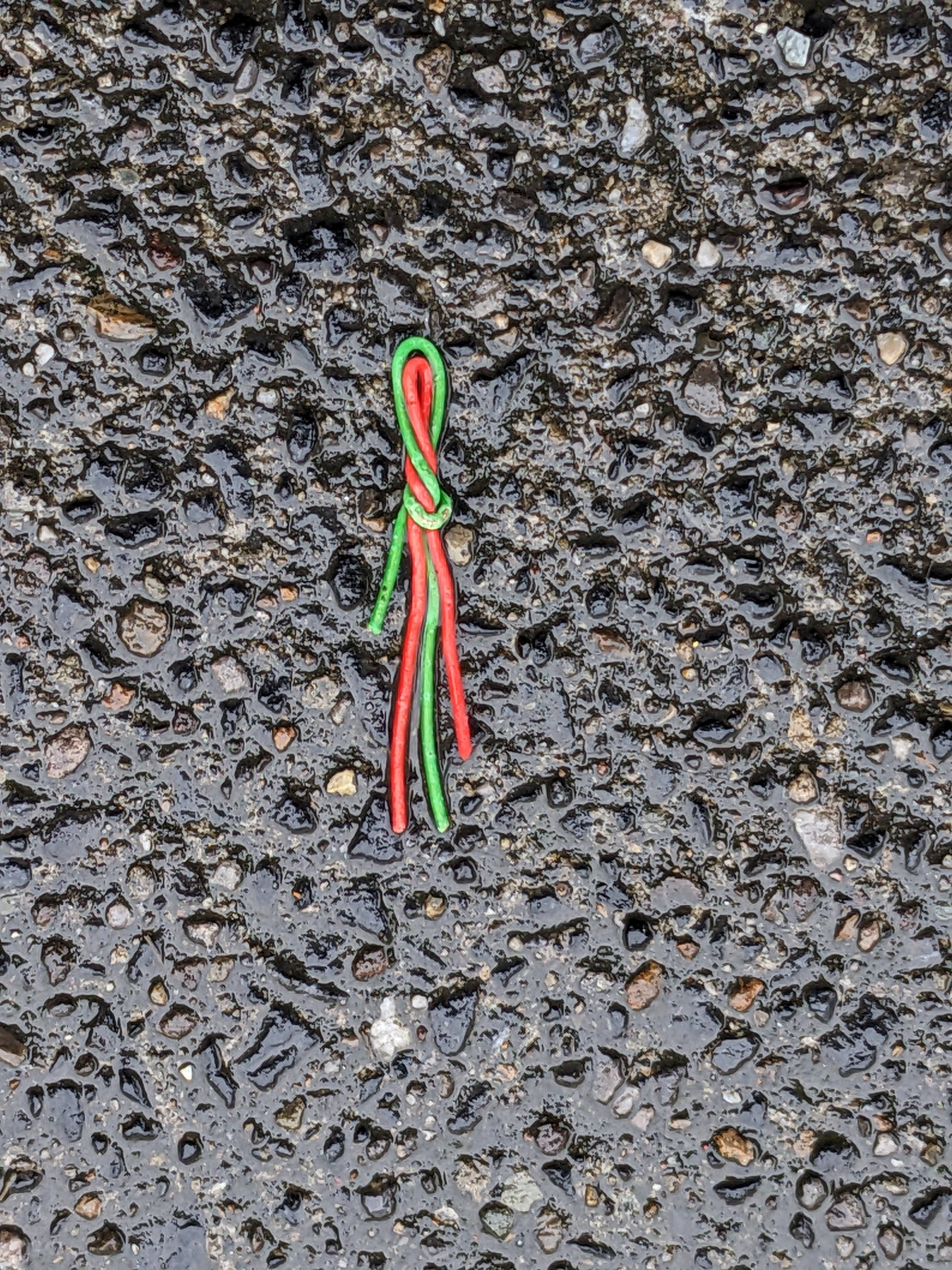
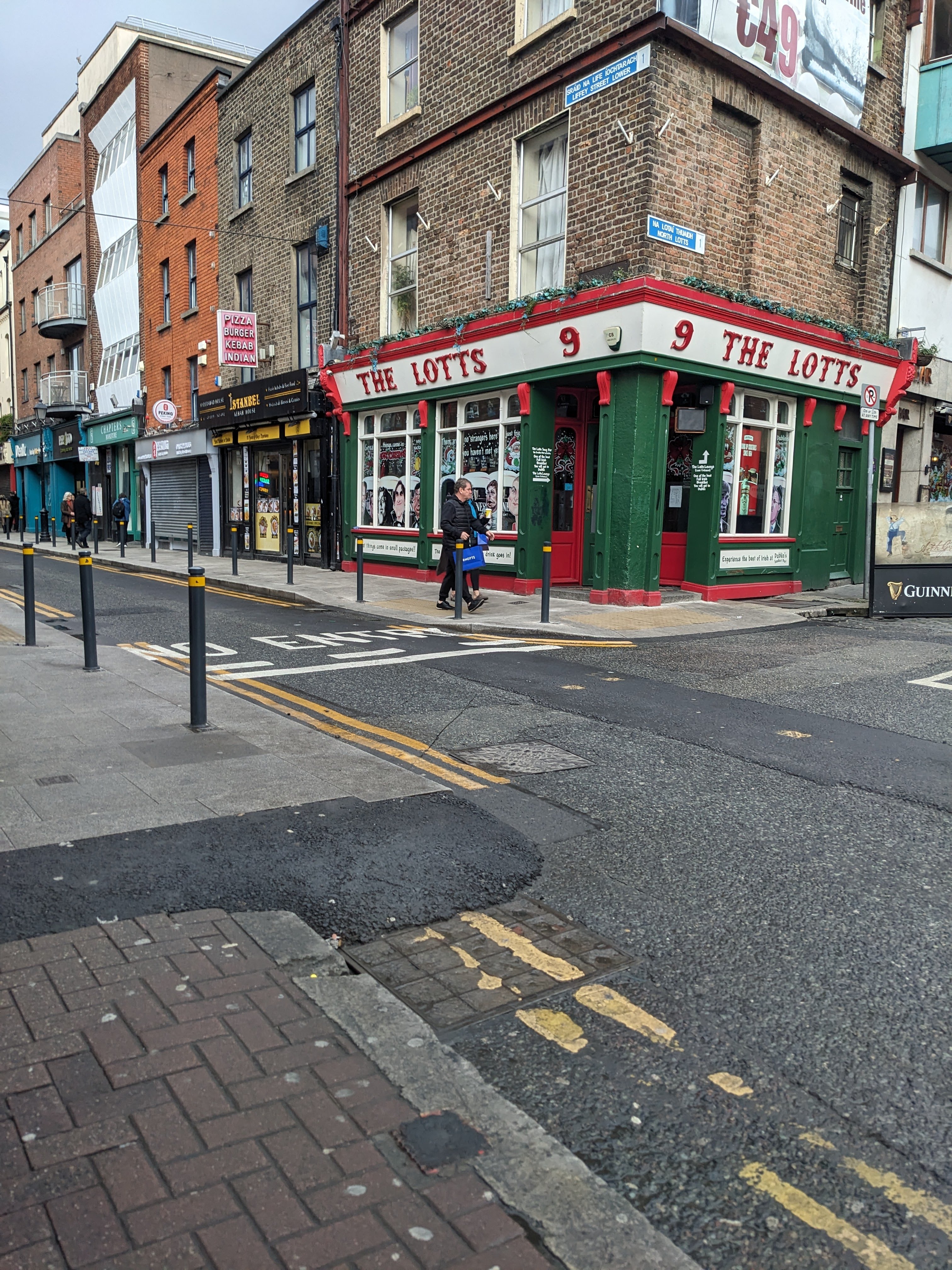
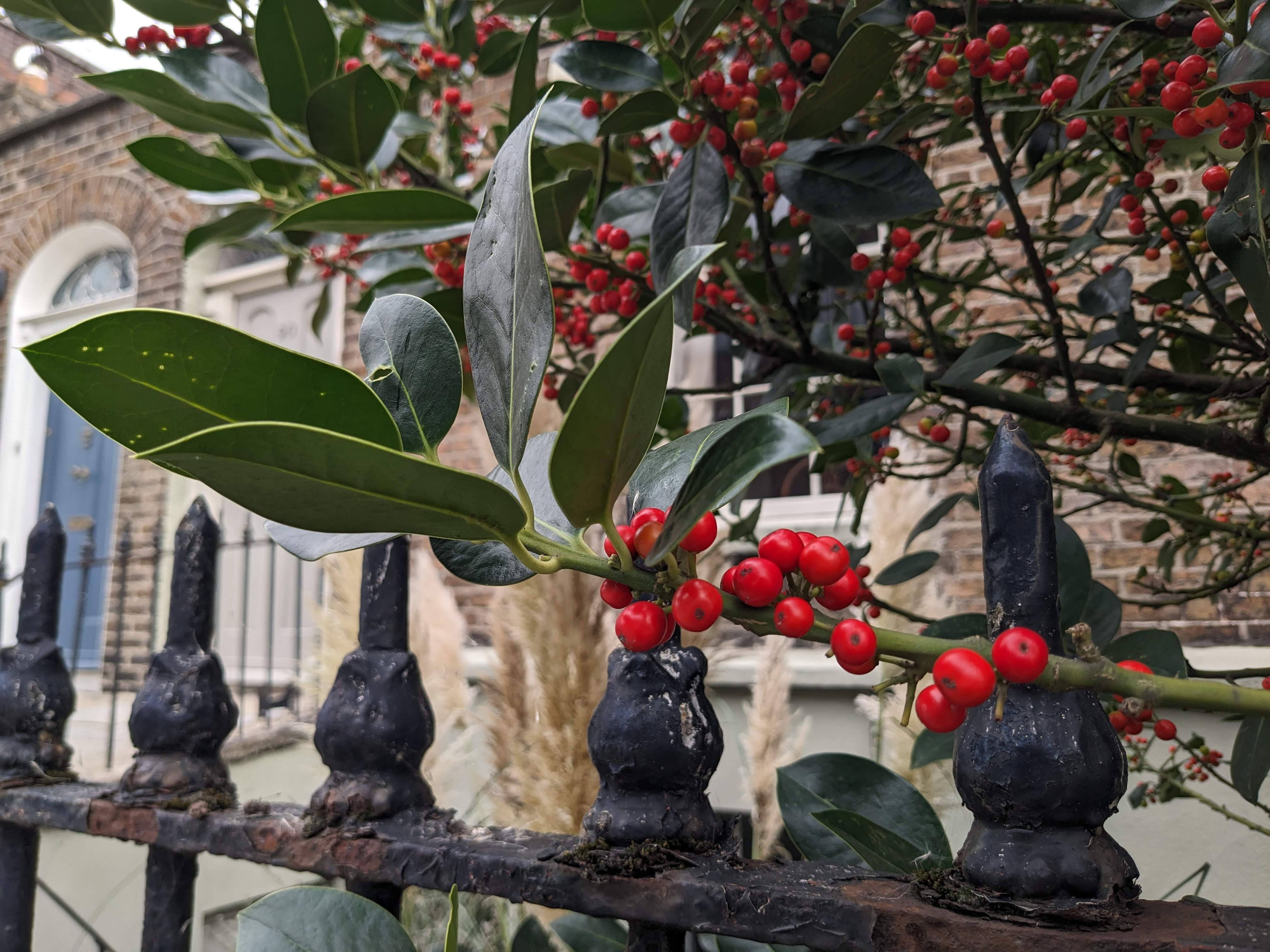
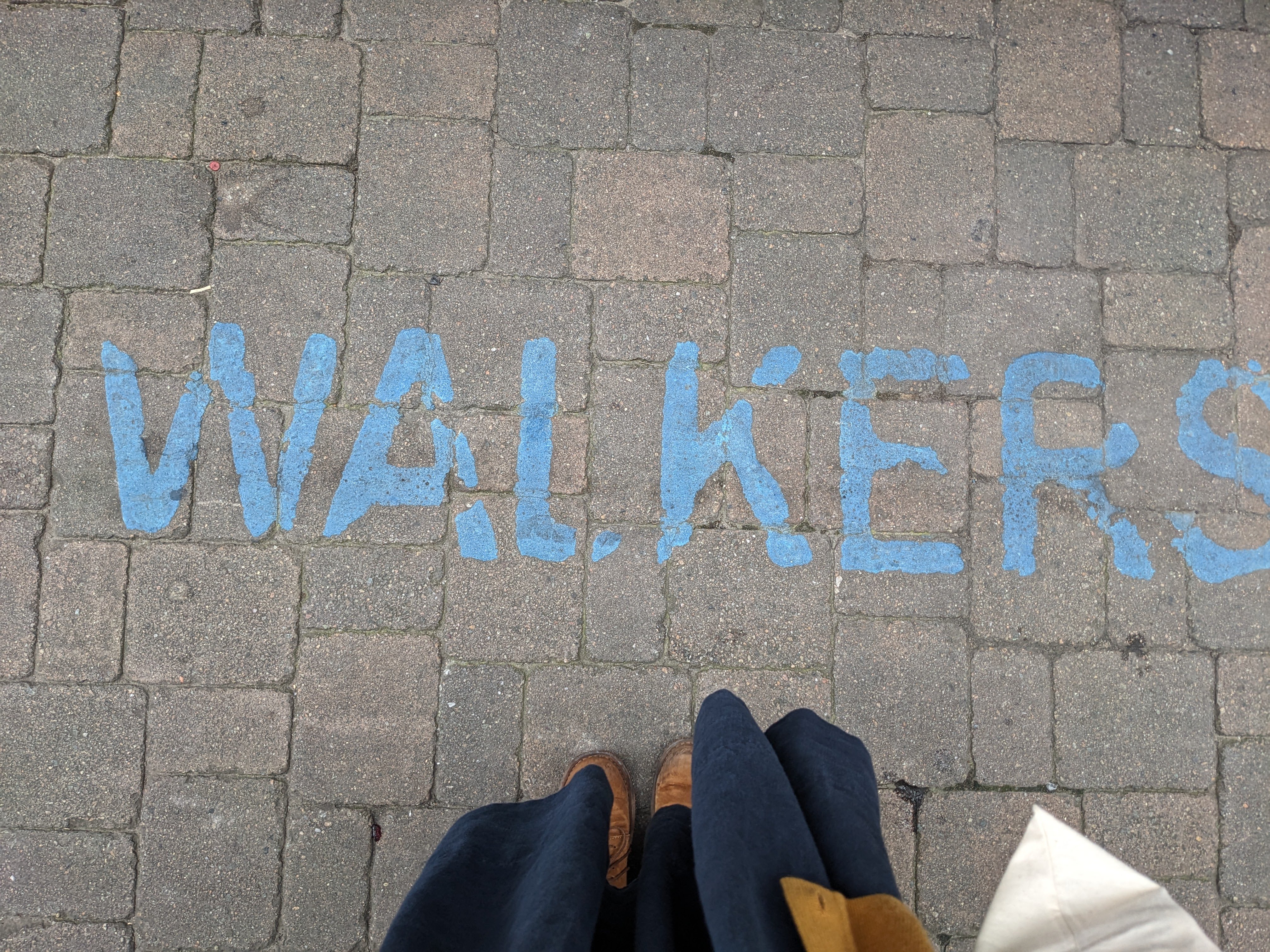
When my mother visited us in December, I realized (again, again) how much more there was to see than I had been seeing. She walks looking down because of chronic vertigo that is worse if she looks around as she walks. I must have assumed there wasn’t much to see down on the ground because I was worried she “wouldn’t see anything”—but then she started asking me to take pictures of all the different grates, grilles, iron utility and manhole covers, so she could remember her time in Dublin. So yes, once again I was confronted with the fact that there is nothing beneath notice, not to mention that there are as many ways of seeing and experiencing the world as there are people. The past few weeks, I have been trying not only to see but to really look at and record the things at my feet.
Project take-nothing-for-granted continues to encompass more and more of the world, revealing as it does more and more of the complexity of places I feel I already know, even know past exhaustion. Is there really anything left to see here? To care about? To be surprised by? I realized recently that I am tired of the places I’ve spent the past 18 months walking. They have begun to feel spent. I’m used to them. I can predict the patterns of garbage and the timings of flowers. Wrong again? Oh ho ho ho ho the world says. Look more closely. Have you seen this yet? You might be surprised at what you’ve missed.
I’m not making it up; it’s true that there is always more to see, care about, be interested in, even if I don’t feel like it (not infrequently the case; feeling like it takes a lot of energy). Also, I didn’t come to this on my own. I’ll cite one source, though there are many (some here): Georges Perec’s An Attempt at Exhausting a Place in Paris, which I read in Mark Lowenthal’s English translation in 2019 (order a copy here with free US shipping; Wikipedia article here; Archive.org copy available to borrow here; on WorldCat at a library near you? find out here). In this book, for a hundred pages or so, a man sits at the same café on the same corner for three days, and the same things happen—pedestrians, shopkeepers, buses, pigeons. I found it absolutely delightful. A model for writing and artmaking, and most of all a model for being alive.
Paris is Paris, and Dublin is Dublin. Would I get used to Paris? Well I got used to other beautiful places, so I am guessing I would. Work, commuting, the ordinary activities of daily life like groceries and cleaning—they happen, and happen to tire me out, wherever I am. Sometimes I just don’t want to be walking eastward along the Grand Canal on yet another morning. Over time maybe even the Place St-Sulpice might seem worn-in. Then what? Good to sit at a café and watch all the buses pass by. Good to walk through the Liberties, down Meath Street, past the butcher again, take a look at the pork kidneys, take a look at the mackerel, silver in their stainless steel containers in the window. In Leopold Bloom’s city as in Perec’s, a lot of nothing happens and the repetition of all that nothing turns out to be beautiful, weird, funny, interesting. One stitch at a time.
What else is there to say? Our ordinary lives are all we have.
Necessary Fiction has a newsletter now and it is like getting a magazine you will actually enjoy, once a week. Timothy Otte reviewsSeriously Well by Helge Torvund (translated by the author); I’d read a review like this every week.
A woman I followed on Twitter since the very earliest days died this week. Her name was Shafiqah Hudson, and she made the hashtag #yourslipisshowing and did so much work around misinformation online. I can’t believe she has died. You can read about her in context here and here. I’m not sure what to do with this kind of loss—someone I didn’t know but whom I read for many years—but her work mattered to me and I know it mattered to many others. And now you know her name too.
We can send UNRWA some money here for the ordinary lives of people in Gaza.
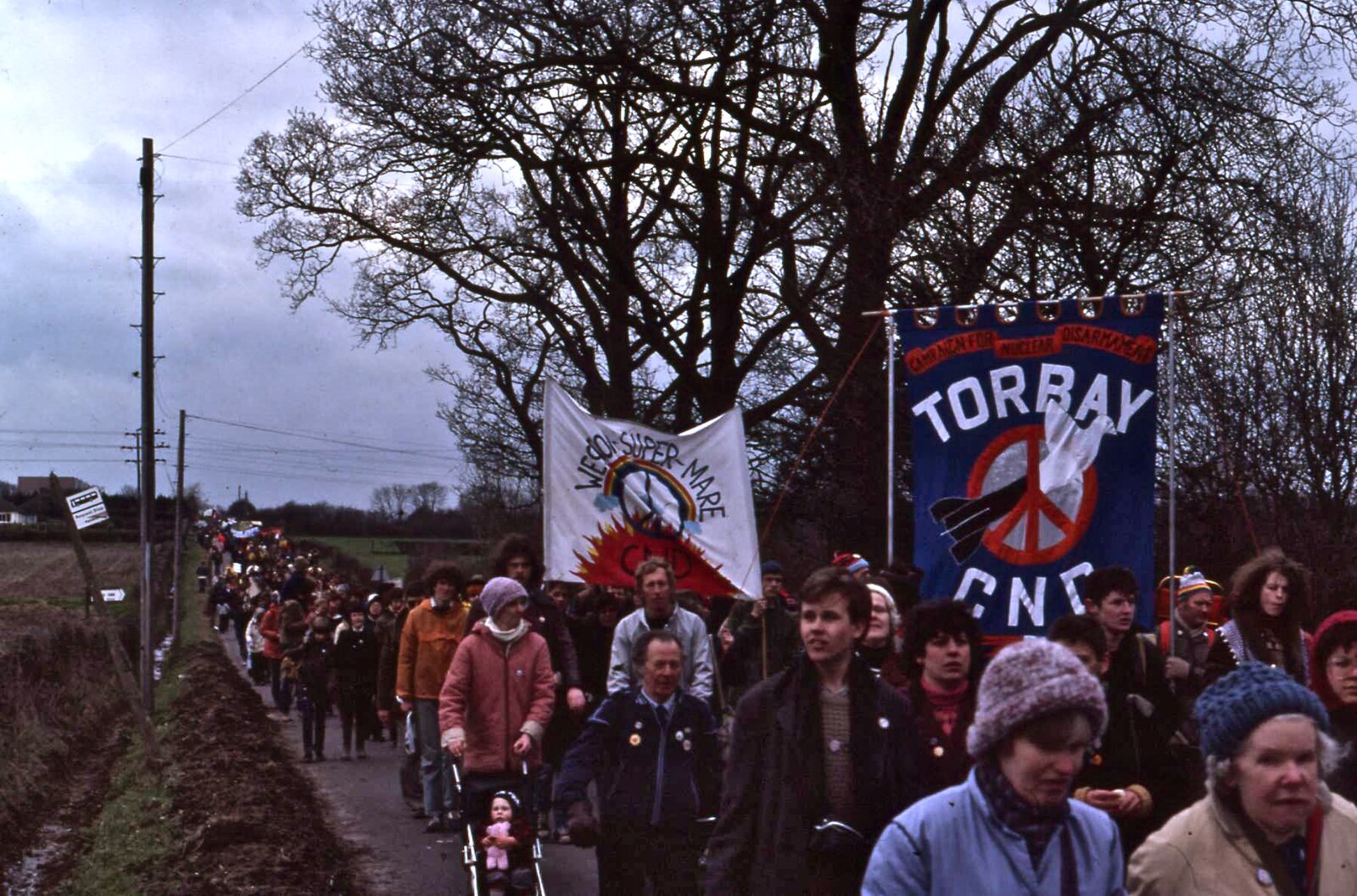
In my earliest memories we are walking together. We are walking together along the sidewalk, wall on one side, street on the other. We are carrying banners. We are carrying signs. We are in strollers or pushing strollers; we are carrying babies. We have mobility aids, we are using wheelchairs, we are helping one another walk, we are striding forward with the people we love and with people we don’t know. We are under the white-gray sky of an upper Midwest January, and it is ten degrees below zero Fahrenheit and it is too cold to snow and here we are: walking. We are walking toward the state capitol building, all of us, together, hundreds of people, sometimes thousands of people. We do this over and over, weekly, monthly, for years. We do it despite the fact that there is no directly attributable change because of it. We show up and we walk together. It is cold, it is uncomfortable, it can be tiresome, there are more immediately pleasurable things to do. But once we get close, once we hear the crowd and see the banners and the signs, we know again: there is no better place to be.
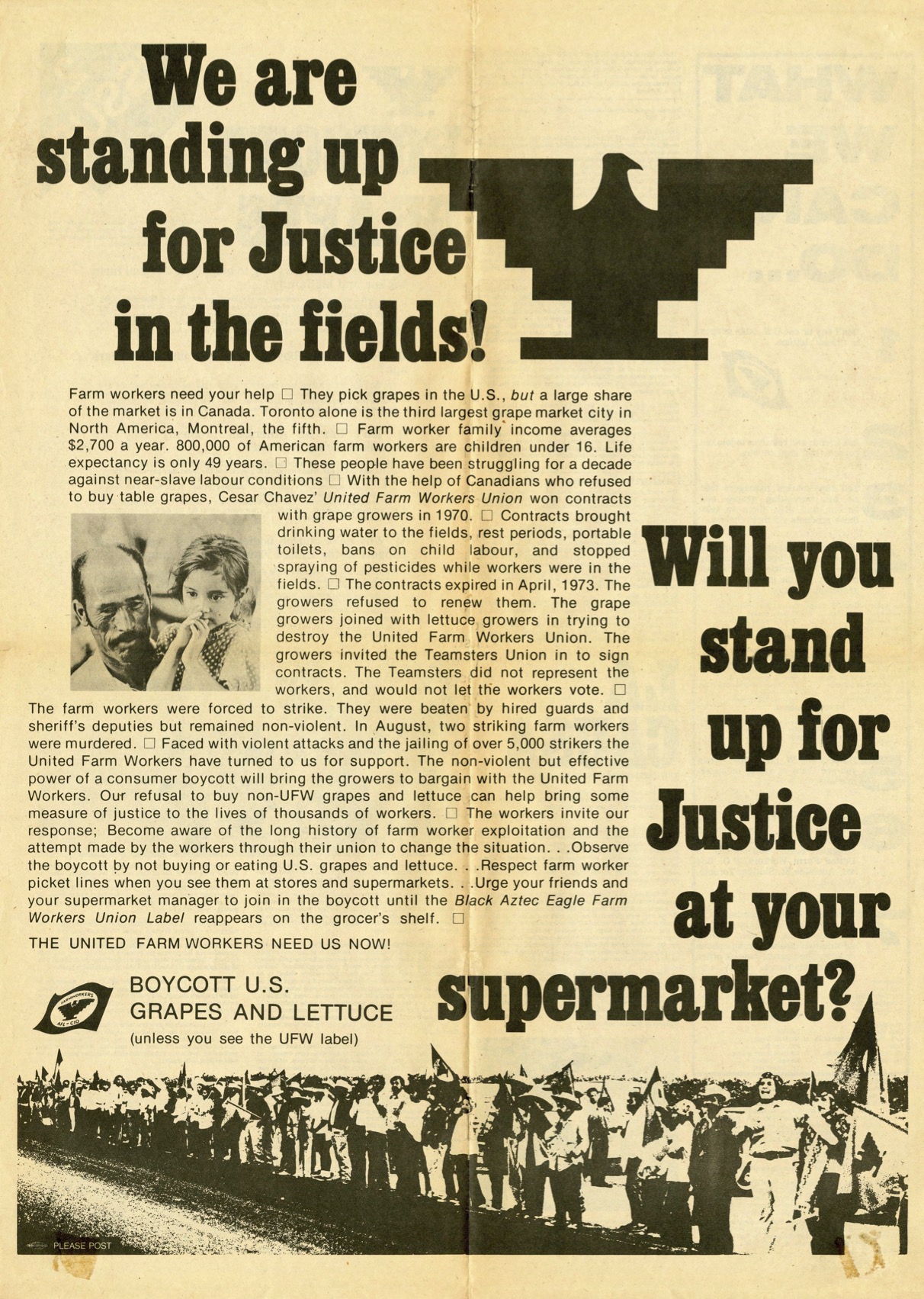
Nuclear freeze marches and rallies. Grape and lettuce boycotts. Chocolate and formula and cereal boycotts. Women holding anti-war signs every week for decades on a bridge over the Mississippi River. Nuns jailed for protesting torture schools funded and exported by the US government. Teenagers and elderly people blockading the driveways of the arms manufacturer. Teachers’ union strikes and farmworkers’ strikes, anti-apartheid strikes. Anti-war march after anti-war march. Free stores and soup suppers. Folk concerts at the local college and in the public park, in the train station. City buses and bicycle lanes. Student strikes, graduate teaching/research assistant strikes, university staff strikes. Occupy. Sleepouts with unhoused neighbors. Underground abortion networks and abortion funds. Act Up posters made on kitchen tables, zines reproduced at copy machines. Curb cuts at every corner, walk signs that we can hear as well as see.
If these actions do not appear on the map it is not because they don’t take place, it is because they do, but their accretion over time, the accretion of their effects over time, is minuscule and subversive and those effects weave themselves into the fabric of everyday life, such that it can be taken for granted that some of us now have weekends and the right to unionize, that certain pesticides and herbicides are banned, that some kinds of equitable access to buildings and institutions are available. And there is still time for more of these minute actions, for example because there are still workers whose hands prune apple trees in freezing January temperatures and who breathe in soot in summer fire season, and there are still new weapons being developed and tested. There is still work to do, and we are the ones to do it. And it is, still, “always too soon to go home”, words I take from Rebecca Solnit’s Hope in the Dark, her prismatic collection of essays on the ends and beginnings of the world. Does it sound like a lot of work? It is a lot of work, but we are a lot of people and we have our whole lives, every single minute of them, for it.
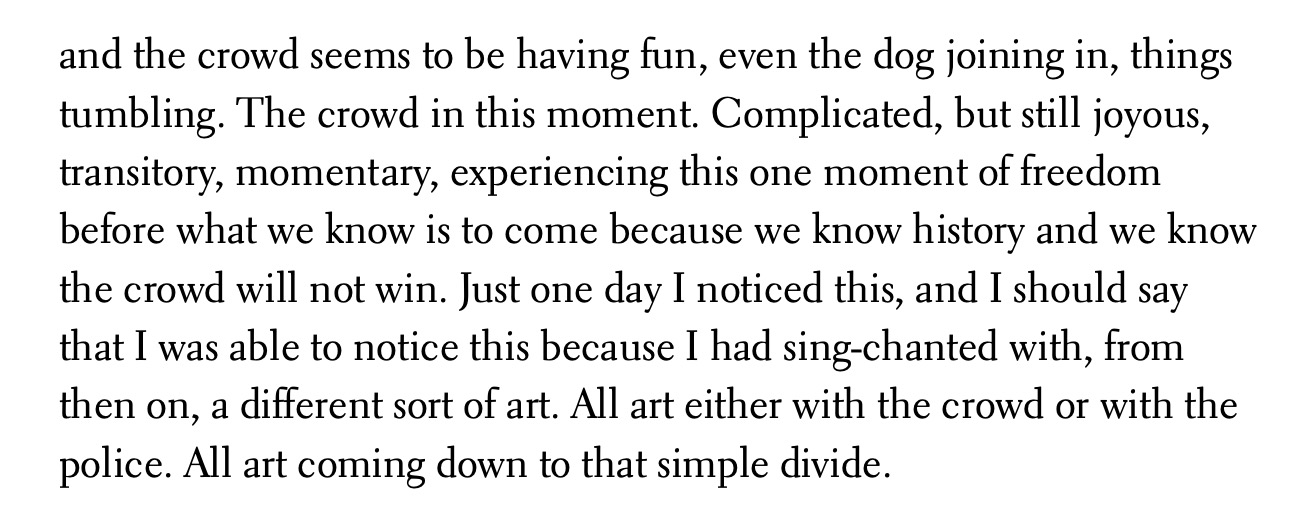
On the side of life is every action, no matter how small, that helps to make a rich life, a free life, possible for everyone, in concentric rings of solidarity and care. The rings say: we are involved with each other. You are mine; I am yours. The specifics are specific to our places, relationships, points in time, knowledge, needs and abilities. A general answer or a single strategy is unfit for the specifics of our lives—responses have to be worked out, over and over, in time and space, among and between us; the complex demands of living in this world with others require modesty and humility and patience and attention and ongoing work and a cheerfulness that is not optimism but a willingness to be honest about both history and the present. To me the guide is: does something make a rich life, free life, more possible, for more than only me? There are no heroic acts in this frame, no one-and-done solutions; there are only the tiny, continuous trueings of a compass both personal and social to the north star of no one is free until everyone is free.
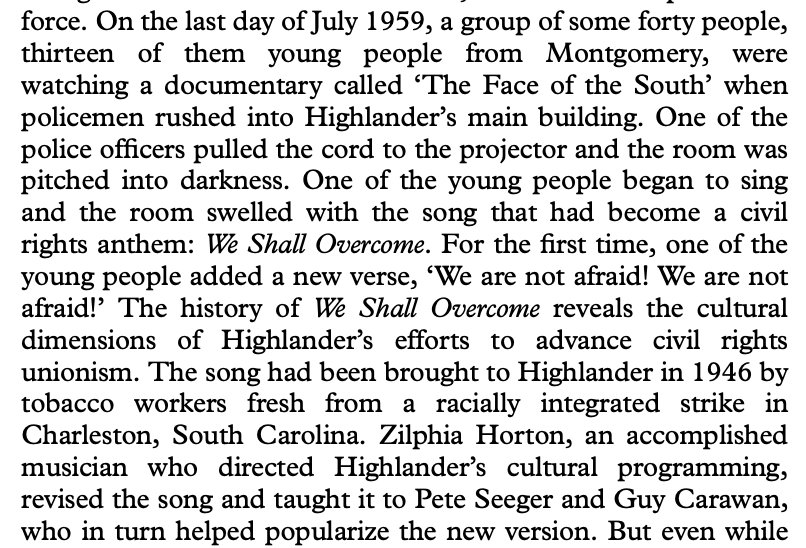
That is not a burden, that is a pleasure. That is meaningful work, a lifetime’s worth. That is a joy. That is freeing. That is why it makes sense to me that marches beget artwork, and artists appear at marches, why singing together at the protest feels good and dancing at the labor strike creates good feeling that translates into good action. That is why it surprises me when community care in the form of public mask-wearing gets framed as fear or even paranoia. I want to say, don’t you realize? The song has the words right in it! It couldn’t be clearer. We are not afraid.1 We are in love. The world and its people are the ones for us. Your grandmother is my grandmother. Your lungs are my lungs.
We are out here together, for one another, with every step in the bracing air, making every tiny refusal, hearing every “why would you do that when it doesn’t even matter”, saying, yes, in fact, it does matter; it does matter to refuse death as best I can—not for myself alone but for my neighbor, including the neighbor I don’t know or can’t see; saying yes, in fact, it does matter to make myself a tiny bit uncomfortable (January freeze march, Minnesota; never having a Nestlé candy bar in childhood; no grapes until adolescence; not crossing a picket line; Black Lives Matter pin bought in 2016 still on my bag despite the hot embarrassment I felt on my face when another white lady in the grocery store line said “isn’t that over?” in 2022; and yes, wearing a mask in public spaces right now—your responses may vary) if it makes someone else a tiny bit more comfortable or our life together a little more possible; saying yes, in fact, we are here together, breathing the same air, drinking the same water, walking on the same streets, waiting for the same bus; saying that the trees you prune become my bone and my blood, that the radioactivity falling from your sky after our missile test becomes the milk I give my children.
When we say, feed the hungry, we mean ourselves as well: we are the hungry. When we say, make a world where to be sick is not to be closed off from that world, we mean ourselves: we are the ones with bodies that can be ill, can be disabled; we are the ones who age. When we say no policewe mean anywhere. There is no other world, there is no other life, no other air, no other water. It is all between us. No time to waste in beginning together the work of worldmaking that is at hand. No work too small to matter, nothing so important it can’t be repeated again tomorrow. No need to wait before discovering the secret of joy.
To be clear, I’m by no means making an equivalence between the ongoing movement for Black civil rights in the US and the discomfort of being, often, the only person in a room of artists or scholars wearing a mask during an ongoing, airborne pandemic. These are not the same thing. But I have learned this framing—of joy, of solidarity, and of refusal of fear—from this movement among others. I have also learned to be skeptical of the demand to see a difference in focus among movements for a just, free, safe, healthy, and joyful life as indicative of disjunction between movements. And in fact, leaders of that civil rights movement saw clearly how things like nuclear arms were involved with, not separate from, voting, housing, dignified working conditions, access to public space, education, healthcare. This is all about our obligation to provide for one another a rich, free life.
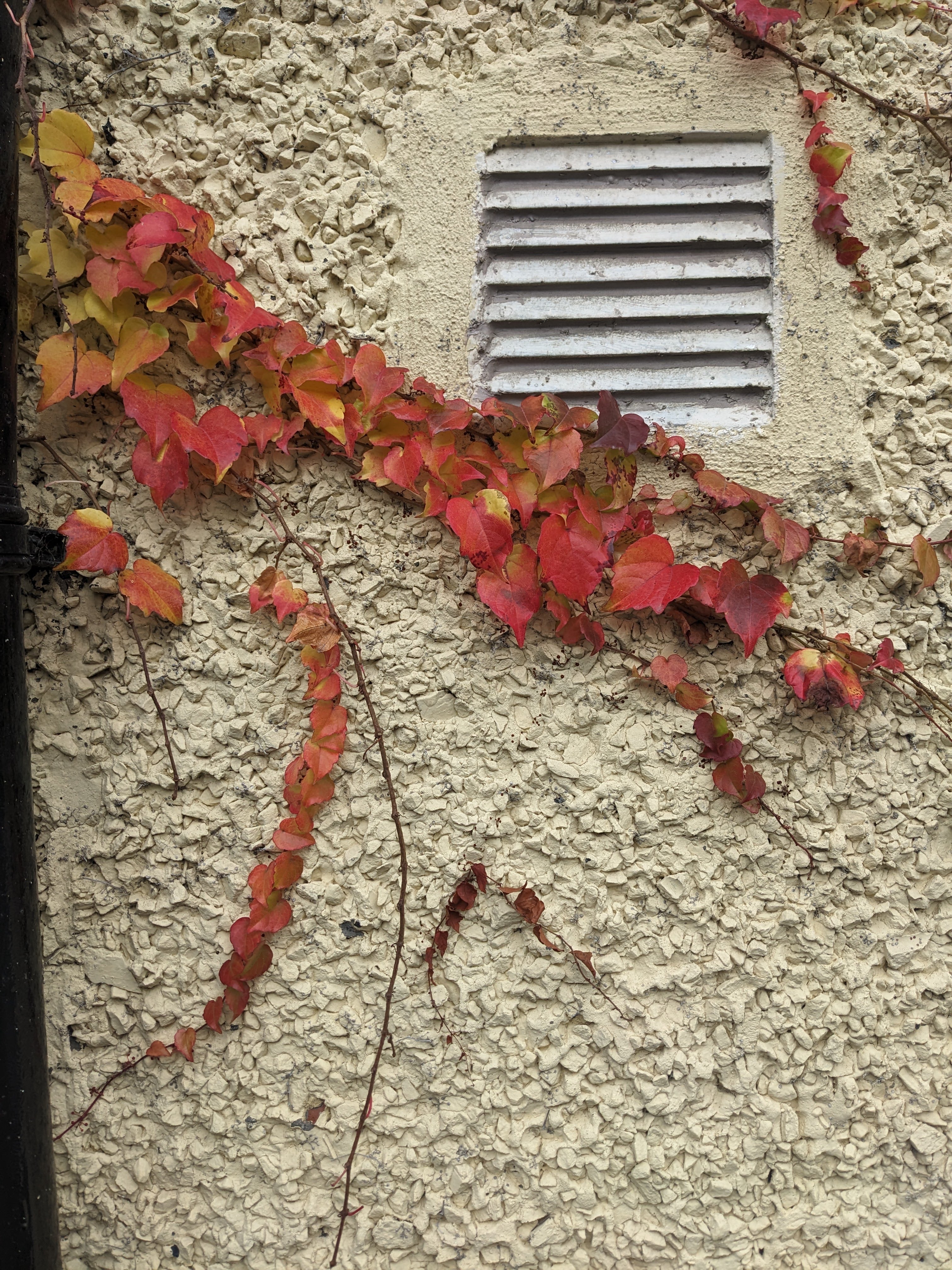
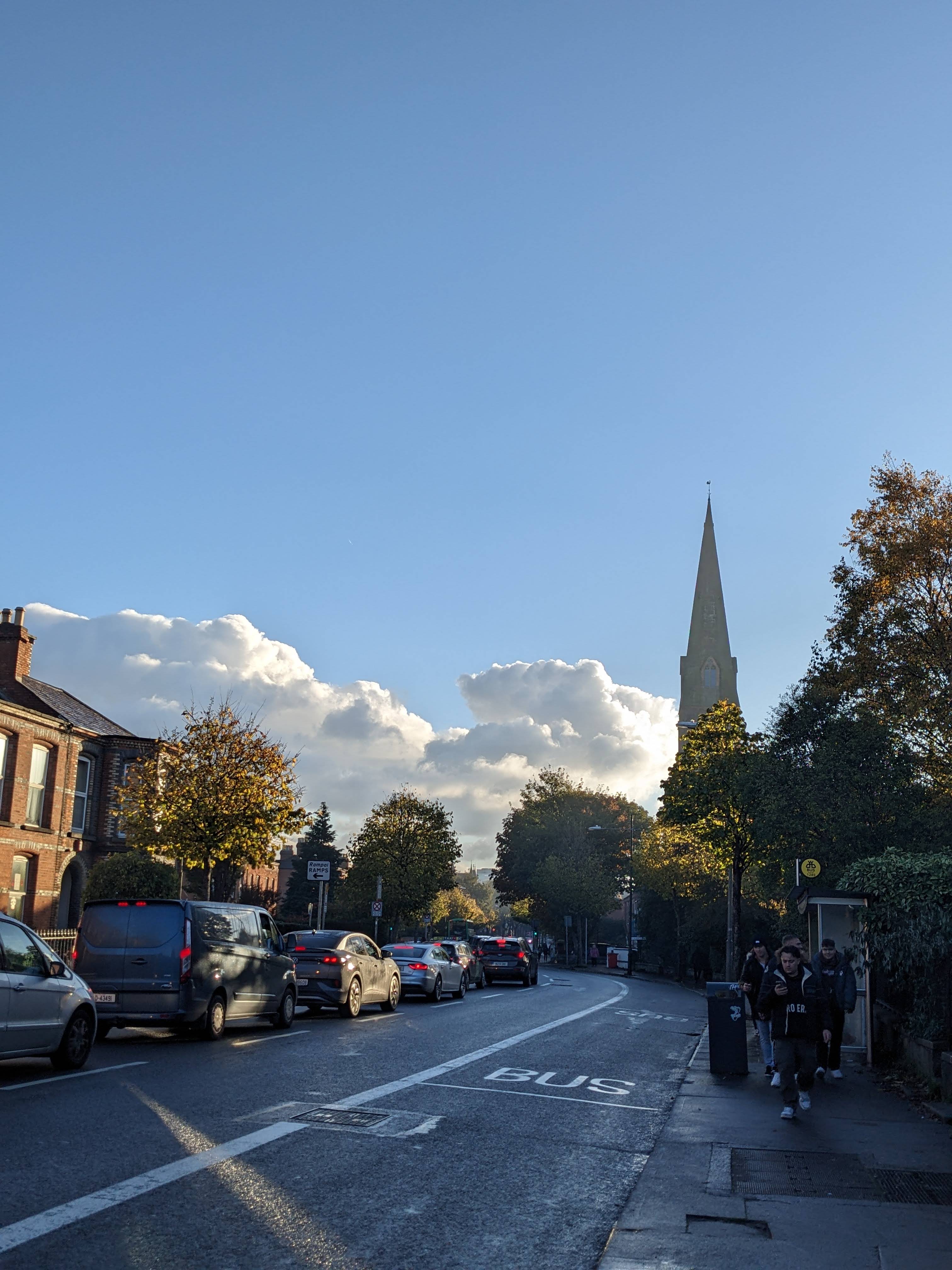
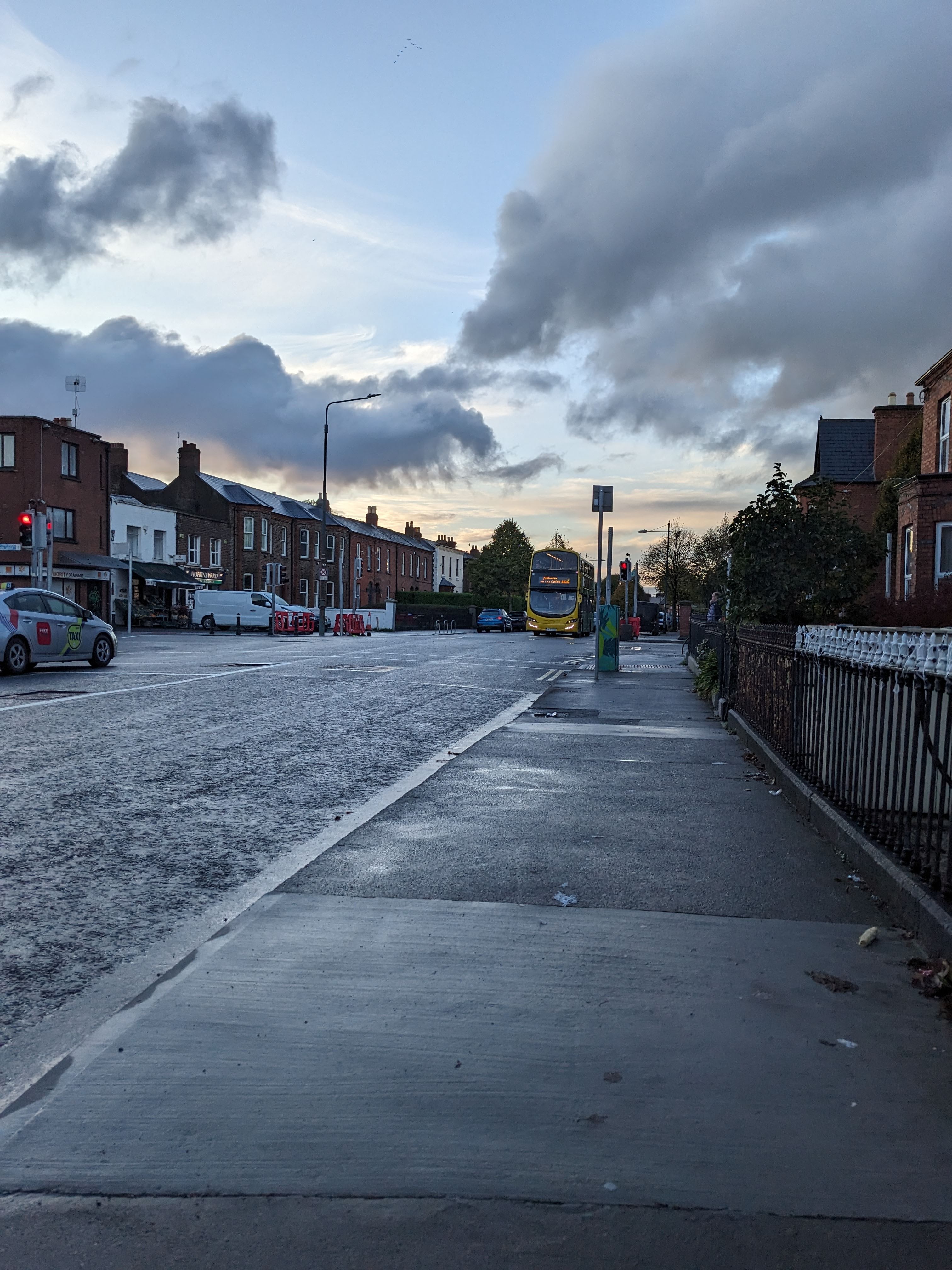
Three storms in the north Atlantic have taken most of the leaves off the sycamores and hazels. They lie in piles, some saturated with water and becoming compost quickly as foot commuters trample them. Some are swept up over the day, so I see them in the morning but walk home along a completely cleared path. Out the back window, the little birch tree is totally bare now. Its leaves were bright yellow—not gold as the hazels and sycamores were, but a cadmium yellow. Now the branches are revealed in their creaminess, outlined in peach that darkens to red. Through the big windows of the house across the back courtyard I can see gulls flying. Winter is here—my students tell me this when I remark on the fall weather. They are right: winter in this landscape is so subtle, as subtle as spring was in Maine. It will pass without my seeing it, if I look for temperatures below freezing or the arrival of snow. My friend texts from much farther north and I see the snow on roofs where she is. Here, the sidewalks are perpetually damp and the laundry will only dry if it is set next to the radiator. The boiler breaks and the landlord is in no hurry to fix it, so as the mercury falls below zero Celsius we wrap ourselves in blankets and put hot water bottles under our clothes. The laundry hangs in the cold damp air of the apartment.
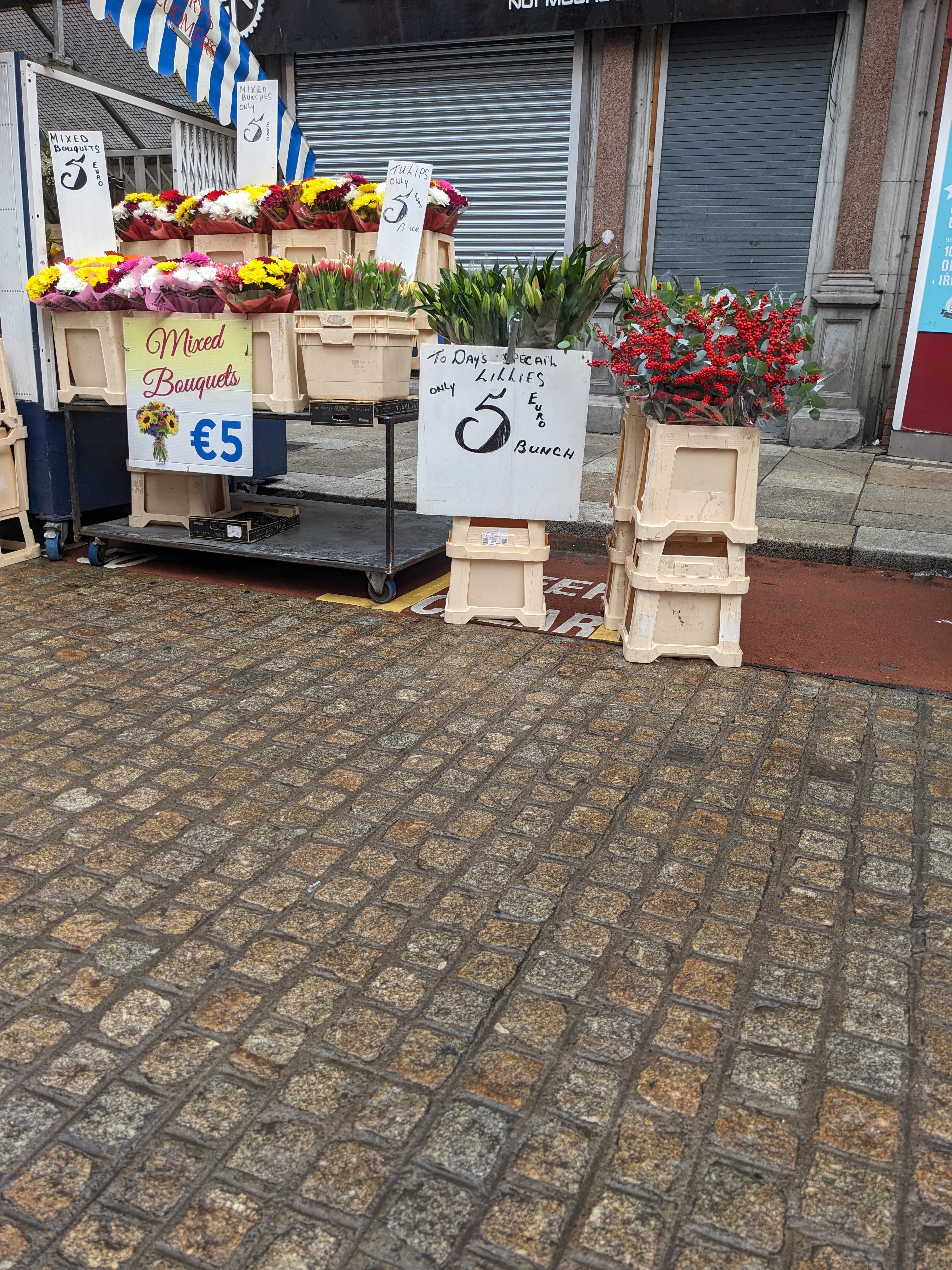
On the corners of major streets the flower sellers show up every morning, and now there are cut trees and evergreen branches as well as the hydrangeas, chrysanthemums, lilies, freesias, carnations that are the general stock. They never seem to run out of tulips. And on Moore Street, the vendors’ flowers and fruit are priced with signs that someone’s drawn by hand. I like the care with which that number 5 was made. Makes me think of this other instance of the number 5(I Saw The Figure Five in Gold), which points to this one.
November was an exceptionally outward-facing month for me, with readings and performances and talks and extra lectures at work. And now that most of that is done (I have one more talk coming up, December 10 at 2 p.m. US Eastern/7 p.m. Irish time; information here) it is very good to have a moment to step back and say, oh, that’s what I’ve made.
It’s not possible for me to see what a thing is while I’m making it, and that goes for everything. It’s necessary to step back from the place I’m cutting out or sewing together a dress, and from the poem, and from the performance, and from the drawing, and see it apart from me. Then I can make the kinds of decision that are about seeing patterns from outside rather than feeling them from inside. I think this is what Corita Kent (and her students) meant when she wrote that “to create and to analyze are different processes” (rule 8). We need both in artmaking. But we have to be bifocal with them. Go out and come back, be immersed sometimes and up for air at others. It’s good to have a very active period of making. And it’s also good take stock of what you make. It’s good to pause, and it’s good to wait. Breathe in and also out.
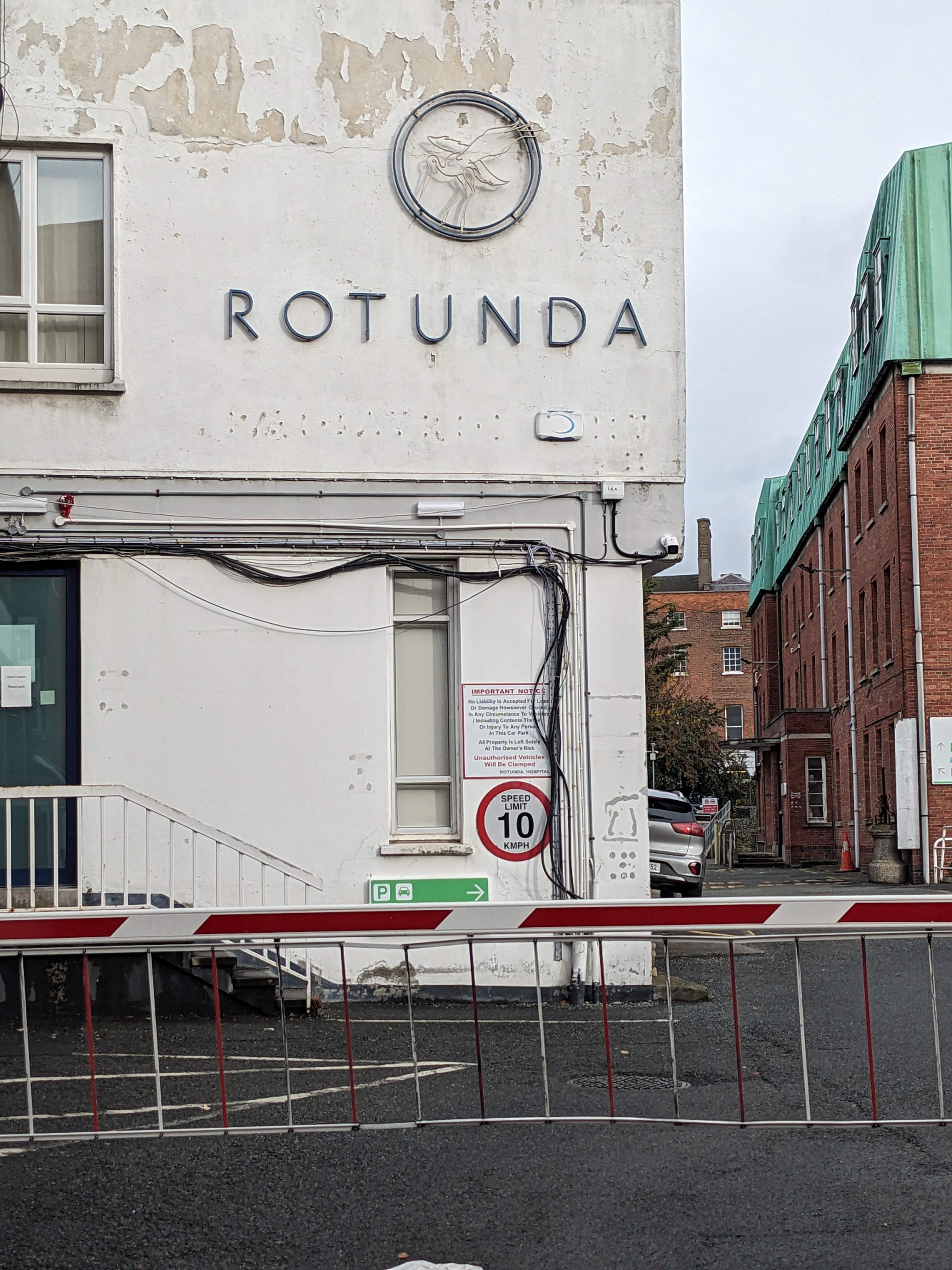
The work I did this past month meant I spent more time at work than usual but it also brought me to parts of the city I don’t often transverse on foot, as I looked for certain materials (for costume-making) and tracked down certain places (for poem-making). I love the old neon sign on the Rotunda Hospital, just north of the city center, its delicate stork and that great O. I saw the figure O in neon.
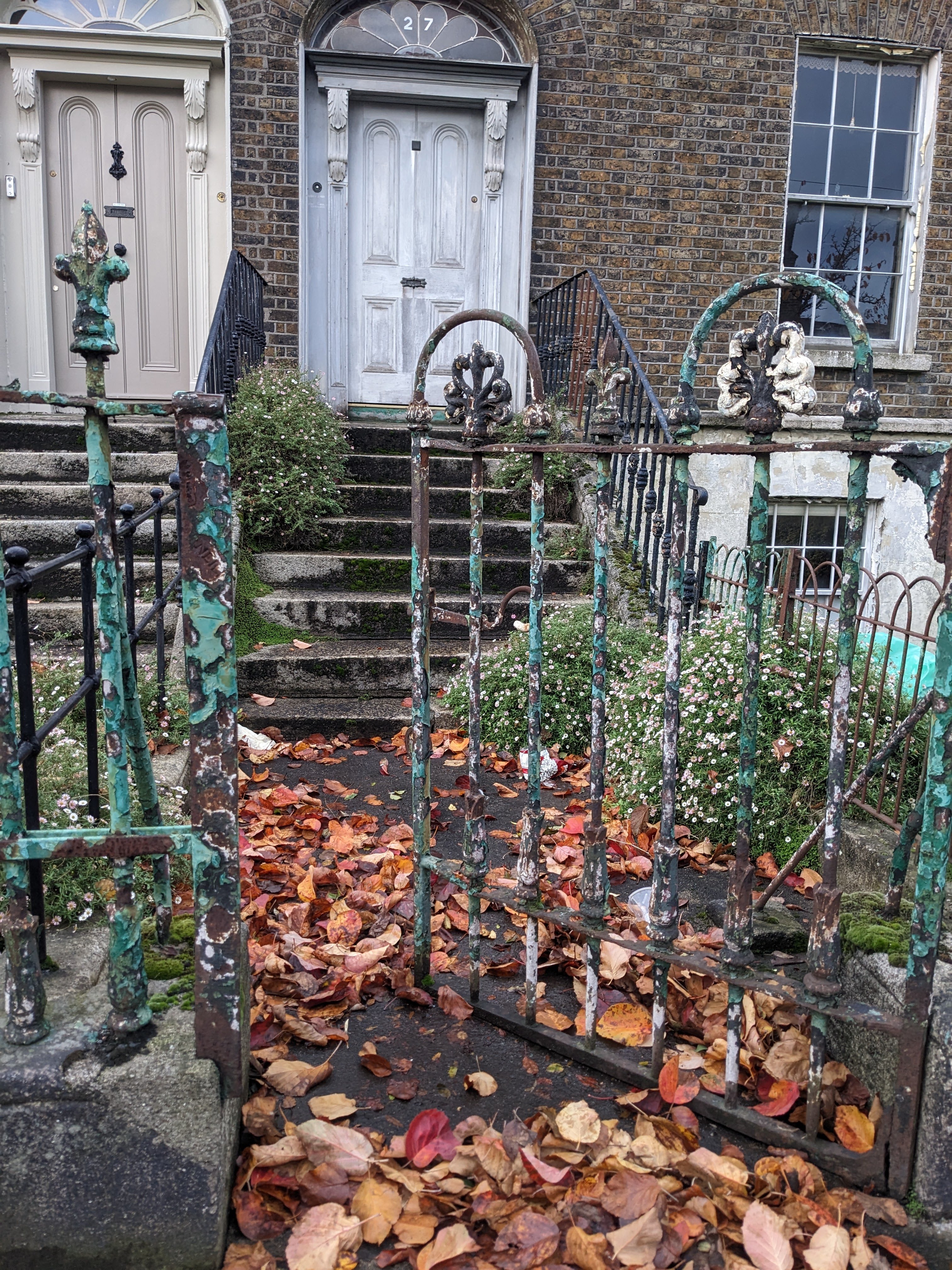
And this gate, that greenblue color I see in many places in this city, especially gates. Every place is a paintbox. I have been thinking about samples recently—the musical practice of borrowing and the sample as a tester or miniature, and the forms samples take (like paint sample cards). Bits of something else brought into a new situation, they change the situation and are changed.
I go to the art museum on a very gray morning and find myself surrounded by someone else’s vision of light. I’ve been listening to “Ladies and Gentlemen, We are Floating in Space” by Spiritualized on repeat. I am reading Brian Dillon’s Suppose a Sentence and Kate Beaton’s Ducks. We boil the kettle to make more hot water bottles and also cups of orzo with a tiny bit of sugar and a good bit of milk.
This time of year it is easy to be bogged down—under the darkness, under the damp, under the fact that the heating is broken, under the cost of living and the made-cheapness of human life, under the very real weight of grief and horror and fear. How to go on? Step by step, little bit by little bit, without anesthetizing myself to the sharpness of the world that is: the indicator of its preciousness and the thing that spurs me to act. But also, without insisting on a hairshirt.
It’s comfort. That’s what I’m talking about. Not numbness, not a commercialized ‘self-care’ that’s really just care for a corporation’s bottom line. Not a “peace of escapism, this peace that fails to confront the real issues of life, the peace that makes for stagnant complacency” (Rev. Dr. King; source). Comfort of body and of whatever the thing is that used to get called a soul. The dignity and integrity of the person. And that’s what I want to write about this month: the words of a few old songs, comfort and joy.
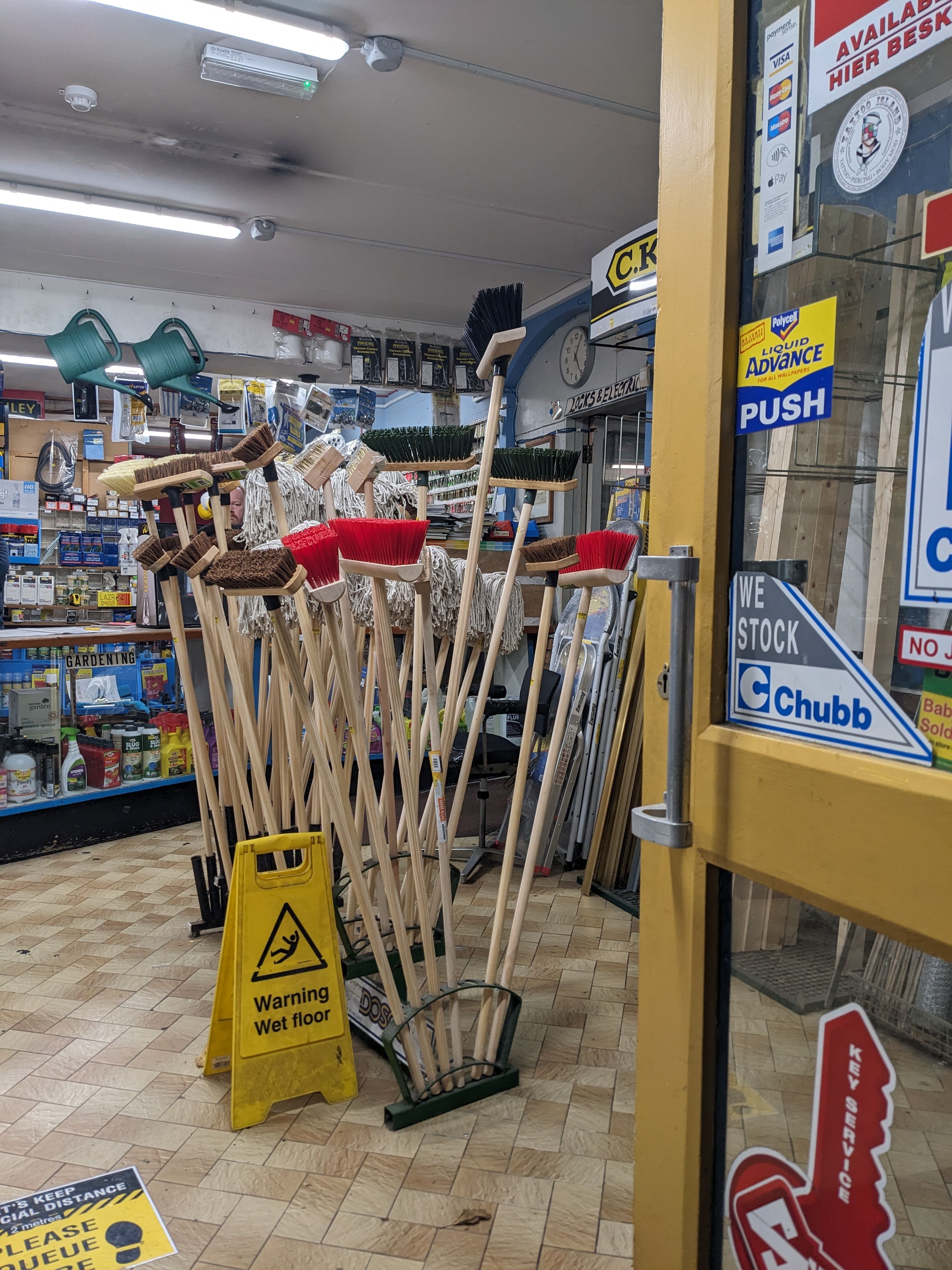
I’ll try, this month. I’ll do my best. But for now I will leave you with this beautiful display of brooms, snapped (with permission) through the door of a shop on an already-dark Thursday evening at the end of November, as I and everyone rushed through the city, our passage lifting up the leaves among us, waiting for the ones who sweep them up while we’re asleep.
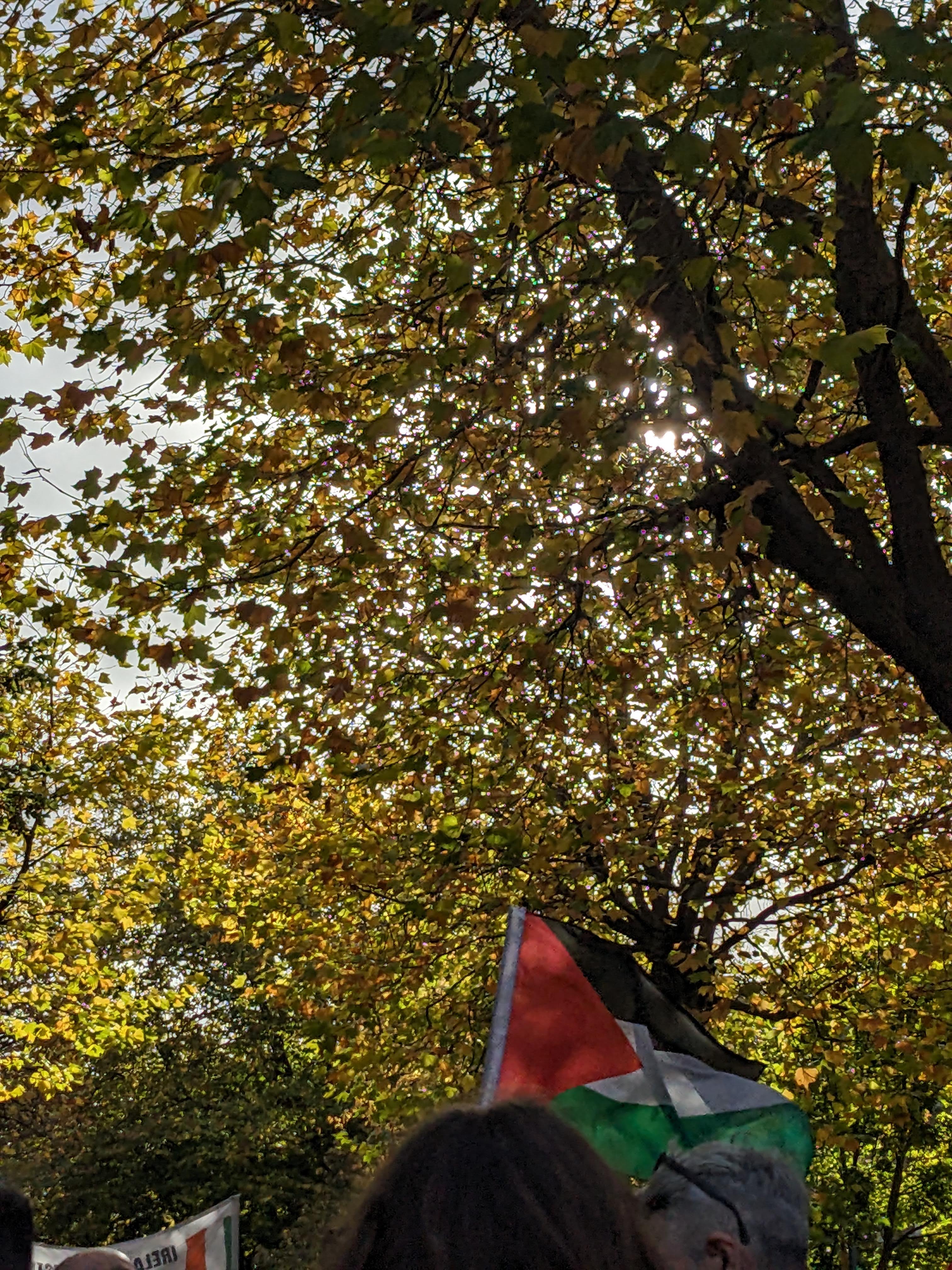
Comfort for everyone, and safety, and belonging. And freedom from occupation, and from fear. And shared, active liberation. And peace of the positive kind, that is the presence of justice. Swords into ploughshares. Free Palestine.
On November 19at 2 p.m. US Eastern I will give the first of two lectures as the Annulet Inaugural Linkages Lecturer. I will give a talk entitled “When you get someplace new, learn to read the landscape like an alphabet”. This talk will be broadcast online, for free. To register, please click here.
On November 21, I will read and talk with Majed Mujed and Hua Xi as part of the Trinity College Literature & Resistance Series, in the Trinity Long Room Hub. You can book a place here (in-person only).
On December 10at 2 p.m. US Eastern I will give the second of the Linkages Lectures. I will give a talk entitled “On the line”. This talk will be broadcast online, for free. To register, please click here.
Once these are done, I am never doing anything in public again. For at least a month. But I’m sure by the start of the new year I will be full of vim again. If you’d like to have me to read or speak at your university, school, class or organization in 2024, please drop me a line.
One day, the light changed and it was: late fall. Or early winter. In the mornings the air is damp and cutting. In our apartment, the windows are covered so thickly in condensation that if it is overcast, the condensation stays all day. Even opening the windows doesn’t always get them to dry out, so our apartment is damp and cold, even with the heat on. A student returns a book they borrowed and it is stippled with lavender mold. My room is so damp, they tell me, and I can see they are ashamed to return the book in this condition, but I’m thinking: what about your lungs? What about your bedding? Spray some vinegar on the book and it will be fine, but bronchioles are a little more delicate.
I look across the back yard to our landlord’s house, and notice that his windows never have condensation on them. Then I take a squeegee and open the window and carefully wipe the water off the window, into the cold outside air.
Despite the sharpness of the damp-cold, on days when the sun is out it’s easy to get overheated. I bike across town to meet hundreds of other people in front of embassies and monuments. When I leave the house I’m wearing two sweaters, long underwear, a jacket, a scarf, a hat, mittens. When I arrive on foot, my bike locked up elsewhere, I have unzipped my jacket, removed my hat and scarf. The sun of early November comes through the golden leaves of sycamores and hazels, and through the mist rising from asphalt in this city of aggressive drivers and tall yellow buses, this city guided along its north and south by straight-edged canals. In cities where the buses are running and the ordinary chores remain to be done—the groceries, the laundry, the dishes—all over the world, there have been people meeting in front of monuments, in front of embassies, in the cool damp air.
As we walk I hear Sister Rosetta Sharpe playing, singing | hear Mahalia Jackson singing: this is the tempo of this kind of walk, to me. We are here for one another’s liberation; we are here for refusal (a refusal we can only do together). What a joy to be able to refuse together, what a tender obligation. Lay down my sword and shield, down by the embassy, down by the armaments manufacturer, down by the multinational corporation benefiting from indentured labor, down by the university, down by the side of the canal, with you. Under the golden leaves some people are crying, and some are shouting, and some are silent, and all of us are together, warmed by the light in the sky that cannot be owned and belongs to all of us.
This week I have been listening to The Alchemy Lecture: Five Manifestos for the Beautiful World, organized by Christina Sharpe at York University (CA). (I’m not sure how long this recording will be available. Information about the series is here. Last year’s Alchemy Lecture is published and available here.) The manifestos are given by Joseph M. Pierce, Phoebe Boswell, Cristina Rivera Garza, Saidya Hartman, and Janaína Oliveira.
One thing I have thought about as I listen is the difference between event-makers who consider the audience a coequal presence with the speakers, and event-makers for whom the audience is an afterthought, or not a thought at all. One way care for audience shows up is in the way event-makers think about architecture. By architecture I mean the shapes of rooms, the way chairs are set up, the ways one can come in and go out of the space, the way eye contact is or is not made (and with whom), how hospitality is broadcast (in body, speech, arrangement, sightlines…), the way that one’s ticket is or is not taken, the organization of space and space-use so as to make it possible to feel one is permitted—or even welcome—to be there (or not), as well as normalization of access (using microphones, having interpreters, asking for masks to be worn, ventilating/filtering air, spaces for all kinds of bodies to sit or be comfortably). These ‘little’ things (they aren’t little—they are worldmaking) are so often neglected because they do not seem glamorous. In fact they are mostly deglamorized, seen as killjoy problems, made to seem a little embarrassing or outrageous, in the way of fun (for whom?).
But I think this kind of space-making, audience-oriented care, and all the choices that doing it requires, are the entire fabric of our relation. And such care often underpins events that are in their entirety rich, carefully made, thoughtful, exciting—why? Because someone who has stood in the back of a hall and washed dishes knows what it’s like to feel not-in-the-room and moreover knows how to make a room, in all its detail, that doesn’t do that to others; someone who has felt invisible or isolated knows what it’s like to be welcomed, against expectations, and so how to attend to real and deep hospitality. Someone who has done or pays attention to the kind of work that makes an institution run—whether teaching composition on an adjunct contract or cleaning toilets and emptying garbage cans or getting up early to chop onions in an institutional kitchen—knows that that labor’s invisibility or lack of ‘glamor’ is not a picture of its dignity, meaning, or value. There is a moment when, in her introduction, Sharpe speaks directly to the workers who clean, make food for, and maintain the university where this lecture is about to take place. That is the kind of thought and attention that to me is a harbinger of a beautifully made event.
Showing care for these ‘little’ (not little!) things is almost always, in my experience, a sign that the careful making will be thorough—that everything made by this intelligence will be attentive and aware that to give an event means to ask people to live toward death with you a while. And so it is with these lectures, which are audible (! recordings aren’t, always!) and smart and interesting and given with a rigorous towardness for the audience, whose living presence the organizers and speakers have clearly considered just as much as they have considered their own there in the room. It goes without saying that the ideas and ways of making them that the five speakers offer are worth your time—I hope you’ll give them a listen/watch while you can.
Another student, in a conference, says they hadn’t wanted to show me their work because it is ‘not poetic’. And then they show it to me and it is so meticulously observant of their everyday life, their everyday language; it is beautiful. Look, I want to say to that student, to myself, to all of us: there isn’t any poetry out there that could be more beautiful than your steadfast attention to how things are, where you are, what they mean, how they work, in the language of your body and house and family, religion, region. There is no received form or received understanding of aesthetic pleasure that could ever be as beautiful as this description of your bus ride. And if you look closely at your bus ride for long enough I think it will also teach you how(s) to think through the questions that might seem far off but are in the end intricately related to it: how to be together. What a life is for. What kinds of things we want to make, with one another, for one another, in this world that is continually ending.
And finally— Let all beings be free, safe, beloved, and well. Stop the bombs. Swords into ploughshares. Free Palestine.
[There are a lot of new people here, thanks to my friend Jon in great part, I think. If you want to know what this place is about, this will give you a sense of it. In brief, I am writing an essay each week for the twelve months between March 1, 2023 and March 1, 2024. They all go out on Sunday mornings Irish time. Each month, one essay is titled “[while walking]” and is drawn from my near-daily walks in the place I live, and another is titled “[while washing the dishes]” and is a chance for me to write about—or invite someone else to write about—something that’s entered the frame of my thinking while doing housework. Across all the essays here, I take Fanny Howe’s idea of “bewilderment” as a guiding principle both aesthetic and ethical, and consider Virginia Woolf’s “little arts” of “talk, dress, cookery” alongside other arts. I aim to think about what it might mean when Frank Bidart asserts that “being is making” and when Toni Cade Bambara writes that the role of the artist “is to make revolution irresistible”. Thanks for being here.]
A note about a few upcoming events in November and December.
On November 9at 7 p.m. Irish time in the Classics Museum at UCD, Jeanne Tiehen will direct a staging of my work An Archaeology, for which I’m making costumes. In-person only; tickets are free but very limited. Email sasha.smith@ucd.ie to book.
On November 19at 2 p.m. US Eastern I will give the first of two lectures as the Annulet Inaugural Linkages Lecturer. I will give a talk entitled “When you get someplace new, learn to read the landscape like an alphabet”. This talk will be broadcast online, for free. To register, please click here.
On November 21, along with two other writers to be confirmed, I will read and talk with the others as part of the Trinity College Literature & Resistance Series, in the Trinity Long Room Hub. Event and booking information will be here (in person only).
On December 10at 2 p.m. US Eastern I will give the second of my Linkages Lectures. I will give a talk entitled “On the line”. This talk will be broadcast online, for free. To register, please click here.
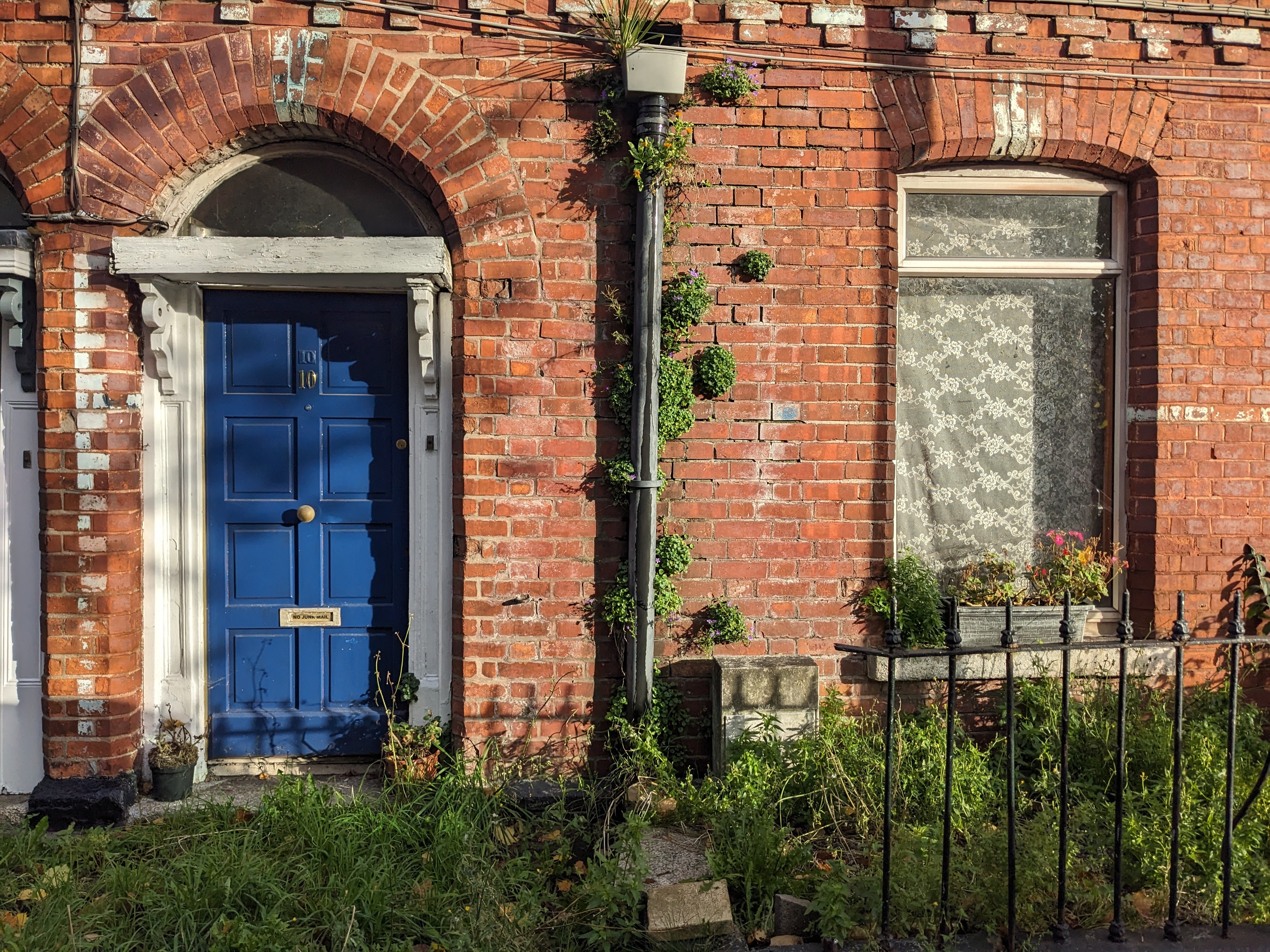
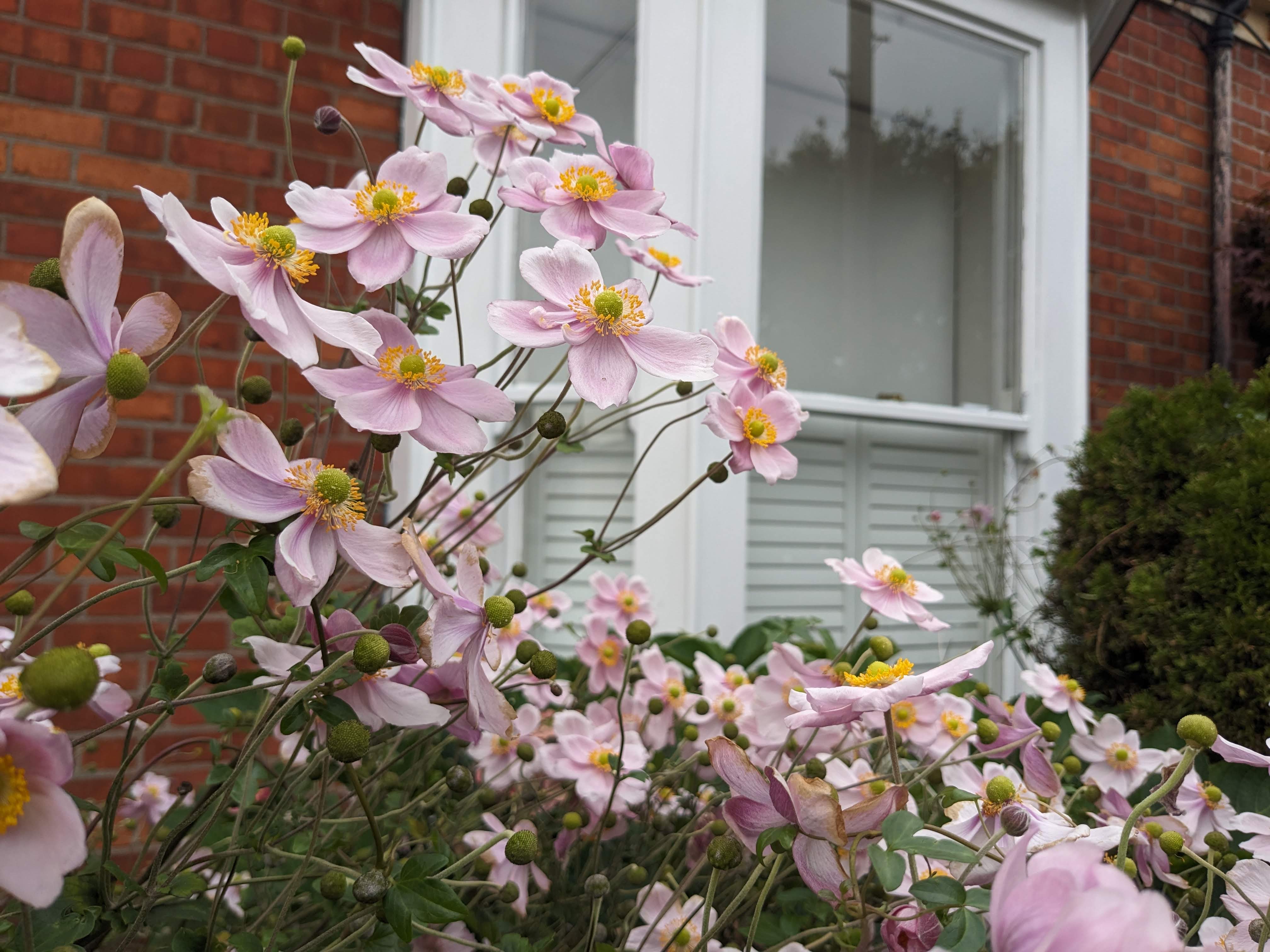
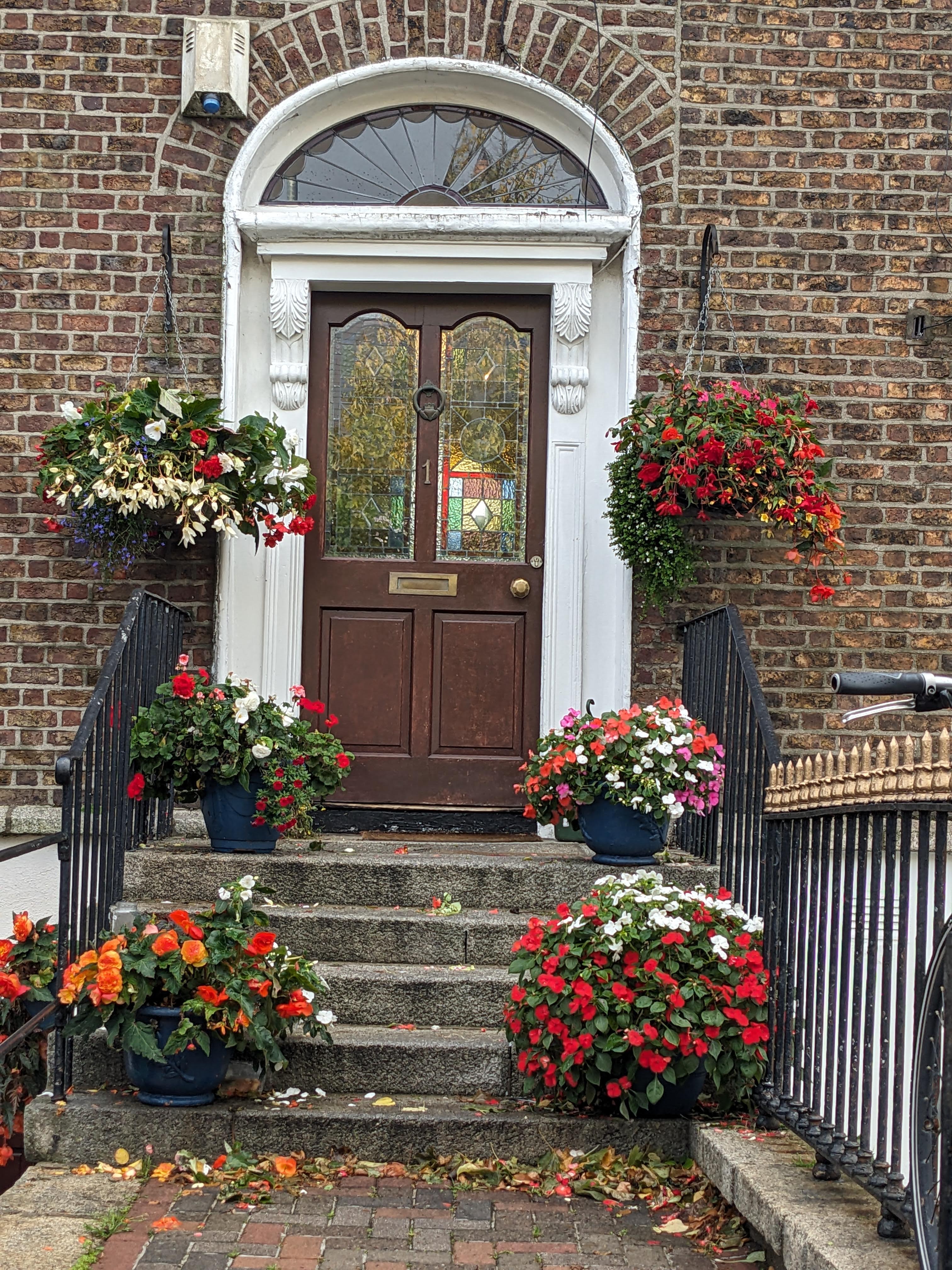
There is a lot of beauty in this city, like everywhere. You look long enough and you can’t stop seeing it. People want to make their spaces feel right to them, and that yields beauty—not the Home & Garden variety, not the Instagram variety, which are a skin of “beauty” but not beauty. By beauty I mean, among other things, the old man I often greet while walking home: he sits on his chair inside his southwest-facing doorway anytime there is sun in the afternoon. He has built little shelves all up and down the inside of the frame to hold plant pots and has tiled them with orange and yellow and brown tiles. He did it himself, he must have. They are ugly but they are beautiful because they are particular—they show the making and the maker in them.
There is a lot of “good taste” here, too; a lot of self-conscious correctness, a lot of primness, a lot of what feels to me like Prufrock saying to himself, “Time to turn back and descend the stair, / With a bald spot in the middle of my hair — / (They will say: “How his hair is growing thin!”)”. A lot of what looks like “beauty” and “good taste” here, as elsewhere, is the adoption of the mores of wealth as a sign for beauty. These mores produce desire in me—they signify space, light, not having to move yet again, no landlord, some kinds of ease—but they often, ultimately, feel hollow. I often feel more alive in a room someone has decorated with “too many” patterns and colors than in a “tasteful” gray or white and pale wood room. I love this essay by Anne Enright in a similar vein. In the end, the facts of the world are generally more of a blur than a binary. The surprise of individual seeing and world-creating pokes through and ruptures the skin of “good taste” to make a moment of beauty.
In any case, let me be clear that when I say “beauty”, I’m not talking about “good taste”. I don’t care about “good taste”. “Good taste” is a set of rules that serve wealth and power by grinding in the values of of wealth and power to the point where they seem normal, unquestionably desirable, almost signs of health (aesthetic as well as bodily/mental), and nearly invisible. “Good taste” is a continual lesson in not-looking-at-the-world. “Good taste” is fitting oneself into a given container and god help you if you overflow. No, thank you. Not “good taste”; I’m talking about the beauty of invention and of lived-inness. The beauty of specificity of attention. The beauty of being-person with other people. That’s what we grieve when anyone dies, I think—the way they made a world, which no one else could have done in just that way. And then also the beauty of the world they were, taste be damned, which no one else will ever be, despite the preservation of matter and energy in other forms.
There is a lot of vileness in this city of beauty, too. Vileness and the pressure of “good taste” go hand in hand.
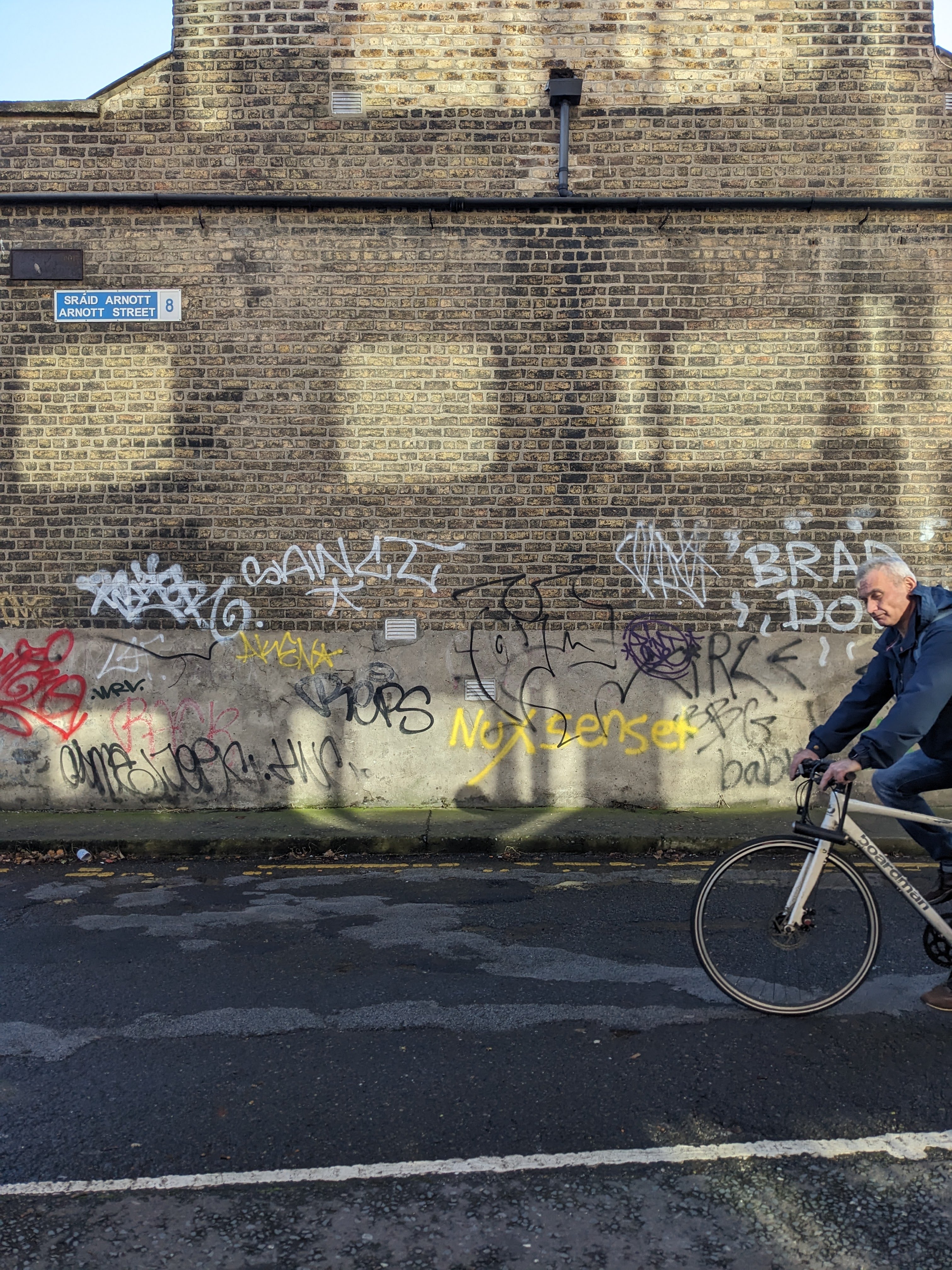
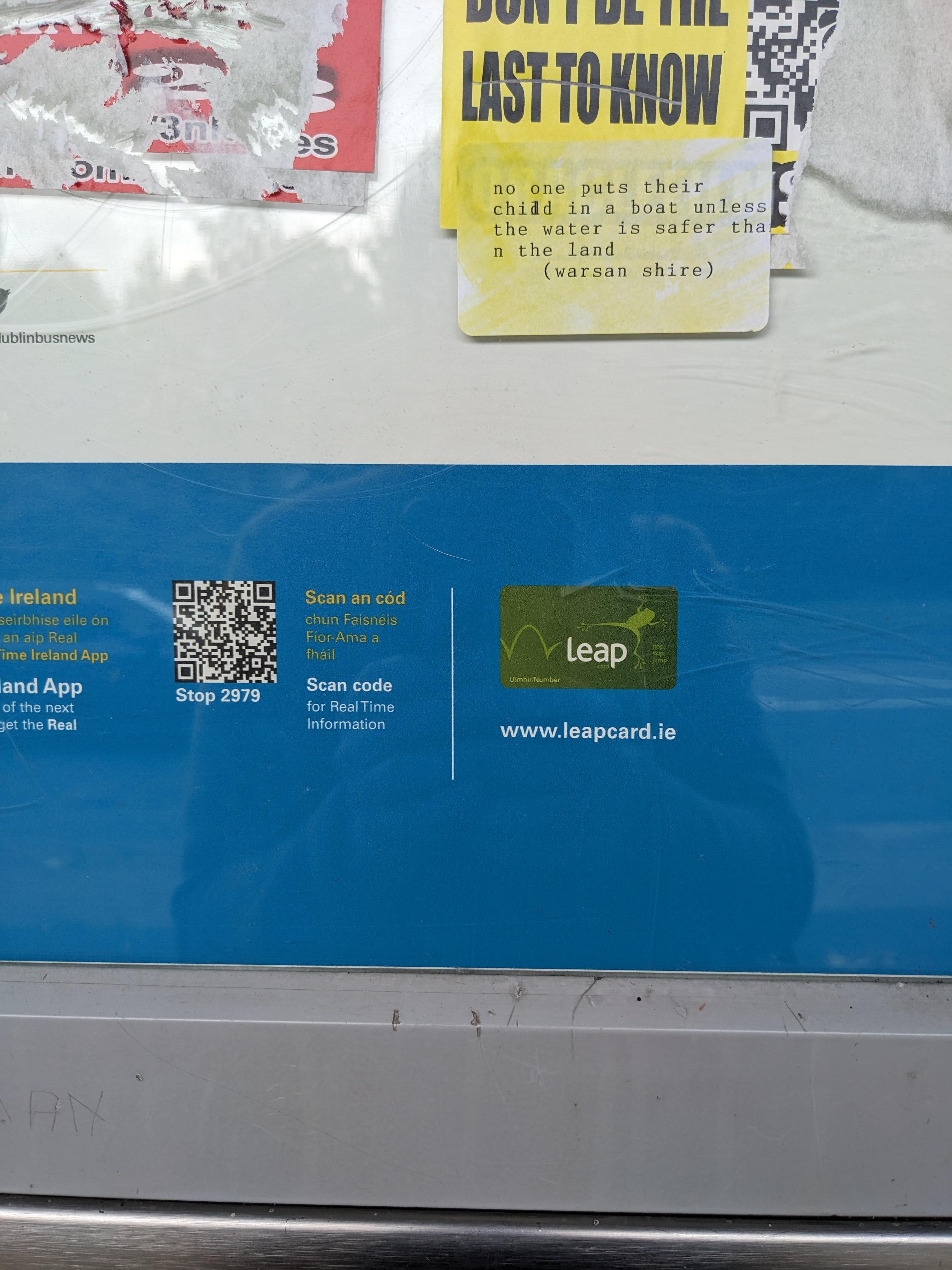
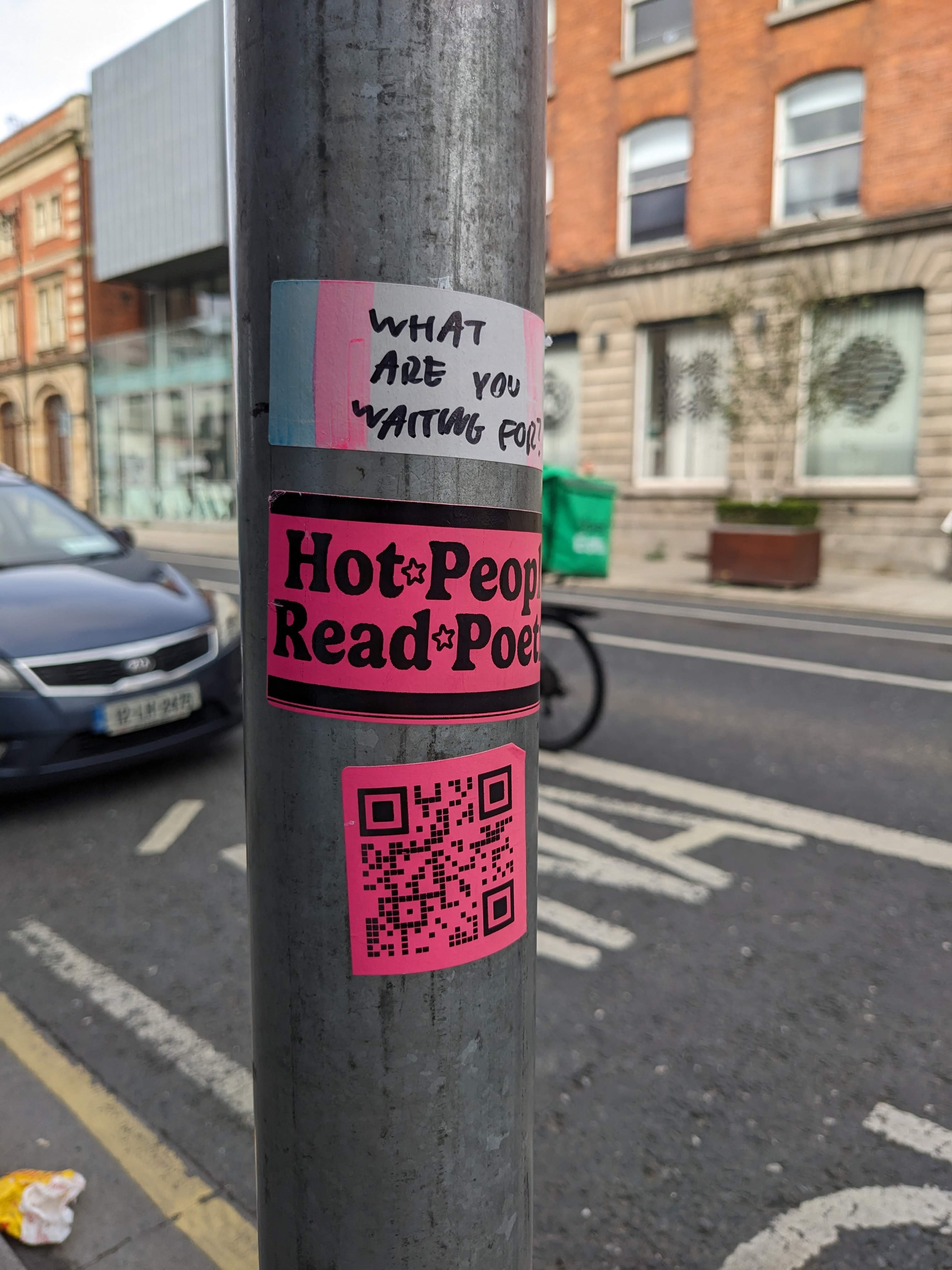
I peel far-right stickers off postboxes, garbage cans, lightpoles, and signs as I walk. They have visual rhythm: appearing every so often along particular stretches of road, in particular areas in my neighborhood. I have never seen anyone put them up, but they are there every week, sometimes more than once a week. And I rip them down every week, sometimes more than once a week. I imagine no one sees me doing that, either, at least most of the time; most of the time, people don’t look around them as they walk or drive. I know that it is not ‘becoming’ of me, a middle-aged woman, to stand and touch ‘dirty’ things in public spaces. Though I generally feel unseen while I peel the stickers off, when I am seen, I see people’s disgust. It is true that the sides of public trash cans are dirty and I, in my leather shoes and work clothes, am ‘clean’. The meniscus of manners and class and taste ought to keep me well-behaved. But I reach out and peel the sticker off and throw it away.
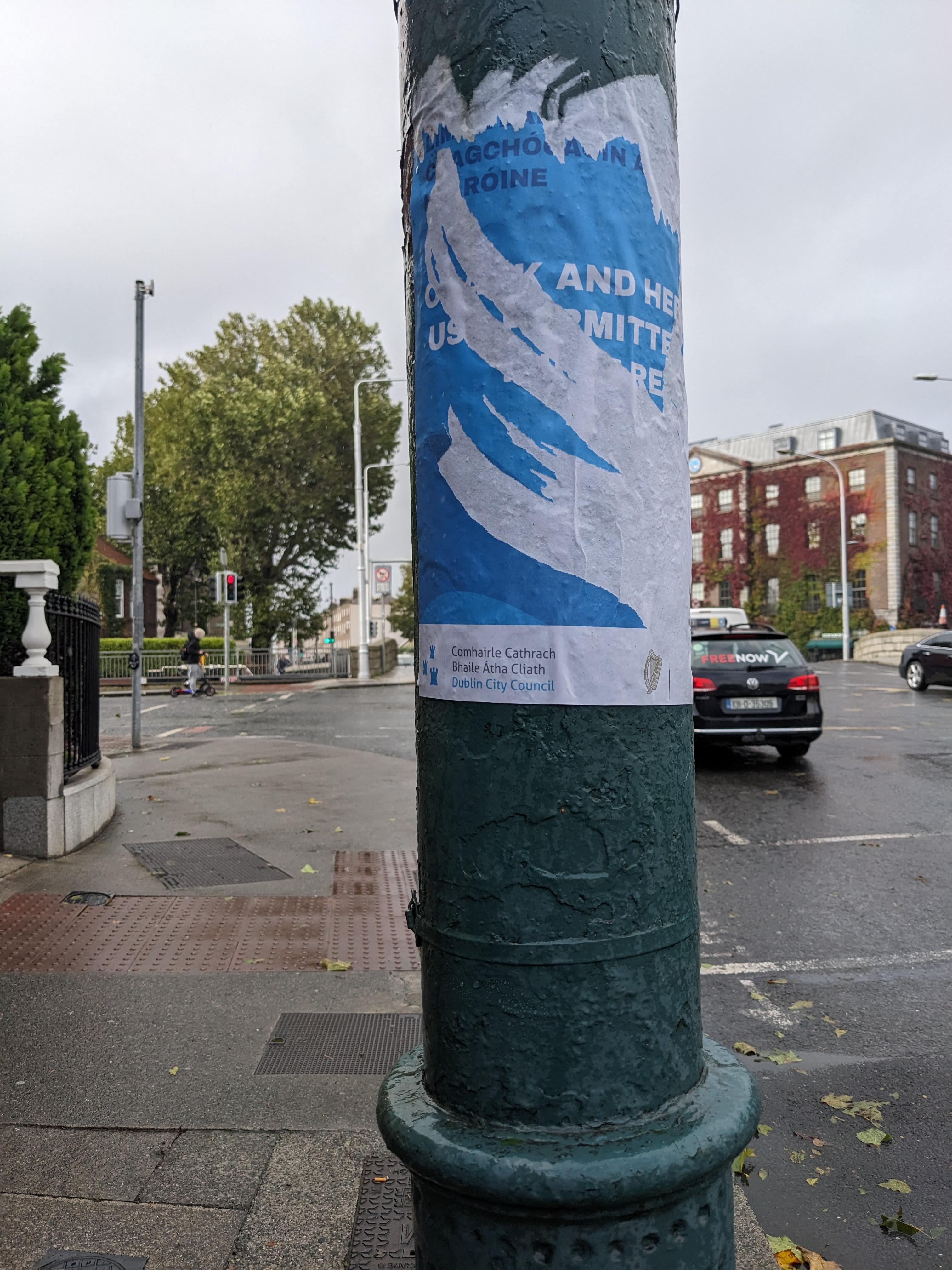
There are stickers that tell lies about vaccination; there are anti-trans stickers; there are antisemitic memes, both gross and grossly obvious; there are profoundly disgusting Islamophobic stickers that someone keeps putting up by the mosque; there are fascist recruitment stickers with QR codes; there are conspiracy theory stickers; there have been, recently, really vile stickers that use the likeness of George Floyd to stir up white supremacist fear and propagate the white supremacist ‘replacement’ myth. In the past few months I’ve seen large wheatpaste posters as above, that appear to be from the city council but are not, and that dehumanize and demonize drug users and homeless people. I’m reciting the stickers’ content categories not to reproduce their rhetoric but to lay out the the field of their concerns—the people they unpeople, and how—as well as the facts of their persistence, their prevalence. This is the underside of good taste, when good taste means looking away, refusing to name things as they are, the use of euphemism, comfort. When good taste means being able to opt out of confrontations with what dehumanizes us, or to feel that another person’s dehumanization might be ‘deserved’ or somehow have nothing to do with one.
Often, walking, peeling off these stickers and throwing them away, I feel weighed down by the ugliness of this place, its dense and complex histories of violence woven through with the world-crossing violences of antiblackness, xenophobia, antisemitism, Islamophobia, much of which is exported by the place I’m from. I don’t know what else I can do in the face of this feeling of weight. There is no heroic action. There are only the everyday actions of looking, thinking, asking, refusing, insisting, examining. So I go on walking and peeling the stickers off, walking and peeling and throwing the stickers away. In this I am alongside others who also do this small, daily work. Writing NO and FALSE in big letters on the stickers we can’t tear off. Putting up our own stickers, too. The sticker calls the eye and says, here. One nice thing about my leather shoes and work clothes—the invisibility they lend me—is that I can put up stickers mostly without being seen. Any risk of being seen is diminished by the sensation of changing the world, materially, microscopically, toward what feels vital and alive rather than deathly. And the risk is also diminished by my smallness, my femininity, my whiteness, my work clothes—the signs of my belonging to an order of “good taste”, the signs of my “unthreateningness” and docility.
Sometimes the stickers have already been defaced or partially removed when I find them, which makes me feel like we are working together, me and whoever else is watching for them and tearing them down. We sticker-removers are termites of the fascists’ world, unmaking some transmitters of violence one tiny chomp at a time, over and over and over. It takes no special tools to be such a termite. Fingernails do most of the work. An ID card peels difficult ones off. And a soft-leaded pencil (its dark marks will not wash away in the rain) permits one to deface any part one can’t remove.
Living beauty is possible for all of us. We can do it—make minuscule changes to the world we move through that insist that care, justice, liberation, that compounding of acts that add up to beauty, are more important than good behavior. I think beauty is a disturbance in the field of comfort—the comfort often given the names of taste, or propriety, or manners—that confronts me with the irreplaceability of everything (everyone) living. I feel a demand to work and fight, mourn and build for and with others when I am faced with that.
Beauty forces a reckoning, over and over, on a minute scale, with my own complacency. It makes me see in specific, makes me see pattern and meaning, especially pattern and meaning that’s not my own. I think beauty confronts us with the eachness of each of us, our difference, our irreducible human preciousness, patterned together. Not conformity; finding out. Widening. The way a new parent looks at their baby and realizes, you are absolutely complete and I couldn’t even have imagined your you a month ago. You. Us. Here. Together. For one another. Clear-eyed. That’s what I mean by beauty.
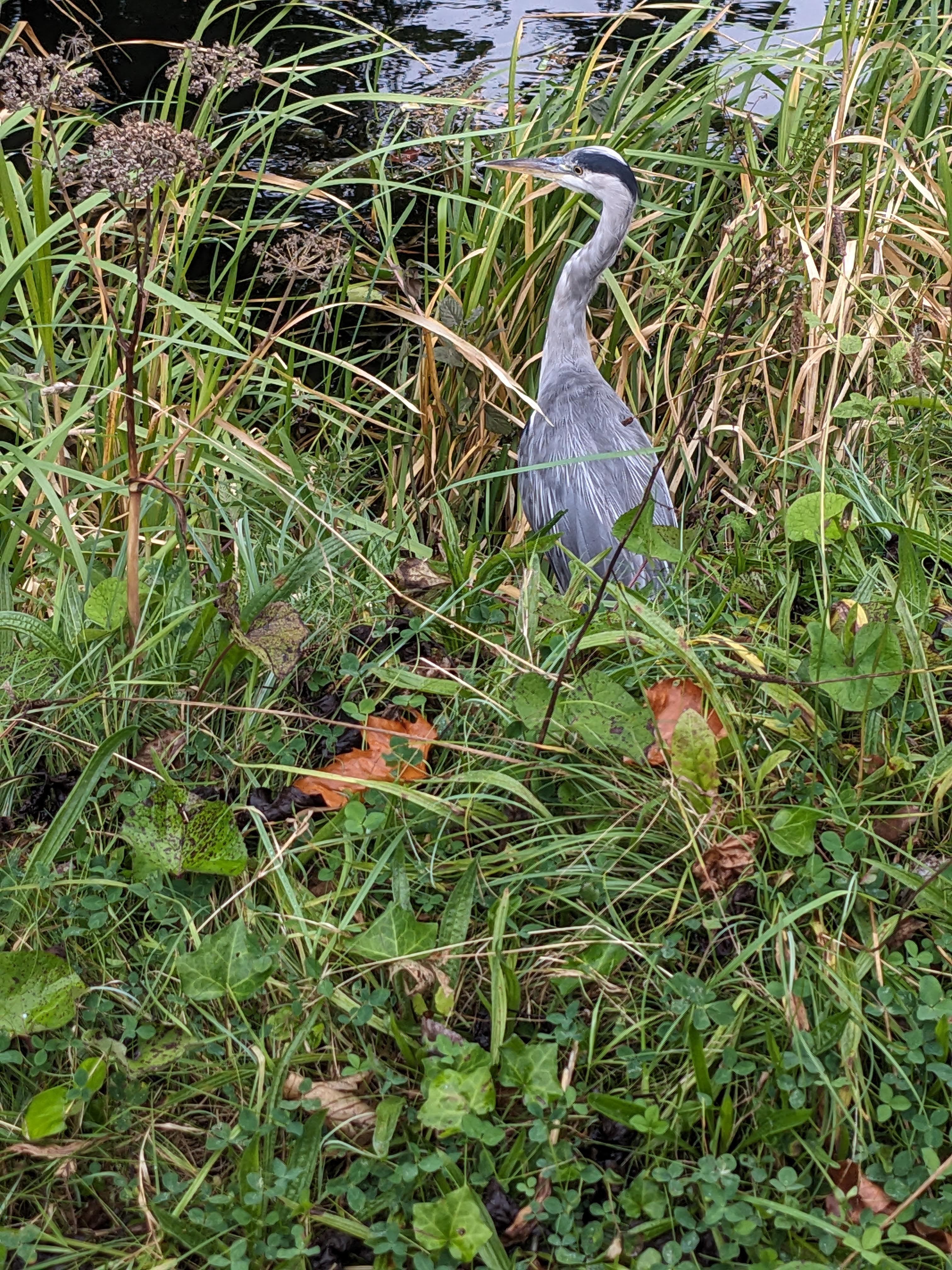
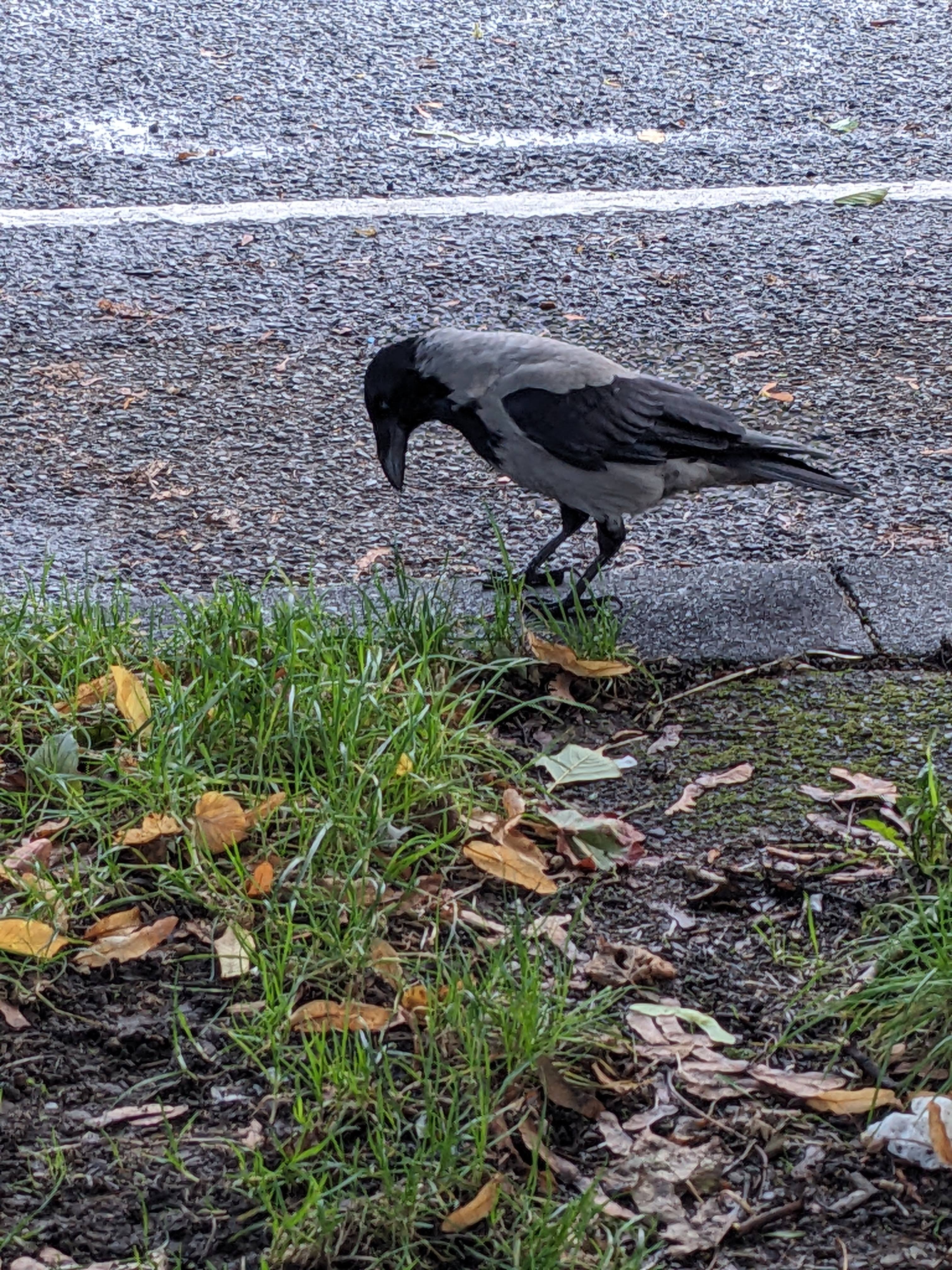
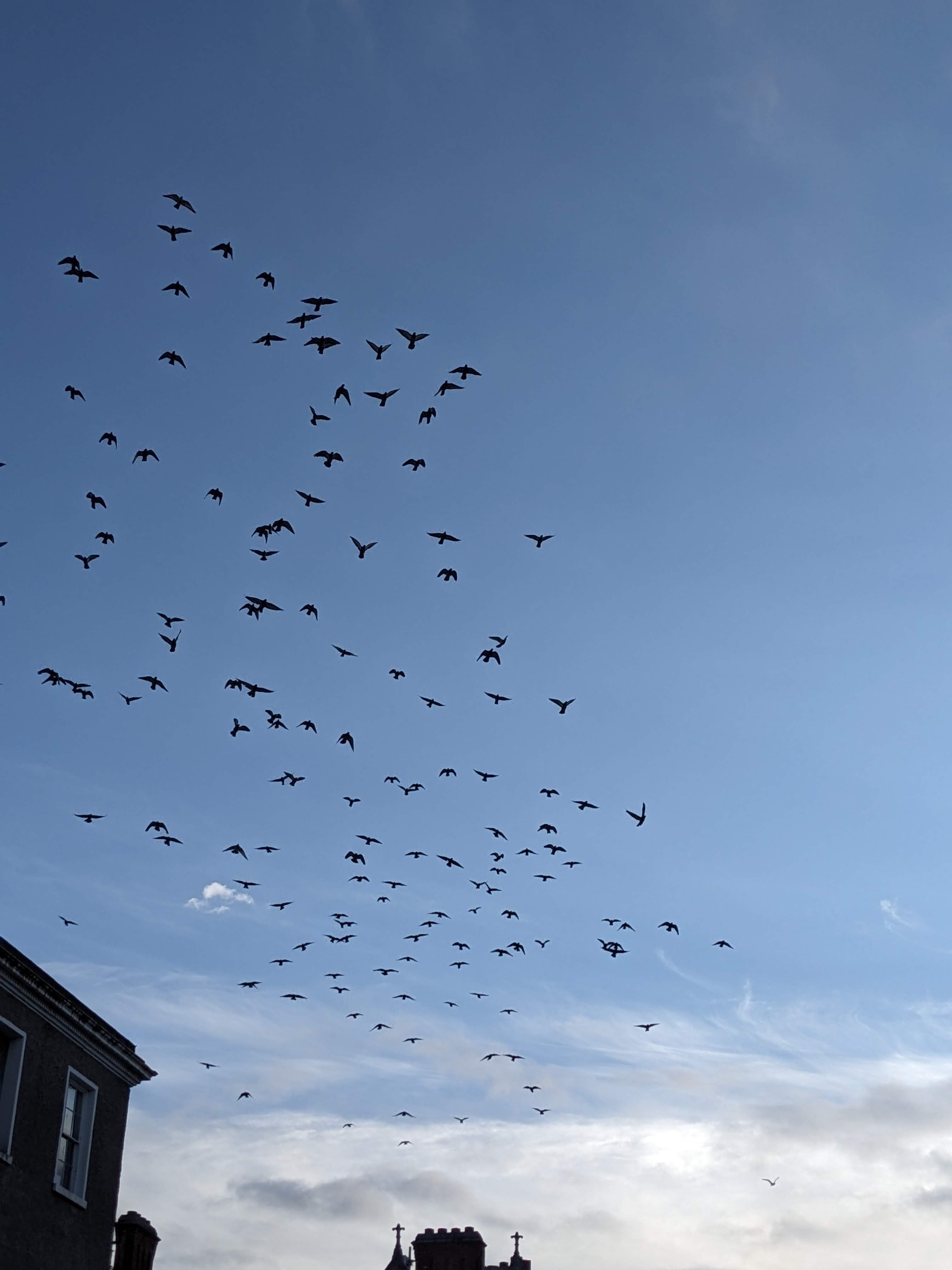
September is just over. I am back to my commute walk now, a roughly 45-minute walk that takes me long the Grand Canal. To my right is a busy two-way street that is clogged with traffic at peak hours. To my left is the canal, and across it a walking path, two cycle lanes, and a narrow street for one-way car traffic. Not a bucolic place at all. The world of the living is present there, though. I was maybe five yards from this heron. There are always swans. Lots of crows, jackdaws, magpies. Seagulls. Starlings. If I moved more slowly or sat longer I know I’d see smaller birds. The variety of plant life is huge. If I knew better what to look for and how to look I’m sure I would see more insects. I have seen fish in the canal, which surprised and delighted me—I had assumed it was too dirty for fish. And there are all the humans around the canal, too: the ones who drive by, the ones who cycle by, the ones who walk, and the ones who sit by it to smoke or drink or hang out with friends because there is no private space in their houses or just sit on the benches for some quiet in the green shade. And there are the ones of us who live in tents along the canal banks.
You don’t have to go away, is what I’m saying, to see ‘nature’. It’s right here, and we are in it—we are it. The faraway nature preserve one might voyage to to spend a day in nature feels to me like a way of pretending we aren’t implicated in it, permeated by it, always with it, in fact like a way of pretending we can even say it instead of saying, more properly, we, us. Embedded in the world of the living, we live along with it, as it. When we die we become it thoroughly. When we breathe, it becomes us. But prior to any conception, it is us, we are it. It ises us, the us of all the living.
When I told some people I’d just met that I’ve walked about 1200 miles this year, nearly all of that in my neighborhood, two questions came up. Did I go out for ‘better’ walks, i.e. did I travel away to See Things, and was I doing anything with the walks. I don’t go away to see things because I am seeing things all the time. I haven’t walked the streets where I live enough to be tired of them and I don’t think I could. When I go a week without checking on the trees, flowers, brambles, gates, paths I feel a pang of regret for all the change I’ve missed. Time is fleeting. What better thing than to be a deep-space telescope of one’s most local surroundings, sending oneself image after image of the same view over time?
The question of doing something with is such a gound-in question in art life.
Such a ground-in question in the lives we live inside of capitalism.
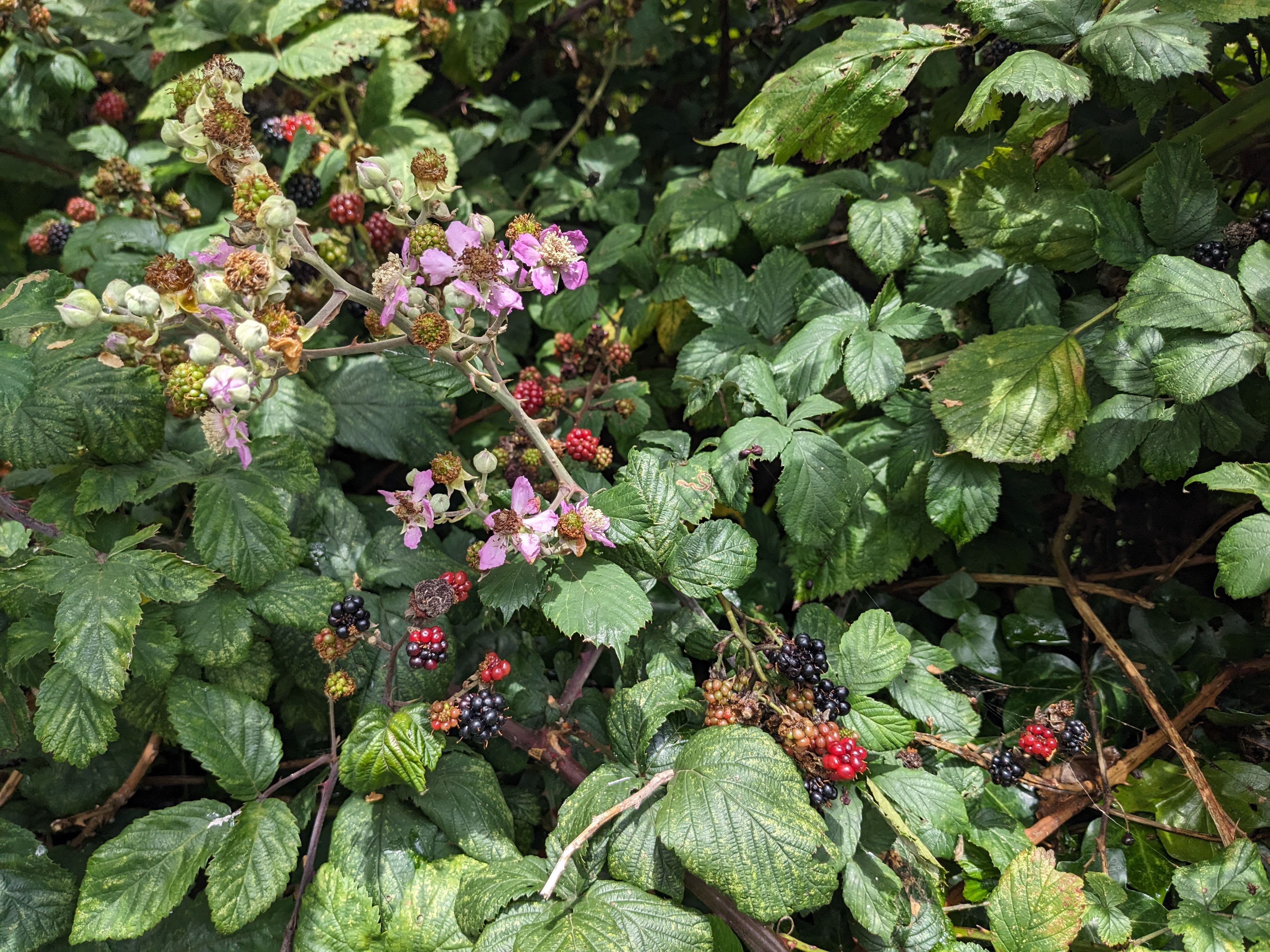
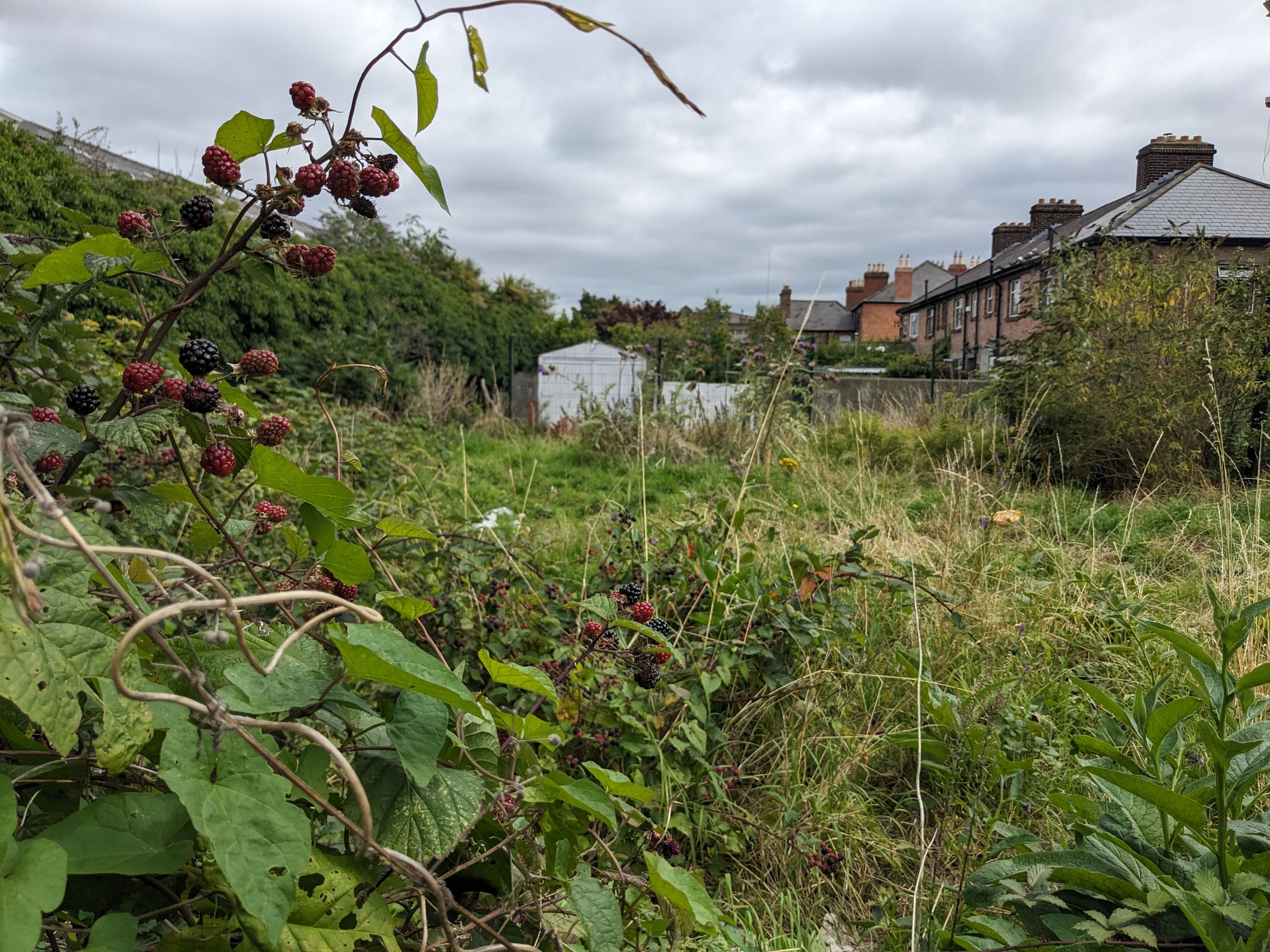
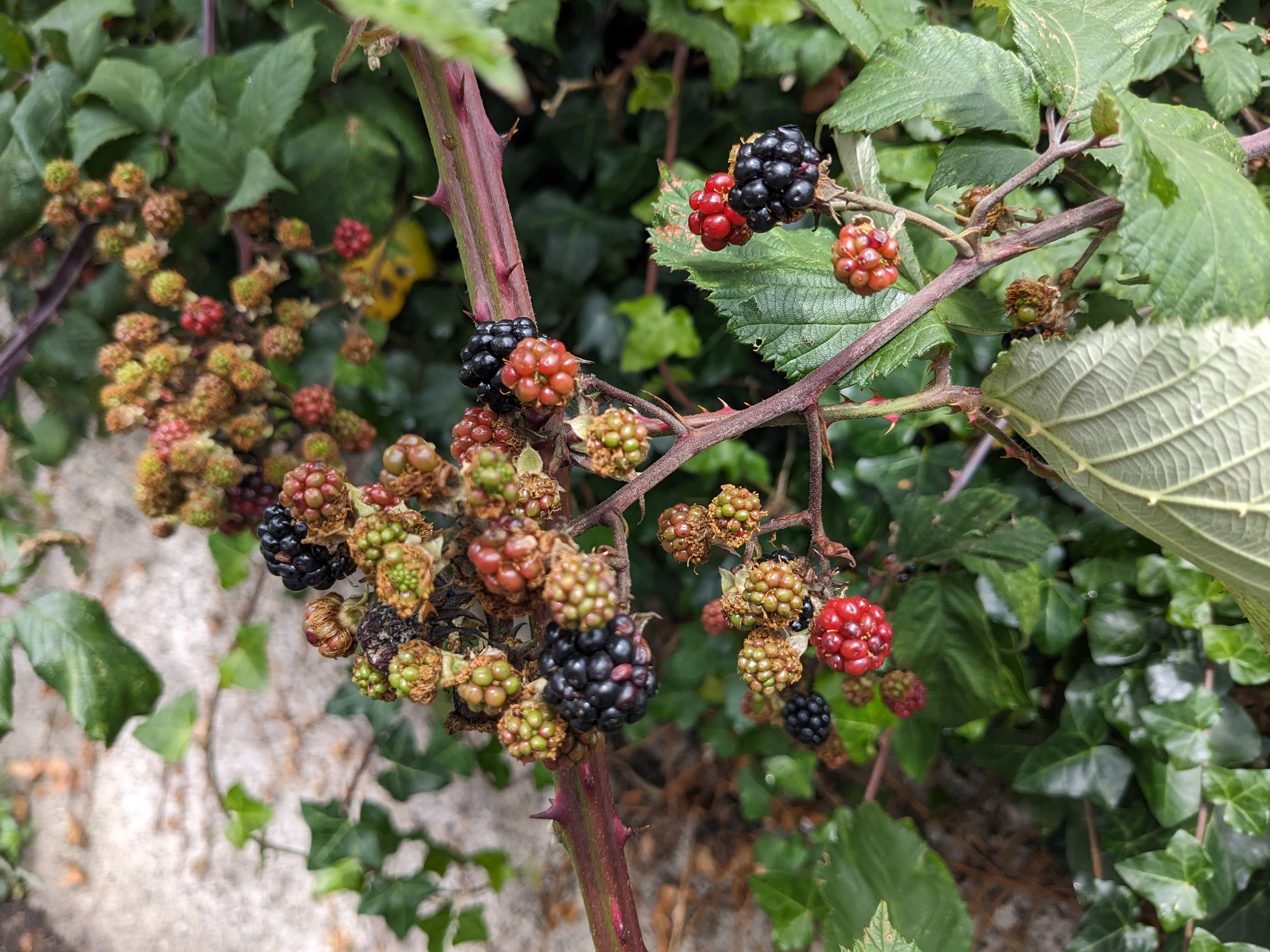
I take these walks because I want to be related to the place I have arrived. I owe it real looking; otherwise my relation to it would be assumption on my part. I am still assuming things despite my walks—because I just can’t see, sense, understand the all of it all. I don’t want to assume, or I want to assume as little as possible. I want to be light on this place. I want to see how things are, be puzzled by them, figure some of them out over time. I want to learn to draw connections in this place. I also want to know where things are, practically: both the best place to get bread in my neighborhood and the places where blackberries are thick hanging over walls in August. My walks, though this isn’t the reason I take them, keep me aware of my nonbelonging by teaching me what it might be to belong here. I value that.
The pleasure of walking and looking is also sufficient reason for walking and looking.
We are here, the world of the living says, including us in the we. That’s what pleasure means, I think.
Walking can be a reply to the speech of the living world, because the scale of walking is on the scale of living things. By walking I mean moving at the pace of a walk. It doesn’t entail the use of one part of one’s body in a particular way. It is about tempo, not anatomy. It’s also about finitude. You can’t walk limitlessly. There has to be an end to it—because your body is tired, or because you need to eat a meal, or to go to the bathroom. Walking reminds us we are alive by insisting on the things living beings need: rest, food, water, an end.
My walks do something with me—they put me among and in. They change my eyes and my language, my sense of smell, my leg muscles. Alive and not alone. What will you do with this is not the question of the world of the living. The questions are, at least but not only, where are you? and who else is with you?
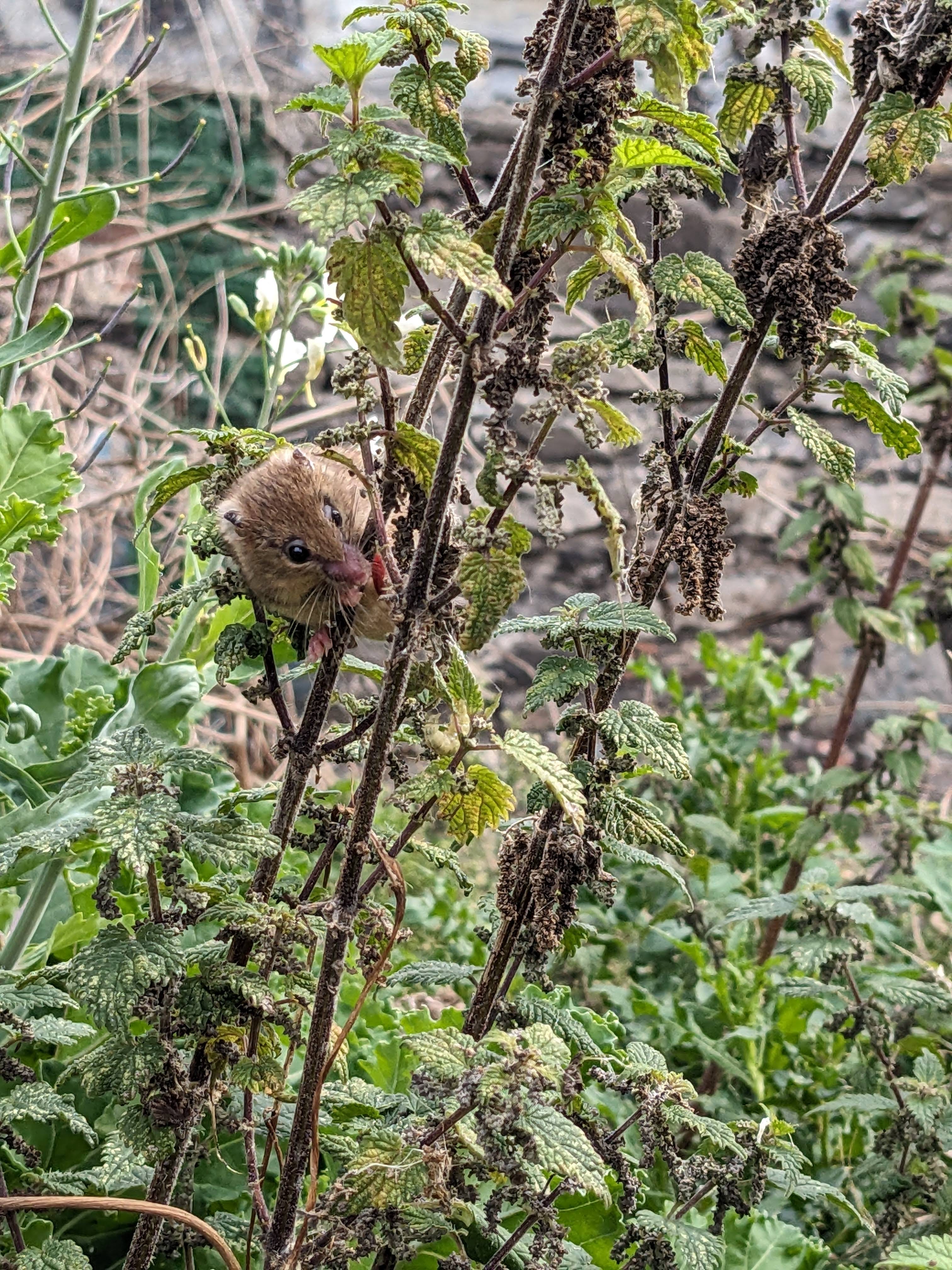
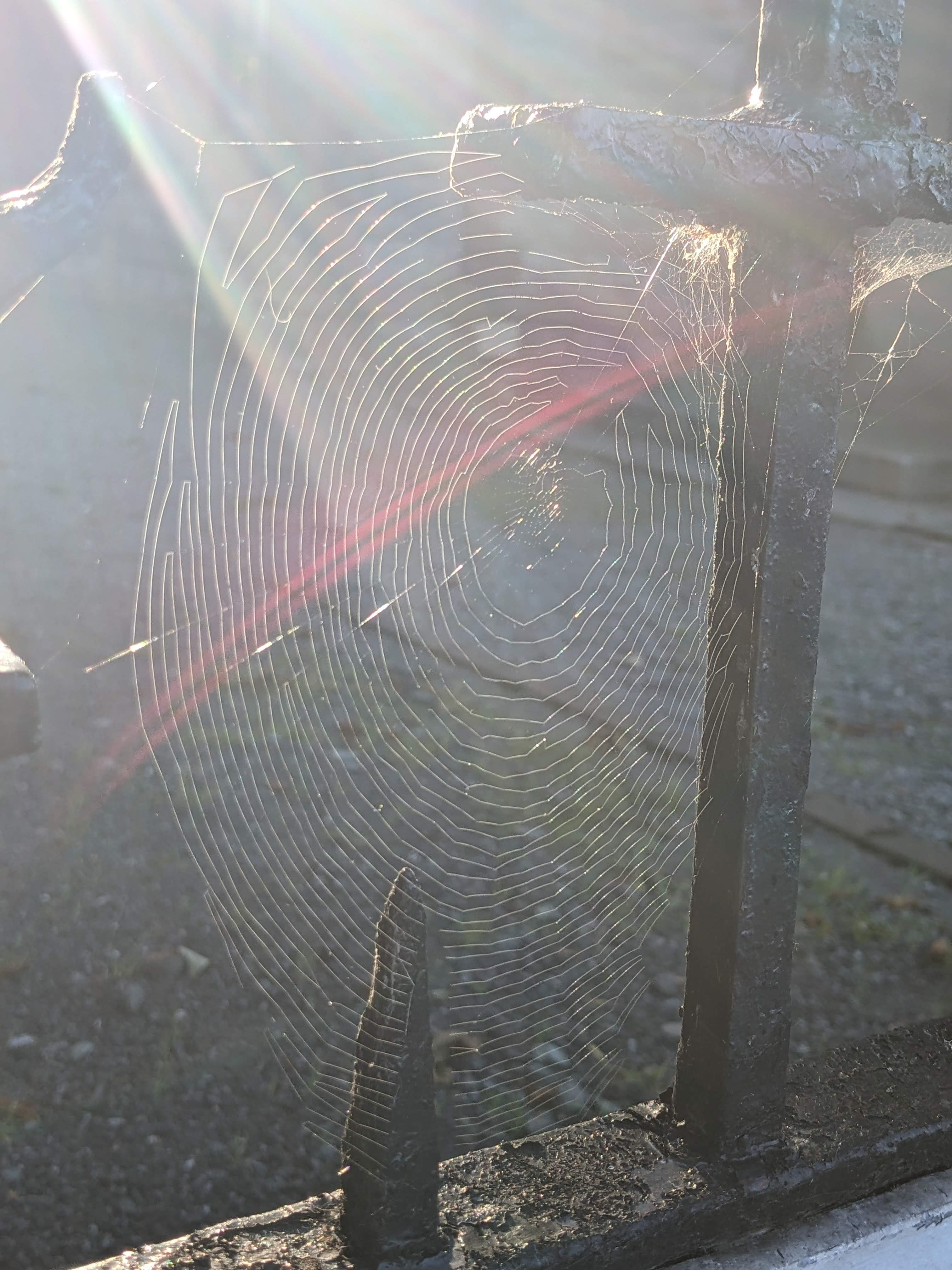
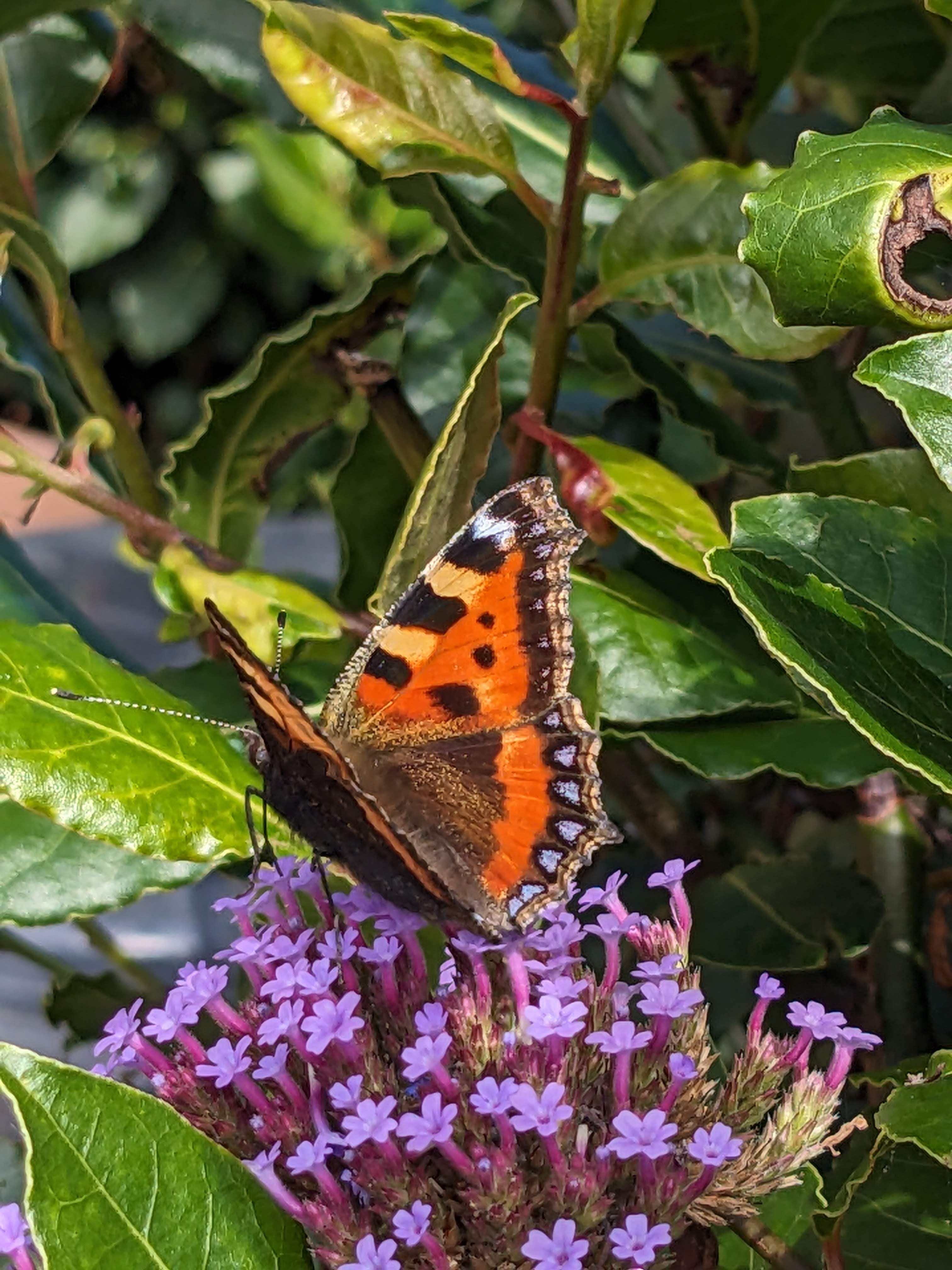
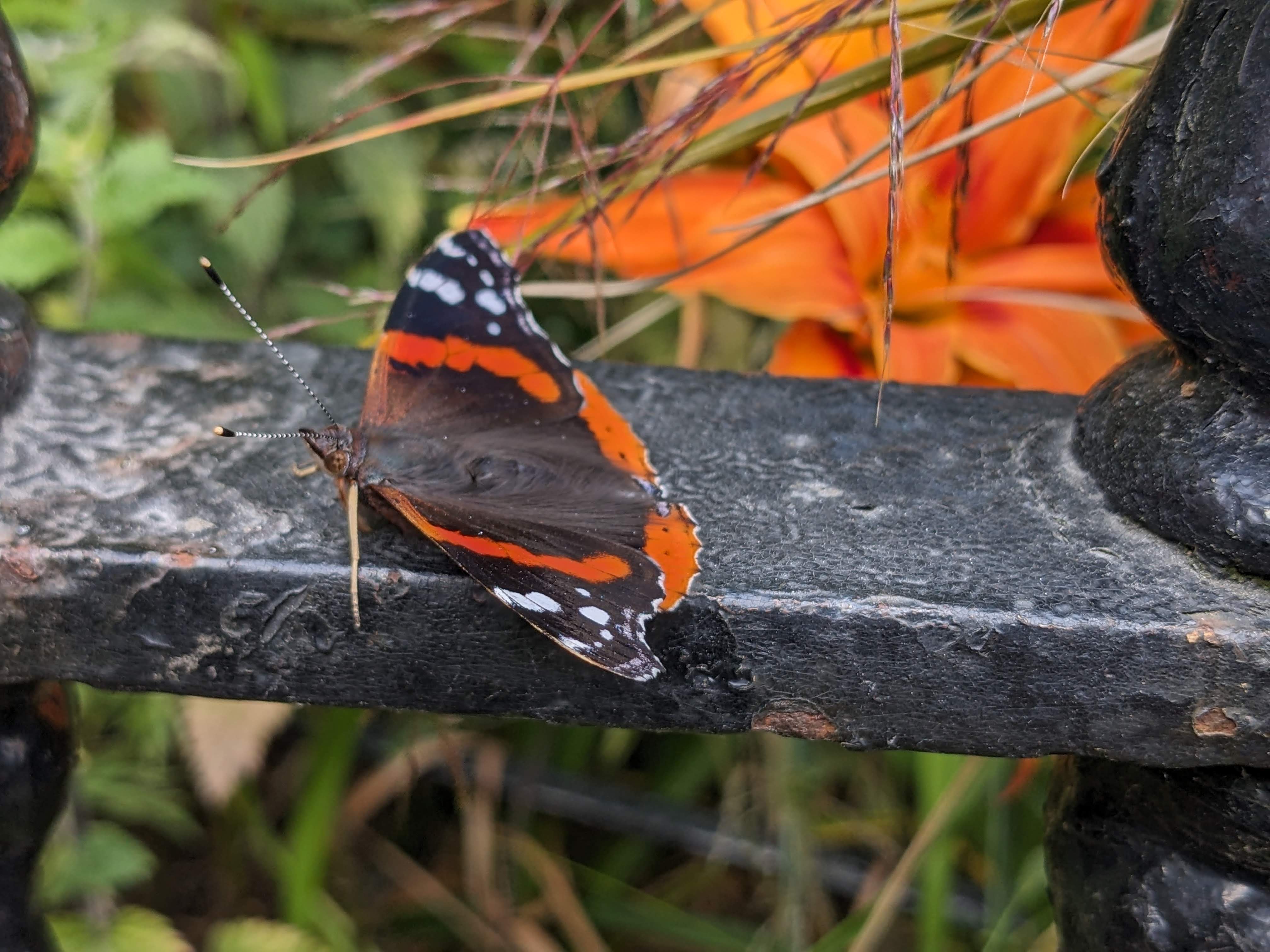
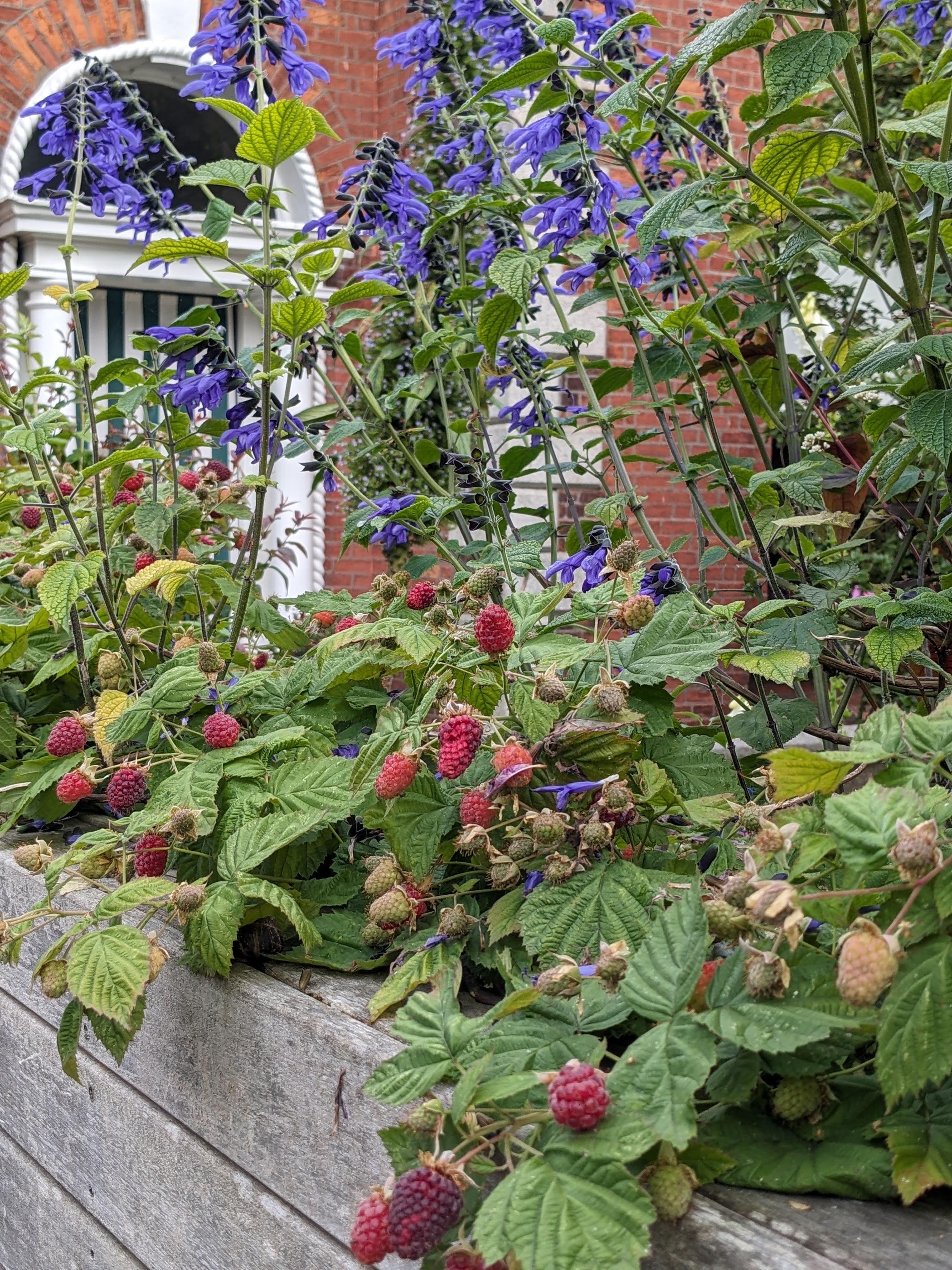
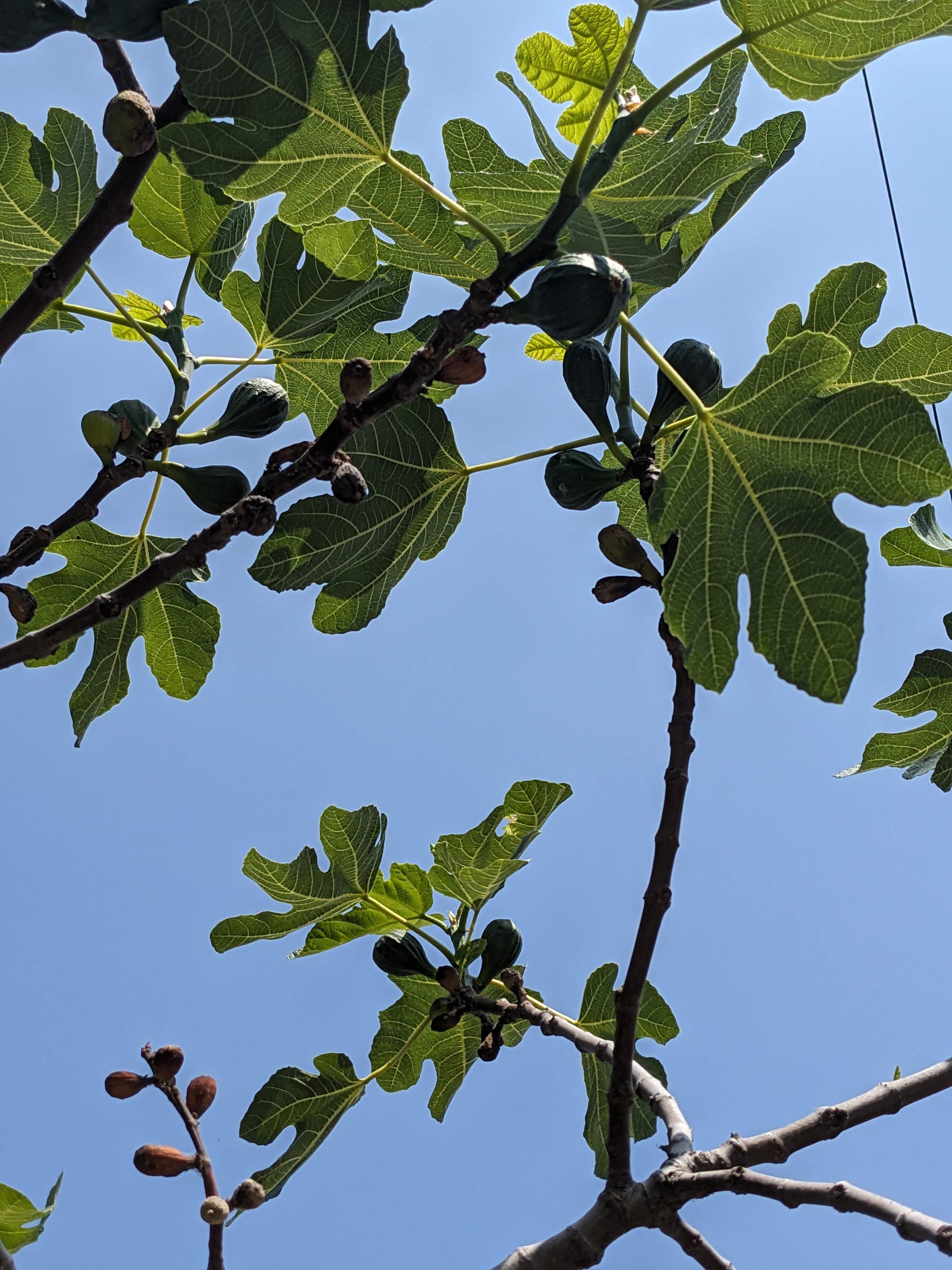
August. Almost autumn. Hardly feels like “August” here in Dublin, but whatever I feel like “August” should be, this has been the August it is: more or less cool and more or less damp, after a July that was the rainiest July on record. Most days have been whitely overcast. There has been fine rain, heavier than mist but not heavy enough to drench. There are ripe figs on trees behind stone and brick walls, and blackberries reaching from behind white-painted metal fencing. Most days have had a period of fair weather in them.
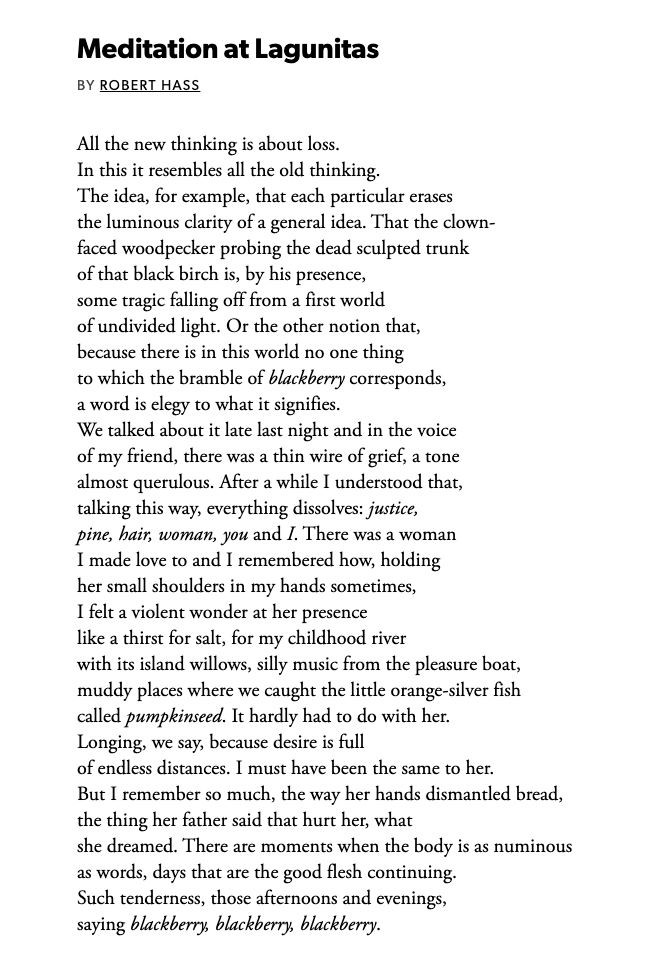
I have been reading poetry every day, a kind of training. I’m trying to learn about poetry. I have been learning about poetry for more than thirty years, twenty years in formal ways, and I feel more and more bewildered by it. How does it do it? How can some people be so sure about it? What would it be like, to be one of those people who is sure about poetry? I feel like I am always just asking about poetry: what, what, what, what, what; how, how, how? I spent a week in July with other poets and every morning the teaching poet gave the group a single poem to read closely. We spent about forty minutes on it, usually, and I could have spent three hours—or the whole day—doing just that close reading. I love this thing called poetry, even though I don’t understand it, I love to do it with other people, and I have no idea how I would go about understanding something so big. So August has been poems and blackberries for me, the latter catching my clothes on their thorns as I reach in to pick ripe fruit. The former always already caught on my clothes.
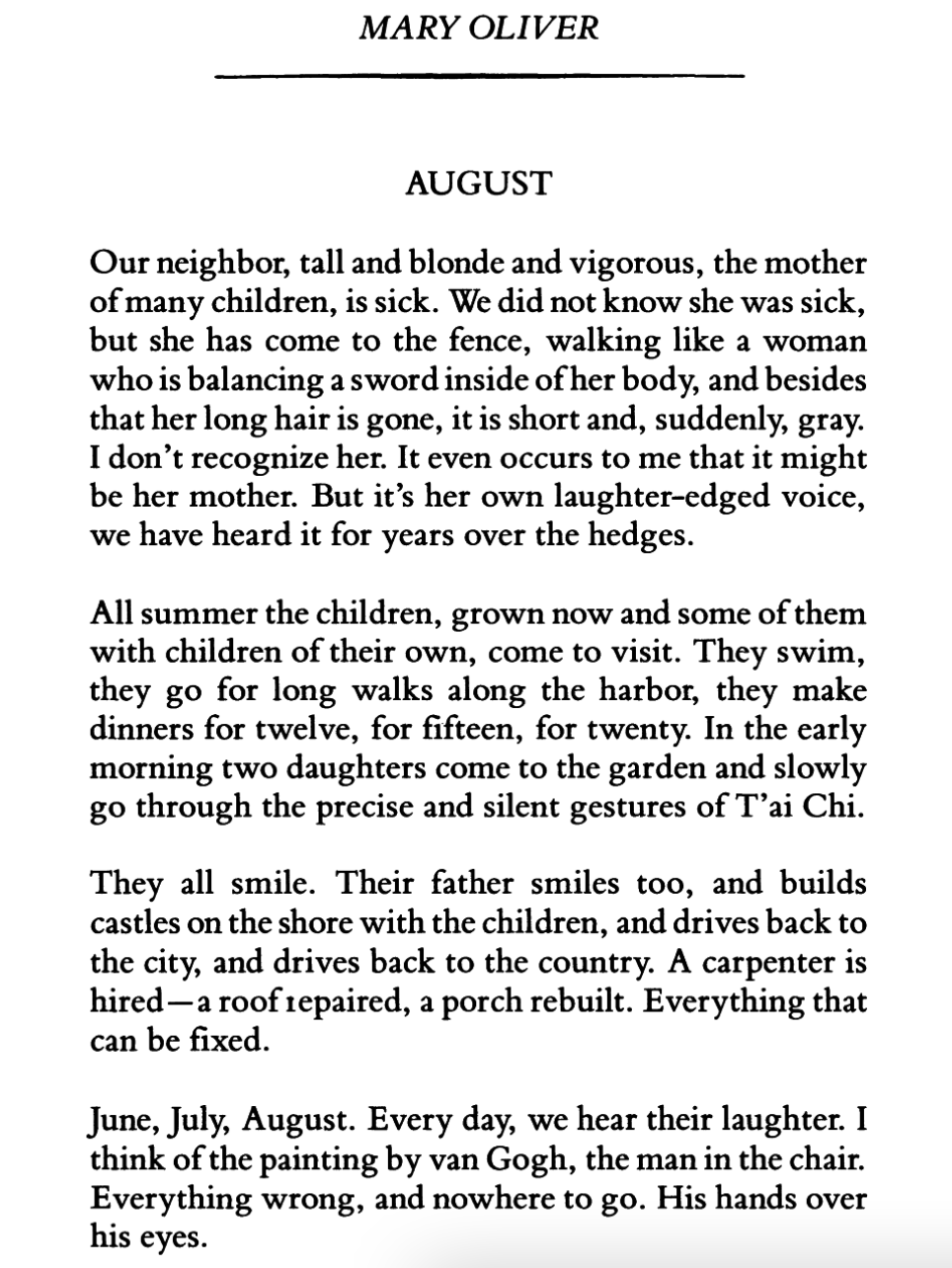
While walking through this cool and damp summer I have had the syncopated knowledge that in so many places this summer has been terrifyingly hot. I’ve felt sick with the knowledge of heat and drought and fire, floods and crop losses, fear and suffering and death—human and nonhuman beings, and the land and the ways of living on and being in those places. When I am afraid I often feel immobilized by that fear and by the immensity of things like the catastrophes of capitalism, imperialism, settler colonialism, plastic, petrochemicals, ‘forever’ chemicals—the ruin of whole worlds, ways of being, possibilities for relation, already in action. The sense of my smallness and the problems’ largeness quickly spirals in two directions. What could I possibly do? What do I have to offer? My life feels very tiny, short, and ineffectual then. And yet life is what we have, each of us and all of us. Not only our individual lives, but our shared one, too. When I remember this I feel immense gratitude for labor unionsandworkers (and students!) who arestriking or have usedstrike threats to get fairer contracts and safer workingconditions—and to remind us what we can ask for and must ask for, and to remind us that we cannot do it alone, and we are not alone.
A model for the present and the future, strikes teach me that we can make sacrifices together that, when we do make them together, feel like joy. Strikes remind me we are together. Our daily lives have to change. That’s a fact. And we can only make that change together—the details may differ from place to place, but the fact remains that we can only do it with other people. We need, we cannot live without, a change that insists that those who cheapen and discard all of life and all the land, water, air desist: militarized nations, massive corporations, massive tech. Our lives are not cheap—none of them, not the lives of the ones who face buoys made of saw blades in border rivers; not the lives of the ones who embark on unbearable journeys in insufficient crafts; not the lives of the ones snipping threads in clothing factories that run day and night, or of the ones carrying ore from a mine, or of the ones packing boxes under the eye of a computer timer in a warehouse. Not the lives of the ones who fly or of the ones who photosynthesize.
We can change our lives together, for one another. The urgency is huge. We are faced with the facts—the exclusionary, unjust, entrapping facts—of landlords’ hoarding and of billionaires’ death-driving. But we don’t have to accept these facts. There is no outside to the circle if we insist there is not. We can set down our tools, close our laptops, park our cars, and walk into the street together, hand in hand, arm in arm, shoulder by shoulder, singing. We can strike from our everyday lives. (I am still in awe and wonder at the self-immolation of Wynn Bruce. How do I live as committedly as that?) What happens if we do strike from our everyday lives, our habits of knowing and doing and being? What happens if we step, for a moment, together, into a new possibility? (Ruby Dee: “[The songs of the civil rights movement] became almost as common as love songs. And also—direction songs.”) Direction songs. We aren’t the first people doing this. If we sing together? Sing instead of shopping? Sing instead of working?
A strike is holy. That’s why it’s hard—holy things feel impossible on the one hand, and maybe almost silly on the other. But looking one other person in the eye and joining them—we will find it is not silly at all, or difficult, at all. There we are. Together.
I think that sense of holiness is a name for what happens when people do something together that departs from the “just how the world is” of the world in order to insist on beauty, dignity, care for the world and its beings, the value-as-such and -in-such of land/water/air/all life. Invention and daring in service to shared life. I haven’t figured this all out but that feeling of holiness is part of why I want to pay attention to poetry—its how more than its why or even its what—and to blackberries and all the other ‘minor’ (not minor!) indices of time and place. The closer I look the more I know: we are here together. Meaning happens amid the smallest movements and by the most minuscule differences. Everything is precious. I’ve said that before, I’ll surely say it again, because it is the simple thesis of the world as I’ve encountered it. There is no living thing that is not bound up in our shared existence. If we mean, we mean together.
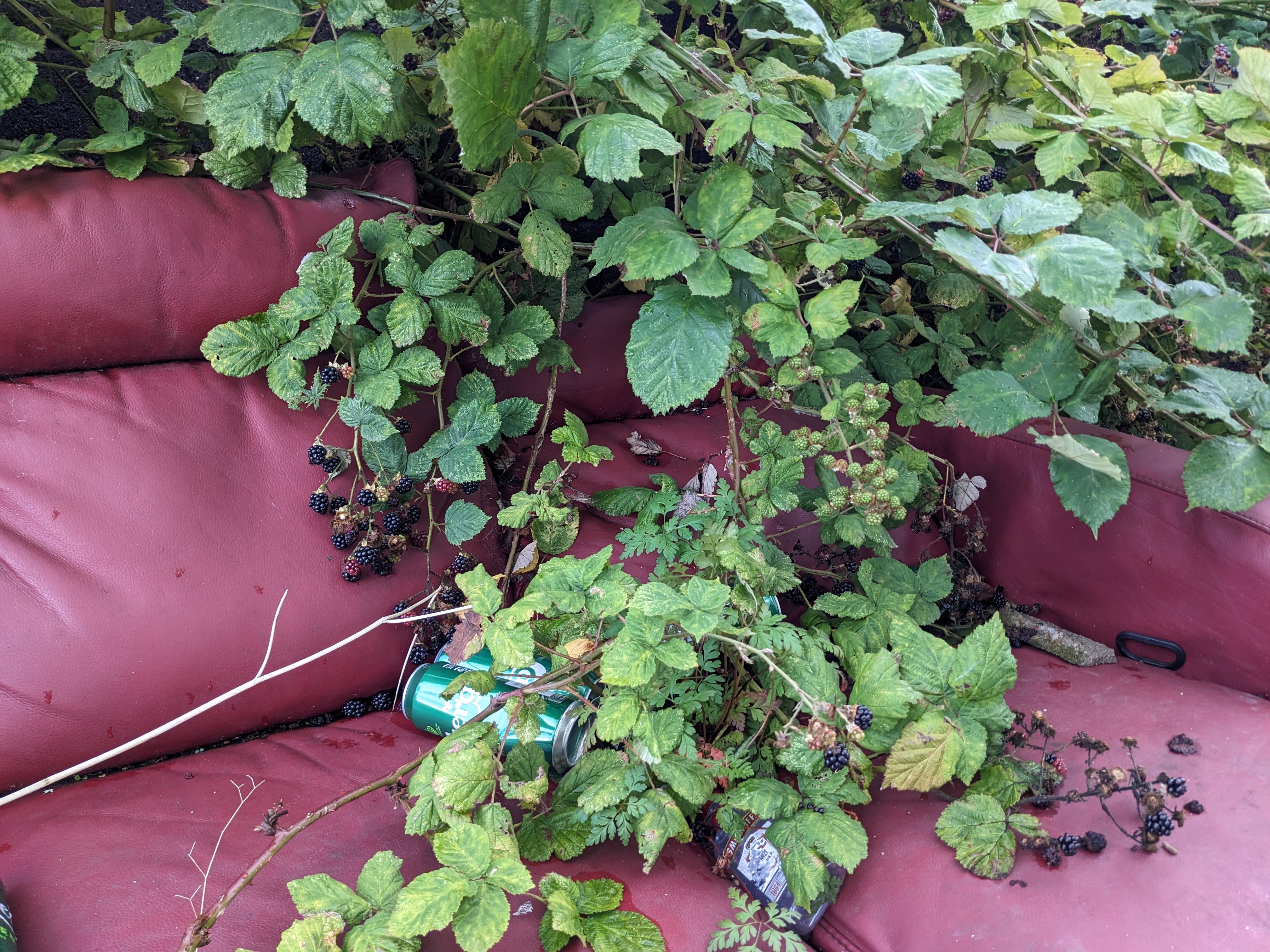
What have I learned, reading poetry and walking, looking at and picking blackberries in neglected lots this August? Thinking takes place over time—I knew it, but I have to learn it again and again. A poem is sometimes the accretion of meaning across a duration rather than the crystallization of an image within a form that can be held in the hand. The most basic, incontrovertible fact of life is that we are bound up together in it, and that one thing that poetry, music, art can do—not necessarily, and not always, but it’s possible—is remind us of that fact, and of our responsibility to one another. (Need something to carry you there? Here’s Sister Rosetta Tharpe with a lesson. And here’s Pete Seeger, Sonny Terry and Brownie McGee with another version of the same.)
Beauty is the lesson we can never finish learning. Whole, open, for everyone. Like poetry, we can spend our lives on it. It’s not simple—it’s deeply complex. It’s not reserved; it’s for everyone, always. It’s not esoteric, it’s here, right here, at our fingertips, again and again, every day. It’s the fact of our intense, intricate co-relation, unfolding.
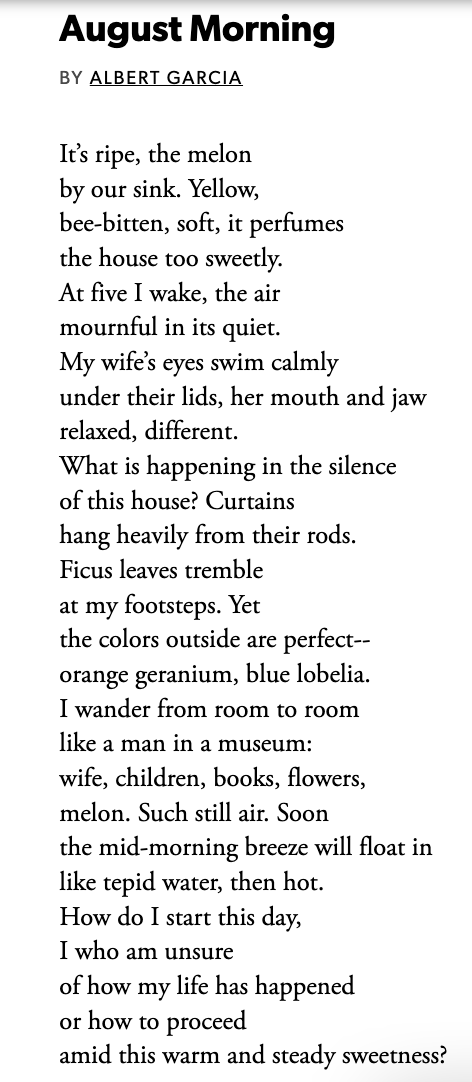
I’ll leave you with one of my favorite poems, one I think is probably on a lot of people’s list of favorites. It’s a poem I was given by a teacher when I was about 22 and it is still mysterious to me. In every season it’s given me something new. I still don’t fully understand how it does what it does, or all that it does. But it does remind me that the world is a shared one—the world of blackberries and beloveds—and that one thing poetry can do is try to speak and spell exactly that complexity, one letter at a time, one poem at a time, until, along with the everything-elseness of the world, we have made and continue to make the world in which we can all live.
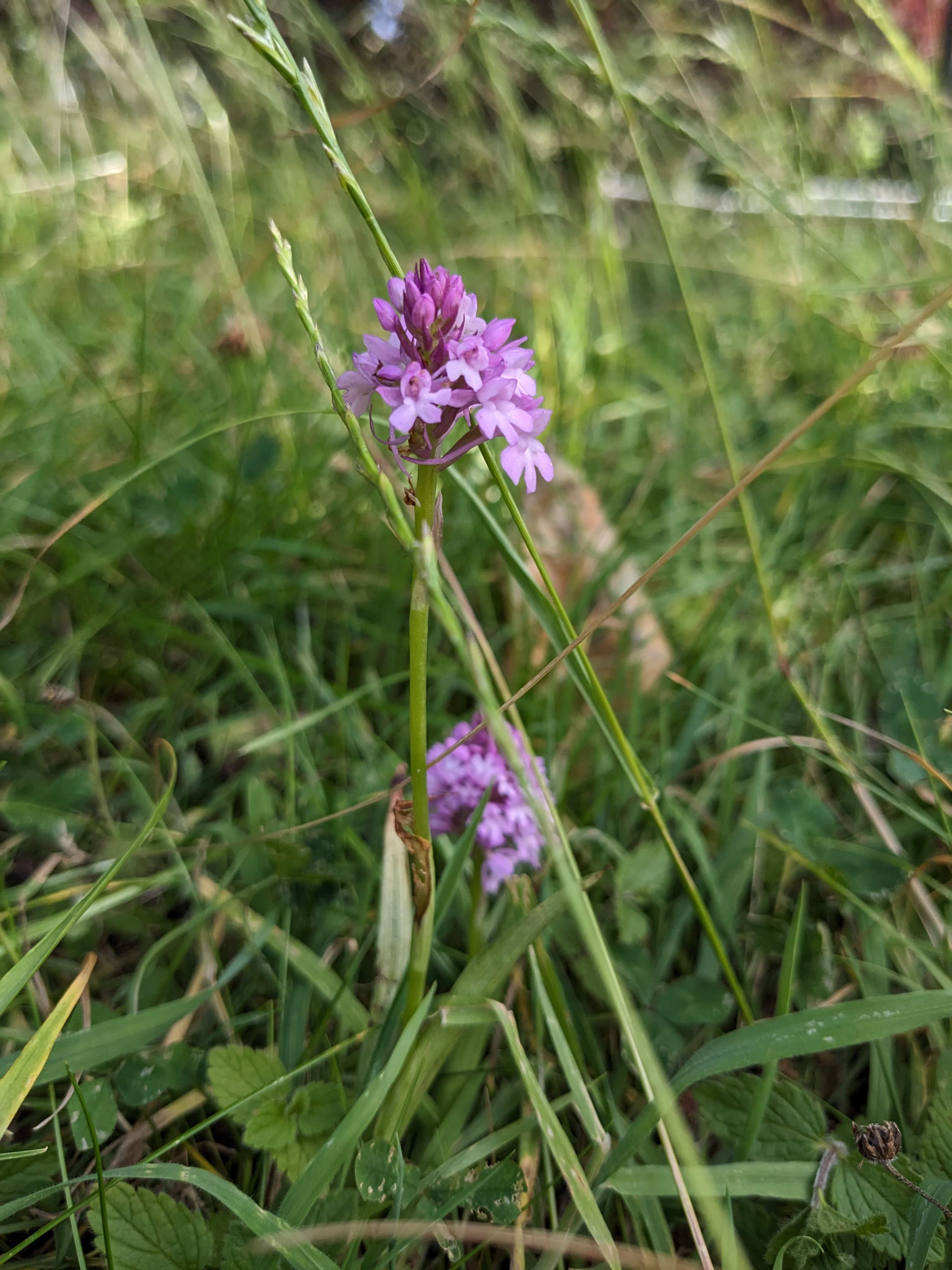
At the start of July I saw a pyramidal orchid for the first time in real life. At the place I work the groundskeepers have left swathes uncut between mown areas for walking and in those places I’ve seen so many wildflowers over the past three months. When you get down by the ground what might have looked homogenous when rushing or even just walking by fractures into incredible diversity of kind, color, size, form. And it doesn’t take a ton of space for this, either. I often think about the breadth of a street, and how many gardens, how many fruit trees could be made in that space. Imagine walking out your door to a vegetable and fruit garden of your own (imagine a redistribution of massive wealth such that having the time to care for and work in such a garden were not a ‘luxury’ but a part of everyday life). In my imagined city there are bike and pedestrian paths down the center, fruit and nut trees shading the paths, gardens between there and the houses. Bus and tram lines too but I’m not an urban planner, here; I’m just a dreamer, kneeling in front of a pyramidal orchid. But look what huge things can happen in such a little space.
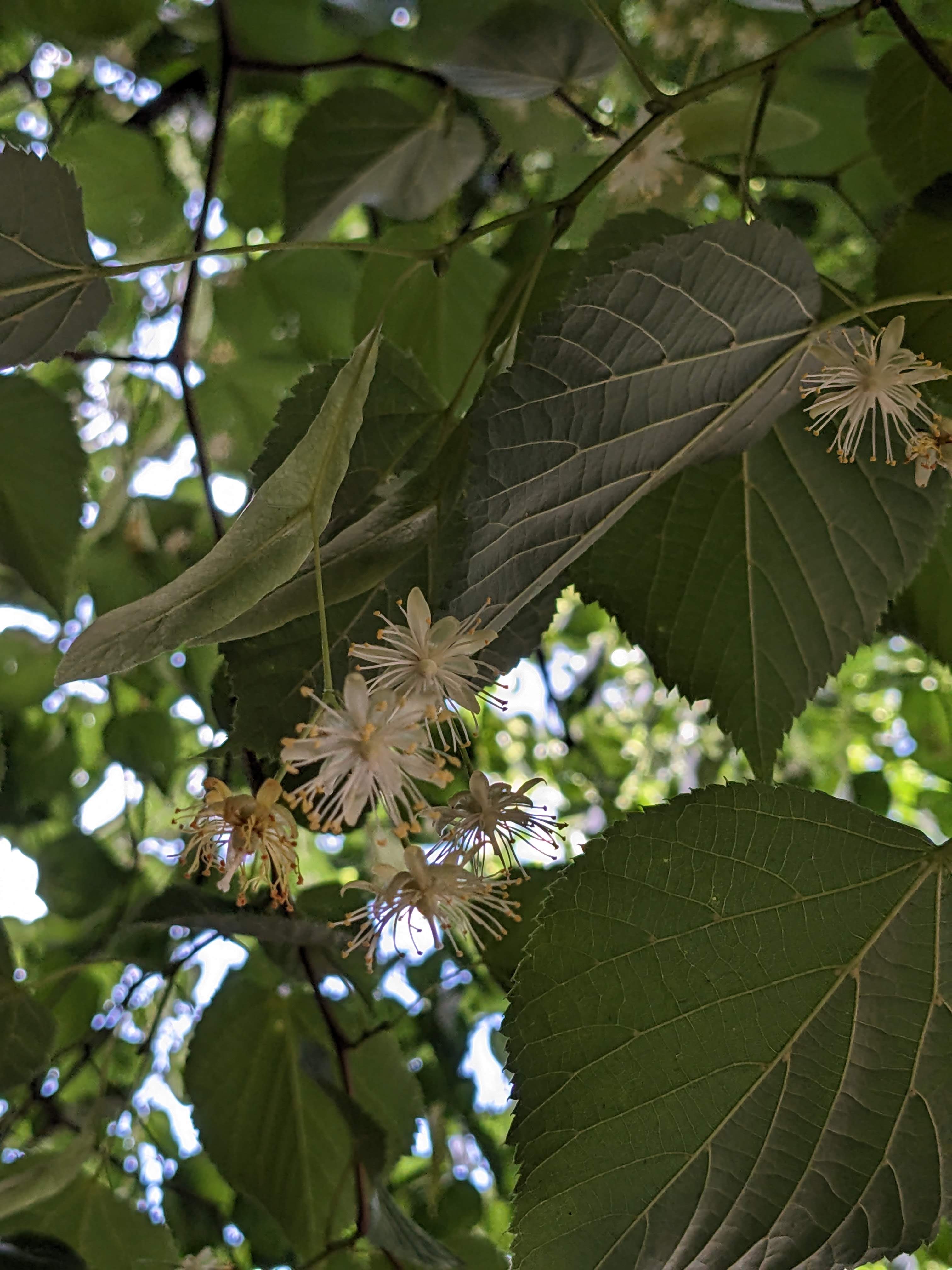
Did your nose lead you through the streets until you found the source of July’s perfume? It is the linden (lime) trees in flower. Only for a short time—a week or two; shorter if it was unseasonably hot. For everyone, freely available, without cost: their scent is a shower of softness.
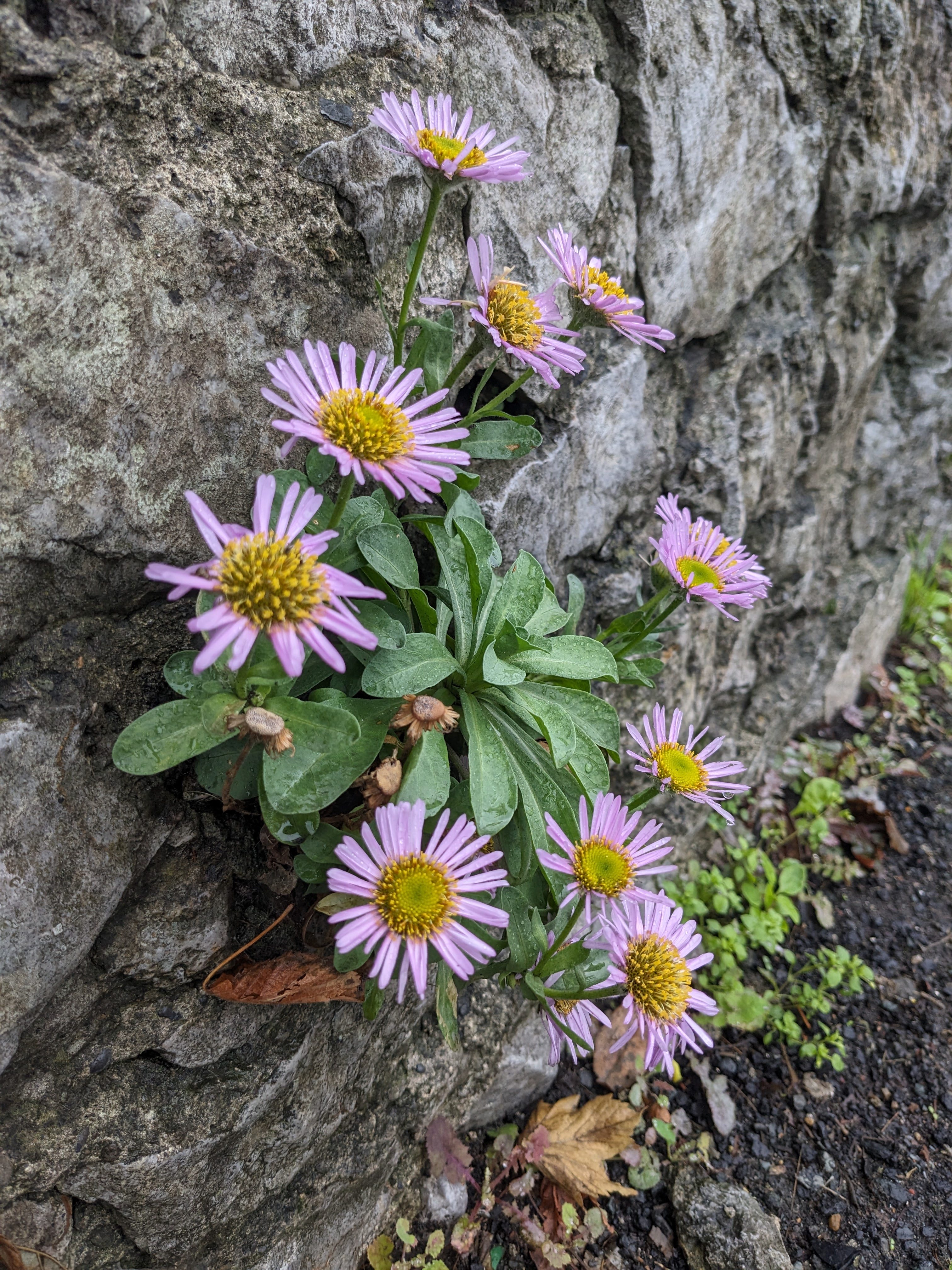
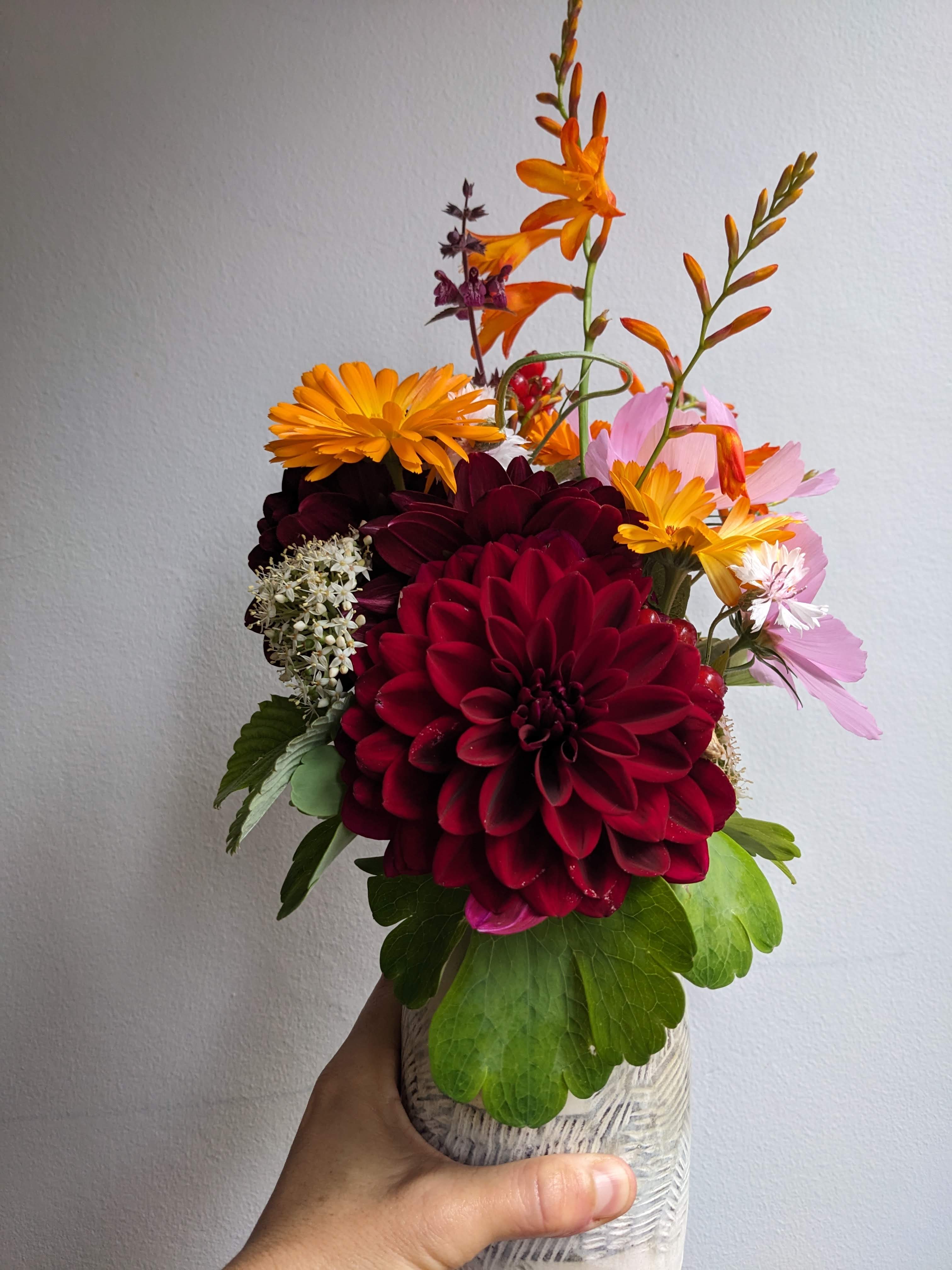
In gardens we may not own but rent or borrow, in friends’ gardens, in the places where plants escape the borders of the private yard and spill onto street or public path; on the grounds of banks and private equity firms; in the crack between pavement and wall: we can find and gather the riches of summer. (If you are in Minneapolis/St. Paul, and you want someone to find and gather these riches for you, Night Owl Farm has a beautiful flower CSA. It’s not cheap but what a gift—flowers every week for the price of a lunch out that week. Elsewhere, look for farms that do this. Great way to support smaller farms and to give presents that don’t need to be manufactured.)
What do the beings of the world say but that borders are fictions and that everything is precious? That life is always going on, all around us, and is infinitely interesting and complex; that the work of making meaning and of coming to understanding is endless and for everyone—could not be achieved by one person alone, or in one lifetime. These border-crossers know that ‘nation’ is a lie enforced by militarization and in service not to life but to wealth. They know that the networks of mutual dependence and reliance are everywhere and nothing living or unliving is outside of them.
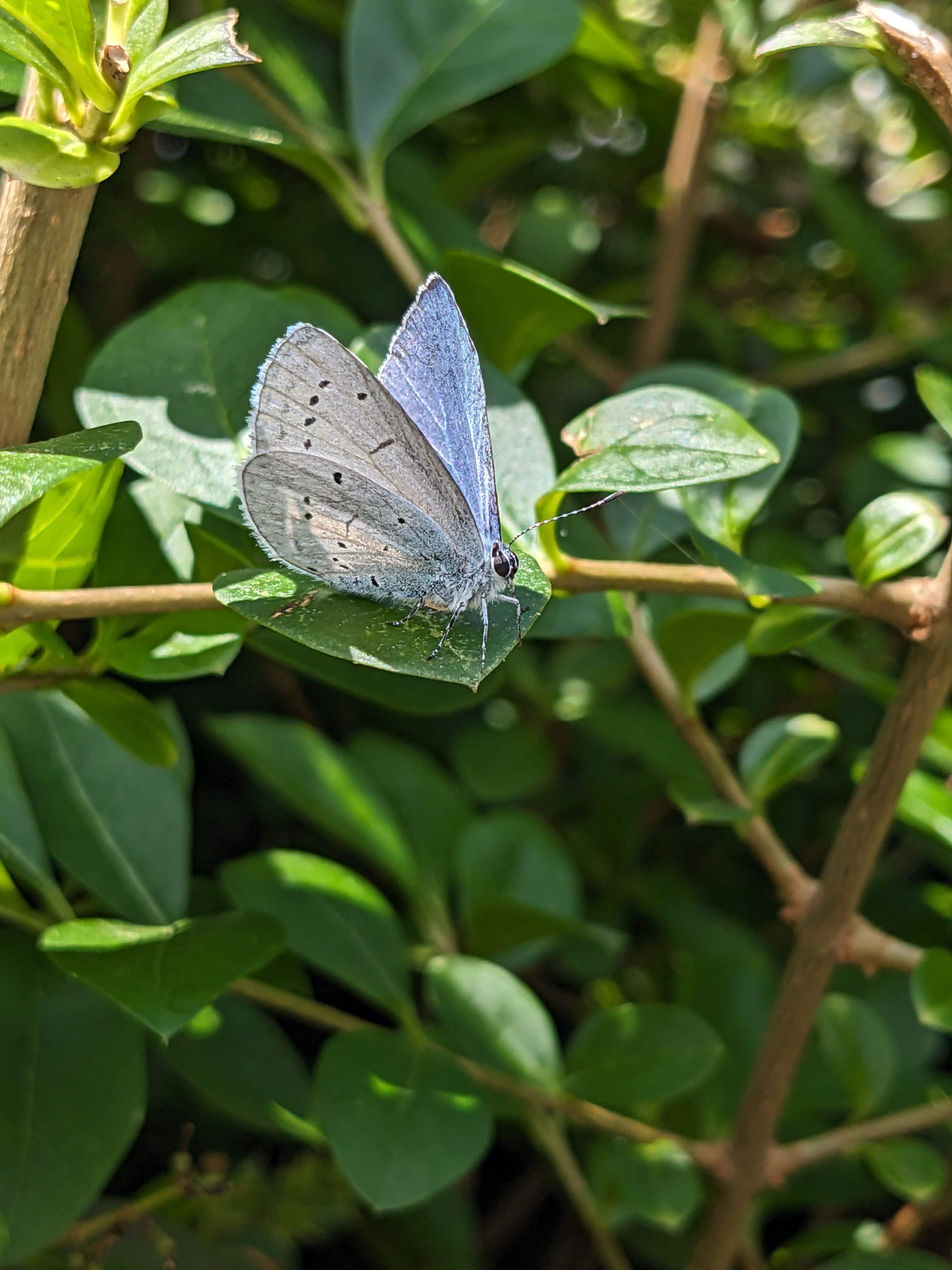
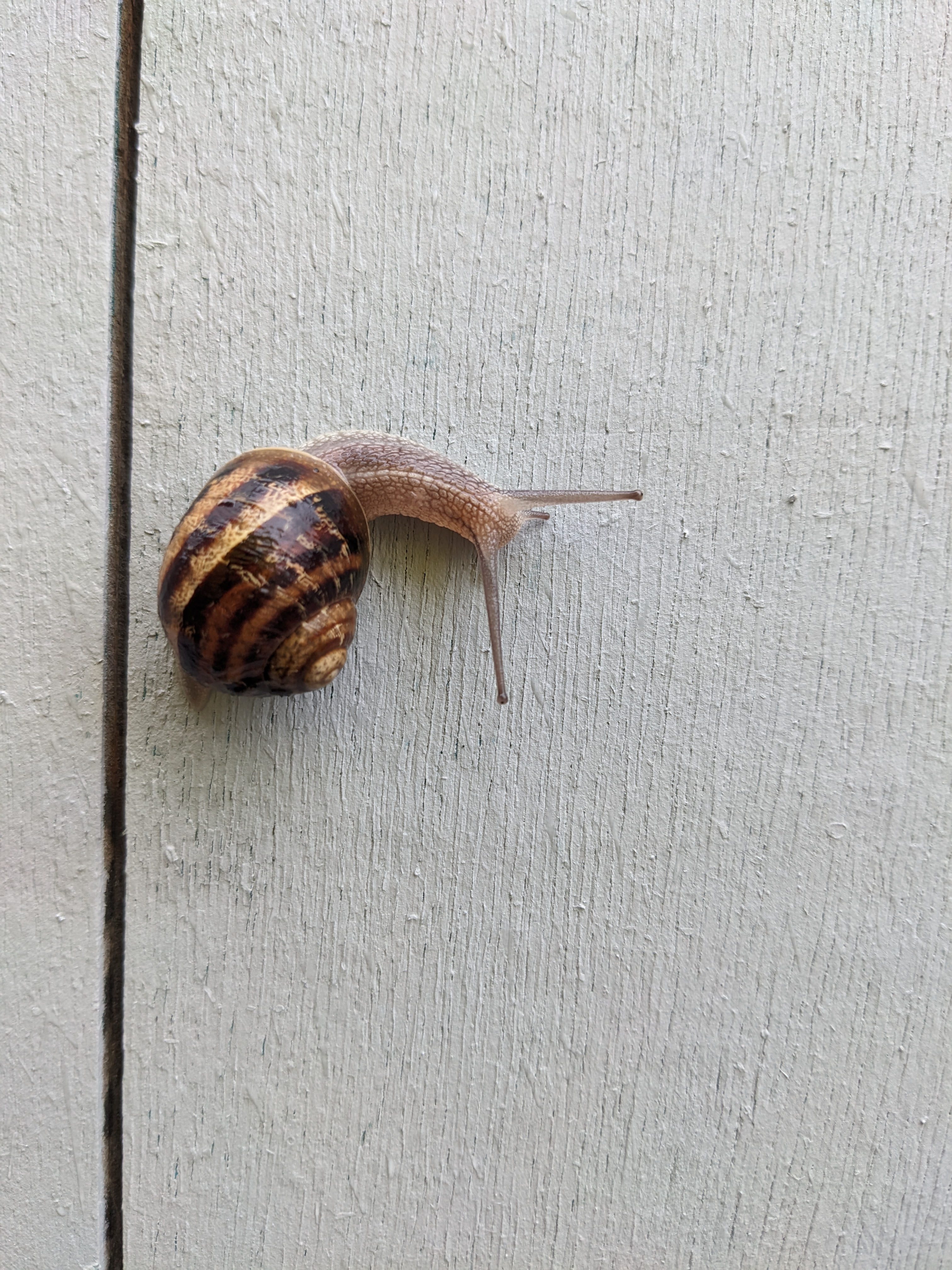
The beings who live alongside us (including the human beings) also tell us that grace inheres in each thing, as it is, in the ways that it is, a grace that is not theological but intrinsic, theology being only one way to interpret what is always already there. Hopkins’ theology brings him to this conclusion—“Each mortal thing does one thing and the same:/ Deals out that being indoors each one dwells:/ Selves—goes itself, myself it speaks and spells,/ Crying Whát I dó is me: for that I came”. The beauty of geometry and the unlimited curiosity it can teach us! “Euclid alone has looked on beauty bare”—would I go that far? Maybe not, but I know the poet uses hyperbole to effect an argument, and I take her point. (Also, I learned this week that snails are left- or right-‘handed’.)
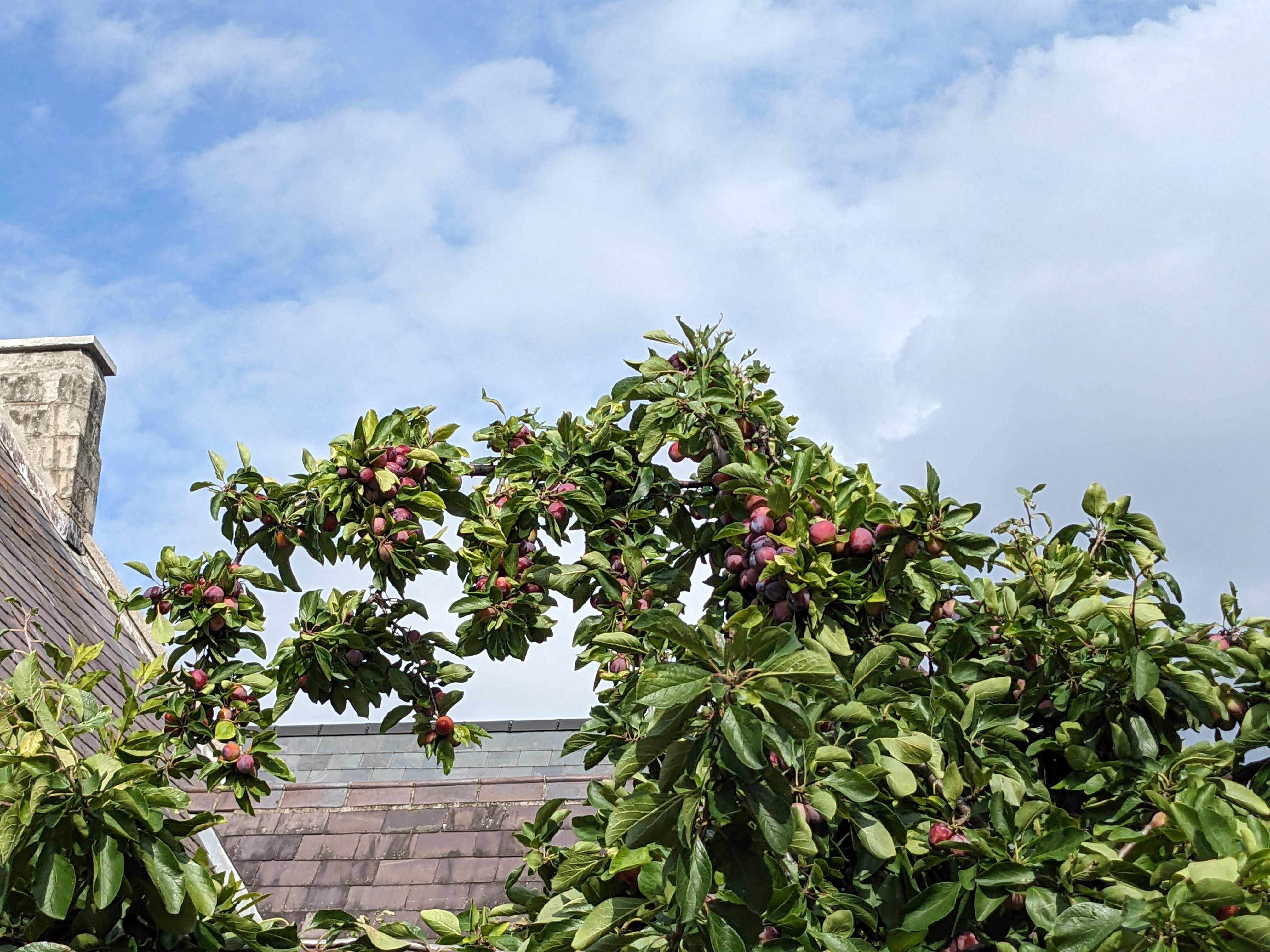
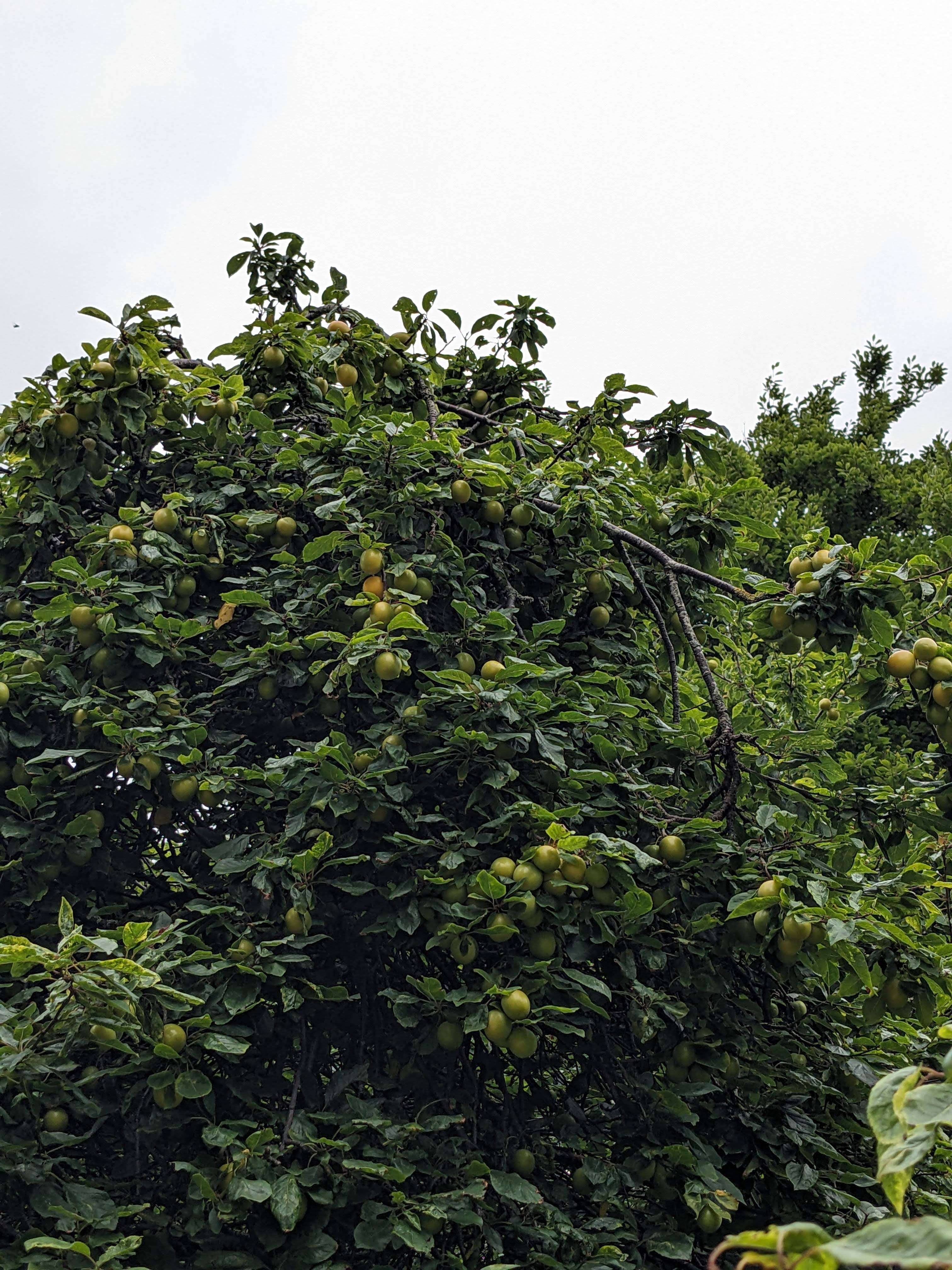
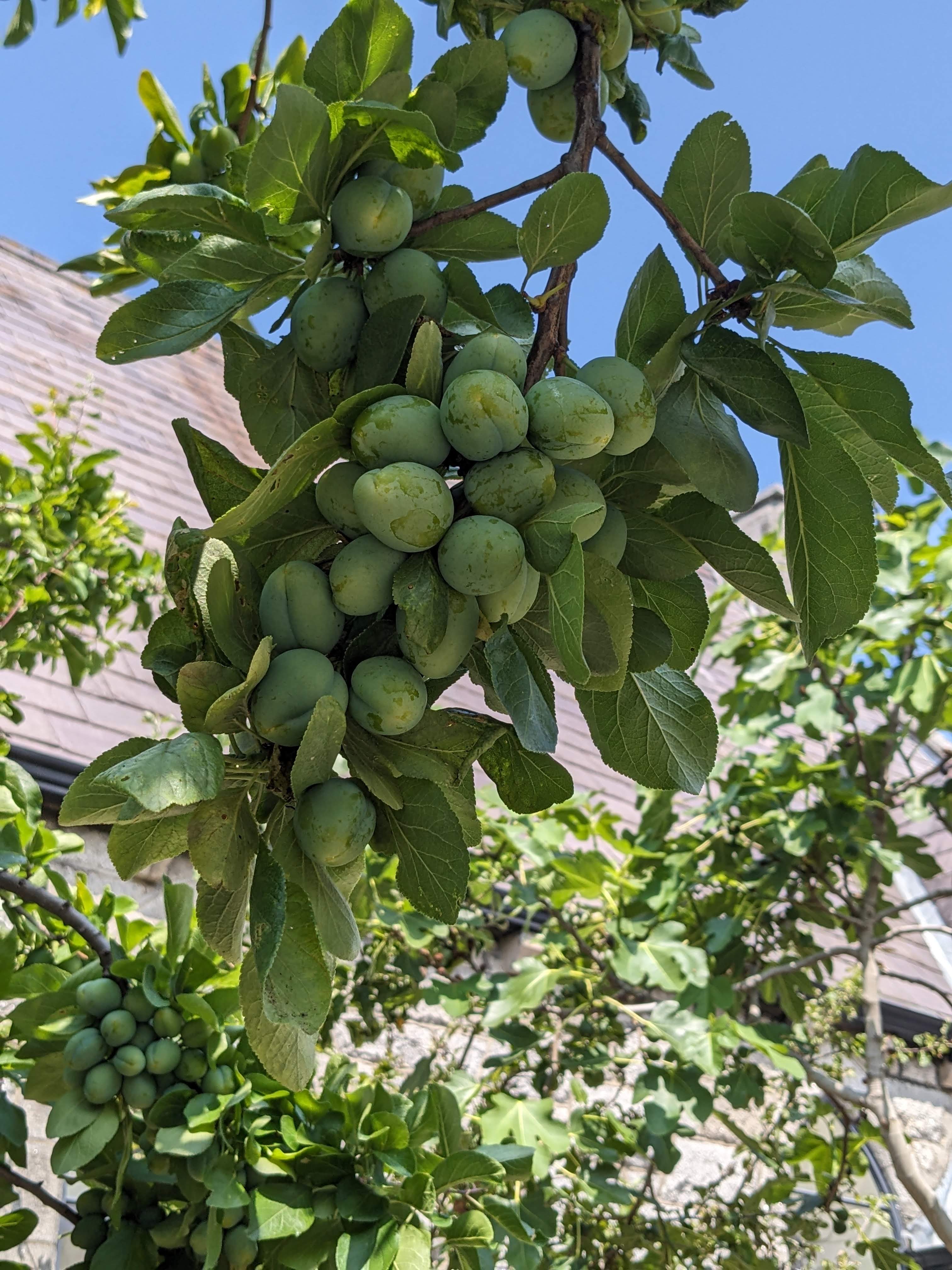
This city is a city of fruit trees: public plantings of plum, cherry, pear and hazelnut all drop their bounty to smash on the sidewalk and be crushed under the tires of cars. As I have walked over the past eleven months I have noted the places where fruit and nut trees are and mapped them, and in July I returned to plum trees—already covered in ripe fruit—to gather what fell. (I only take windfalls from trees that are private, or I ask at the door if there is fruit on the ground whether I could pick from the tree. And I shake public trees to adduce them to drop fruit for me.) From windfall plums and mirabelles I made four small jars of jam. I have to push back against the scarcity feeling when I gather this public fruit—telling friends on purpose where the trees are. It has to be for everyone and if I’m against its enclosure I have to be against my own desire to enclose it. There is more than any one person can use. And imagine if all the plum and apple and cherry trees in the back gardens of derelict buildings could be harvested? Imagine a jam kitchen for anyone to use. Imagine a café that served meals or treats on a pay-as-you-can basis, made with food grown in back gardens and on city streets. The world of plenty and of solidarity is already here, we just have to act as though it is. This world in which we could live by the dictum of sufficiency-and-no-more rather than by more-and-more-and-more is possible and we are part of it.
It seems impossible to me to walk without thinking about riches: in Dublin this is so because of what the financialization of housing has done, and also because there are banks and finance corporations and tech corporations and the trappings of extreme wealth, and because property is so prominently present as well as the dehumanization and abandonment of the poor. But it’s also so because the world itself is riches. Not marble nor the gilded monuments—what “lives in lovers’ eyes”, what is lasting and meaningful to me is the way that looking and walking makes me alert to ever more complex detail, the way observation teaches me to see that detail and its relations and to metaphorize and generalize from this, to understand structures and concepts in new ways, which again direct me to the world of things, material and phenomenal.
August is almost here; September is coming. I’m planning to write, loosely, in the region of learning to write and teaching writing. If you’re reading this and there was a moment you can remember where a teacher changed your mind/your life/your practice about/of poetry or writing, or a reading you remember that broke your mind open in important ways, would you be willing to tell me in the comments?
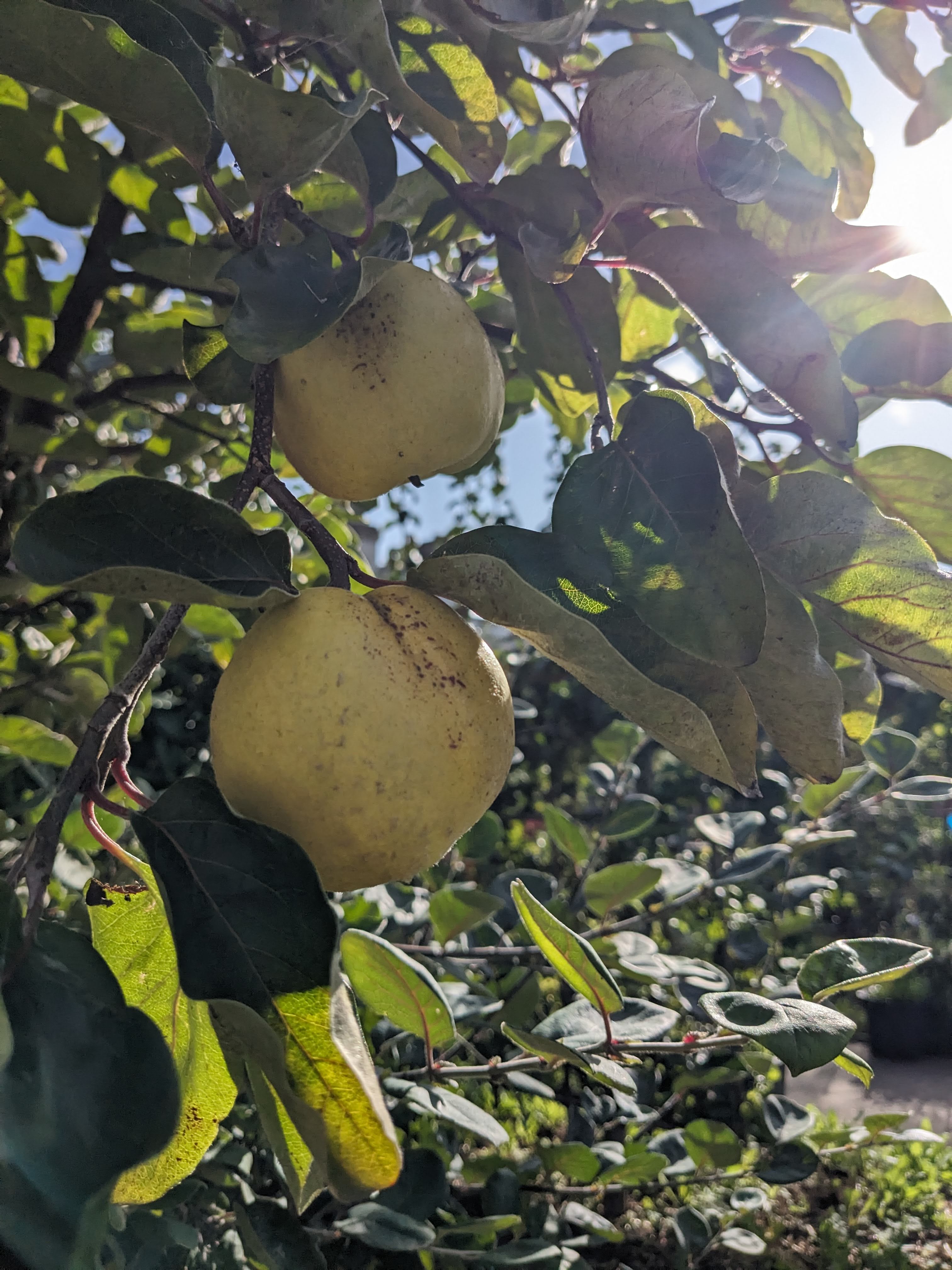
June is fruit, humidity, the return of rain although not sufficient rain in some places and far too much in others. I’ve been watching the gardens with fruit trees and bushes all spring and now that it’s full summer I’m watching them with covetousness. I did sneak one raspberry from a cane that overhung the sidewalk. There are apples, quince, pears, raspberries, blackberries, plums, and figs on my usual loop. There is a greengage tree at the university that was absolutely covered in white blossom early this spring.
June has also held the lingering awareness of the Canadian fires: smoke arrives here off and on as haze. Only once so far has it been a low haze, and even then nothing like what I experienced in summer 2021 when we moved from Maine to Iowa and drove through smoke so thick the sun was a small, red disk in the west. But enough to trigger sinus infections and breathing problems and simply to keep the maritimes and Québec in my mind. When the rain comes here I think of it also arriving on those burning and smoke-filled cities and forests. The horror of the fires are what they contain. Hard to think of the trees, plants, animals, birds—and also of the buildings, oil, plastics, insulation, heavy metals, people’s houses and objects, all burning.
All this beauty. It is not ordinary: it is so precious. I talk to a woman in a town outside of Dublin where I’ve gone to look at a house and she says, but of course you will get a car. I laugh, because this is what you do when people confront you with your own ‘silliness’. Well, no, I say. I’ve never had a license. But you’ll surely have to get a car, she says again. And I demur and we go on to talk about something else, and I am not quite brave enough to say, I won’t get a car because I’ve been thinking about this for almost thirty years. I won’t get one because that would tether me to oil fields and military occupations and a couple of tons of machinery and insurance agencies. I won’t get one because I’ve been walking for more than forty years now and have yet to exhaust the possibilities of foot, bicycle, bus, tram, and train. There are fires all over North America. Online a scientist posts a graph of the Greenland ice melt from this season: I’ve never seen anything like this, he writes. The temperature of the ocean around this island is shockingly warm right now, and every time I see one of those diagrams with the years represented as a red or blue line I feel sick to my stomach. There is very little I can do. It isn’t a one-person problem. It isn’t solveable by my decision to do one thing or another. But I can go by foot and bicycle and public transit. I get something out of that—it changes me (what I can imagine, how I use time, what I see…), expands me, feeds me and makes me happy. I try to constrain my desires and my consumption just that much but it doesn’t feel like a loss. One way—one way I’ve found for my life—of yielding to the bog orchid and the corncrake, the ladyslipper and the loon. Your ways may be different to mine.
But I don’t say any of this to the woman.
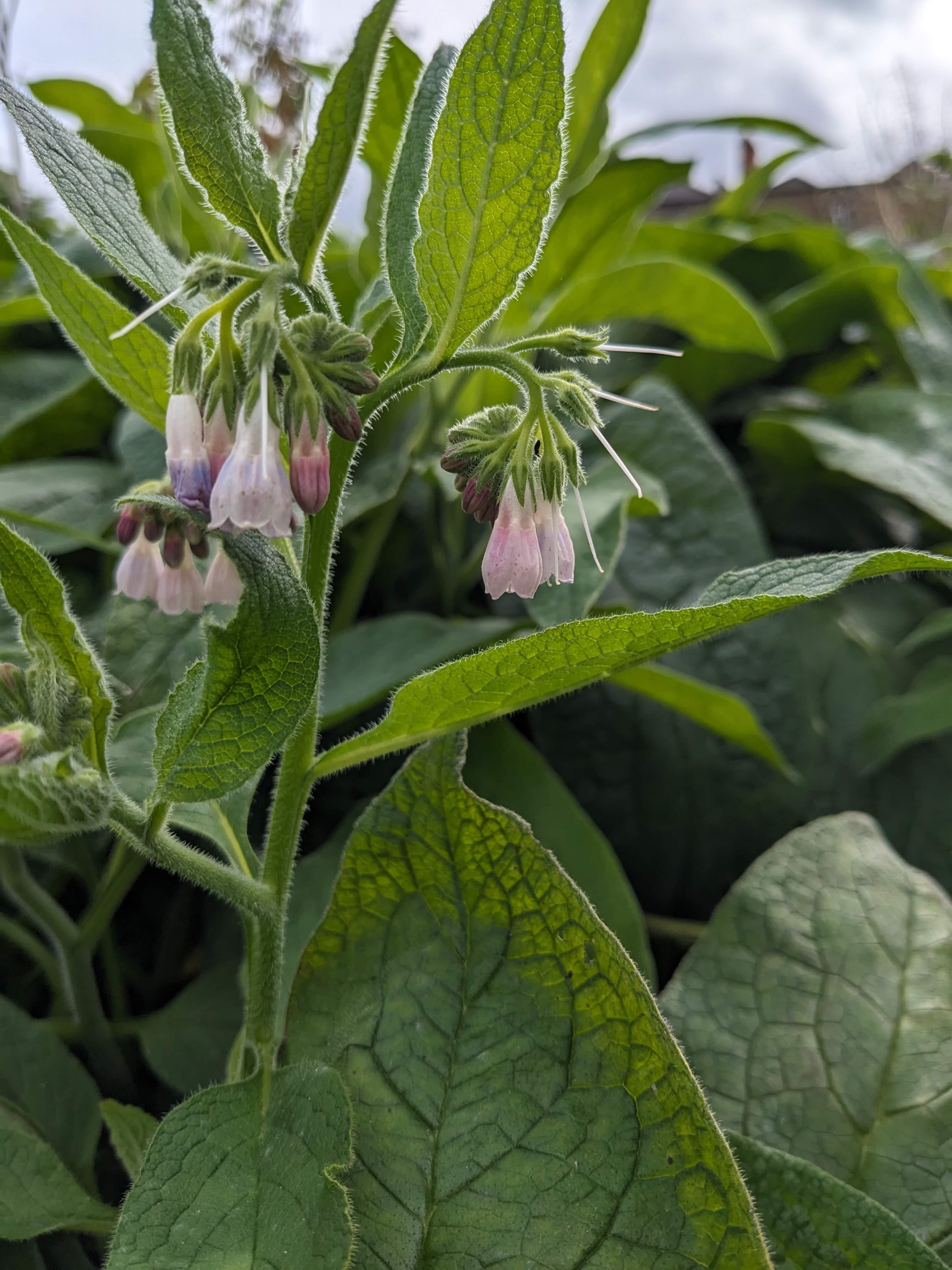
Going by foot has benefits, just not speed. But I’m not sure that speed is a benefit in any case apart from when one needs to get to a hospital or similar. The midpoint of the year has gone by now but the academic (teaching) year here is just beginning to slow down. I can’t help but think how much better and more humane it would be if we kept to a much slower pace all through our teaching year. I pick flowering weeds as I walk from the bus stop to my office on campus and put them on the photocopier, week after week. I’ve been able to see the empty lots and byways transform over the past months, day by day, on this short walk.
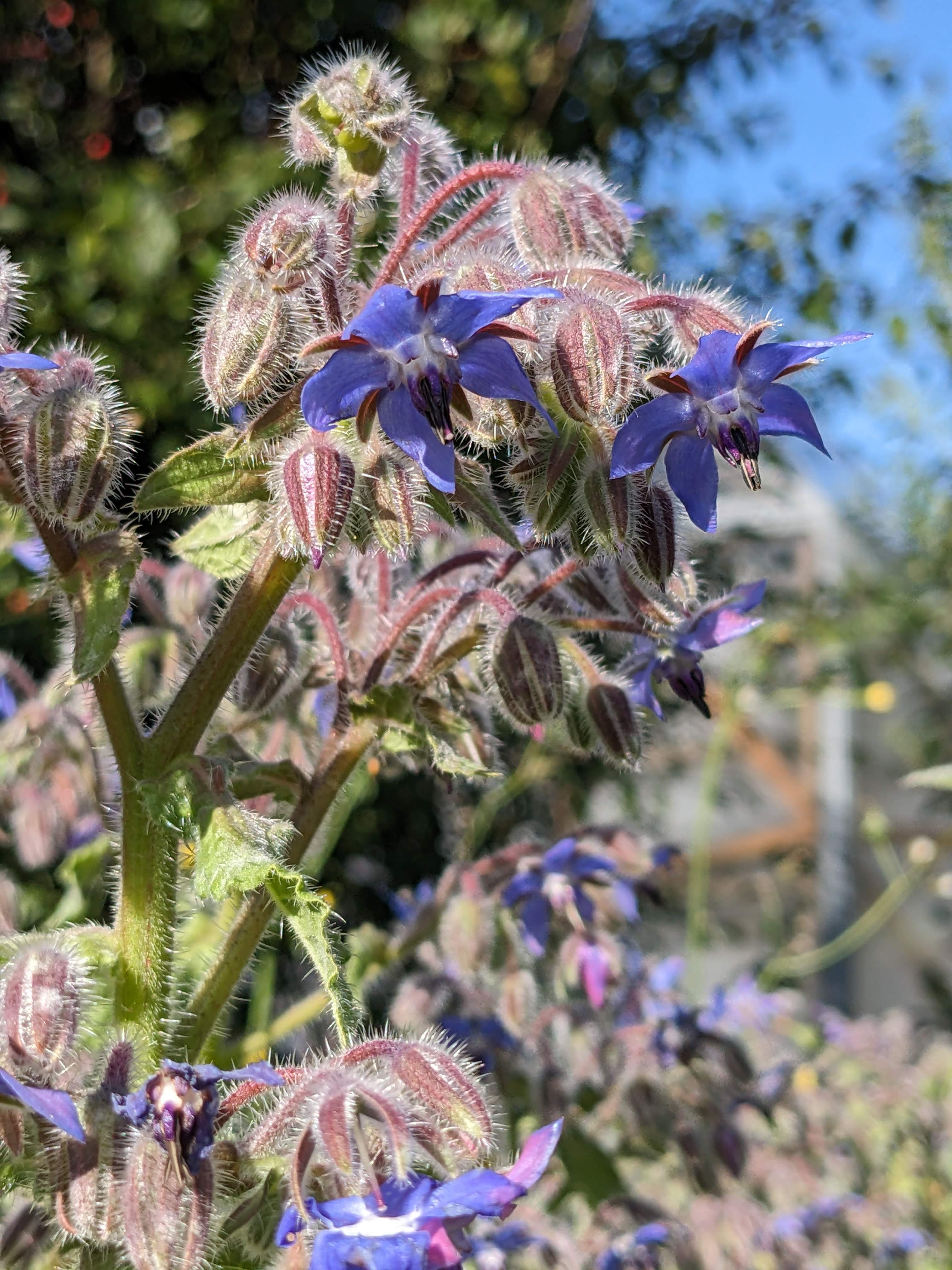
This week there were more flowers in bloom than easily fit on the platen and the image is packed with them. The colors now are yellow, white, red. Yellow has been a constant through the spring and summer; poppies showed up around the start of June. Blues and purples, the delicate speedwells, have receded. The yellow of late June is a change from the butter-yellow of cowslips and the almost fluorescent buttercups; it is slightly warmer, almost ambered. Now along the canal is meadowsweet, and in waste ground I see chamomile, yarrow, tall oxeye daisies and the ever-present marguerites, white clover. Calendula still overruns garden walls and the creeping purple bellflowers do, too. Do you enjoy color charts? You may enjoy this.
Summer is also the season of house sales. Every week a new sign pops up in the neighborhood. I’ve gone to see a few houses, in part out of curiosity, in part out of longing. There is nothing nearby that we could afford; the average two-bedroom house sells for more than €400,000. I watch bids online and see houses go for €70,000 or €100,000 over asking. How long will it continue like this? The houses are “tastefully redecorated” or “a perfect starter home”. One I visit sells for almost €430,000 and has no heat or floors. One near us sells for €690,000 and has been gutted down to the studs, needs wiring, plumbing, and heat. Another, a house with a beautiful old rose garden in the front, sells for more than the first and will need total renovation. Twenty families have lined up to see the house at that viewing, which was the third of four the agent had scheduled.
Here is richness. The fruit in the neighborhood—cherries in high-pruned street trees, these plums in the paved courtyard of an apartment building. I imagine a city that is a shared garden: boulevards planted with fruit trees. A department of arborists and gardeners. Civil service in companion planting, mulch, and weeding. I would sign up to work in that service. Walking in the shade of these trees, I think, I will never take a garden for granted. Green space, the ability to plant things and care for them, the ability to plant trees, especially—it feels so fundamentally necessary. We make gardens for ourselves but also for the everyone of the passers-by, and also for the future. Who planted this plum tree in the garden of what was once a Methodist chapel? They surely did not imagine me, but here I am watching their labor bear fruit.
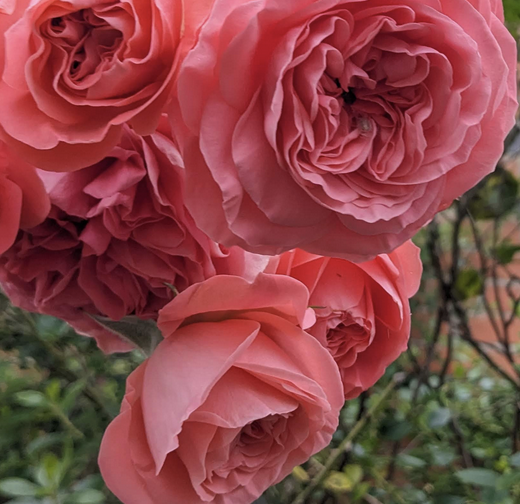
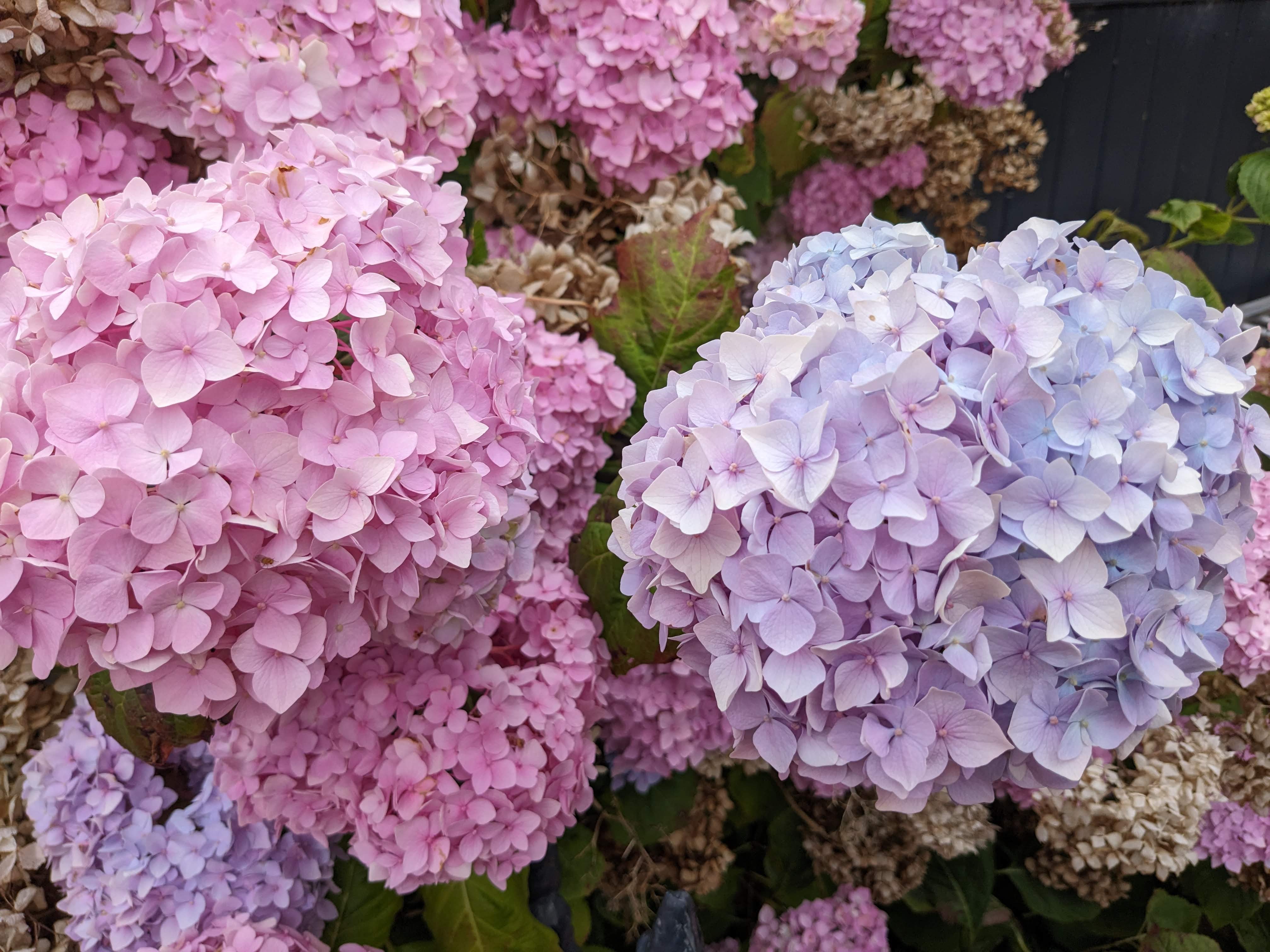
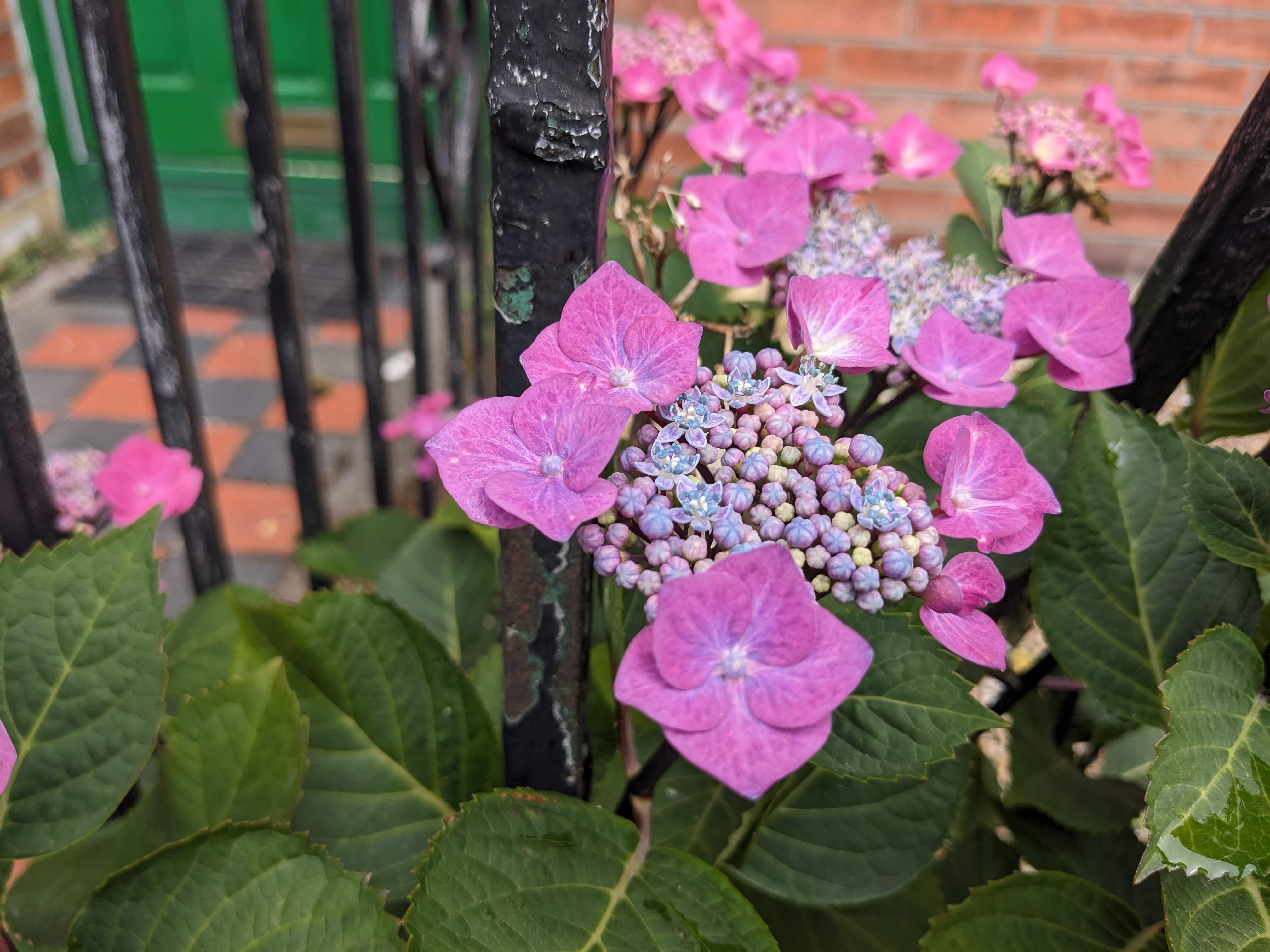
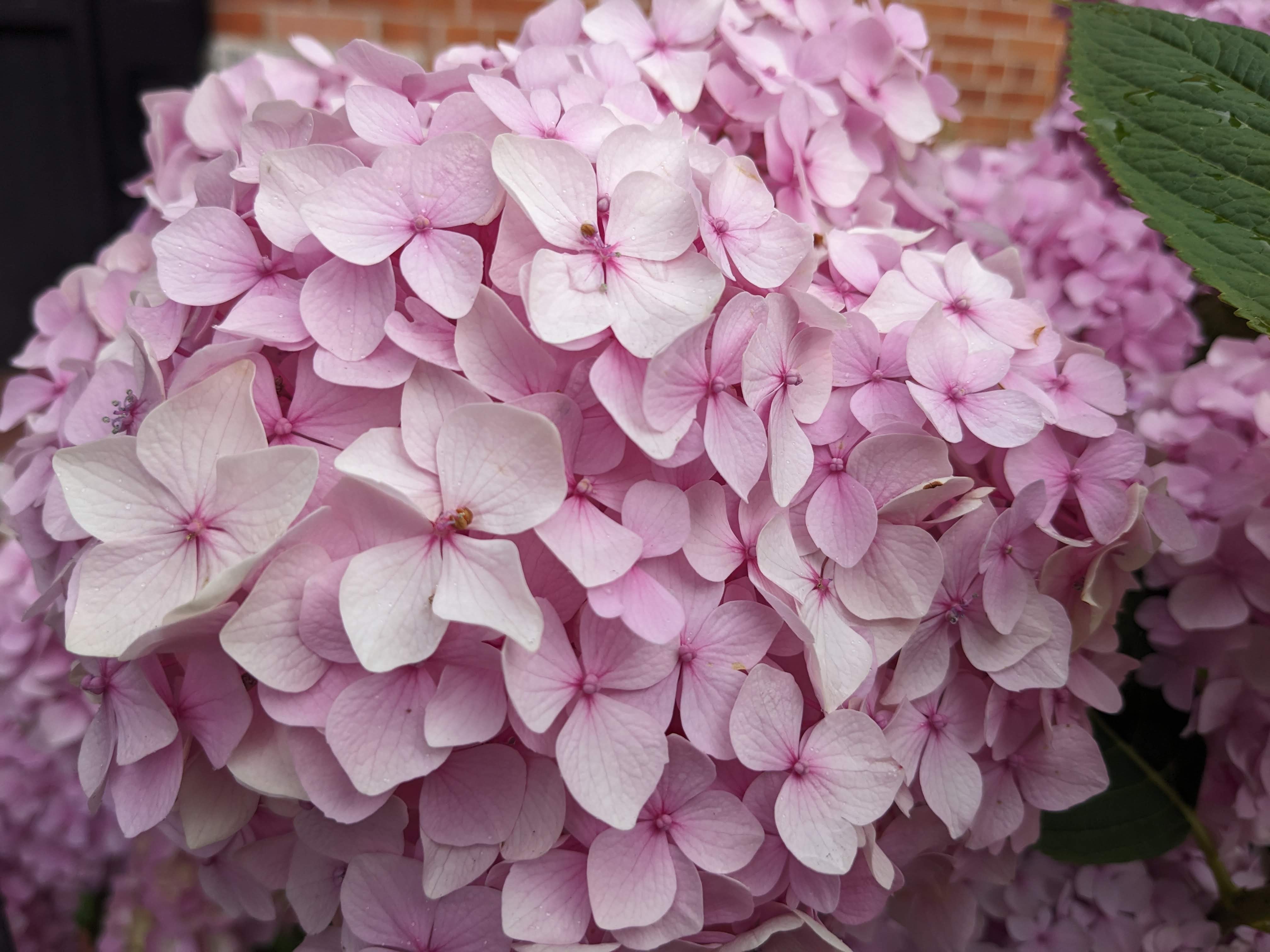
Late June is the time of the hydrangea. Most beautiful, generous, luxurious flowers. Down the street from us a house is being converted from a single-family to apartments, and the owner has (I think?) removed a massive hydrangea plant covered in a gradient from bright blue through purple and all the pinks. I saw it every day this spring, watched it carefully to catch the flowers emerging. I fantasize about knocking on the door to ask the builders whether the plants are gone or I hallucinated them. The garden I hallucinate is never gated from me.
seid umschlungen, Millionen / diesen Kuß der ganzen Welt!*
Refuse not to see it. See it, see it, see it, see it. In the vacant lots, in neighbors’ yards, in the cracks in pavement, in overgrown front gardens, in gutters on abandoned buildings, around the neglected city trees’ bases, at bus stops, in public planters, along the highways: see it, see it, see it.
Beauty is here. Joy is here. Neither may last but: here they are. They’ll be again. Right there. In the most ordinary places. Real. For everyone. For every, every, every, every one of us.
![[while walking]](https://bewilderment.ohbara.com/wp-content/uploads/2024/02/Screenshot-2026-03-13-at-10.55.52.png)
![[while walking]](https://bewilderment.ohbara.com/wp-content/uploads/2024/01/Screenshot-2026-03-13-at-10.58.18.png)

![It's always too soon to go home. And it's always too soon to calculate effect. I once read an anecdote by someone in Women Strike for Peace (WSP), the first great antinuclear movement in the United States, the one that did contribute to a major victory: the 1963 Limited Test Ban Treaty, which brought about the end of aboveground testing of nuclear weapons and of much of the radioactive fallout that was showing up in mother's milk and baby teeth. (And WSP contributed to the fall of the House Un-American Activities Committee [HUAC], the Department of Homeland Security of its day. Positioning them- selves as housewives and using humor as their weapon, they made HUAC's anticommunist interrogations ridiculous.) The woman from WSP told of how foolish and futile she felt standing in the rain one morning protesting at the Kennedy White House. Years later she heard Dr. Benjamin Spock-who had become one of the most high-profile activists on the issue-say that the turning point for him was spotting a small group of women standing in the rain, protesting at the White House. If they were so passionately committed, he thought, he should give the issue more consideration himself. (From Rebecca Solnit's HOPE IN THE DARK, p.3)](https://substack-post-media.s3.amazonaws.com/public/images/c85c8458-4129-41e8-9e5f-663cc531ee1a_2282x1912.png)

![[while walking]](https://bewilderment.ohbara.com/wp-content/uploads/2023/12/Screenshot-2026-03-13-at-11.05.20.png)
![[while walking]](https://bewilderment.ohbara.com/wp-content/uploads/2023/11/Screenshot-2026-03-13-at-16.57.13.png)
![[while walking]](https://bewilderment.ohbara.com/wp-content/uploads/2023/10/Screenshot-2026-03-13-at-16.59.42.png)
![[while walking]](https://bewilderment.ohbara.com/wp-content/uploads/2023/10/Screenshot-2026-03-13-at-17.01.13.png)
![[while walking]](https://bewilderment.ohbara.com/wp-content/uploads/2023/08/Screenshot-2026-03-15-at-09.24.27.png)
![[while walking]](https://bewilderment.ohbara.com/wp-content/uploads/2023/07/Screenshot-2026-03-15-at-09.26.59.png)
![[while walking]](https://bewilderment.ohbara.com/wp-content/uploads/2023/07/Screenshot-2026-03-15-at-09.30.51.png)
![[while walking]](https://bewilderment.ohbara.com/wp-content/uploads/2023/06/Screenshot-2026-03-15-at-09.33.39.png)