in praise of anthologies: everyone’s library
I learned to read poetry by reading anthologies and textbooks, sitting on the cement floor of the basement to keep cool in childhood Augusts and on the living-room radiator to keep warm in childhood Decembers. I read Understanding Poetry by Cleanth Brooks and Robert Penn Warren, a yellow clothbound copy that had been annotated by my father’s college English teacher. I read anthologies of twentieth-century poetry that had been up-to-the-minute when my father was in college twenty years before; I read prosody textbooks, books of prompts paired with individual poems. I read ex-library anthologies of children’s literature for teachers, and anthologies of poems selected for children and young people. These books were kept on shelves with books about Egypt and books about Ireland, books about baseball and books about taking and developing photographs, books of art projects to do with children, cookbooks. They were part of the fabric of everyday life.
As a child I didn’t know there was such a thing as “being a writer” because writing was something that just happened (grocery lists; school papers; stories) and poems were just things that were around, like chairs. Writing in our house was for everyone, just like drawing was: you can make three lines into and A or four lines into an E? Congratulations: it’s poem time. Memorize “Jabberwocky” or “The Lake Isle of Innisfree” or part of “The Raven” or “A Dream Deferred” and get a quarter, the same reward you’d get for immersing yourself in Lake Superior when we went camping over the summer. Poetry was normal; it appeared every few pages in the ancient readers that had been my grandfather’s schoolbooks. It was threaded among short stories in the Norton Anthology of Children’s Literature that had been my father’s. It hung on the wall, both a framed poem by my aunt and clipped-out poems on newsprint. The house I grew up in was like an anthology in all it held—an old-fashioned anthology, eclectic and thematic and revealing of the tastes of those who made it.
Encountering poetry in anthologies and in the house I grew up in meant that the context I learned poetry in was not the context of one author’s work or the order of a collection, but the context of an editor’s concerns and the context of what my parents found, collected, enjoyed. It meant I read widely but rarely in depth. It also meant I memorized poems just by happenstance, as I encountered them as discrete objects in different books or hanging on the wall, day after day. I could see the poems in a way, because they were just there, one at a time.
When I went to college I brought with me the ways of reading that the anthologies and old textbooks of my childhood taught me. It didn’t come easily to me to read as some of my peers did—dozens of newly published single-author collections each month. I skipped around, read a collection here and there, went deep in the stacks to find books by their spine thickness and alluring colors. (I still remember one edition of Neruda’s Twenty Love Poems and One Song of Despair, Merwin’s translation, a tiny, pink book I renewed repeatedly until I’d had it out for more than a year. I carried it around everywhere.) I read horticulture and textile history books, histories and linguistics textbooks. And I read anthologies, both for class (thick Nortons) and for pleasure (by subject and by year, from the Best American poetry series to new anthologies of experimental and contemporary poetry). But after I left university, I didn’t read anthologies much: they were too large and heavy to move around.
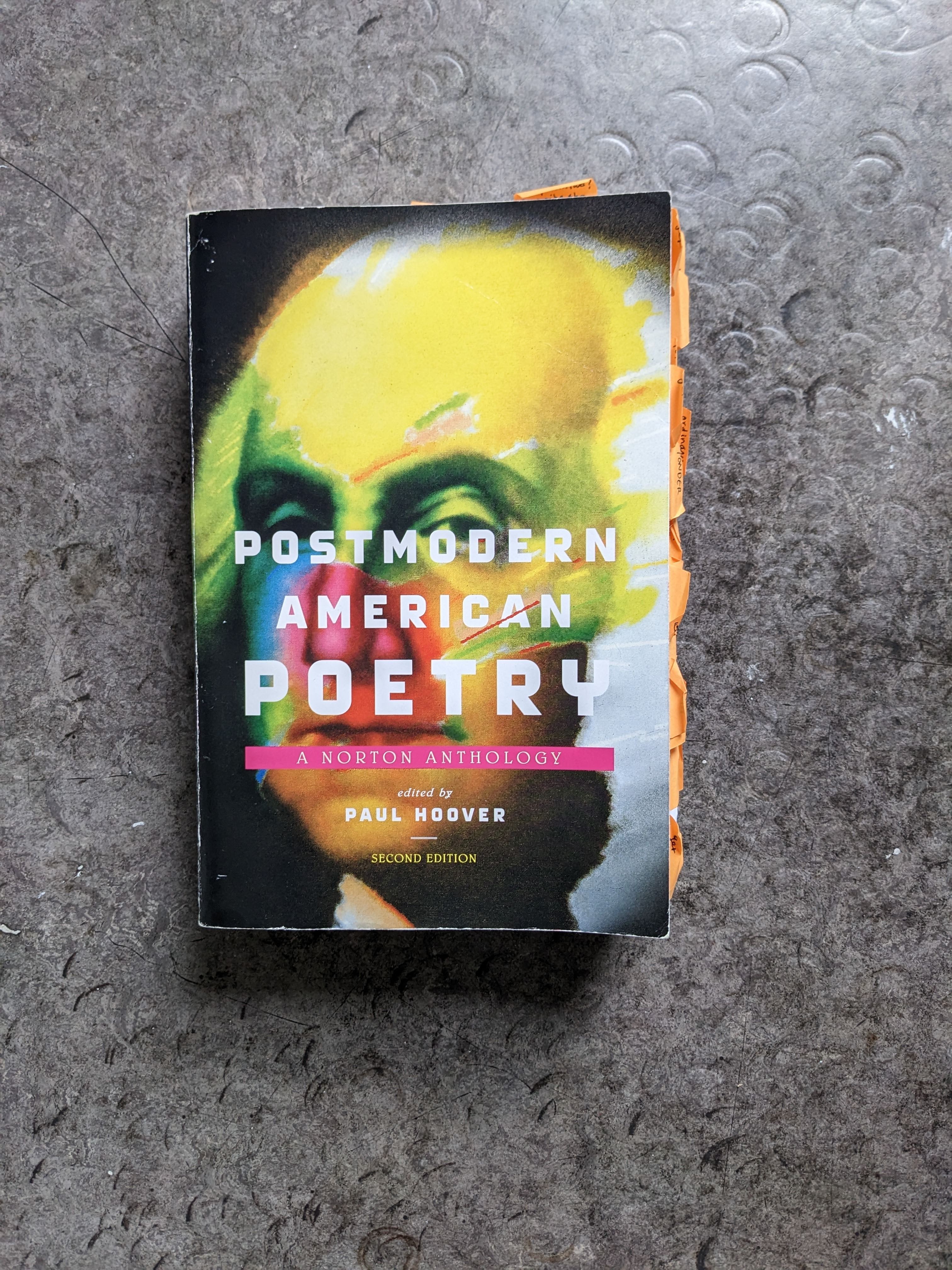
In December 2022 I found a used copy of the Norton Anthology of Postmodern American Poetry in a bookshop. I like to have a project to start the year with, and I thought, huh. I could read that. In the past few years as I’ve taught both generalist and specialist courses I’ve often come up against places where I can feel the limits of my training. I knew reading this anthology would help me slot some pieces of my poetic history and contexts together. So, between January first and the end of March 2023, I read some of this anthology almost every night. It was one of the most pleasurable reading experiences I’ve had in a long time. Why?
It was various. So many things to read, so many different things. If one writer’s work wasn’t my favorite, I knew there were just a few pages of it—and I could really pay attention for just those pages. The variety helped me see similarities and transfers of ways of working, thinking, making, as well as branches and new possibilities. It reminded me how many ways there are and have been to poem, and also how long ago some of the habits of ‘new’ ways of making poems appear.
The chronology of the book was also pleasing. I wanted to read to learn: to understand some histories of influence and confluence in US poetry in the mid- to late 20th century. I wanted to get to know the work of writers whose work perhaps helps to set the perimeter of the field I work in—21st century experiment, or post-language lyric, or the expanded field, or whatever way it might be called. Chronology helped me understand where how I work and what I read came from (in part, of course. No anthology could capture the breadth of sources for the making of poetry). Who taught whom, directly or indirectly? I could map that, and begin to connect the map the anthology made with other maps I had. As often happens with a map, I could understand more about where I was.
I found pleasure in the book’s sheer size. It felt great to sit with that big volume on a pillow in my lap in bed, with a pen. It felt serious—a kind of study that was a challenge—and I remembered how good working hard to read and write feels. It returned poetry to the center of my vision in a way that hadn’t been possible during years of many moves, many job changes. I felt accomplished each time I worked with the book, even though some nights I could only manage a page or two. But page by page I worked through it entirely. In some way it restored an earlier way of writing and reading to me, one I wouldn’t have known how to set out to find again.
Reading anthologies helps me see widely, helps me understand pattern. It introduces me to writers whose work I might otherwise not have met, and it helps me understand their relationships. (In this case, I was also reading to understand who taught whom, where poets who are anthologized in this way lived and studied and worked, and to trace the kinds of words that were used to talk about these poets—information I found in the short texts introducing each one’s work.) Reading anthologies makes me a more critical reader, too, teaching me to see the seeing of the organizing force not as neutral but as positioned in taste, influence. I noticed that there were almost no writers from the US midwest in The Norton Anthology of Postmodern American Poetry, for instance, and that many of the writers clustered in two or three geographic locations, having been educated at five or six universities. I also noticed how white it was, and how ‘normal’ that was in the anthology. This edition (the second) was published in 2013. I think a third edition would look very different—or maybe not. It would depend on the organizing force.
I will leave this week’s dispatch by making an anthology recommendation. One of the most enjoyable anthologies I’ve read is the 1999 Beacon Best Of, edited by Ntozake Shange. I bought it almost ten years ago when I was on a kick of reading everything she’d written (or, in this case, edited). It’s a really good selection of all kinds of writing, and I remember reading it was like finding a shop with all the most beautifully made and presented things for sale.
And finally—
Let all beings be free, safe, beloved, and well.
Stop the bombs. Swords into ploughshares. Free Palestine.
See you in a week.