I looked closely at the grommets of the world
We are eleven weeks into a twelve-week term right now, and if you are a teacher you know what I’m going to say next. I’m tired. I want to be clear: I love my work. I absolutely love thinking about poetry, love teaching, especially love teaching undergraduates. I love reading, walking, looking, and talking with others. I guess most of us who teach in universities love this work. Part of loving my work is the pleasure I feel in the creative act of teaching—responding to and thinking with others, making plans, writing lectures, arranging information visually, working to see students’ own wants and needs for their writing and to guide them in it. And also: we are eleven weeks into the term and we are probably all wiped out. I’m wiped out, anyway.
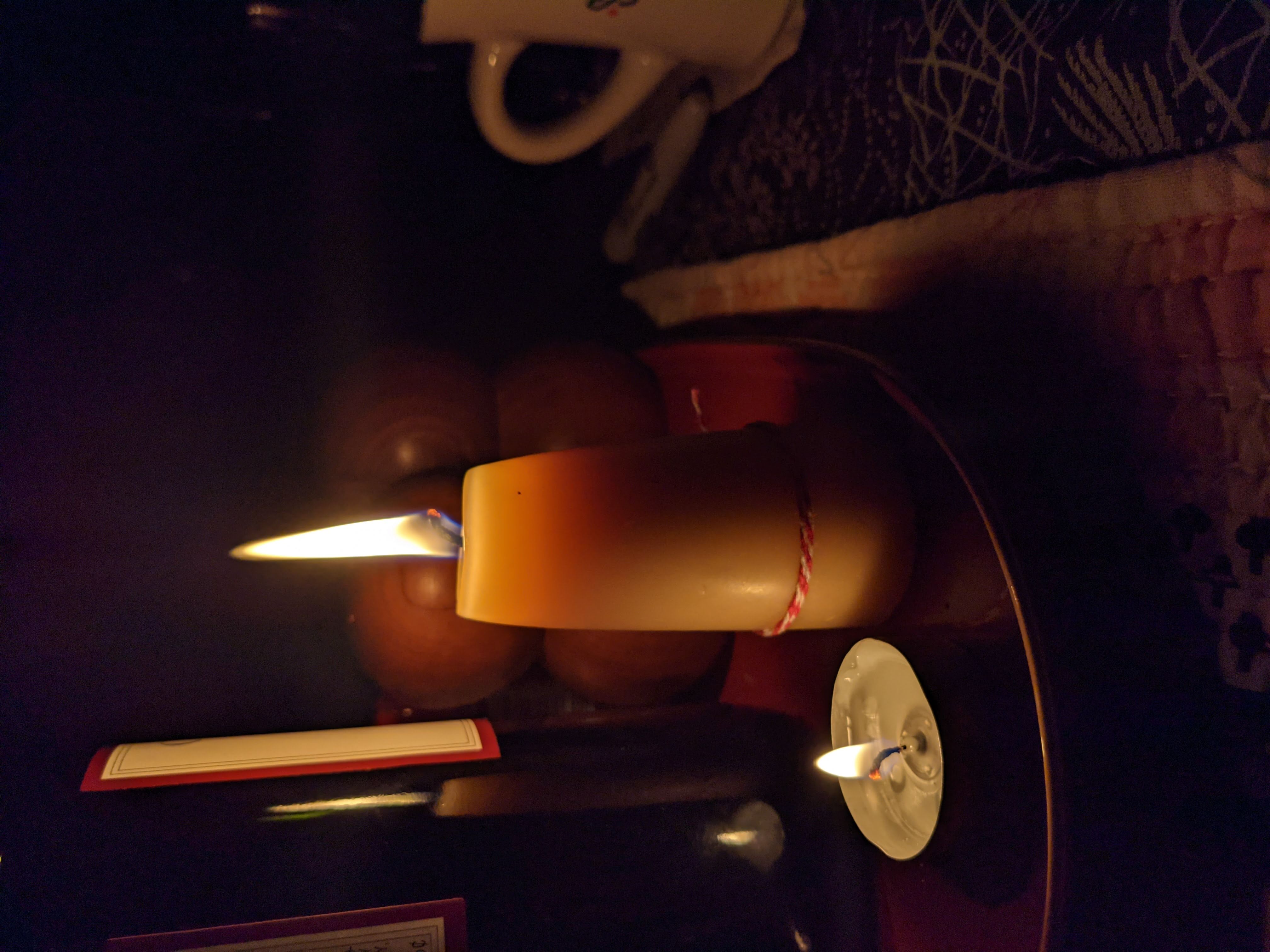
During term time, while I do some writing and some making (and in fact this year I’ve done a lot more than usual of both), it’s only as the end of the term approaches and a wider kind of time appears on the horizon that the Ideas begin to arrive. This tends to happen just as the semester’s frenetic pace comes to its peak. Events! Deadlines! Conferences! Student consultations! Extra teaching I said yes to when November seemed really far away! Class plans to make! God forbid, a social occasion! Feedback to write! How is it Sunday again! Against the whipsaw of term-time, the drawing in of evening feels like extension and suspension. I look forward every year to late November and December. (I know someone else who does, too, and she wrote a book about it that’s just come out.) The nights are really getting longer now. It’s at this point, the point of the cosy darkness and the impending break in teaching, that I begin to get ideas for making and ideas for writing.
This year, unlike most recent years, I will not spend my winter break writing job application letters, or sending out portfolios of “further documentation”, or doing interviews over Zoom from the spare room in my mother’s apartment. I will not be planning an overseas or cross-country move. Incredibly, I won’t even be preparing to teach totally new classes. It is hard to articulate just how spacious the security of my (still relatively short) four-year contract feels. Sometimes I still have to force myself to pause and realize that I don’t have to be in hypermotion mode right now. I can stop and think and pause and I can take time to make things as I do.
In fall 2021, I wrote in my notebook I want to write about art, gardens, and grain elevators, but I’m distracted by syllabus revisions, my spreadsheet of jobs whose application deadlines have already begun to loom, and the should-should-should engine of sending work out in hopes of placing something somewhere. I don’t feel brave and I’m easily tired. Or maybe what I mean is, it’s hard to live as if making and teaching art matters inside of a culture and an economy that deeply believes it does not. I was so tired that semester. We had just moved for the third time in two years, this time halfway across the US. I was teaching, again, all new classes at a totally new institution, to a new student body. We were a year and a bit into the pandemic. I could feel the ideas and even my desire to write or make work, but I couldn’t quite get there. Exhaustion, for sure, was part of this. But so was the pace of teaching and the pace of insecure work, which made a constant hum of your health insurance will end in July. So I spent my time applying for jobs. There are only ever 24 hours in a day; some things have to fall away under the facts and demands of everyday life. It made me think about what it takes to make a beautiful life.
Artmaking—well, any really important human work, whether taking care of children or other family members, of making friendships, or housemaking, or working with others to make a just and beautiful life—takes time, spacious time as well as the time we make in bits and pieces when we take ten minutes here, half an hour there, making notes on the backs of receipts while standing in line, reading a book on the bus to and from our paid work. Spacious time for thought is a gift—and it should be for everyone, not just a few of us. Time to think, make, and be still is not a luxury: it is the place where we figure out how to think more deeply, more complexly. Really it’s the place where we learn to be in the world not by rote but by response. Where we learn to be Ourselves with one another. Where we learn to have the kinds of connective, associative thoughts that are the basis both for teaching and for art—but also I think the basis for living in a world that is very complex and intrinsically shared with other complex beings.
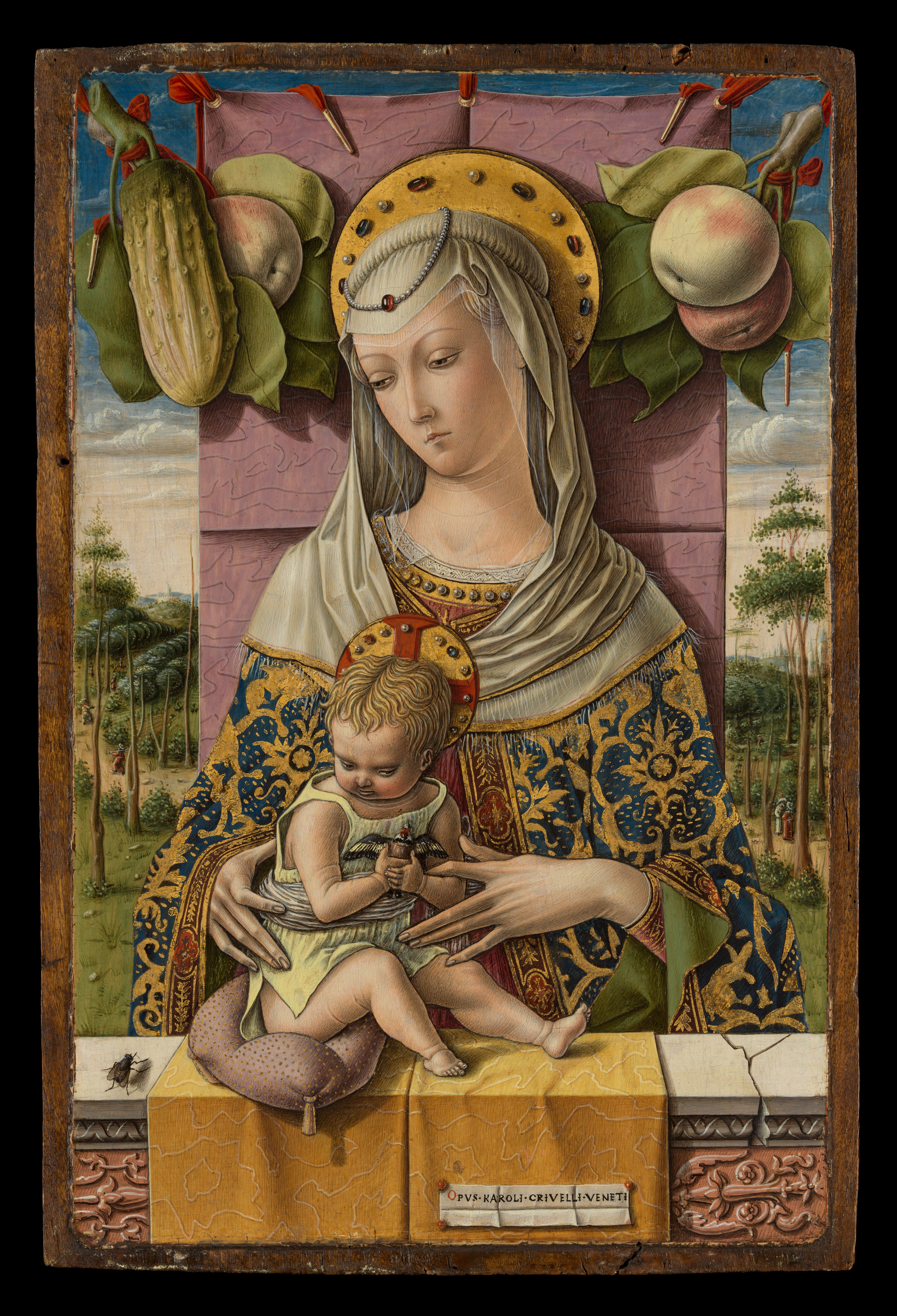
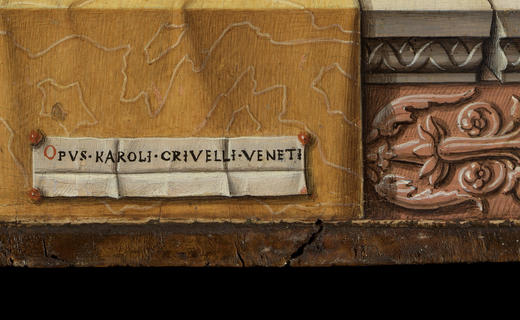
Let’s swivel for a moment. (The thread will become clear, I hope—stay with me.) Here is a Madonna and Child by Carlo Crivelli (1480; collection of the Metropolitan Museum of Art, Open Access holdings). It shows Mary and the child Jesus, who is holding (crushing?!) a goldfinch. The child looks down over his right shoulder to see a fly, whose shadow is cast on an ornate marble wall. The marble is cracked; the Met website says this is typical of Crivelli’s paintings, to paint broken walls. Jesus is sitting on a cushion that kind of looks like a scrotum—it’s a beige-mauve, with stipples that must be french knots all over it. Mary is wearing a blue mantle with gold flowers and geometric designs, and the halo perched at the back of her head is studded with irregular gemstones. Behind her, there is a dusty-purple cloth, with a woven pattern that matches a mustard-yellow one draped over the wall, under the cushion that’s under the child. And behind all that, a landscape: trees and clouds and a few small figures walking in it. But wait. What’s holding up that cloth? Red cloth laces, to a scale that seems to be the painter’s, not the subject. Tied into the laces are apples on a branch, and a cucumber with a piece of its vine.
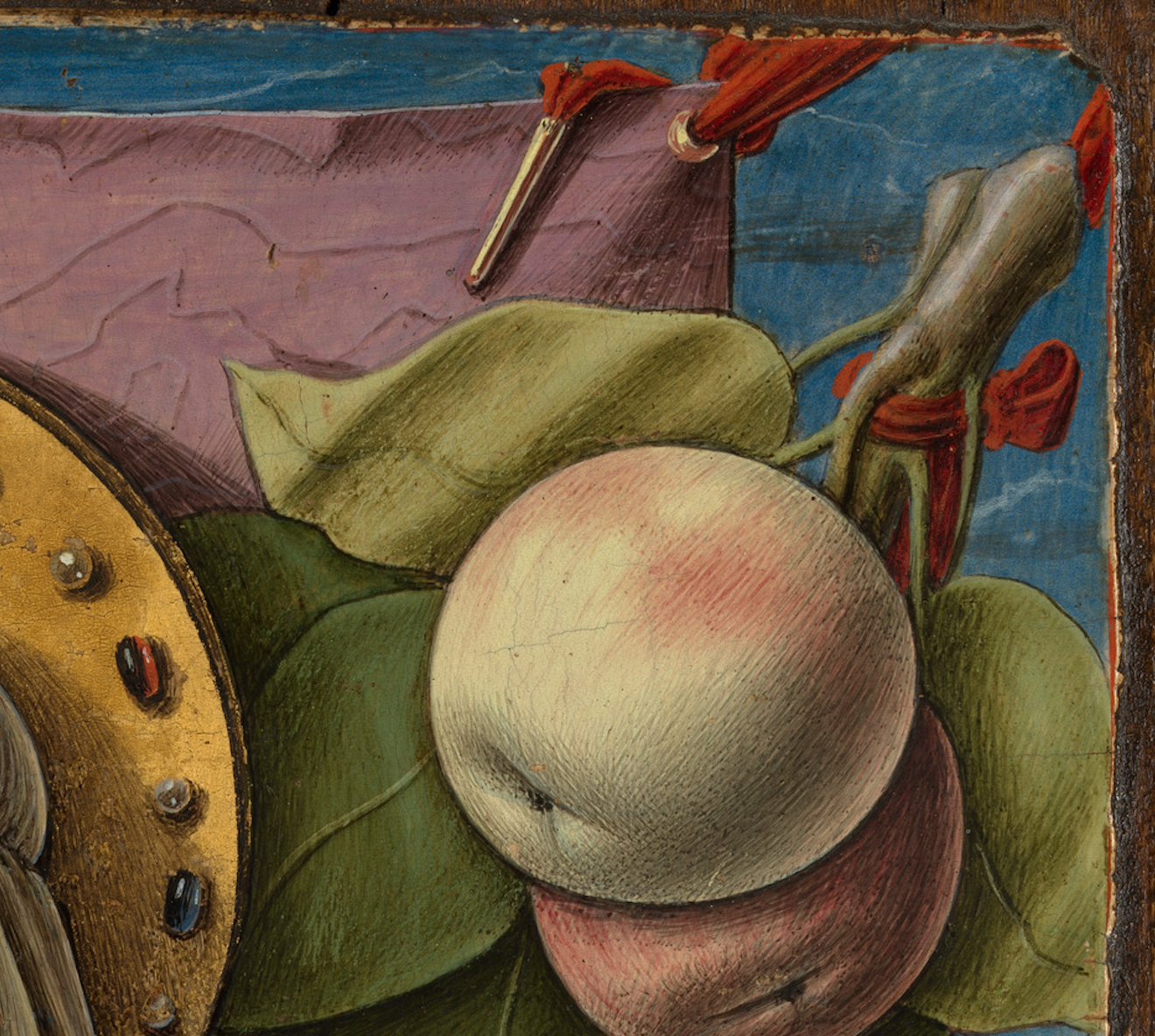
If I were an art historian I might be able to tell you about Crivelli’s place in history, or about the way he chose to represent these two figures. If I were a theologian, maybe I’d write here about the symbolic meaning of the fruits Crivelli included. But what I want to look at are those laces—the laces whose scale links making to made thing, the place in the painting where two kinds of time and two points in space meet. These are the time of physical making (a time of ongoingness: layer on layer of tempera and gold on the wooden panel) and the time of ideas (a time of arrival that can feel epiphanic but that is in fact linked to material conditions that permit ongoingness of work, of thought, of gaze). They are the space of the image (how it presents itself to us as a real world facing our own) and the space of the making of the image, the painter’s hand near the panel much larger than the hands he painted. The laces are the connection between these times and spaces.
The laces look like having an idea to me. They look like the kind of connection you make when you are able to be deeply and lengthily immersed in your own expert practice over time—and by expert practice I am referring as much to the expert practices of care, relation, and maintenance as I am to those expert practices whose results win awards, are collected by museums, and get their authors lauded as geniuses. The laces are so weird to me. They don’t quite belong! But there they are. And what makes them belong is the attention with which Crivelli has rendered them—those grommets they pass through; their metal tips—and also the way they make sense in and of the painting. Of course there needed to be something behind her. Of course a cloth. Of course it would need to be held up. by something. Of course laces, and laces to where? —To the outside of the painting. Looking at this image I feel I can see the ideas happen. I can feel the time it takes to have them. And I have a sense of the singularity of this person’s seeing: this isn’t a replica, it’s a record of thought and response to the visual and imaginative world.
Something so small, the folds of the laces, the hardware that you’d need to hold a curtain up. But this painter in Italy in 1480 took the time to think about how laces and grommets look. As far as I can tell, he thought about this as closely as he thought about the faces of his subjects, or the feathers of the goldfinch. By his attention the painter shows me the value not only of looking closely at Important Subjects, but also at those ordinary things that constitute our universes—things that make our thinking possible even though we might not think of them. He reminds me that this is where Ideas come from: from material, from life. He redirects me: don’t neglect the world.
I’m reminded, looking at this painting, that the model I believe in for making art—by which I mean not only paintings, poems, performances, (etc.) but also a deliberately made daily life that refuses to capitulate to the limiting imaginations of capitalism, patriarchy, white dominance—is fidelity and attention to precisely those daily, ordinary objects and relations. I think back to those many seasons of winter making when I was also pressed by the knowledge that my contract would lapse in the spring, or by the fact of an adjunct college teacher’s paychecks (and the consequent need for supplementary work). One of the biggest obstacles to artful imagination (and to be clear I think that an artful imagination is not the domain of talent or genius, but is a description of what it is to be human) and the slow time imagination requires is capitalism itself. To think ourselves, together, fully, to have ideas that do not merely replicate painful or dehumanizing or simply extant forms as if they are the thoughts themselves, we must be able to work at the pace of thought—the occasional epiphany, yes, of the shadow under the fly, but more often the pace of thought that takes its own time and in that time comes into its exact, irreplicable self.
And finally, completely relatedly—
Let all beings be free, safe, beloved, and well.
Stop the bombs. Swords into ploughshares. Free Palestine.
Thank you for reading. See you in a week.
Comments
2 responses to “[while washing the dishes]”
inspiring
art
writing
sharing
Thank you for reading, Rhea!