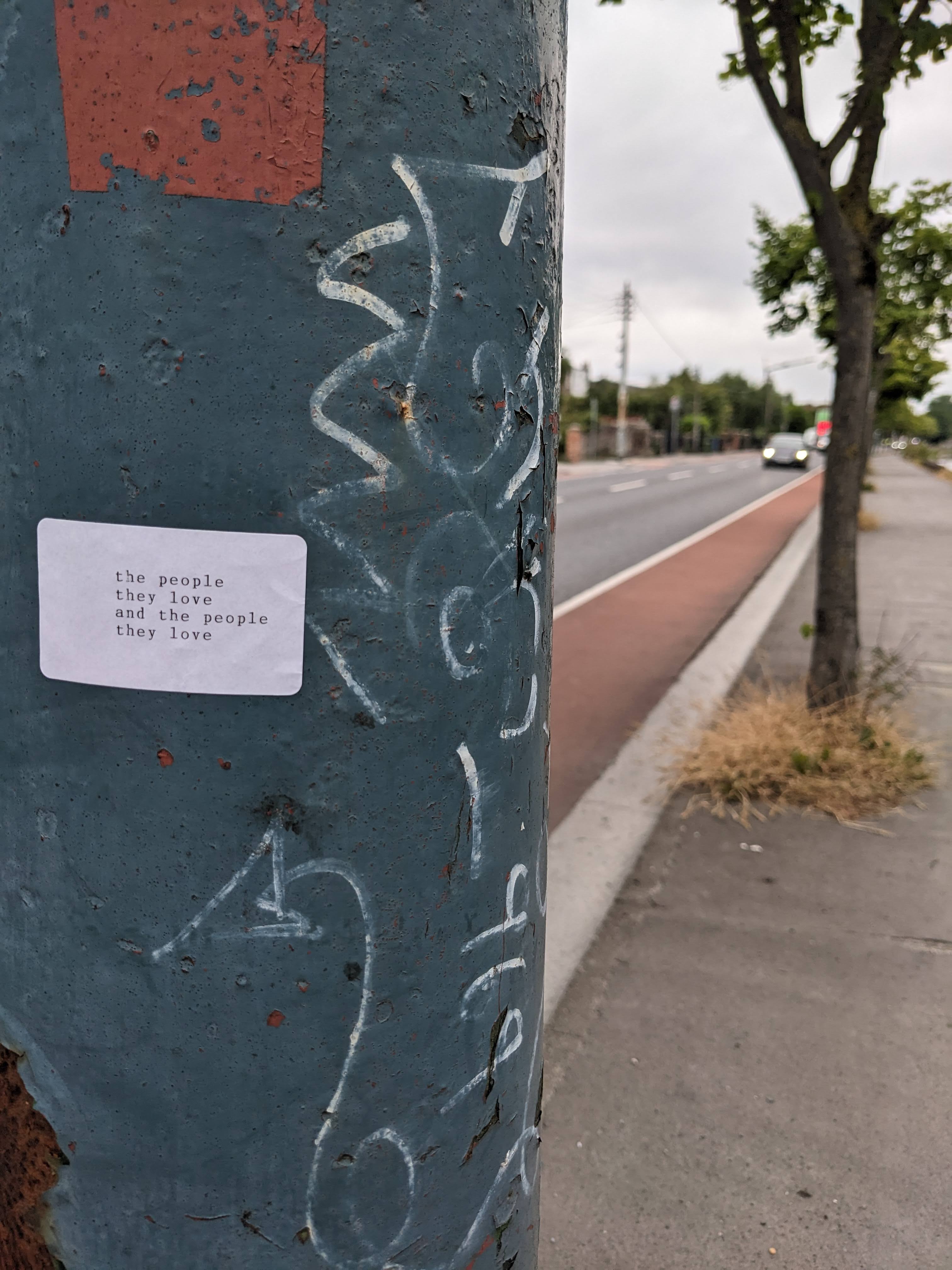
Author: bewilderment

  • bare life and bare, bare death

    bare life and bare, bare death

    written in Iowa in an especially warm September (2021)

    A little note at the start: there is a lot of discussion of death in this essay. There are mentions of torture, and I talk about war. There’s a lot about covid-19. There are also a lot of images of skulls (drawn images, no photographs). Finally, for those of you who’d like advance notice about entomological images, there is a photo of a cicada. It’s a long and looping essay, still a draft. Thanks in advance for your slow attention, but also take care of yourself and give it a miss if you need to.


    In Iowa, my place of residence for 2021-2022, the skulls are everywhere: on a child’s dress, white on gray. A sticker on a student’s laptop. On the back of truck after truck, the stylized skull that is the symbol of a comic book antihero, adopted by US soldiers during the second US war in Iraq, and then by neo-nazis and right-wing extremists and white supremacists and police supporters. They are printed on a student’s scarf, looped around her neck in a gesture that stops me in my tracks: a noose of skulls. The sign of death. The sign of the end of the world, poison, go-no-further, the limit of human person touching the limit of corpse, object brushing up against subject.

    This isn’t a new motif. I remember when I noticed the skulls appearing, ten years ago or more, because when I first saw them I was shocked that anyone would wear a symbol of death. But there they were, on scarves and shirts and hats and skirts in H&M and Top Shop. They appeared about a decade into an endless war that only recently ‘ended’, and now I think of this motif as a way of processing all that was submerged during that time and has happened since: all the violent, horrific, dehumanizing death at a remove of thousands of miles, much of it carried out by unmanned drones. All the thousands of coffins coming back to the US with dead twenty-somethings in them, borne across tarmac without so much as a photo on the front page of the US paper of record. All the hundreds and thousands of children and women and men killed in places hidden from us by the same paper. So I started thinking about the skulls: about why they were still showing up, what underlying currents might cause images like these to bubble up in our daily lives like gas in a swamp.

    The fashion industry moves so quickly, changes so quickly. Nevertheless, the skulls are still there. How is it that this image continues to appear? I find skull-print clothing in the children’s section at Target and think, isn’t this an old design? The child in the skull dress rides a hoverboard down the central Iowan sidewalk toward me, and I step into the grass so she can pass. The hoverboard takes up most of the width of the sidewalk. The grass has a little sign sticking out of it, a white sign with a green circle on it: Keep Pets And Children Off. Poison. Grass Has Been Treated. When I step back onto the sidewalk and into the shade, the air is cool even though the day is warm and the sun is high. September.
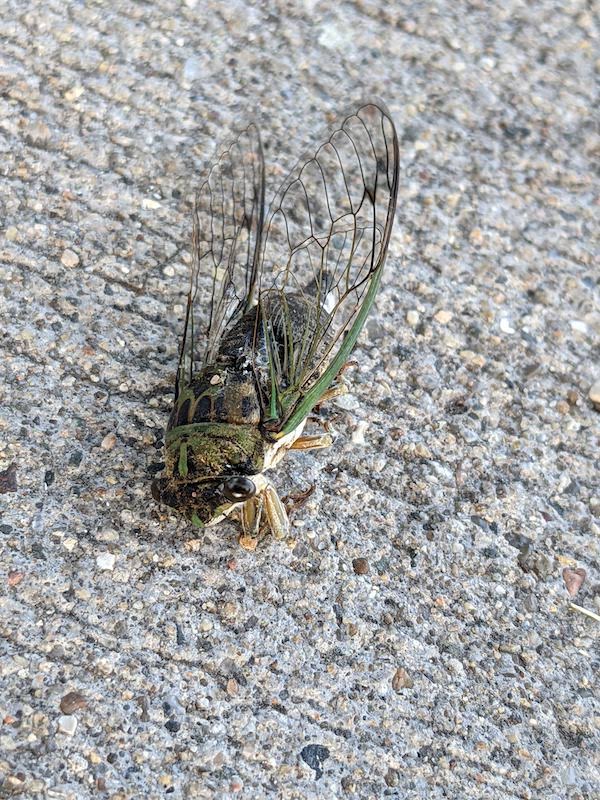

    Arriving in Iowa in August 2021, the heat hit my whole body. In the evenings, cicada song was so loud that with the windows open the insects’ noise surpassed the volume of music and television. In August and through September I walked early every morning, when the humidity was high but the temperatures were relatively mild, and every morning I found cicadas smashed on road and sidewalk, both fifth instars and adult cicadas.

    Adult cicadas’ wings are iridescent and stiff. Their bodies are colored like enamel, copies of Lalique cicada brooches that turn out to be actual cicadas. Instars are gray-brown, glossy, almost waxy. There were so many dead cicadas that I developed an ability to spot their carcasses in advance and lift my eyes enough not to see them closely, while also avoiding stepping on them. Cicadas are large enough that they seem to be individuals. It was hard to see them flattened or squashed or just upside-down and motionless in the street.
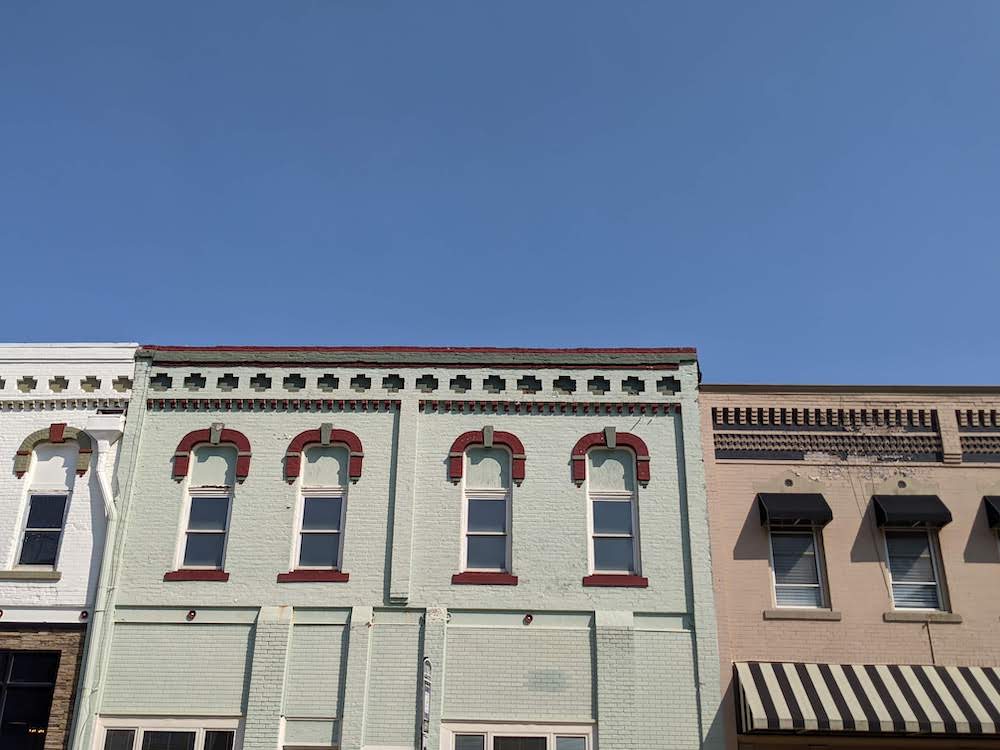
    Early September is a beautiful time of year in the Upper Midwest, an island of crisp weather before a final week or two of high heat and humidity in the second half of September. Before our 2021 arrival in Iowa I had spent almost two decades away from Midwest autumns: the huge open blue skies emptied of humidity, the ragweed releasing its billions of grains of pollen. The monarchs, the milkweed pods. When I last lived in the Upper Midwest I was a university student, only a year or two out of my family’s house. Then, September mornings felt like total freedom. Those mornings, I could go anywhere on my bicycle, and the air would be crisp and bright and everything would be living all around me. My feelings of September freedom took place in the first few years of our endless war, which began just after the towers were hit by airplanes used as missiles.

    It was a bright Midwestern September morning when 2,977 people died in a city halfway across that continent. That morning would be the beginning of thousands of retributive deaths in other places over two decades. But I didn’t know all that, on that Tuesday morning: I only knew bicycle, blue sky, September, Mississippi River shining wide beneath the Tenth Avenue Bridge, the cool dark in the university ballet studio before my eyes adjusted to the dimness. I remember that morning’s sky very clearly. I walked out of class with everyone else after the head of the dance department dismissed us, mid-barre. No one told us what was happening; it was only later that I began to hear. The sky was huge, open, empty. No planes flew through it. I lay on my boyfriend’s double bed all afternoon with him. We had seen the towers fall and the bodies fly from them as if they were paper, or doves, or some substance other than the unbelievable, factual substance of human bodies falling, leaping, from skyscrapers, through a September sky that was ash, ash, ash, ash.


    In September 2021, I am an employee on a one-year contract at a small liberal arts college in the Upper Midwest. I ride to campus, lock my bike behind the library and walk to my office under blue sky. On my way, I cross paths with a male student, tall, white, soft curly hair, wearing a green T-shirt with an image of a snake coiled around an automatic rifle. (The Gadsden reference is clear.) Underneath the image it reads “COME AND TAKE IT”. I don’t want it, I think, reflexively. I just don’t want you to kill me with it. I realize as I think those words that to say them out loud might, in some contexts in my country, seem so laughably submissive as to be a provocation to violence—this country where we yearly revisit our most spectacular victimhood in order to justify a perpetual, universal vigilanteism that is hardly given a second thought.
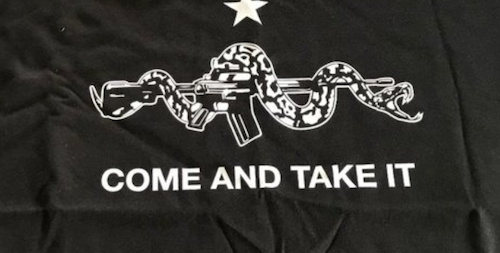
    The student with the snake-and-gun T-shirt isn’t in my class, but the feeling of the shirt is. When I collect my students’ writing exercises in the first week, about half of them contain a reference to a mass shooting—an imaginary one. The prompt was to write a poem, based on Allen Ginsburg’s “A Supermarket in California”, where something unusual or magical happens in a grocery store. The unusual event in many of their poems turns out to be gun violence, public death, terror: a mass shooting. It’s a small sample size, just twenty students at a tiny college in rural Iowa, but nevertheless I’m taken aback at the amount of space mass shooting takes up in their imaginations. Then again, they have practiced for such an emergency many times every year since they were small. The fact of public mass killings is so deeply embedded in their understanding of the world that they see them everywhere, even when they close their eyes and write. They live in a place where people who prefer for children and teachers not to die are made out to be a threat to “liberty”. But in the classroom I see that the threat of being killed reduces the liberty of my students’ imaginations. In a culture that worships death, the ritual and ceremony, the liturgy and its secret language, are performative speech acts. The words we use, the ways we speak, makes what we imagine real.

    I often think about the student with the ‘Come and take it shirt’, or a version of him, when I’m working at a university in the US. Every time I’m in a classroom with young men in the US I feel keenly aware that, demographically, they could kill me and others in the room: for perceived slight, for bruised ego, for anxiety and grief badly handled, for unmet entitlement, for whatever reason or for no reason. This sense dilutes as the semester goes by; in the end, I believe in our shared human life, the one we make in classrooms together. I believe my students can transcend and make sense of their hurt, worry, and anger as much as anyone else can. I believe they have the right, as we all do, to struggle toward a liberating being-with-others. And I also know that some of them will not make it. I know they, as I do, live in a culture that is suffused with violence in service to whiteness and maleness, wealth and nationalism and a perverse practice of Christianity. I know that white and male rage and entitlement simmer beneath the surface of everyday life, emerging Vesuvial from time to time in spectacular displays of violence that are talked about as isolated incidents.

    A mushroom also appears to be an isolated incident, but is an instantiation of a massive mycelial network submerged in earth, just out of sight. This is what I’m thinking about. How our cultural and physical bodies show that we know what is happening, even if that knowledge is pressed down, made unspeakable.


    It is beautiful early September in Iowa, and the days are passing as if all our days are just ordinary days. But the calendar. of public life knows these days are not ordinary: they are the preparation for a public renewal of our national commitment to death. Since returning to the US in 2017 I have had to learn a new date in the calendar here. Watching “September 11th” creep up is like observing the approach of a religious holiday I don’t celebrate while living in an especially orthodox area. For some people—who lived through those events; family members of those who died or who were first responders or who lived nearby and witnessed those horrors; people who suffer under the US’s draconian surveillance policies and from vigilante violence against anyone apparently Muslim—maybe this yearly revisiting is meaningful, painful, deeply personal. Perhaps it is necessary for some people. In the case of those who had no body to wash, wake, and bury, maybe the yearly reappearance of this event in the public consciousness affirms that the unendingness of grief is unending: each year, at least for a day, everyone else is thinking about it again, too.

    But in my case, each year, articles about “September 11th” in the week leading up to the anniversary take me by surprise. The papers print a yearly, national observation of the nearly religious, unstated principle “we will avenge your deaths”. But we the taxpayers of the US have ‘avenged’ those deaths hundreds (if not thousands) of times over, using missiles and drones and “the mother of all bombs” and literal decades of human life stolen by our torture and confinement systems. Every year we commemorate a relatively minor (in global terms) attack, and every day we are required to repress the facts of the minor and major attacks carried out in our names.

    What I’m trying to say is that even as I bike to the college where I will teach under a clear and open blue sky, I realize that out of a sky like this has come, and will come, death for many people I can’t see; death I pay for with the taxes on the salary I bike to work to earn; death that is tallied up in an accounting that puts 2,977 lives on one side of a balance, and infinity on the other.


    Biking home from the university one afternoon my eye is drawn to something in the road. As I get closer, I see, horribly, that it is a squirrel. At first, I think the squirrel is alive: it is lying on its stomach and its body is whole. But then I am just near it and I see that it has probably fallen from the huge tree that shades that part of the street, misjudged a leap and died on impact. It is gory. I do not want to have seen this but as soon as I have seen it I can’t unsee it, and I can’t unfeel the urgent desire to lift this animal out of the road and into a grave. I feel the same with the cicadas, and these I do often lift out of the way. But the squirrel I can’t—it’s too horrible, I’m too disgusted, and there’s the practicality of fleas and mites and how to move such a thing and where to, and on top of all this I’m in the road, on my bike. So I don’t do anything, and over the coming days as I bike by it it is flatter and flatter, drier and drier, until now, two weeks after the death of this animal, it is just a piece of leather and a stain.

    It had been a whole being.
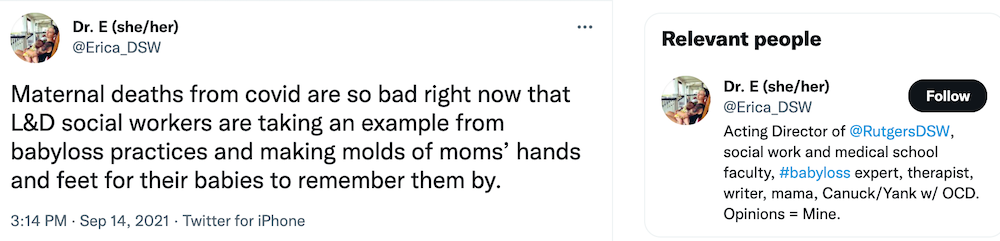
    They had been a whole being. That’s what I find myself thinking every time I encounter one of the reports of people dying in intensive care of Covid-19. At this point, most of the reports are about people who are not vaccinated, and the undertones are wonder at ignorant carelessness or schadenfreude at what seems like karma but is just the fact of viral transmission in populations where some people have less resistance than others. The photos that accompany these reports are hard to look at: they show people subject to intense medical intervention. Some are intubated. All have IVs and other monitoring and medicating equipment attached to their bodies. Some have no clothes on, or almost no clothes. Alongside the reports of deathbed regrets or defiance there are also reports from the workers who have been taking care of people—who have been caring for people as they die, sometimes in great fear and often alone—over and over for the past three years, and who are exhausted, fearful, and traumatized themselves. All these dying people. All the nearly seven million deaths. All these nurses, doctors, janitors, cooks, assistants, and other workers in hospitals and clinics who have been going to work, day after day, not knowing what lay ahead but nevertheless going to work. Each one, a whole being.


    Each year, when August ticks into September in the US, the number 2,977 floats through our newspapers, social media, radio. The number is something more than a number: it now stands for uncountable loss. The immensity of the figure is emotional and numeric. Emotional: all that loss, all at one time. Numeric: 2,977 flickers at the edge of countability and our ordinary capacity to conceive. We use numbers like that in daily life—price of a computer, maybe; a secondhand car?—but it’s unlikely that we know 2,977 people. In its immensity 2,977 is a reminder of the hugeness of perception, zooming out toward galaxies, and the minuteness of perception, zooming in toward atoms. Telescoping out, 2,977 is an untellable number of universes. Infinite details, possibilities, relations were lost when those people died. Limitless grief. Each one, a whole being. Telescoping in, 2,977 is a dot in a field of time composed of the death of every being who has ever lived. 2,977 is both a number of individuals and an integral number, unbreakable into component parts, at once a tally of each person dead on that blue-skied September day and a total from which perhaps few people beyond those directly affected can extract a single name trailing its complete, beloved ghost (a whole being). 2,977 is a number from which there is no return and yet a number to which the US as a country returns, religiously, each September. The idea is: the number is so huge. The shock of the huge number is enough to remind us of the shock of that day. Let there never be another such day, the number says, when so many universes are extinguished all at once. 2,977 is too many to lose.

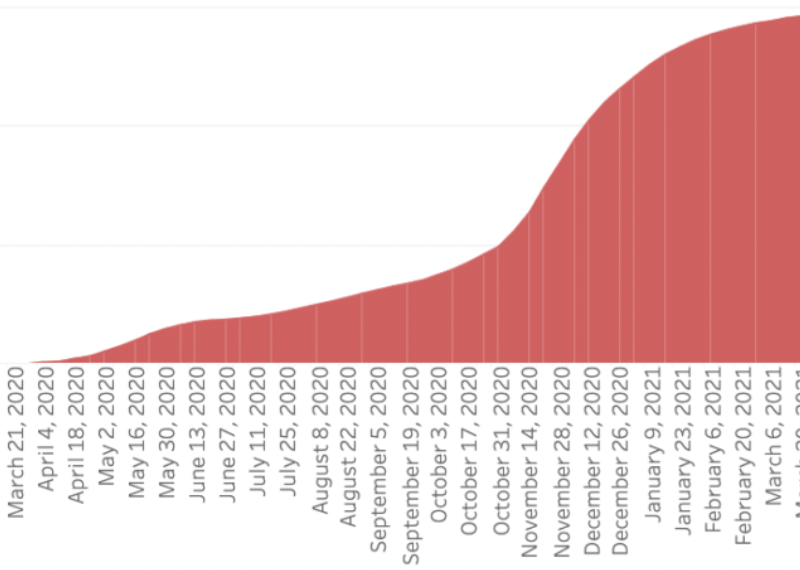
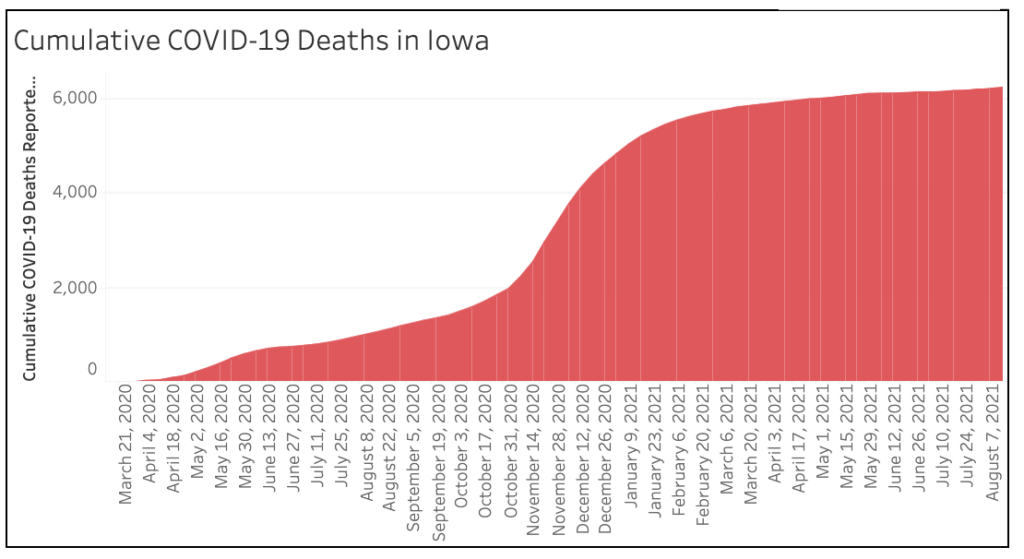
    The day I first drafted this essay was September 10, 2021. In the United States, that week, 3,231 people died of Covid-19.


    The average Covid-19 death rate between March 2020 and September 2021 in the United States was just over a thousand deaths per day. Every three days, on average, the number of deaths equalled those of that one September morning. But there has been no monthly, weekly, yearly national commemoration. There has been no massive mobilization of resources to face and rid ourselves of the cause of all this death. Instead, in much of the country, not long after the dying began, governors and legislators doubled down on the side of death, prohibiting common-sense public health measures, spreading lies, and letting a contagious virus run its course among poor, weak, sick, elderly, Black, Native, immigrant, and young people.
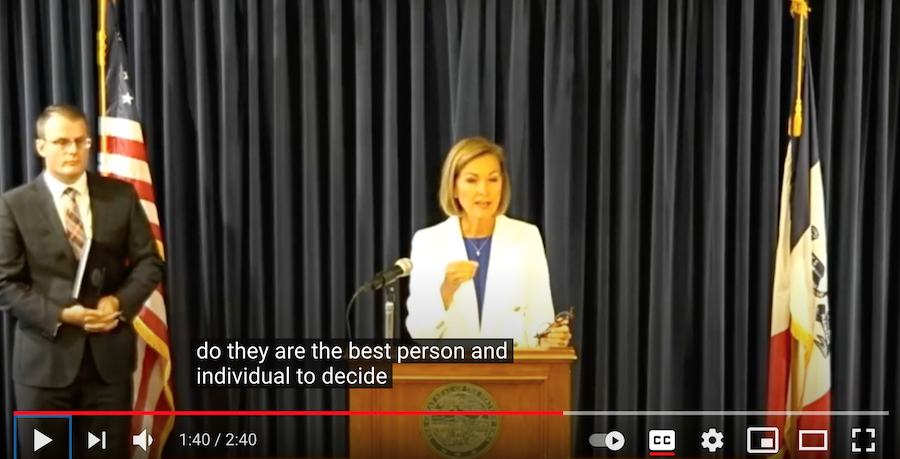
    I read local newspapers as a way of understanding where I live and what is happening there. I love to know that there are church members debating about new windows, and that the local humane society is sponsoring a walk-a-thon, and how the recovery from a storm is progressing. The papers give me context and language for what I see as I walk through the place I live. In the comments sections of the newspapers I read during the first years of the pandemic (in two different towns in two very different places) I frequently encountered an argument that most of the people who had died of Covid-19 were elderly. The argument went, older people and people with underlying health issues are more susceptible to death in any case. And then it came to its flawed conclusion: being vulnerable in any case, these deaths are therefore no great loss, no great worry. We should get on with our lives as usual. Week after week in September 2021 I read comments with arguments like that one—more or less the same as that one—in the local papers. And the conclusion was almost always the same: that some people’s lives are simply the cost of other people’s comfort.

    But each death is a death of a beloved universe. And each person suffering, being ill, being isolated, fearing—that is a whole person, however old, or disabled, or already sick. It seemed, reading these comments, that many people I lived among had decided that some kinds of life are no life at all; that there are whole categories of expendable people, generally unseen, whose deaths are permitted or even welcome in service to “life as usual”. We need to get on with our lives. Okay. But who gets to get on, and with what kind of life?

    Imagine reaching a point in your very real, very whole existence when you knew that people around you considered you disposable simply because you…were elderly? Or couldn’t or didn’t have employment? Imagine living in a body whose “pre-existing conditions” (including the human condition of being born into a mortal body) meant your place in the great social calculus is the remainder, swept away as an unfortunate but unpreventable casualty of each new wave of economic life and human death. Solidarity relies on a public sphere in which each of us knows that even people we can’t see, even people whose lives look nothing like ours—lives that might have less mobility, less authority, less power—have an absolute right to those lives.

    In the same newspapers, over the same period, many column inches were taken up with personal and official testimonies, remembrances, and oral histories of a national catastrophe two decades in the past. When is remembering an encumbrance of getting on with life? And when is remembering required for life to feel like it is going on normally? What is the “normal” life that we “get on” with when we return to a tragedy put to nationalist use? The character of “normal” life for the US since September 11, 2001, is the mass, ongoing death of people whose lives are figured as abnormal, or barbaric, or dangerous, or who are simply out of sight. Normal life in my country is the death of others in service to “normal life”.


    All along, as the days unspooled after the towers fell and in the two decades since, we in the US have been asked to remember some deaths: 2,977 of them. But this public demand is not the private remembrance of commemoration and grief or grief and humility or grief and solidarity; it is a publicly demanded, publicly performed and ritualized remembering that has been put to use for private profit and pillage, for murder and terror and impunity. We were asked to remember, but we were also asked to forget.

    We were asked to forget that there were no weapons of mass destruction. To forget that bombs fall on real people, with houses, families, ideas, imaginations, pasts, futures, none of which likely included being killed by American weapons. We were asked to forget mass death, hundreds of thousands of people dying over the course of decades. We were asked to forget, as years went by, that we were paying for these deaths, and that in paying for a war we were also paying for critical infrastructure failures, both practical and interpersonal, that meant the deaths of even more people. And we were asked to forget that all of this was based on a lie, and that the lie meant a few people close to the president got very, very rich.

    So our mourning moment was subsumed into support for or ignorance of years and years, decades, of war, all of which were happening so far away from most of us that, in the urgency of keeping body and soul together on a federal minimum wage of $7.95 per hour, we could forget, or we had to forget, or we simply didn’t know.
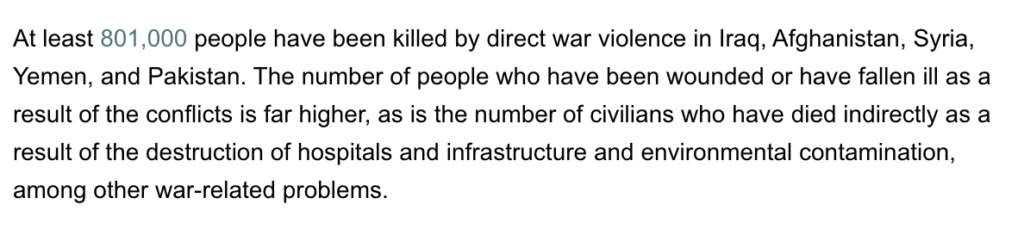
    We have had so much practice in forgetting, as a country, and so much practice in looking away.

    In his discussion of dreams, Freud writes that the dreamer suppresses the negative, latent content of a dream, and this content takes new, distorted, diluted, or unrecognizable forms. In dreams we may, like a child offered an apple she does not want, “[assert] that the apple has a bitter taste, without even having tasted it” (Freud, The Interpretation of Dreams, 119). Through the process of displacement, fear, loathing, and other negative affects relocate to unrelated elements of the dream, while the actual target or cause of these affects may only glancingly or passingly appear. When negative affect is repressed, it is the work of what Freud terms the ‘Foreconscious’, which “reenforces […] antagonism against the repressed ideas” (ibid, 480). What is, however, does not disappear just because it is repressed. It emerges as symptoms. Freud is writing about sexual desire and about violence, how these manifest in the psychological activity of individual subjects. I’m thinking of Freud’s theory not as a diagnosis, but as a metaphor.

    We in the United States are told we live in the greatest place on earth. We are told we are free, we are rich, we are powerful. The impunity our government grants our military to act with in places beyond our borders is doubled at home by our police.

    The US military-industrial complex (both domestic and foreign) is inordinately wealthy. US parks are beautiful, US highways are wide. In the US, our grocery stores give us strawberries in January and ice in July. But like the dreamer whose sleeping mind displaces fear, rage, longing, desire, our minds repress what makes our comfort—the appearance of freedom and plenty—possible. And repression makes our minds comfortable: if we were to confront the mass death that underwrites “getting on with life” or “back to normal”, how would we ever sleep?

    When the dreamer’s subconscious represses even the knowledge that there has been transfer of negative affect onto a banal target, that is not the end of the road for the affect. The fear, rage, longing of the dream’s latent content does not die, dissipate, nullify, or depart. It finds crevices. It squeezes through, returns to us in daylight. The great fear? Fear of death. The end of the world, enacted on us as we enact it on others. It comes through the cracks, looking for oxygen.

    Since 2020, we have all lived in the presence of continual mass death. In the US, after a few months of relatively mild restrictions designed to curtail both the number and the normalization of mass death, people in important and visible positions decided that we could live with mass death on a daily basis. What do we do with that fact, as organisms? As a social organism? Pay no attention to the man behind the curtain. What is the effect of this decision to normalize mass death in social terms? In bodily terms? In the terms of the images we make and live among?
    The fact is that for the last twenty years in the US we have lived in the presence of continual mass death, albeit far from our houses and ordinary lives. For the last twenty-two years in this country we have also lived in the presence of continual mass death in high schools, elementary schools, nightclubs, grocery stores, movie theaters, colleges, sorority houses. For the last fifty years in this country we have lived in the presence of continual mass death sprayed from airplanes onto landscape, plant, water, animal and human alike. For the last eighty years we have been living in the knowledge of the mass death of the nonhuman beings whose lives are integrally connected to our own. We go on as normal: we go to school, go to the movies, go to the grocery store (where we buy fruit and vegetables and meat and grains). We pay our health insurance premiums. We love our children and our parents. We make our art. We bicycle to campus, watching for roadkill. And underneath all this normal life?

    Each of us, one whole being.

    Each one of us, in an us much wider than county, state, regional, national boundaries: a whole being.

    The lives of everyone on earth touch the lives of everyone on earth: we know that intimately these days, as the breath in the lungs of one child enters the lungs of another, and the virus replicates. What happens to us when we forget this, our shared life? What happens when the knowledge of our shared life is pressed down by a thick forgetting of death, of the deaths of others elsewhere underwriting our “normal lives”?


    The morning arrives, and the sky is bright and high and blue again, as it has been almost every day since we arrived in Iowa. September washes over the rolling hills of south-central Iowa, and over the pools in New York that are surrounded by the names of the dead. It washes over the hospitals where the ICUs fill up and doctors send out desperate messages looking for a bed in the city, the state, the region. What is to be done? Our jobs are calling us back; the economy is “fully open”. The few financial supports have ended, student loans are coming due, and we still have to eat.

    We have to get on with our lives, and so we must somehow displace our fear and rage and longing and grief, our knowledge of the irreplaceable nature of each human on earth and our fear of living in a death-driven society. We find ways to tamp down our despair. We look away from the cicada and the squirrel as we head to work or the grocery store; we switch off the radio when the numbers for the day’s fatalities are reported. Eventually we can feel that things are normal again. But like anything repressed, the fact of mass death and the culture that relies on it will find places to emerge. It makes its way toward the light of day.


    Thank you for reading.

  • [while walking]

    [while walking]

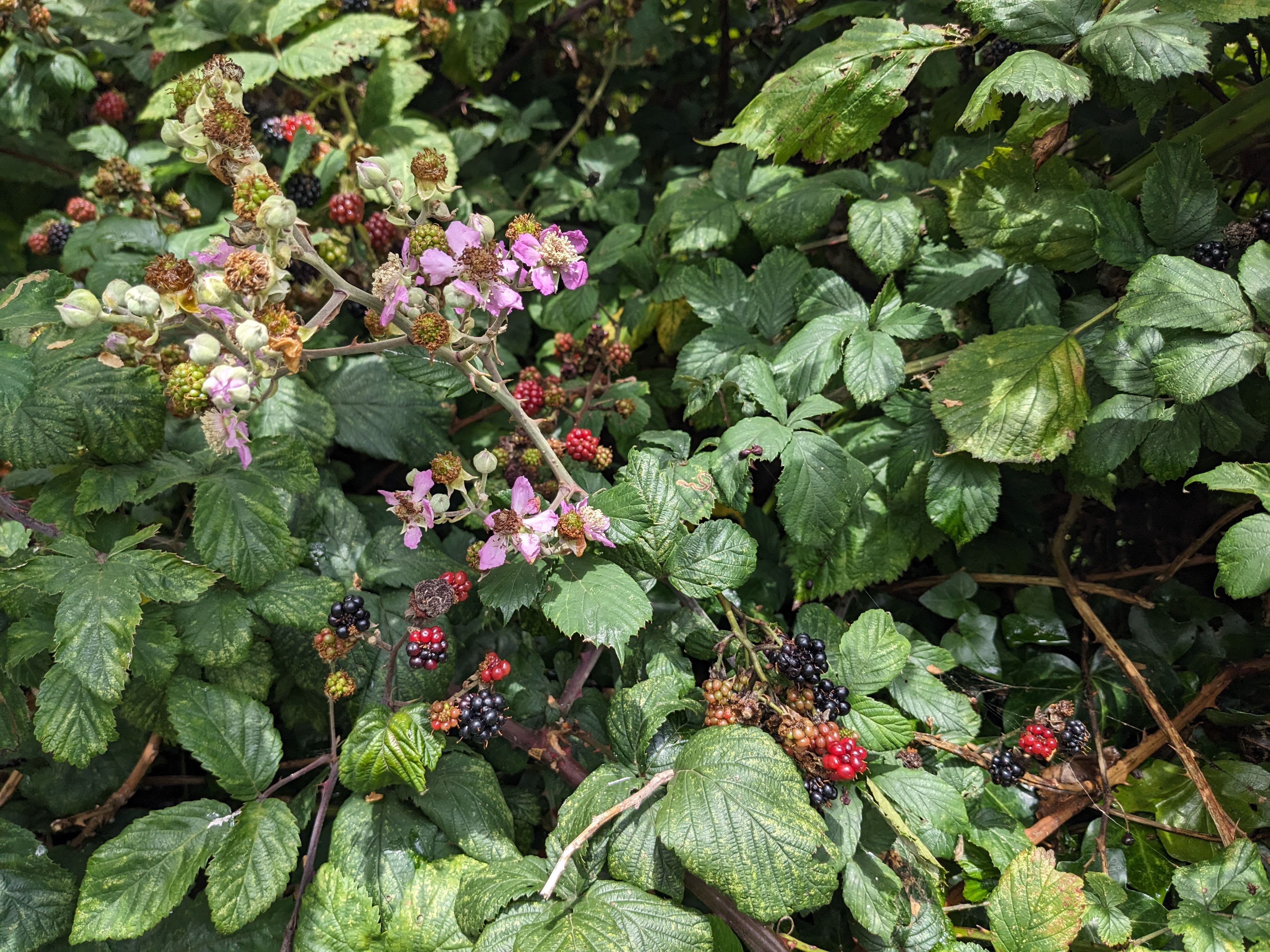
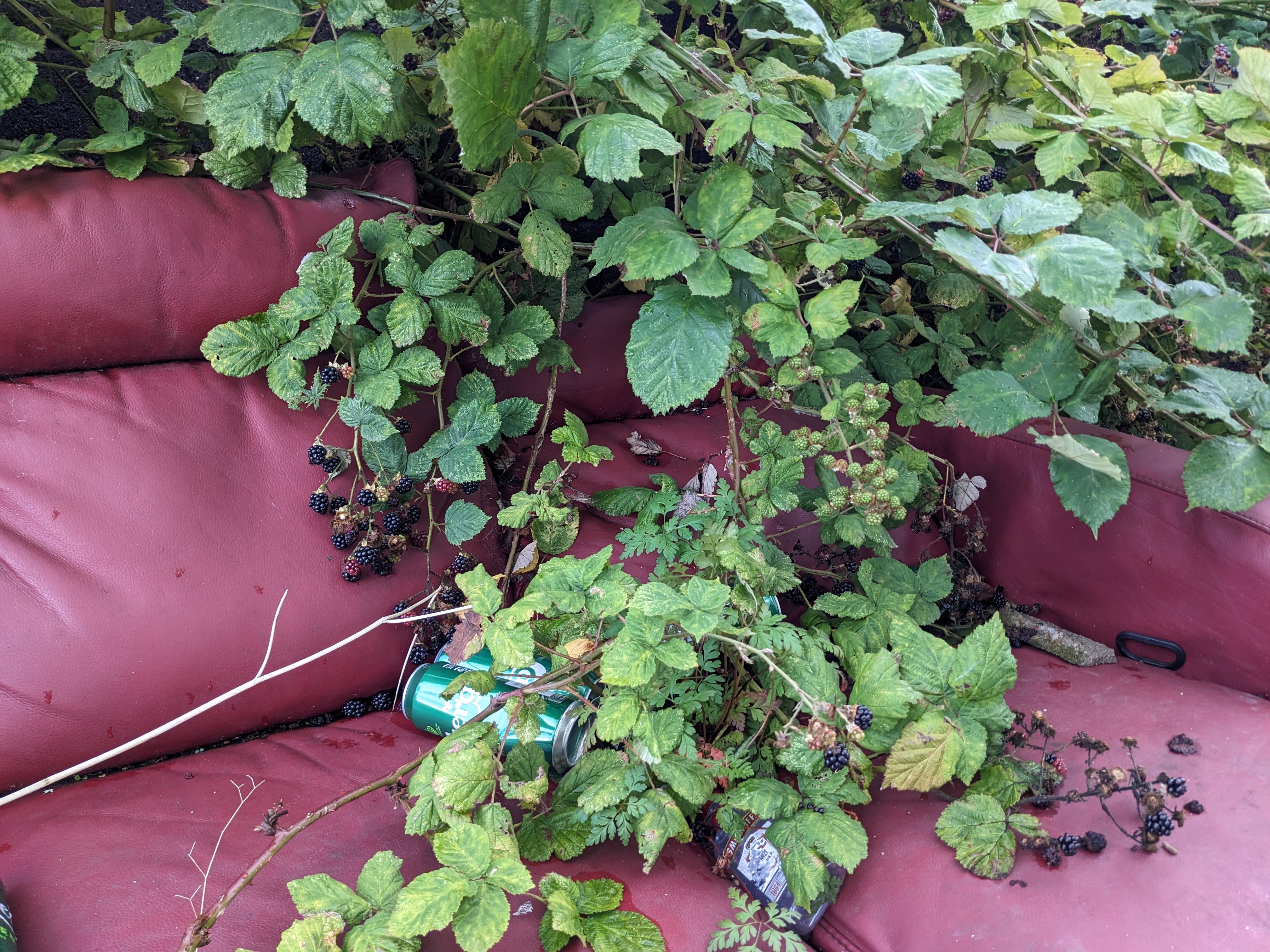
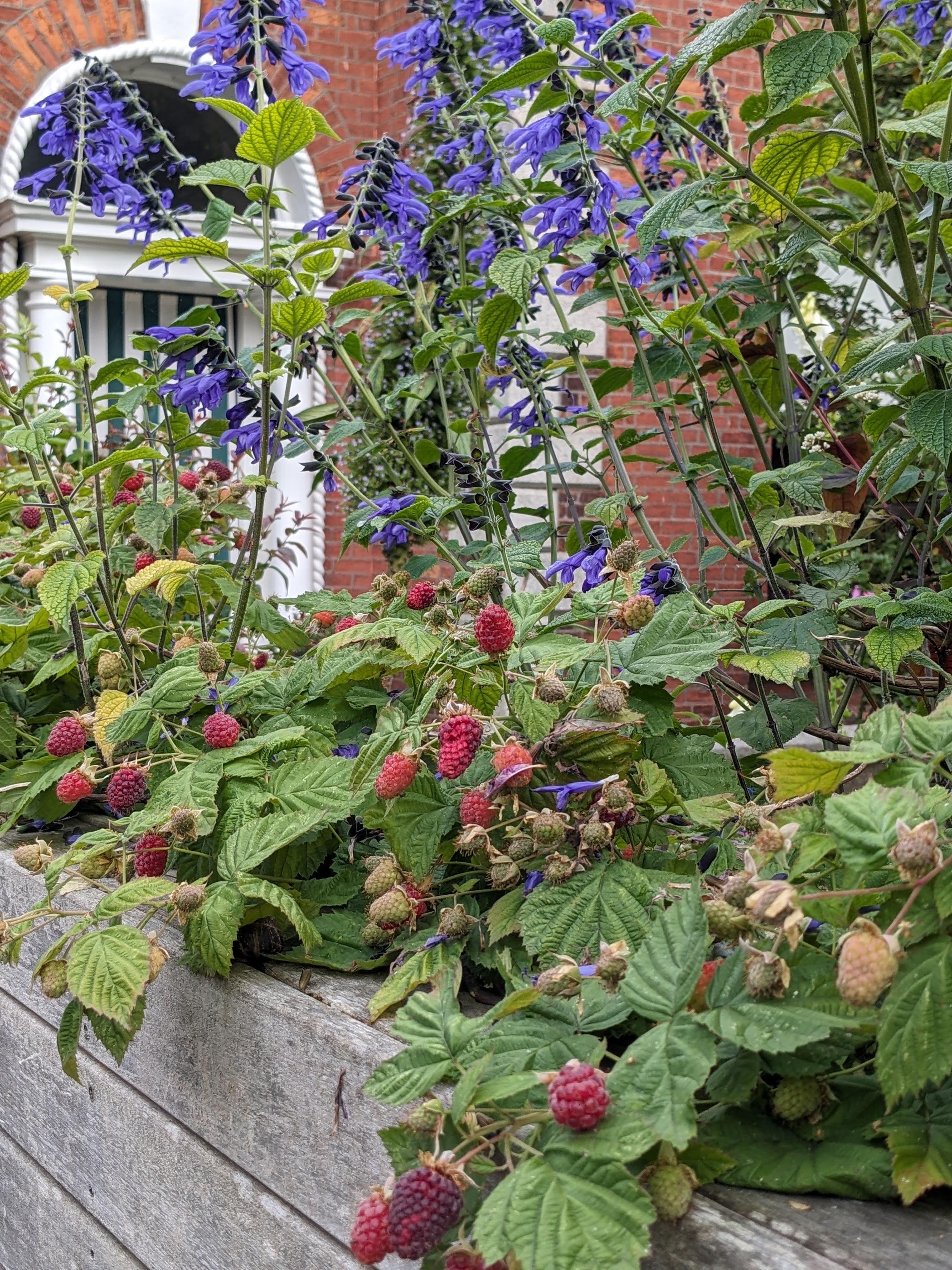
    blackberry, blackberry, blackberry

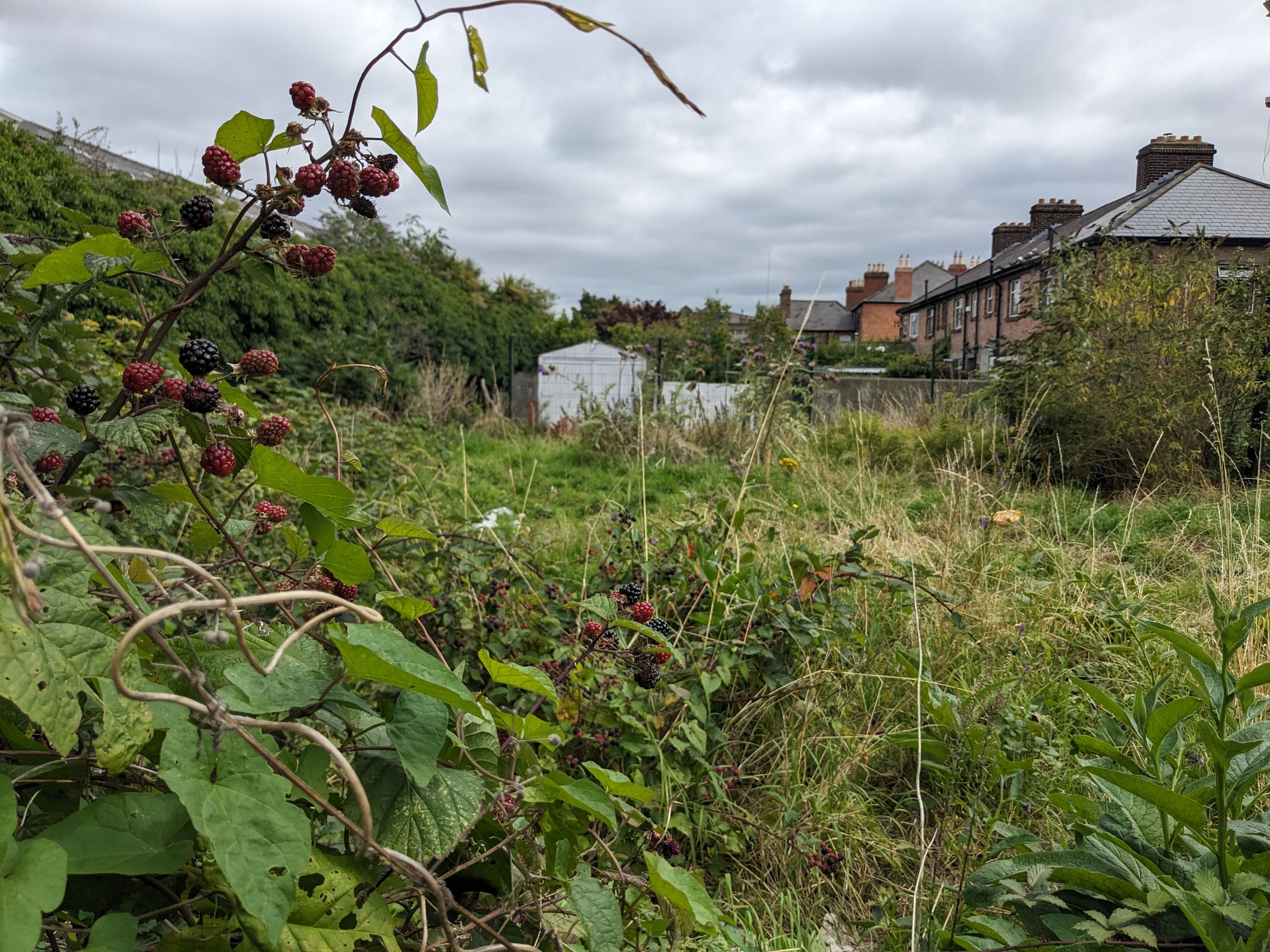
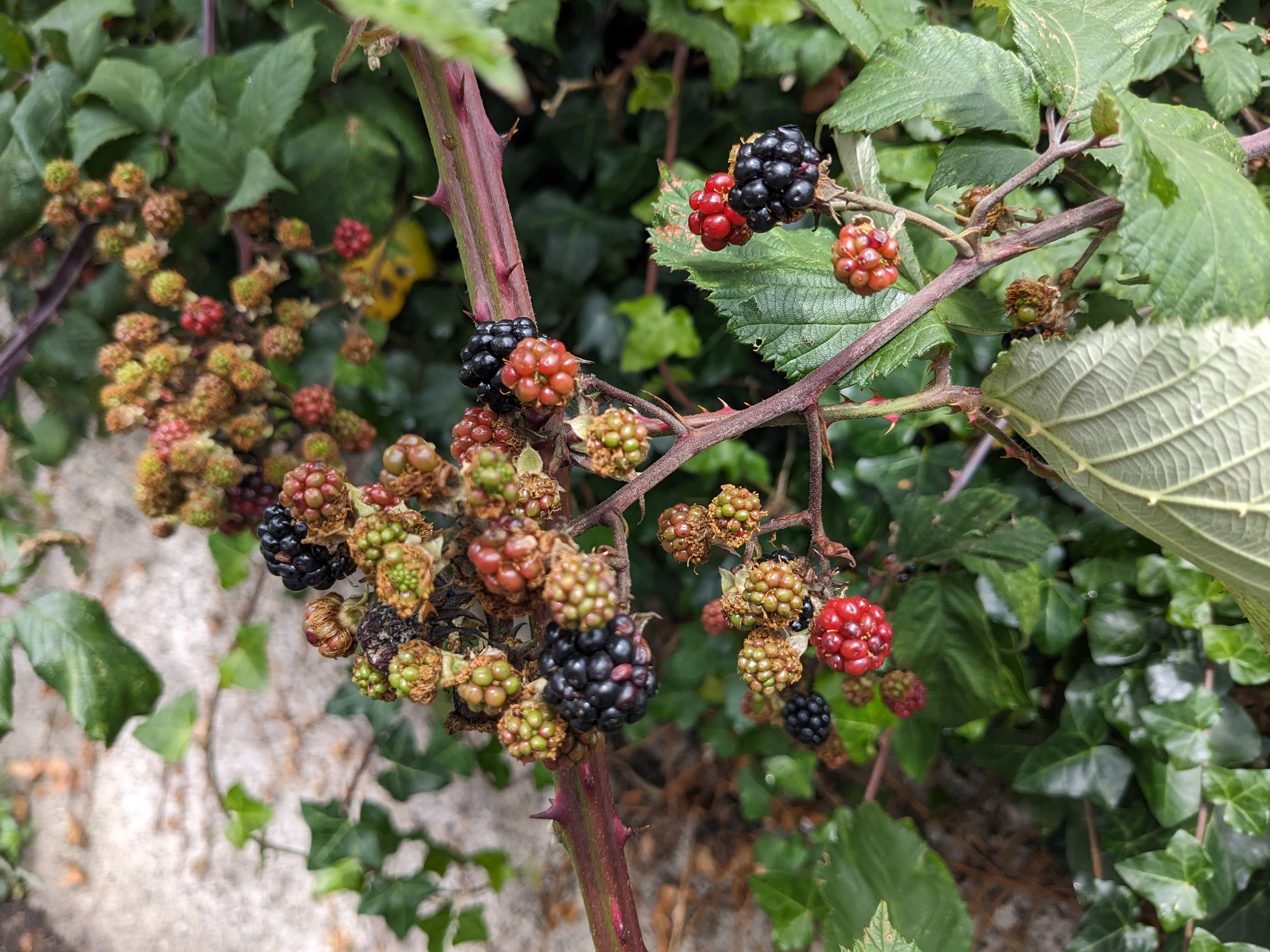
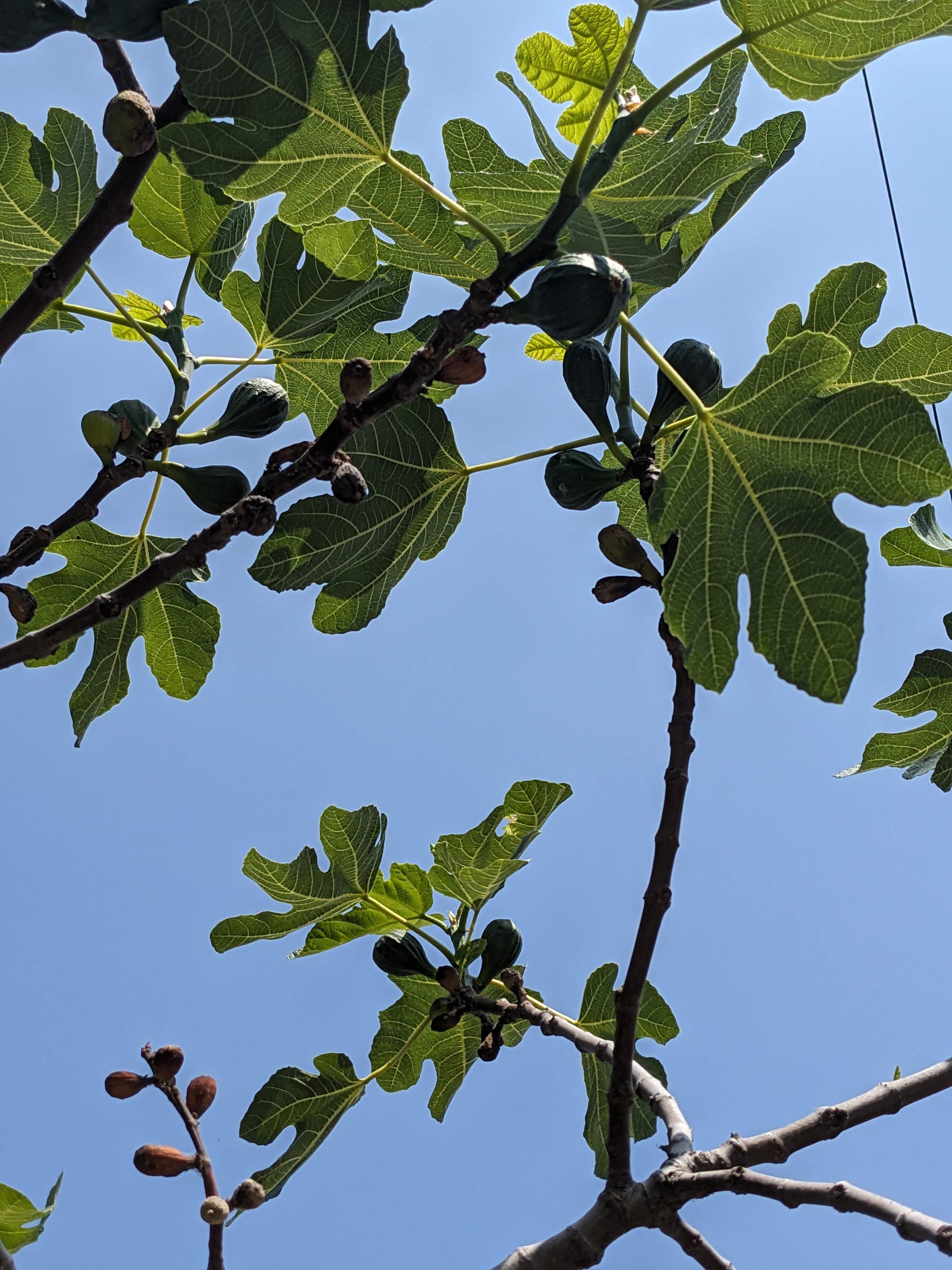
    August. Almost autumn. Hardly feels like “August” here in Dublin, but whatever I feel like “August” should be, this has been the August it is: more or less cool and more or less damp, after a July that was the rainiest July on record. Most days have been whitely overcast. There has been fine rain, heavier than mist but not heavy enough to drench. There are ripe figs on trees behind stone and brick walls, and blackberries reaching from behind white-painted metal fencing. Most days have had a period of fair weather in them.

    I have been reading poetry every day, a kind of training. I’m trying to learn about poetry. I have been learning about poetry for more than thirty years, twenty years in formal ways, and I feel more and more bewildered by it. How does it do it? How can some people be so sure about it? What would it be like, to be one of those people who is sure about poetry? I feel like I am always just asking about poetry: what, what, what, what, what; how, how, how? I spent a week in July with other poets and every morning the teaching poet gave the group a single poem to read closely. We spent about forty minutes on it, usually, and I could have spent three hours—or the whole day—doing just that close reading. I love this thing called poetry, even though I don’t understand it, I love to do it with other people, and I have no idea how I would go about understanding something so big. So August has been poems and blackberries for me, the latter catching my clothes on their thorns as I reach in to pick ripe fruit. The former always already caught on my clothes.

    The text of the poem August Morning, by Albert Garcia. It reads: It’s ripe, the melon by our sink. Yellow, bee-bitten, soft, it perfumes the house too sweetly. At five I wake, the air mournful in its quiet. My wife’s eyes swim calmly under their lids, her mouth and jaw relaxed, different. What is happening in the silence of this house? Curtains hang heavily from their rods. Ficus leaves tremble at my footsteps. Yet the colors outside are perfect-- orange geranium, blue lobelia. I wander from room to room like a man in a museum: wife, children, books, flowers, melon. Such still air. Soon the mid-morning breeze will float in like tepid water, then hot. How do I start this day, I who am unsure of how my life has happened or how to proceed amid this warm and steady sweetness?

    While walking through this cool and damp summer I have had the syncopated knowledge that in so many places this summer has been terrifyingly hot. I’ve felt sick with the knowledge of heat and drought and fire, floods and crop losses, fear and suffering and death—human and nonhuman beings, and the land and the ways of living on and being in those places. When I am afraid I often feel immobilized by that fear and by the immensity of things like the catastrophes of capitalism, imperialism, settler colonialism, plastic, petrochemicals, ‘forever’ chemicals—the ruin of whole worlds, ways of being, possibilities for relation, already in action. The sense of my smallness and the problems’ largeness quickly spirals in two directions. What could I possibly do? What do I have to offer? My life feels very tiny, short, and ineffectual then. And yet life is what we have, each of us and all of us. Not only our individual lives, but our shared one, too. When I remember this I feel immense gratitude for labor unions and workers (and students!) who are striking or have used strike threats to get fairer contracts and safer working conditions—and to remind us what we can ask for and must ask for, and to remind us that we cannot do it alone, and we are not alone.

    A model for the present and the future, strikes teach me that we can make sacrifices together that, when we do make them together, feel like joy. Strikes remind me we are together. Our daily lives have to change. That’s a fact. And we can only make that change together—the details may differ from place to place, but the fact remains that we can only do it with other people. We need, we cannot live without, a change that insists that those who cheapen and discard all of life and all the land, water, air desist: militarized nations, massive corporations, massive tech. Our lives are not cheap—none of them, not the lives of the ones who face buoys made of saw blades in border rivers; not the lives of the ones who embark on unbearable journeys in insufficient crafts; not the lives of the ones snipping threads in clothing factories that run day and night, or of the ones carrying ore from a mine, or of the ones packing boxes under the eye of a computer timer in a warehouse. Not the lives of the ones who fly or of the ones who photosynthesize.

    We can change our lives together, for one another. The urgency is huge. We are faced with the facts—the exclusionary, unjust, entrapping facts—of landlords’ hoarding and of billionaires’ death-driving. But we don’t have to accept these facts. There is no outside to the circle if we insist there is not. We can set down our tools, close our laptops, park our cars, and walk into the street together, hand in hand, arm in arm, shoulder by shoulder, singing. We can strike from our everyday lives. (I am still in awe and wonder at the self-immolation of Wynn Bruce. How do I live as committedly as that?) What happens if we do strike from our everyday lives, our habits of knowing and doing and being? What happens if we step, for a moment, together, into a new possibility? (Ruby Dee: “[The songs of the civil rights movement] became almost as common as love songs. And also—direction songs.”) Direction songs. We aren’t the first people doing this. If we sing together? Sing instead of shopping? Sing instead of working?

    A strike is holy. That’s why it’s hard—holy things feel impossible on the one hand, and maybe almost silly on the other. But looking one other person in the eye and joining them—we will find it is not silly at all, or difficult, at all. There we are. Together.

    I think that sense of holiness is a name for what happens when people do something together that departs from the “just how the world is” of the world in order to insist on beauty, dignity, care for the world and its beings, the value-as-such and -in-such of land/water/air/all life. Invention and daring in service to shared life. I haven’t figured this all out but that feeling of holiness is part of why I want to pay attention to poetry—its how more than its why or even its what—and to blackberries and all the other ‘minor’ (not minor!) indices of time and place. The closer I look the more I know: we are here together. Meaning happens amid the smallest movements and by the most minuscule differences. Everything is precious. I’ve said that before, I’ll surely say it again, because it is the simple thesis of the world as I’ve encountered it. There is no living thing that is not bound up in our shared existence. If we mean, we mean together.


    What have I learned, reading poetry and walking, looking at and picking blackberries in neglected lots this August? Thinking takes place over time—I knew it, but I have to learn it again and again. A poem is sometimes the accretion of meaning across a duration rather than the crystallization of an image within a form that can be held in the hand. The most basic, incontrovertible fact of life is that we are bound up together in it, and that one thing that poetry, music, art can do—not necessarily, and not always, but it’s possible—is remind us of that fact, and of our responsibility to one another. (Need something to carry you there? Here’s Sister Rosetta Tharpe with a lesson. And here’s Pete Seeger, Sonny Terry and Brownie McGee with another version of the same.)

    Beauty is the lesson we can never finish learning. Whole, open, for everyone. Like poetry, we can spend our lives on it. It’s not simple—it’s deeply complex. It’s not reserved; it’s for everyone, always. It’s not esoteric, it’s here, right here, at our fingertips, again and again, every day. It’s the fact of our intense, intricate co-relation, unfolding.

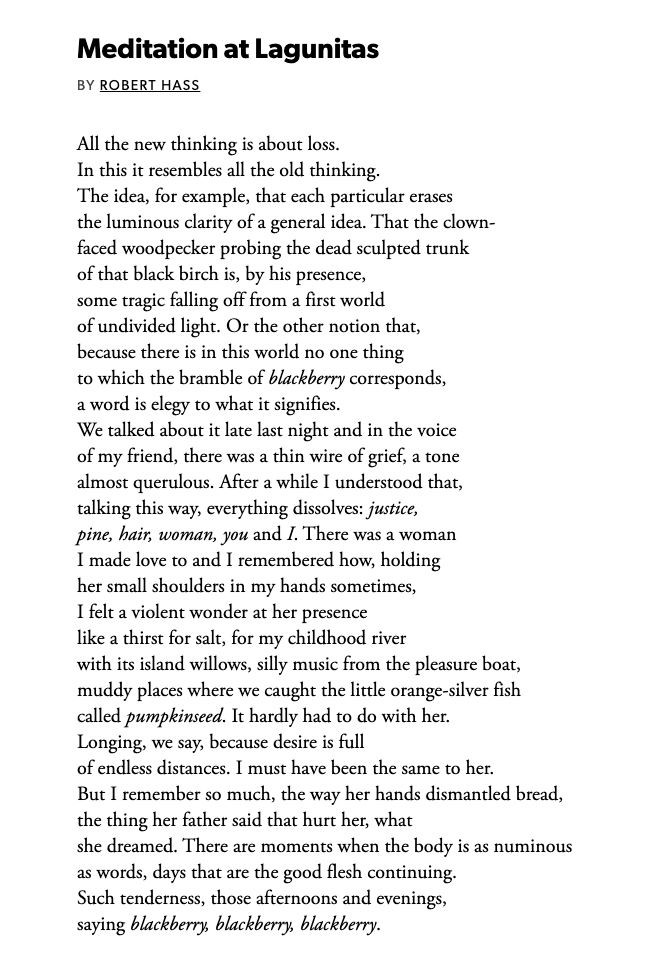
    I’ll leave you with one of my favorite poems, one I think is probably on a lot of people’s list of favorites. It’s a poem I was given by a teacher when I was about 22 and it is still mysterious to me. In every season it’s given me something new. I still don’t fully understand how it does what it does, or all that it does. But it does remind me that the world is a shared one—the world of blackberries and beloveds—and that one thing poetry can do is try to speak and spell exactly that complexity, one letter at a time, one poem at a time, until, along with the everything-elseness of the world, we have made and continue to make the world in which we can all live.

    The text of the poem "Meditation at Lagunitas" by Robert Hass: All the new thinking is about loss. In this it resembles all the old thinking. The idea, for example, that each particular erases the luminous clarity of a general idea. That the clown- faced woodpecker probing the dead sculpted trunk of that black birch is, by his presence, some tragic falling off from a first world of undivided light. Or the other notion that, because there is in this world no one thing to which the bramble of blackberry corresponds, a word is elegy to what it signifies. We talked about it late last night and in the voice of my friend, there was a thin wire of grief, a tone almost querulous. After a while I understood that, talking this way, everything dissolves: justice, pine, hair, woman, you and I. There was a woman I made love to and I remembered how, holding her small shoulders in my hands sometimes, I felt a violent wonder at her presence like a thirst for salt, for my childhood river with its island willows, silly music from the pleasure boat, muddy places where we caught the little orange-silver fish called pumpkinseed. It hardly had to do with her. Longing, we say, because desire is full of endless distances. I must have been the same to her. But I remember so much, the way her hands dismantled bread, the thing her father said that hurt her, what she dreamed. There are moments when the body is as numinous as words, days that are the good flesh continuing. Such tenderness, those afternoons and evenings, saying blackberry, blackberry, blackberry.

    Thank you for reading. See you in a week!

  • [while washing the dishes]

    [while washing the dishes]

    I thought about a french fry as tall as a house

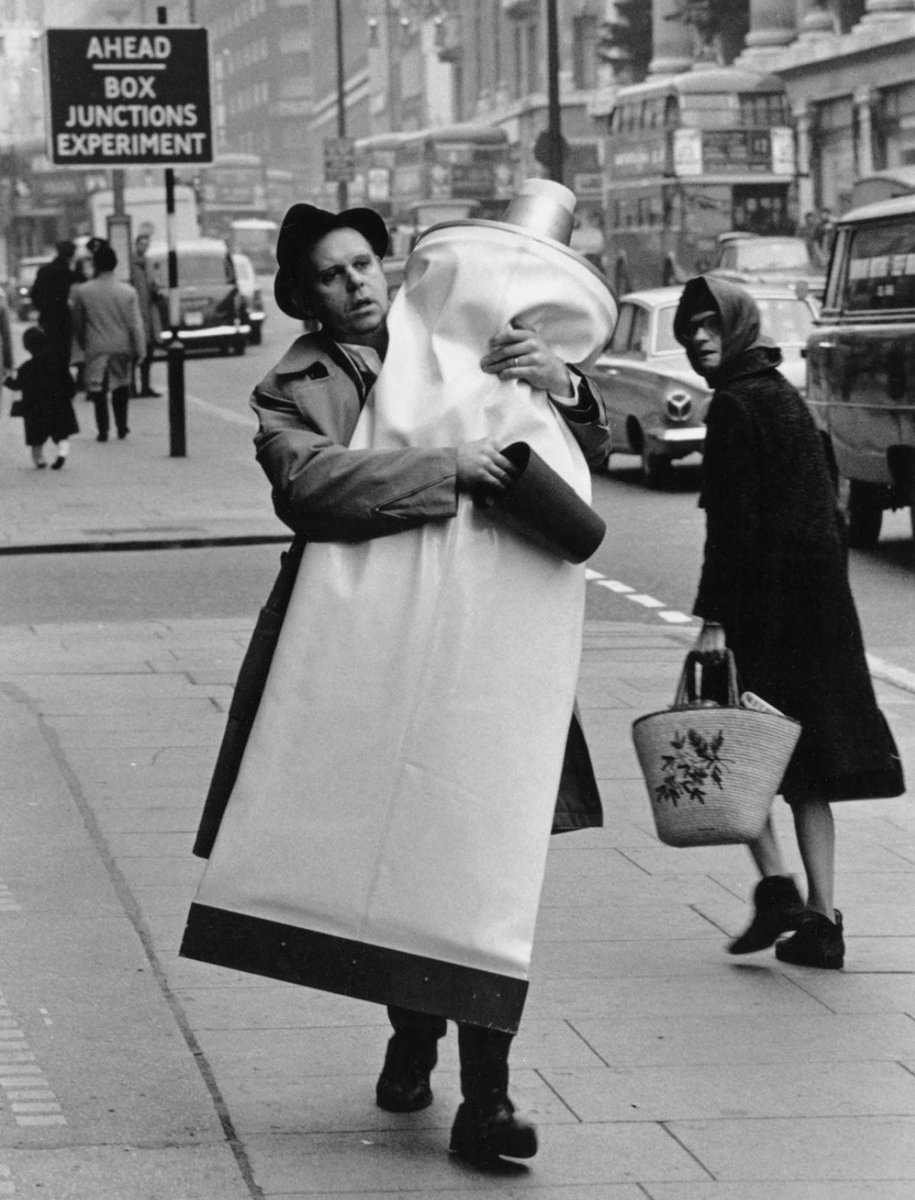
    A busy street in London. A man, facing us in a trenchcoat and a dark hat, mouth open as if breathing heavily, has his arms wrapped around a human-sized toothpaste tube. He carries the cap in his right hand. A woman in a kerchief turns to gawp at him!

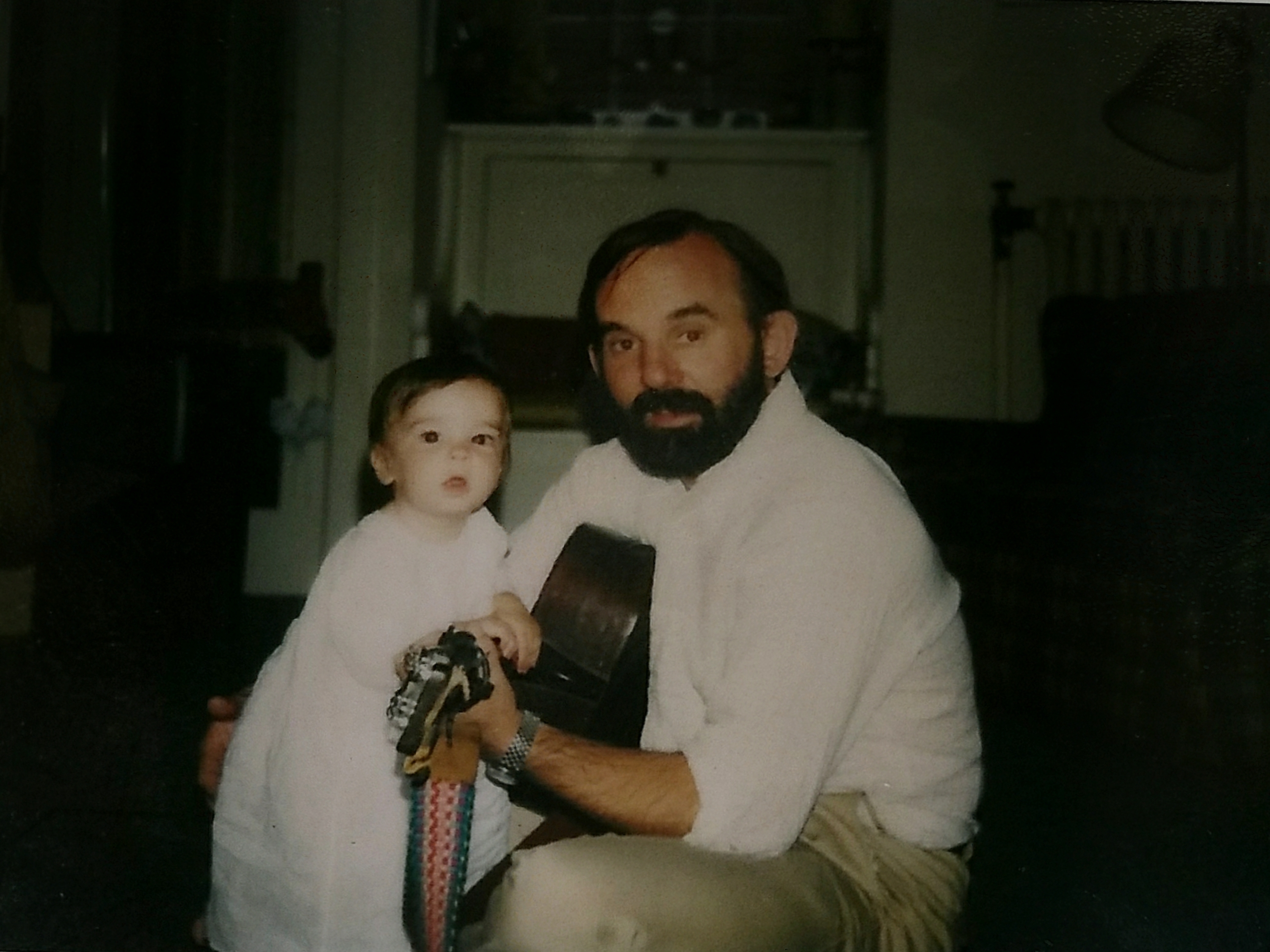
    Claes Oldenburg died about a year ago (July 22, 2022). He was 93. I have been reading a lot about the midcentury US art world over the past few years and his name is one that comes up over and over. But for me the name Claes Oldenburg is not a name for columns and quiet marble hallways or the whisper-passed, enclosed knowledge of art school, or even the rustly pages of the newspaper of record or the books by art critics I love to read. Claes Oldenburg is a name that means summer heat and drawings on secondhand paper and humor I sense but can’t really understand until I grow into it, and, most of all, it is a name that reminds me of the kind of person my father was. Like Oldenburg, my father died in 2022. Like Oldenburg, my father was the product of the white, American mid-20th century (though Oldenburg was a Swedish immigrant, and my father was born in the US to a settler family). Like Oldenburg, my father lived in New York and spent time in the art scene there in the 1960s, though he was never an artist by profession, being instead an artist of his everyday life.

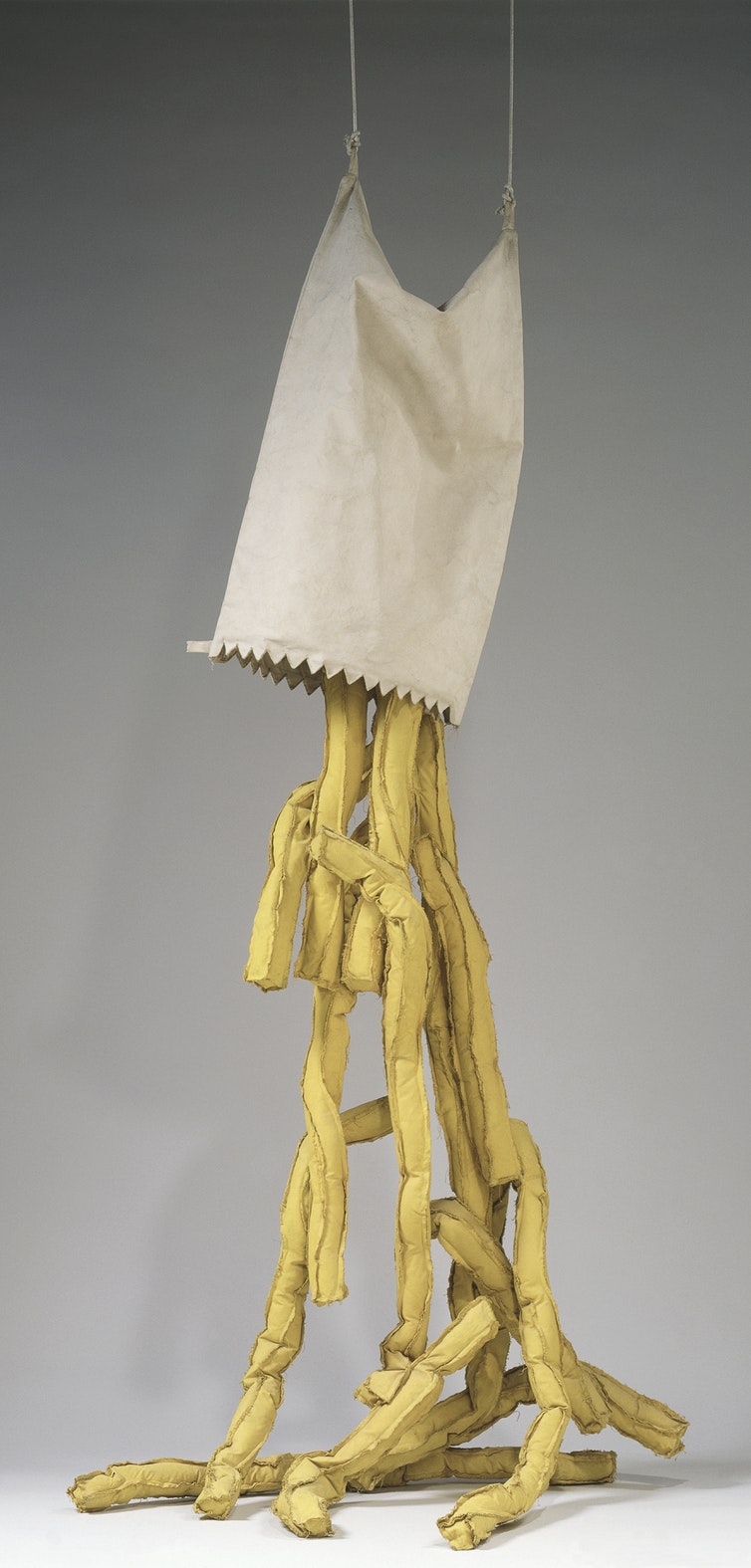
    My father’s approach to art was to like it. That was an active verb for him: he liked a lot of things, from Alexander Calder, his perennial favorite, to Yoko Ono. (He once took me to an exhibit of Ono’s work that changed my life.) His favorite painting was Rembrandt’s Lucretia, which is held in the collections of the Minneapolis Institute of Arts (now MIA), and which his mother took him to see often as a child. I can remember dozens of times in that museum, just standing with my dad in front of the painting, looking at it, and after a while he would say, It’s beautiful. And that would be it. When we were children we were also often taken by my parents to the museums in our city, which were free, warm, and open to children without pandering or condescension. And it was with my father, and probably my brothers and my mother, that I remember first encountering the work of Claes Oldenburg, in the form of his hanging sculpture Shoestring Potatoes Spilling From a Bag. How could I help but like that work, when the person who introduced me to it approached it (and the Sol LeWitt mural near it, and the Louise Nevelson construction around the corner) as something it was possible to find visual and intellectual and felt pleasure in, however it was it came? Liking art as a way to be with art is one of the major lessons I took from my dad.

    A rectangular cloth bag hangs with the mouth of the bag downwards, suspended by two cables. Long rectangular prisms ('fries') are falling from the bag's mouth. It looks like a drawing of a spilling paper bag of fries brought to life in massive scale.

    On the day I met Claes Oldenburg’s work I was a child, holding my dad’s hand as we walked through the collections of the Walker Art Center in Minneapolis. Shoestring Potatoes Spilling from a Bag, hung in a stairwell. I have a bodily memory of it—it’s one of the earliest memories I have of a work of visual art, and most of those memories take place at the Walker. The memory I have is of its size, but not size as in monumentality; size as in disproportion. It’s a sculpture of a small thing that’s represented hundreds of times larger than it is. The sculpture’s not-quite-rightness made me feel good, and that’s a feeling I’ve been interested in ever since. It’s not a “good” of smoothness that thought can slide off of; it is a “good” that made me ask but why? and follow that question with more thinking. The shoestring potatoes are huge (wrong! fries are small) and they are floppy-soft (wrong!! sculptures are smooth and hard!). The bag is not quite symmetrical, and the whole thing hangs not like paper (which it represents) but like cloth (which it is). Thinking through my first reaction (pleasure, humor) has helped me understand this sculpture and Oldenburg’s work—what it’s saying about art, about everyday life, and about the intersections between the two.

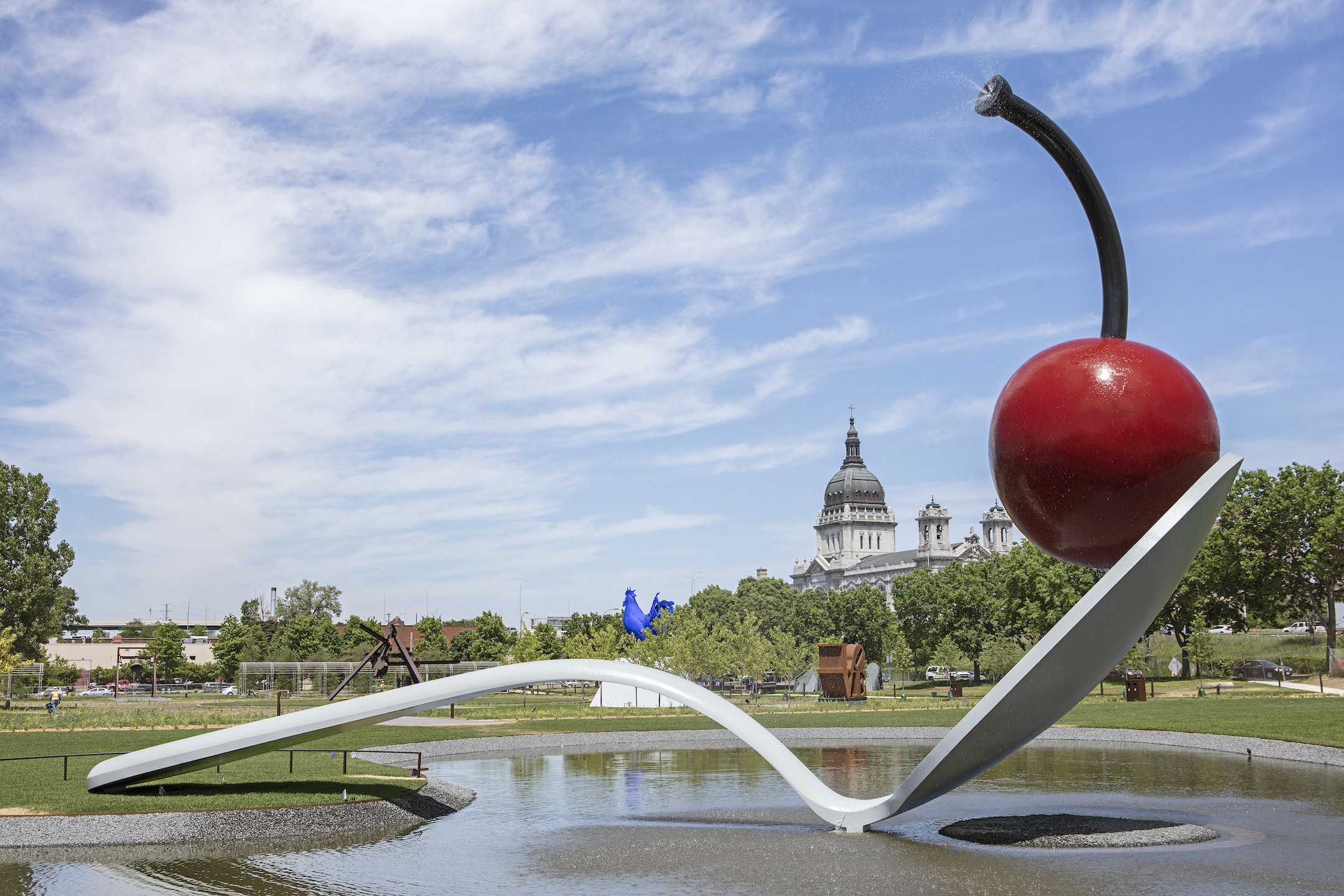
    Most people in the city I come from have seen the huge sculpture Spoon Bridge and Cherry that sits in the garden outside the modern art museum. Oldenburg is known for massive works like this, many of which he made with his wife Coosje Van Bruggen, who died in 2009. This sculpture, like most of Oldenburg’s work, is playful and interested in the objects of everyday life. What happens to them when the scale changes? What happens when we see a typewriter eraser or a clothespin as a monumental object? Whose lives and work are memorialized when these are the things that we have to look up to see, instead of a man on a horse, pointing toward the territory? I am drawn to Oldenburg’s work—the soft sculptures especially, but also the prints and drawings that lead up to and accompany them—because he makes images and sculptures that show ordinary things and that are rendered in ordinary materials. Not marble, but cloth. Not oil paint, colored pencil. Children’s media, not able to be dismissed as children’s media. Or “feminine” material—cloth—and processes—sewing—that are to be taken as seriously as carving marble or casting bronze.

    Claes Oldenburg’s work formed a background to my childhood, though I wouldn’t have been able to tell you his name. That makes sense, not least because he was preoccupied with the things and thoughts of everyday life, the kinds of background objects we forget are even there—clothespins and bathtubs. That his sculptures became part of my world’s wallpaper seems like one right trajectory for them. But also, I was a child, and the art museum was not so different from other ordinary places: the grocery store, the kindergarten classroom. All were part of the life my parents made for me and my brothers, and so the images and objects of these places became part of what I knew the world to be, early on. It was long after my early encounters with Oldenburg’s work that I connected the soft sculpture of the french fries falling from their bag to a specific person with a name and a place in art history. In a narrow classroom, among printmakers and painters, photographers and installation artists, our professor handed out the reading for the week. The handout was Oldenburg’s 1961 manifesto “I am for an Art”.

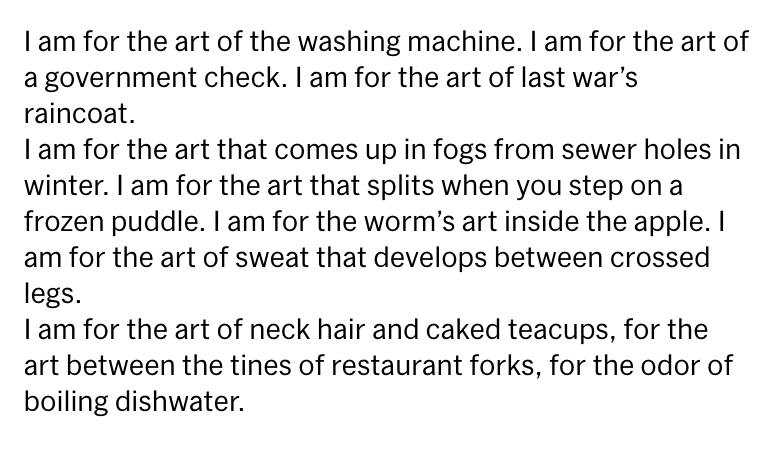
    I am for the art of the washing machine. I am for the art of a government check. I am for the art of last war’s raincoat. I am for the art that comes up in fogs from sewer holes in winter. I am for the art that splits when you step on a frozen puddle. I am for the worm’s art inside the apple. I am for the art of sweat that develops between crossed legs. I am for the art of neck hair and caked teacups, for the art between the tines of restaurant forks, for the odor of boiling dishwater.

    In the manifesto, Oldenburg writes that he is “for an art” that “does something other than sit on its ass in a museum.” “I am for an art,” he goes on, “that grows up not knowing it is art at all, an art given the chance of having a starting point of zero. […] I am for all art that takes its form from the lines of life itself, that twists and extends and accumulates and spits and drips, and is heavy and coarse and blunt and sweet and stupid as life itself”. Oh! Yes. Rereading that manifesto now, after years of reading it alone and with others, gives me language for what Oldenburg’s work meant to me, and, I think, what it meant to my dad. It gives me language that insists on looking at and turning toward what might be passed over or assumed to be uninteresting; a language of obstinacy and of invention. A language that I saw in my dad’s encouragement to look, and look again, at the places we lived. Back when I first encountered Oldenburg’s manifesto, in the classroom of a beloved and revered teacher, “I am for an Art” awoke in me an understanding of what it could mean to have ordinary life at the center of one’s gaze, to steadily affirm that the objects, perceptions, and actions of one’s own life were part of a lifelong engagement with art.

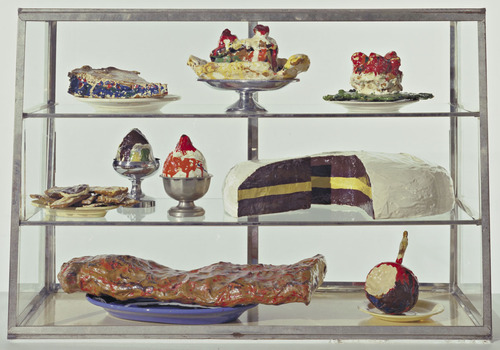
    Of course, Oldenburg’s work does sit in museums, now; his and Coosje van Bruggen’s monumental everyday objects are not everyday objects once they are made of coated steel at immense scale. But I don’t take the manifesto that literally, or that singlemindedly. (It’s a fault-fact of my language that we can’t say all of what we mean simultaneously, and so our experience of contradiction might look like correction or sequence rather than multitudes or copresence. That’s one part of what Fanny Howe is writing about in her essay “Bewilderment”, by the way.) I take it to mean: look. What art is (what poetry is!) isn’t settled. By extension, neither is beauty! It’s not to be found in the places called “art museums” alone. Look for it everywhere: look at the charming form of that typewriter eraser. Look at how the toothpaste tube sags when it gets empty. Look at the beautiful lines of that slice of cake. And all of a sudden it’s clear that it is the seeing that makes the art: your seeing, you, ordinary person, seeing your ordinary life, which (it is revealed to have been all along) is the site of big, living questions about aesthetics, about geometry, about ethics, about optics, about haptics…. Claes Oldenburg’s work taught me, as a very young person, that art was for ordinary life—that art is in fact made of ordinary life; that there is no separation between the things of our lives and the things of art. And his work teaches me that art can be playful, light—and that playfulness and lightness are serious ways of understanding or getting to know the world. From his work in part I draw the knowledge that sculpting means sewing as much as it means working with a hammer and chisel, and that, too, reminds me that art is and can be made of whatever is to hand in our ordinary lives.

    A small white child in a long pale garment stands in 3/4 view on the left. The child is holding onto the neck of a guitar being held by a man squatting on the right. He is white, too, with a beard and dark hair.

    I love art and I love people who make it with seriousness and playfulness (and serious playfulness) and Claes Oldenburg seems to have been one such person. When I look at Oldenburg’s sculptures now, I see my father’s seeing in them. I see I learned from him a lesson in delight, in taking things as they are, in looking again, in being playful, and in the pleasure that can come in there being a difference between what you expected and what showed up, whether in the art museum, in the classroom, or on the bus home from work.


    Thanks for reading. See you in a week!

  • crying: a dissertation

    crying: a dissertation

    could my tears tell me anything about philosophy?

    This week’s Bewilderment is a reprint of an essay that first appeared on April 12, 2023, in the ‘First Person Singular’ vertical at Memoirland. Thanks to Sari Botton for publishing this there, and to Liz Iverson who alerted me to the opportunity.

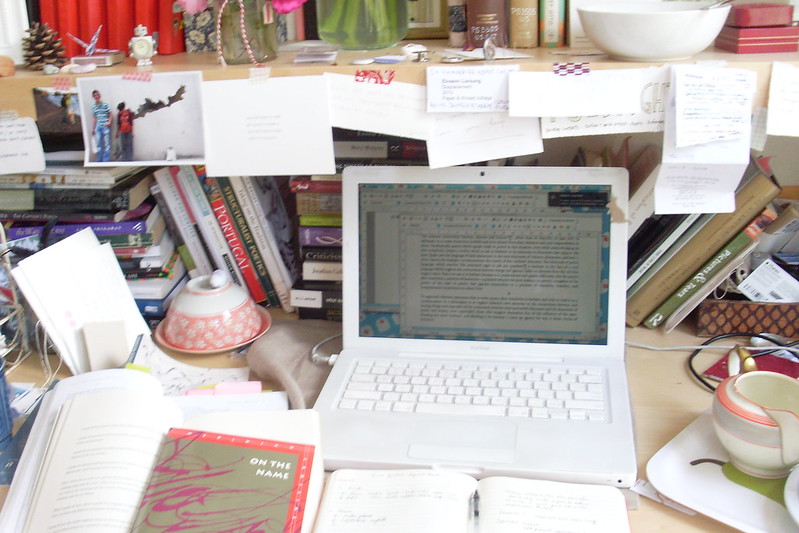
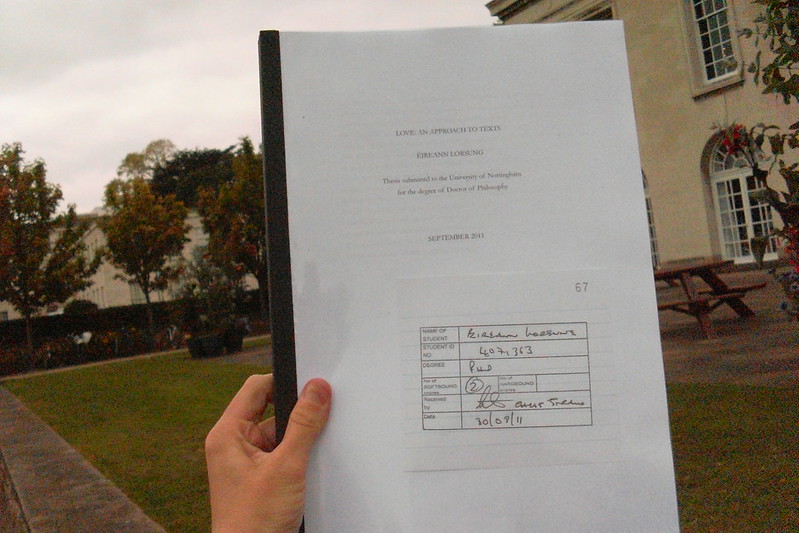
    “Crying: a dissertation” is the only part of my doctoral work I’ve ever tried to publish; in fact, it’s not exactly my doctoral work, anymore; when I decided to send it out, I completely revised this passage as an exercise in (1) letting go of some of my doubts and anxieties around the dissertation, (2) figuring out how to write a very straightforward personal essay that stayed true to my own experience of complexity and even contradiction, and (3) trying to communicate some of the scholarly ideas in my PhD work—that are also central to my teaching and life—in a way that felt conversational but not reductive. So here you have it, along with a few images of the desks where I wrote that PhD and one of the day I handed the pre-viva draft in. Thanks for reading.


    I wouldn’t describe myself as a crier: I don’t cry at movies; I’m often dry-eyed at funerals, despite a soft heart. But between 2007 and 2012 I spent more time crying than at any other time in my life. Was it a coincidence that during that time I was working on my doctoral dissertation? 

    My dissertation was in part about feeling and scholarship. Could one be a scholar and feel things? Everyone around me said no, and so I went through years of research and writing roping off the part of me that, over those years, cried in bathrooms and public parks, libraries, grocery stores, bedrooms (mine and not mine), classrooms, university corridors. I felt crying was essentially shameful: the thing I did when language and logic failed me. My tears seemed like a sign that I was unsuitable for serious scholarship. But that isn’t quite right. In my experience, crying was not divorced from knowing; it was simply farther out, past the language I had at the time. I knew; I just couldn’t talk about it yet. 

    The history of tears is a hidden history. Its geography is the margins: back rooms, alleyways, under the table, in the corner. The philosophy of tears is erasure, impropriety, unnaturalness, witchiness, irrationality. Tears are too much, like anger is, in some bodies. And bodies are at the center of this, because it’s a body that produces tears. They come from glands above the eye, leak through our tear ducts and down the sides of our noses. If a person is dehydrated, their glands will not produce enough water to moisten the surface of the eye, which will become irritated. And they will not be able to cry. What I’m trying to say is, there’s no way to think about tears without thinking about other things that bodies do, like eat and drink, or like die, fuck, laugh. 

    My tears seemed like a sign that I was unsuitable for serious scholarship. But that isn’t quite right. In my experience, crying was not divorced from knowing; it was simply farther out, past the language I had at the time. I knew; I just couldn’t talk about it yet. 

    There’s a long tradition of thinking about intellectuals as somehow disembodied, ideal minds that can have ideas about things without being affected by those ideas, or without their ideas affecting the things they think about. Of course, no such person exists: it’s just that certain kinds of people—well, white, educated, cisgender, straight, relatively wealthy, generally Christian men, to put a point on it—get to walk into literature and history and philosophy as if they are that ideal mind. This isn’t about laying individual blame; it’s that if everyone around you speaks like you, you probably won’t notice that you have an accent, but you’ll be able to hear the accents of anyone whose ways of speaking are inflected by some difference in place or family or language. You get the picture. If the model for being a serious thinker is someone who never cries, well, what happens to the person for whom tears are always close to the surface? 

    About halfway into my PhD, I happened across a book called Pictures and Tears, by an art historian named James Elkins. My method of finding new things to read was not a very scholarly one: I would walk through the library’s stacks, dim towers of books on either side of me, and, according to a rule I had instituted, pull off the shelf any book that caught my eye, no matter how unrelated to my thesis. At this point, I hadn’t read anything about crying. I hadn’t thought about it as a subject, something to look at and form questions about, despite writing about feeling.

    I took Pictures and Tears home from the library with me, the green cover snug in my bag between notebooks. In the book, James Elkins asks how and why some people cry in front of paintings, and goes on to wonder about why these responses aren’t really part of the scholarly field of art history. To cry in front of a painting is a private kind of scholarship, one that the necessary repetition of the scientific method cannot reach. But for Elkins, this doesn’t mean that tears have nothing to offer. It means, instead, that the frame we put around meaning might need to change. As I sat with the book under a quilt my friend had made for me, I realized that instead of having to separate tears and (“real”) knowledge, maybe crying in front of paintings could tell me about relationships between kinds of knowing. But I had never cried in front of a painting, and I doubted that I could. 

    On May 14th, 2010, at about six o’clock in the evening, I was in Paris—a few days away from my desk and the library and PhD-student-life in England. The Louvre was free that night, and a friend wanted to go, so I did. I was in no particular state of heightened anticipation. If anything, I was prepared to be a little bored, because I like smaller museums better than huge, encyclopedic ones. I did have one reason to go, though: I wanted to see a new painting by Cy Twombly that I heard had been installed. At this point, I can’t even recall how I knew that it existed. This preamble matters, because though I’m not usually a blasé person, I was that night. I need you to know that I didn’t have a feeling of special excitement about the visit. I didn’t really give it much by way of forethought, in fact.

    There’s a long tradition of thinking about intellectuals as somehow disembodied, ideal minds that can have ideas about things without being affected by those ideas, or without their ideas affecting the things they think about. Of course, no such person exists…

    We walked through sections of European paintings from the Renaissance (obligatory stop by the Mona Lisa and a quick pass through the Botticellis) and then, following small plaques on the wall, made our way through rooms of Roman metalwork. The floors were cool, pale marble. The woodwork was dark. In the rooms, the cases of gold and lead objects glowed. I walked into an antechamber containing two such cases and stood facing the room I’d come from to look at them. They were small and dark and the room, despite being lit with museum lights and the light from the window, felt relatively dark, too. Then I turned to walk into the next room. 

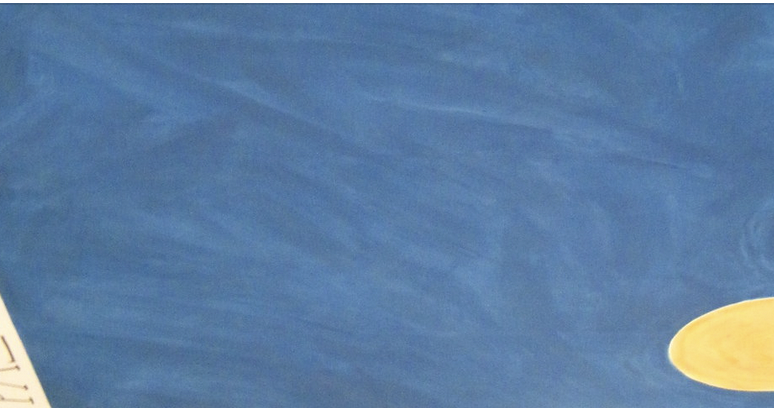
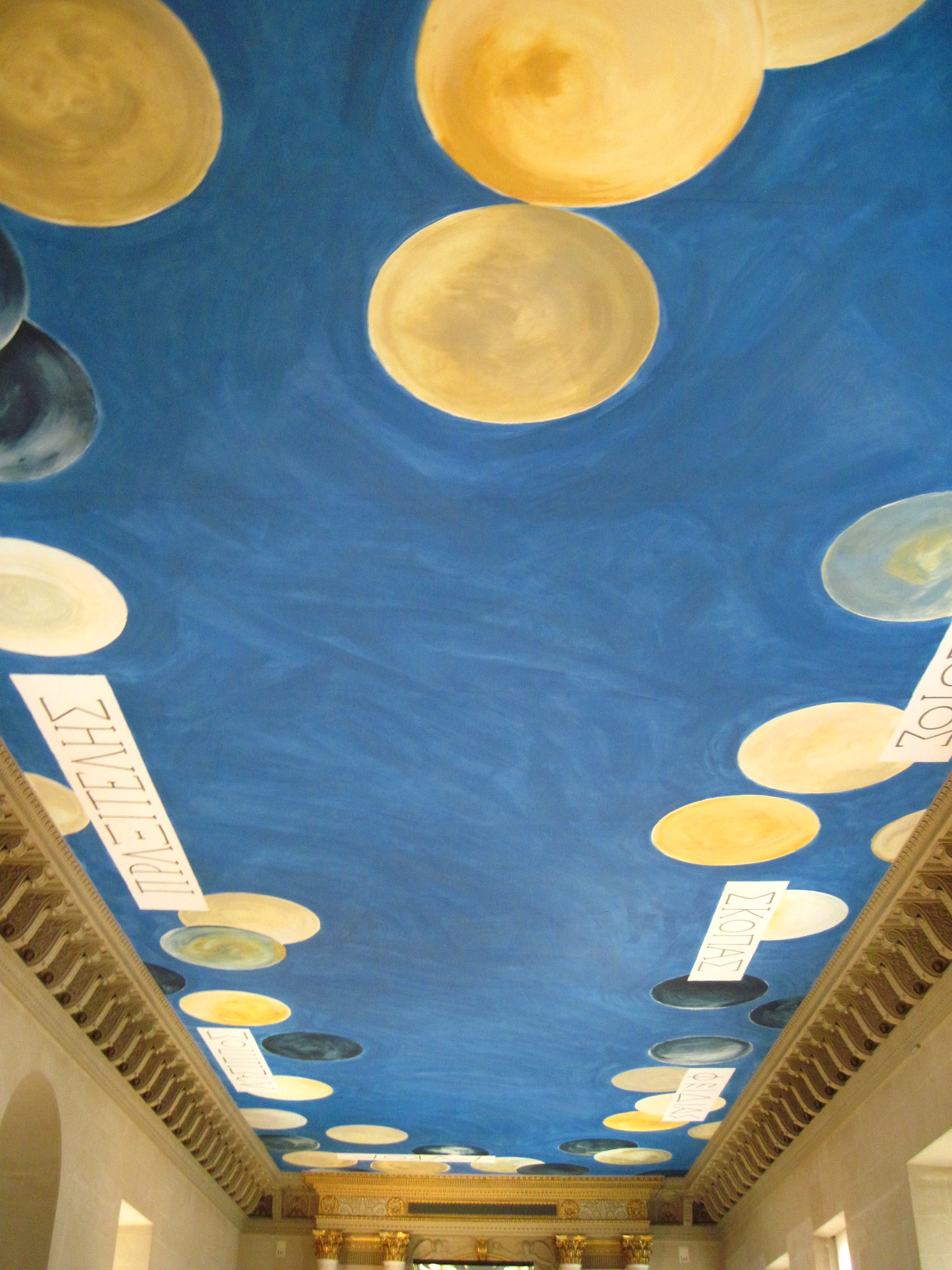
    Elkins lays out what he imagines to be the ideal conditions under which one might cry while looking at a painting: go alone, avoid trying to see everything, take your time, avoid others’ interpretations. By being with the painting on one’s own (and its own) terms, by ignoring others’ readings of it, and by spending time alone with it, it might be possible to cry in front of—or because of—it. On that evening in Paris I wasn’t alone, but Elkins’ other conditions held. When I turned from the darkness of the antechamber and its small wood-framed cases, there, right in front of me, opening into a brightness that felt larger than the actual dimensions of the room, was Cy Twombly’s The Ceiling.

    In factual terms, this painting, The Ceiling, can be measured and its details can be noted and filed away in the correct art-historical filing cabinet (waiting to be called up in newspaper articles or research or gallery didactics). It is 3,750 square feet in size. It was painted in 2010. It is inscribed with the names of Greek sculptors. Its colors are pale brown-gray, gold, blue, white. The blue field that dominates The Ceiling is meant to call up the water of the Aegean Sea. Those details don’t satisfy me, though, in terms of what I experienced that evening. The words, the art historical facts, aren’t enough to convey the massiveness of this painting, and its massiveness is part of its meaning. The Ceiling is more, does more, than I can capture in this dispassionate catalogue of color and dimension. What can I say? I burst into tears in the doorway to a world where everything was suddenly blue and white and gold.

    I realized that instead of having to separate tears and (“real”) knowledge, maybe crying in front of paintings could tell me about relationships between kinds of knowing. But I had never cried in front of a painting, and I doubted that I could. 

    When I returned from Paris to the English city where I was studying, many things were unchanged. I still associated tears with acute embarrassment and worried that they made me seem, to others, like an incapable thinker. The process of writing and reading was still difficult, sometimes deeply painful, threaded with self-doubt. The “dry-eyed” theoretical works I was learning to read, and that I had real affection for, were still there. But I brought back with me the equal reality of my spontaneous tears in response to Twombly’s blue-white-gold immensity. In that moment, in an immediate and irrefutable way, I learned an also about knowledge that has stayed with me ever since. There is no either-or when it comes to thinking: the same selves who do the work of theory are the ones who grieve a death, or thrill to new attraction; whose hands get pruney in the dishwater and who need to eat and drink. 

    I don’t know why I cried in front of this painting and not in front of any other, even paintings I love, or others of Cy Twombly’s works, ones I’ve admired. What comes to mind when I look back is simply the size of the painting: how large it was, how high up it was, and how it filled the whole room visually. It seemed to fill the room, and me, in such a way as to welcome me—all of me. Looking at The Ceiling in tears meant looking at it in the first person. It was I, only I, who stood there crying. My tears were my signature, my way of taking on tradition from the place only I could have: I the scholar, finally in the same exact place as the I who could not control her tears.


    August is here; September is coming. Next month I’m planning to write, loosely, in the region of learning to write and teaching writing. If you’re reading this and there was a moment you can remember where a teacher changed your mind/your life/your practice about/of poetry or writing, or a reading you remember that broke your mind open in important ways, would you be willing to tell me in the comments?

    Thanks again for reading. See you next week.

  • [while walking]

    [while walking]

    the riches of everyday life

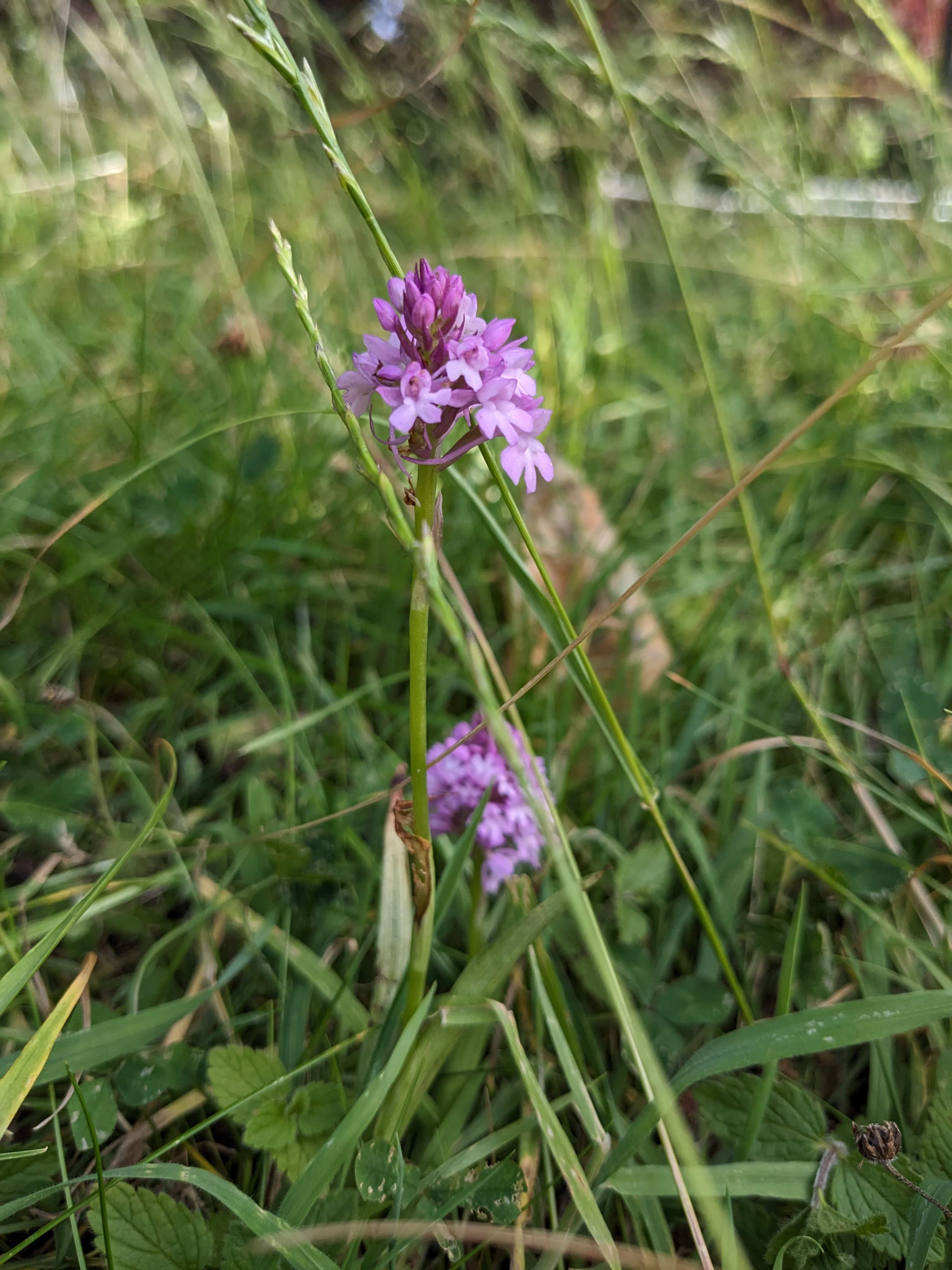
    a pyramidal orchid and grasses. the orchid is pale magenta

    At the start of July I saw a pyramidal orchid for the first time in real life. At the place I work the groundskeepers have left swathes uncut between mown areas for walking and in those places I’ve seen so many wildflowers over the past three months. When you get down by the ground what might have looked homogenous when rushing or even just walking by fractures into incredible diversity of kind, color, size, form. And it doesn’t take a ton of space for this, either. I often think about the breadth of a street, and how many gardens, how many fruit trees could be made in that space. Imagine walking out your door to a vegetable and fruit garden of your own (imagine a redistribution of massive wealth such that having the time to care for and work in such a garden were not a ‘luxury’ but a part of everyday life). In my imagined city there are bike and pedestrian paths down the center, fruit and nut trees shading the paths, gardens between there and the houses. Bus and tram lines too but I’m not an urban planner, here; I’m just a dreamer, kneeling in front of a pyramidal orchid. But look what huge things can happen in such a little space.

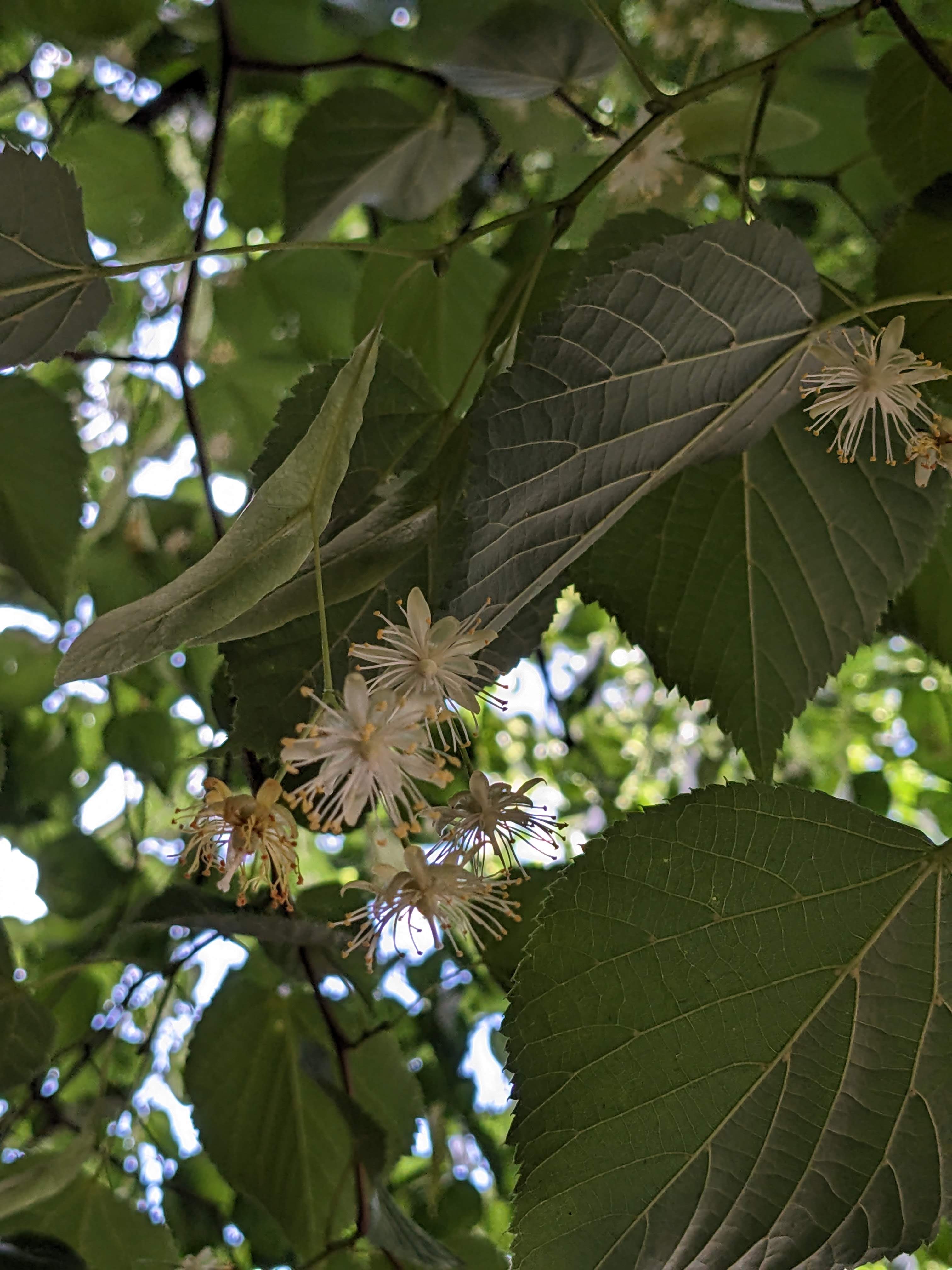
    starlike linden blossoms under the darker green canopy of their leaves

    Did your nose lead you through the streets until you found the source of July’s perfume? It is the linden (lime) trees in flower. Only for a short time—a week or two; shorter if it was unseasonably hot. For everyone, freely available, without cost: their scent is a shower of softness.

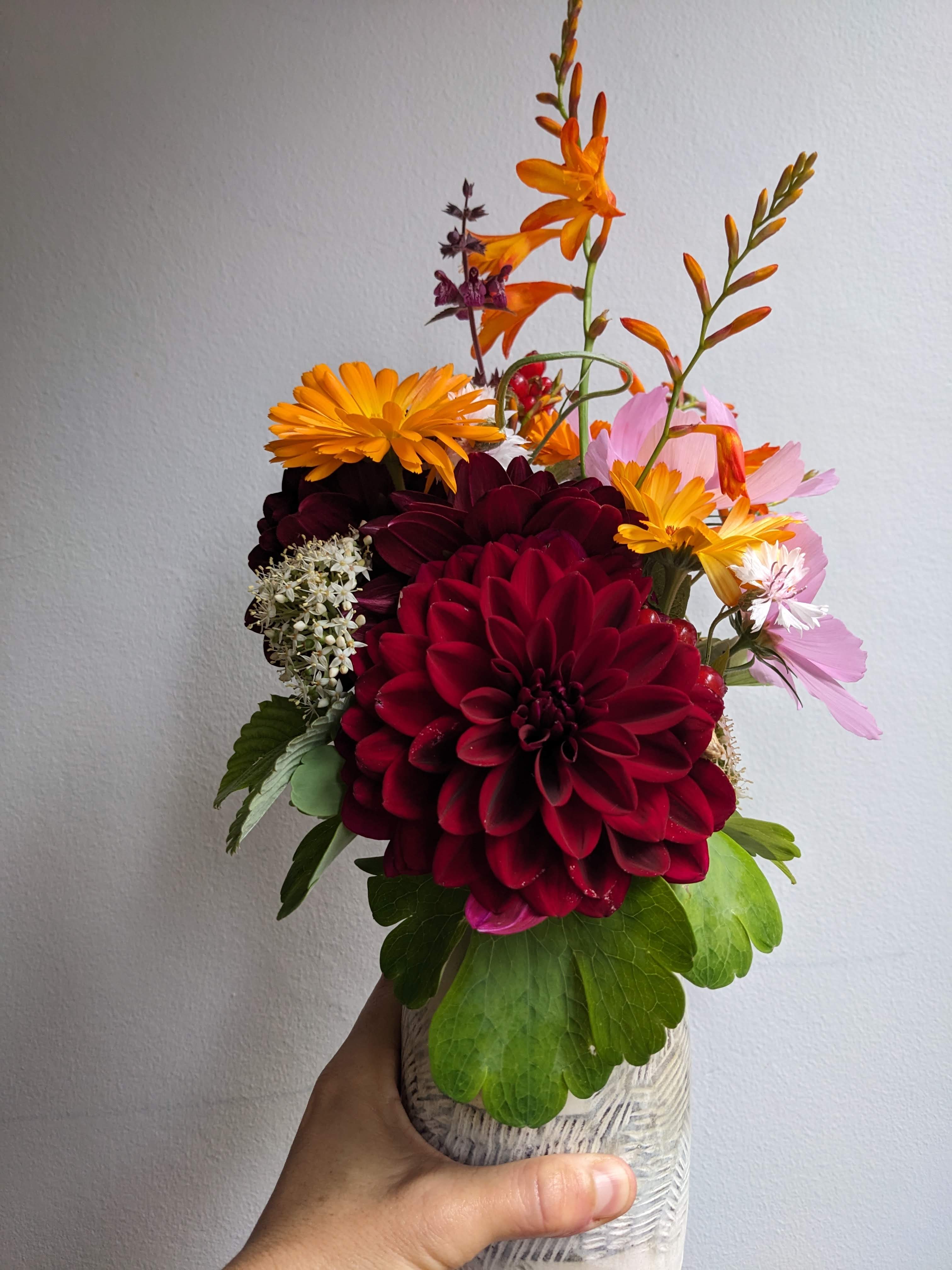
    white person's hand holds a pale gray clay vase with deep red dahlias, orange calendula and crocosmia, pink cosmos, white dogwood, pale pink bachelor's buttons, and a magenta lamium, as well as columbine and strawberry leaves

    In gardens we may not own but rent or borrow, in friends’ gardens, in the places where plants escape the borders of the private yard and spill onto street or public path; on the grounds of banks and private equity firms; in the crack between pavement and wall: we can find and gather the riches of summer. (If you are in Minneapolis/St. Paul, and you want someone to find and gather these riches for you, Night Owl Farm has a beautiful flower CSA. It’s not cheap but what a gift—flowers every week for the price of a lunch out that week. Elsewhere, look for farms that do this. Great way to support smaller farms and to give presents that don’t need to be manufactured.)

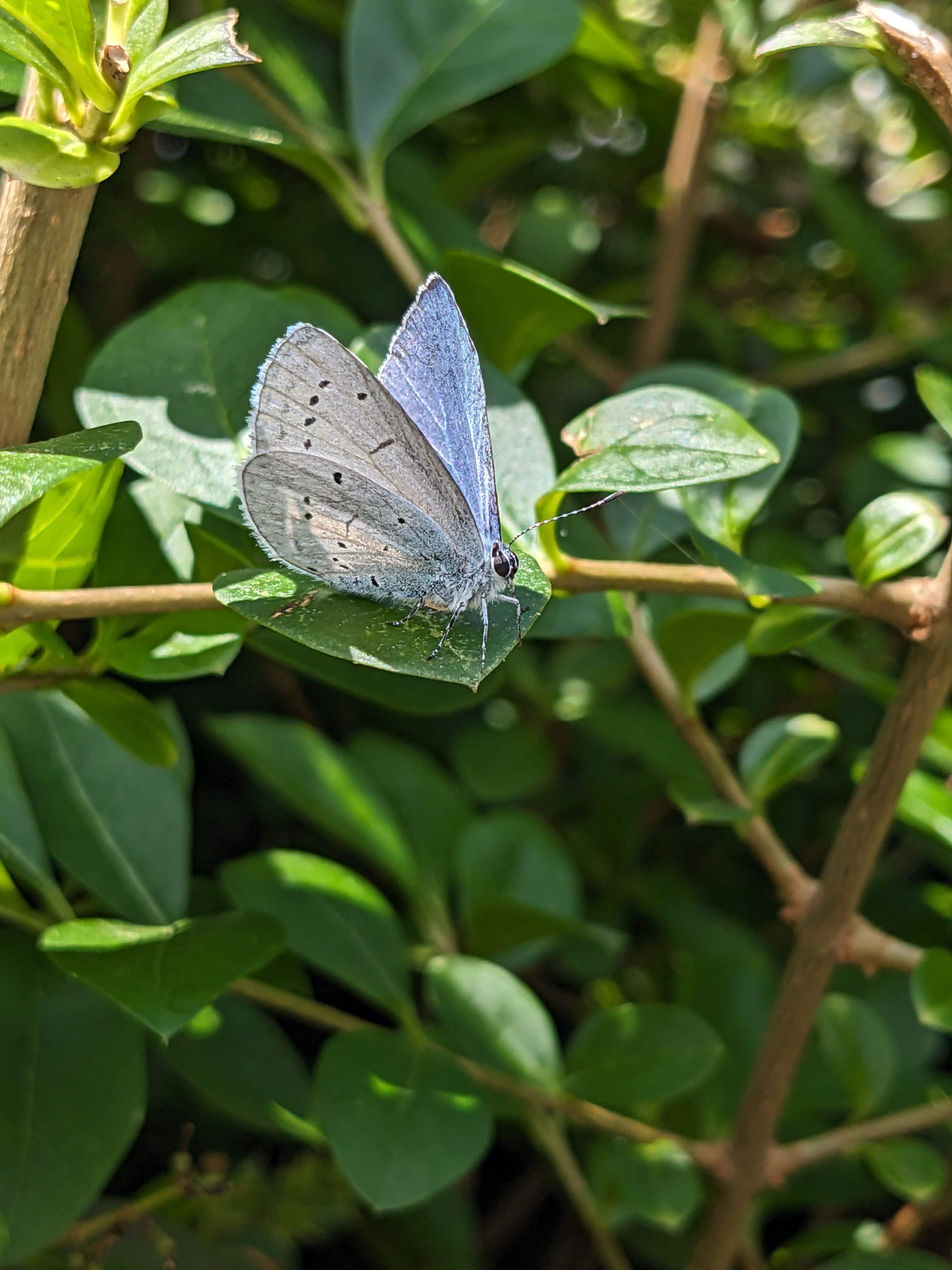
    small silvery-blue butterfly on a damp leaf

    What do the beings of the world say but that borders are fictions and that everything is precious? That life is always going on, all around us, and is infinitely interesting and complex; that the work of making meaning and of coming to understanding is endless and for everyone—could not be achieved by one person alone, or in one lifetime. These border-crossers know that ‘nation’ is a lie enforced by militarization and in service not to life but to wealth. They know that the networks of mutual dependence and reliance are everywhere and nothing living or unliving is outside of them.

    The beings who live alongside us (including the human beings) also tell us that grace inheres in each thing, as it is, in the ways that it is, a grace that is not theological but intrinsic, theology being only one way to interpret what is always already there. Hopkins’ theology brings him to this conclusion—“Each mortal thing does one thing and the same:/ Deals out that being indoors each one dwells:/ Selves—goes itself, myself it speaks and spells,/ Crying Whát I dó is me: for that I came”. The beauty of geometry and the unlimited curiosity it can teach us! “Euclid alone has looked on beauty bare”—would I go that far? Maybe not, but I know the poet uses hyperbole to effect an argument, and I take her point. (Also, I learned this week that snails are left- or right-‘handed’.)

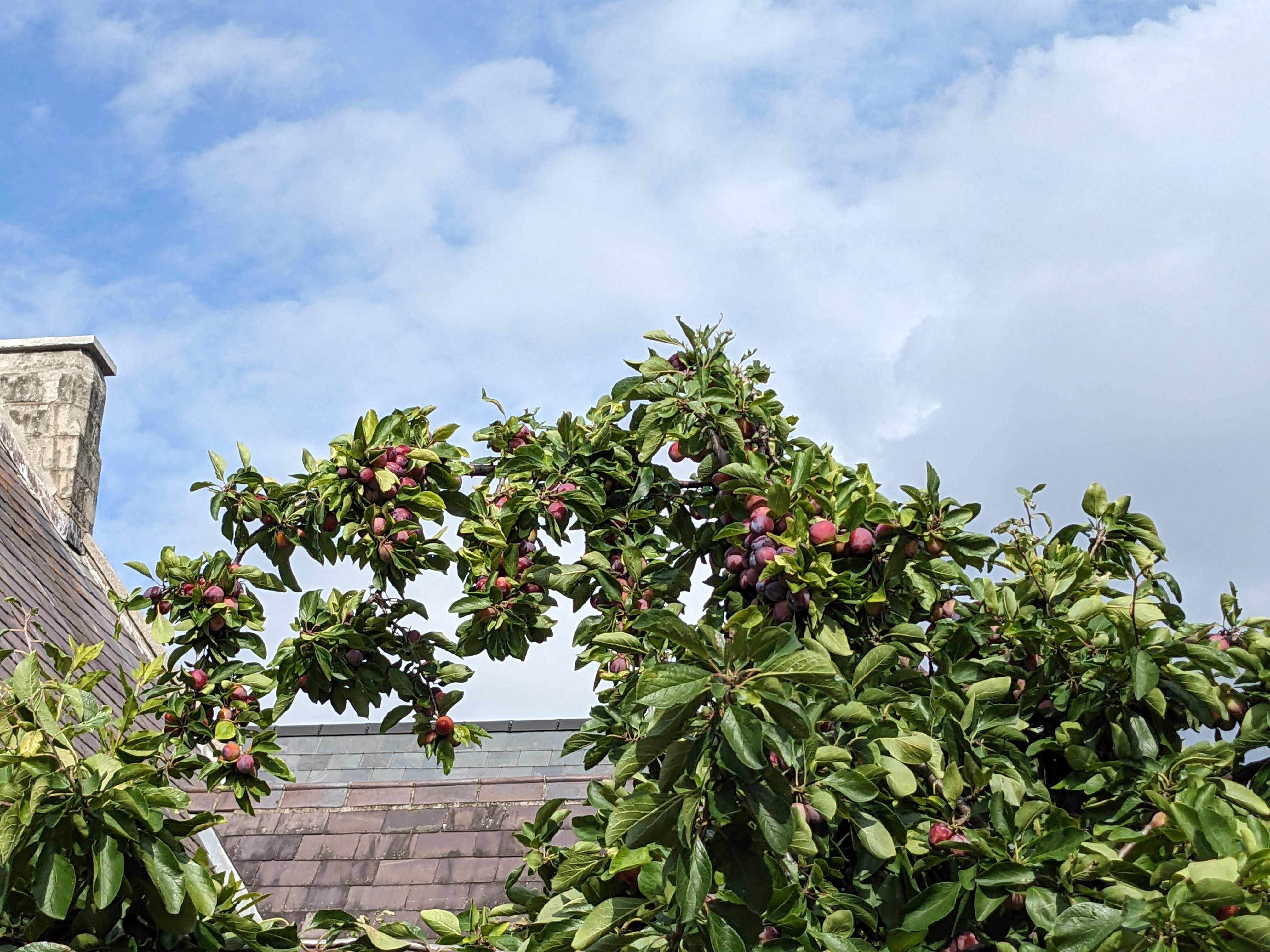
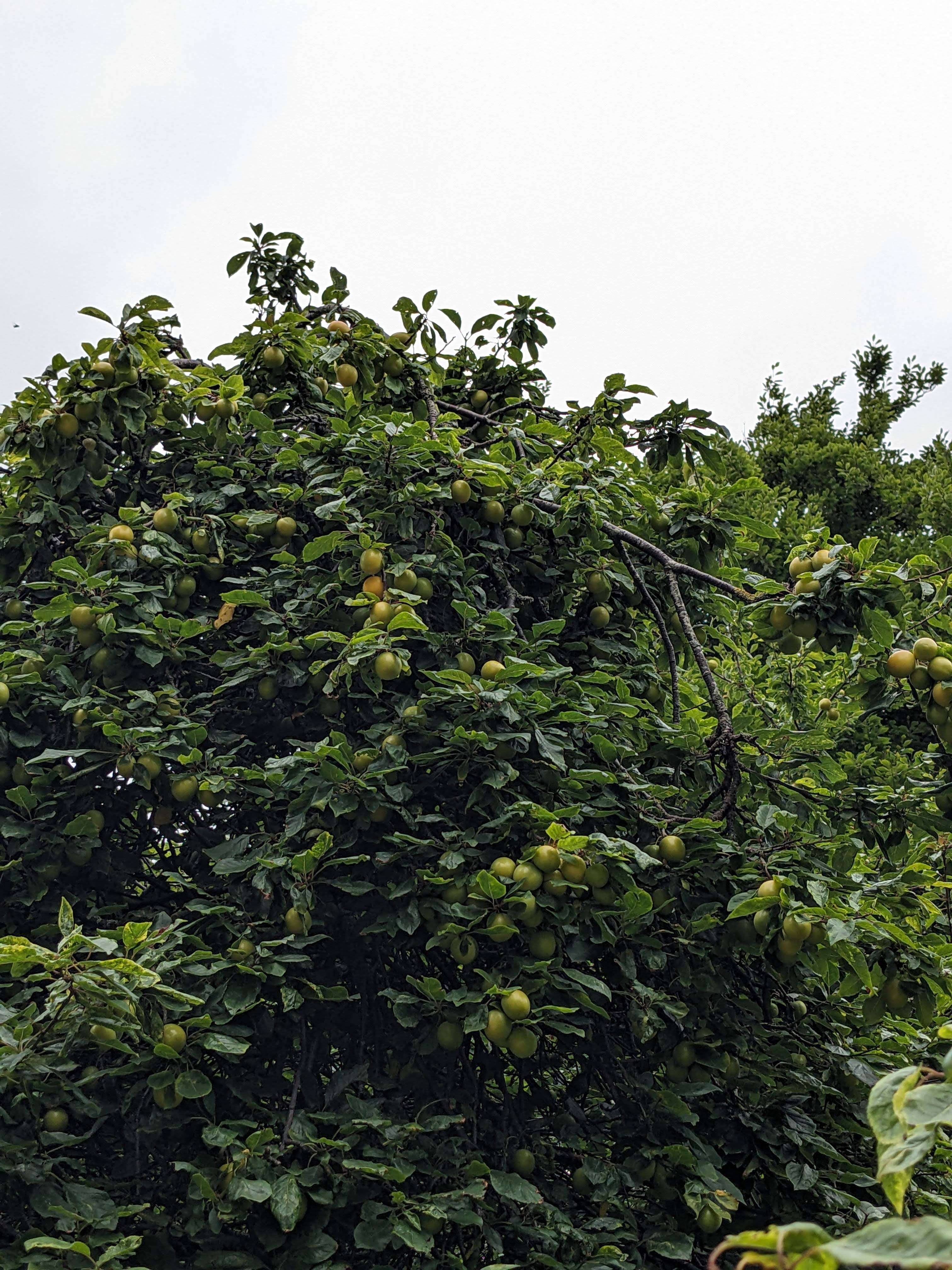
    the top boughs of a plum tree full of purple fruit bend under the weight against a blue sky

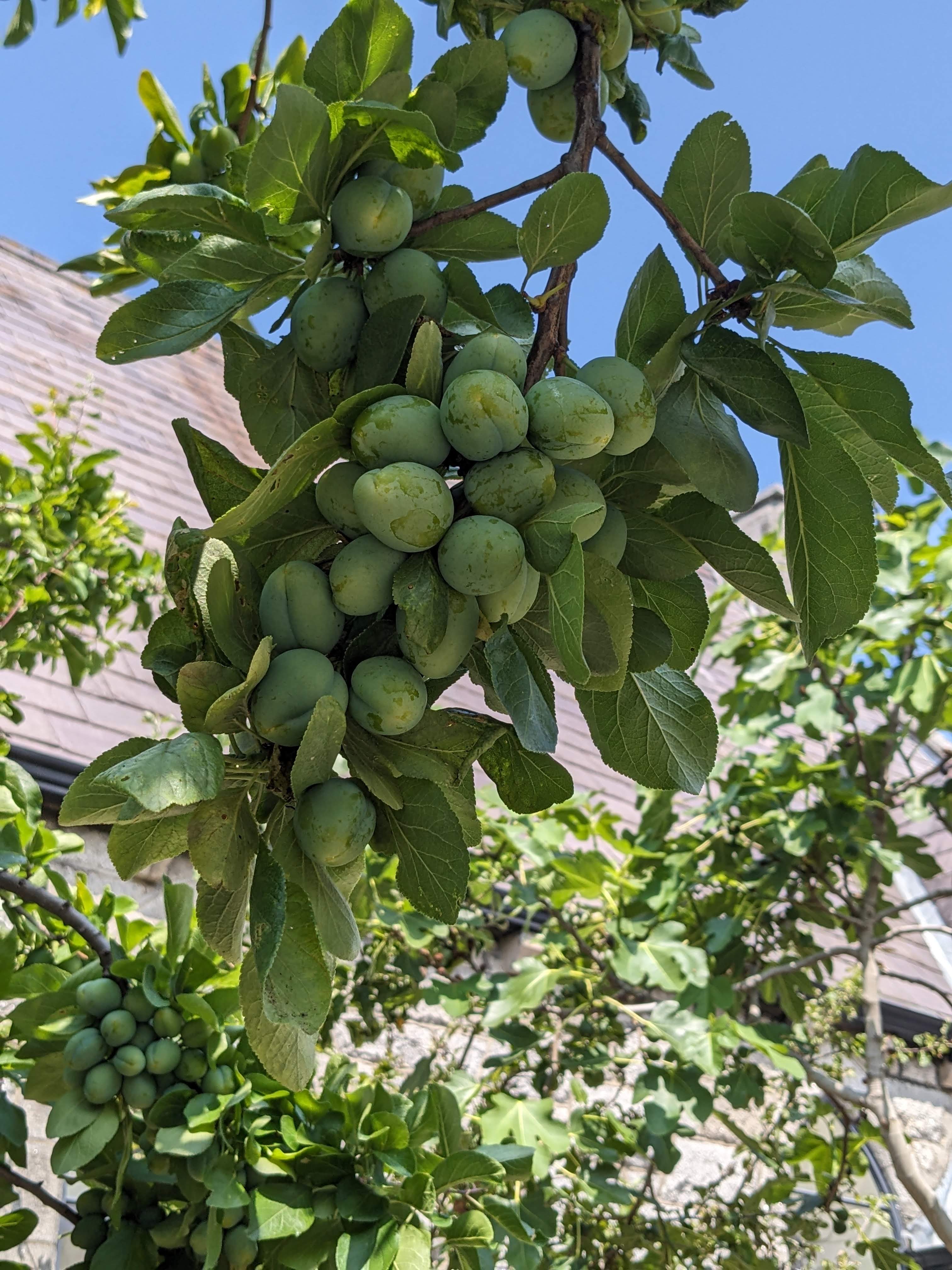
    This city is a city of fruit trees: public plantings of plum, cherry, pear and hazelnut all drop their bounty to smash on the sidewalk and be crushed under the tires of cars. As I have walked over the past eleven months I have noted the places where fruit and nut trees are and mapped them, and in July I returned to plum trees—already covered in ripe fruit—to gather what fell. (I only take windfalls from trees that are private, or I ask at the door if there is fruit on the ground whether I could pick from the tree. And I shake public trees to adduce them to drop fruit for me.) From windfall plums and mirabelles I made four small jars of jam. I have to push back against the scarcity feeling when I gather this public fruit—telling friends on purpose where the trees are. It has to be for everyone and if I’m against its enclosure I have to be against my own desire to enclose it. There is more than any one person can use. And imagine if all the plum and apple and cherry trees in the back gardens of derelict buildings could be harvested? Imagine a jam kitchen for anyone to use. Imagine a café that served meals or treats on a pay-as-you-can basis, made with food grown in back gardens and on city streets. The world of plenty and of solidarity is already here, we just have to act as though it is. This world in which we could live by the dictum of sufficiency-and-no-more rather than by more-and-more-and-more is possible and we are part of it.

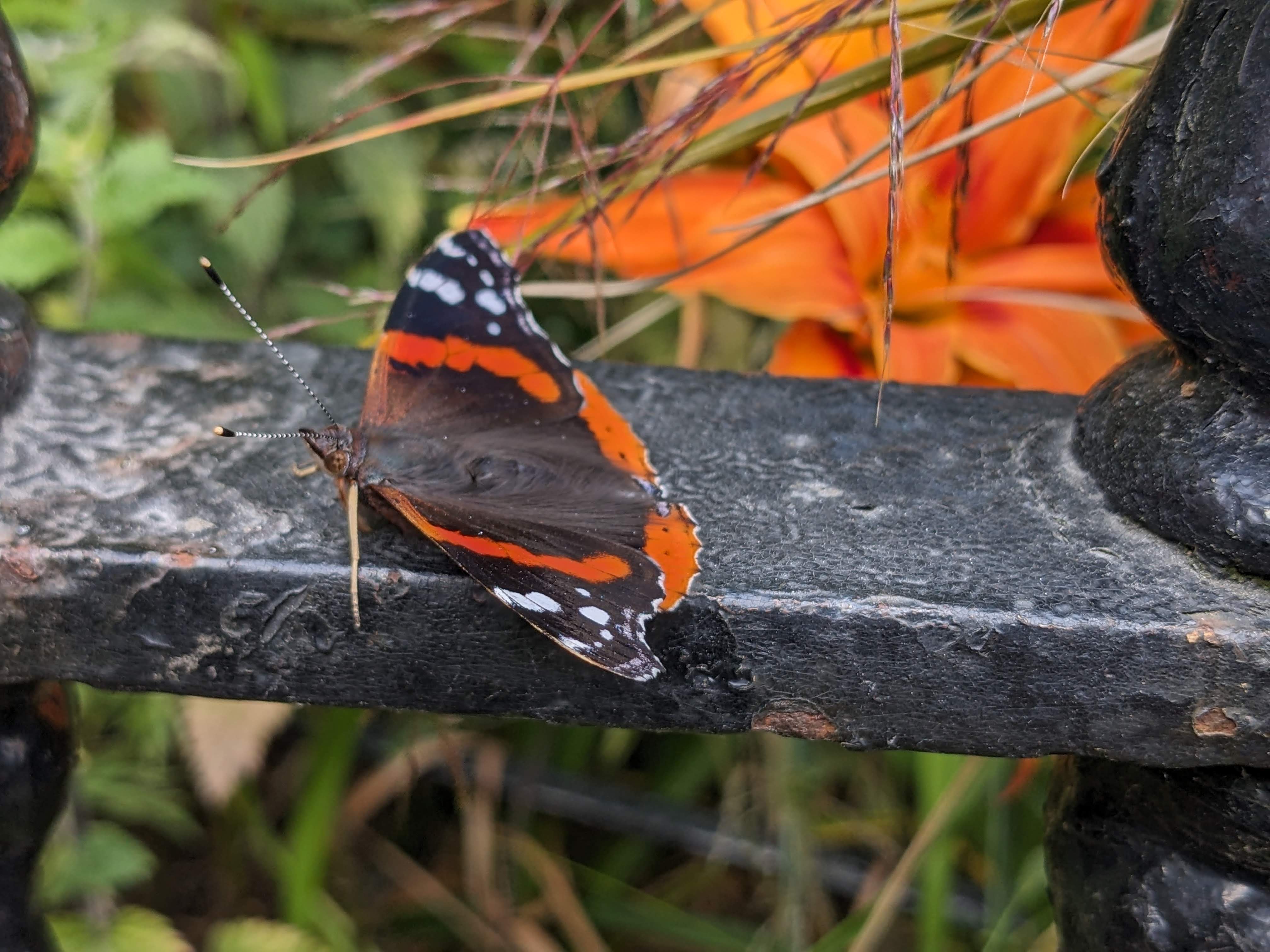
    an orange and black butterfly pauses, wings open, on a black-painted iron gate.

    It seems impossible to me to walk without thinking about riches: in Dublin this is so because of what the financialization of housing has done, and also because there are banks and finance corporations and tech corporations and the trappings of extreme wealth, and because property is so prominently present as well as the dehumanization and abandonment of the poor. But it’s also so because the world itself is riches. Not marble nor the gilded monuments—what “lives in lovers’ eyes”, what is lasting and meaningful to me is the way that looking and walking makes me alert to ever more complex detail, the way observation teaches me to see that detail and its relations and to metaphorize and generalize from this, to understand structures and concepts in new ways, which again direct me to the world of things, material and phenomenal.


    August is almost here; September is coming. I’m planning to write, loosely, in the region of learning to write and teaching writing. If you’re reading this and there was a moment you can remember where a teacher changed your mind/your life/your practice about/of poetry or writing, or a reading you remember that broke your mind open in important ways, would you be willing to tell me in the comments?

    Thank you for reading. See you next week!

  • some notes on notebooks

    some notes on notebooks

    which, it turns out, are not *for* anything but themselves

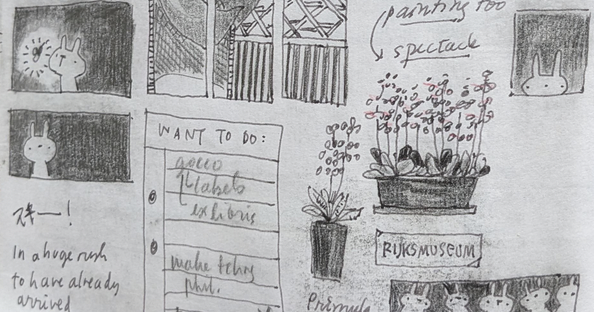
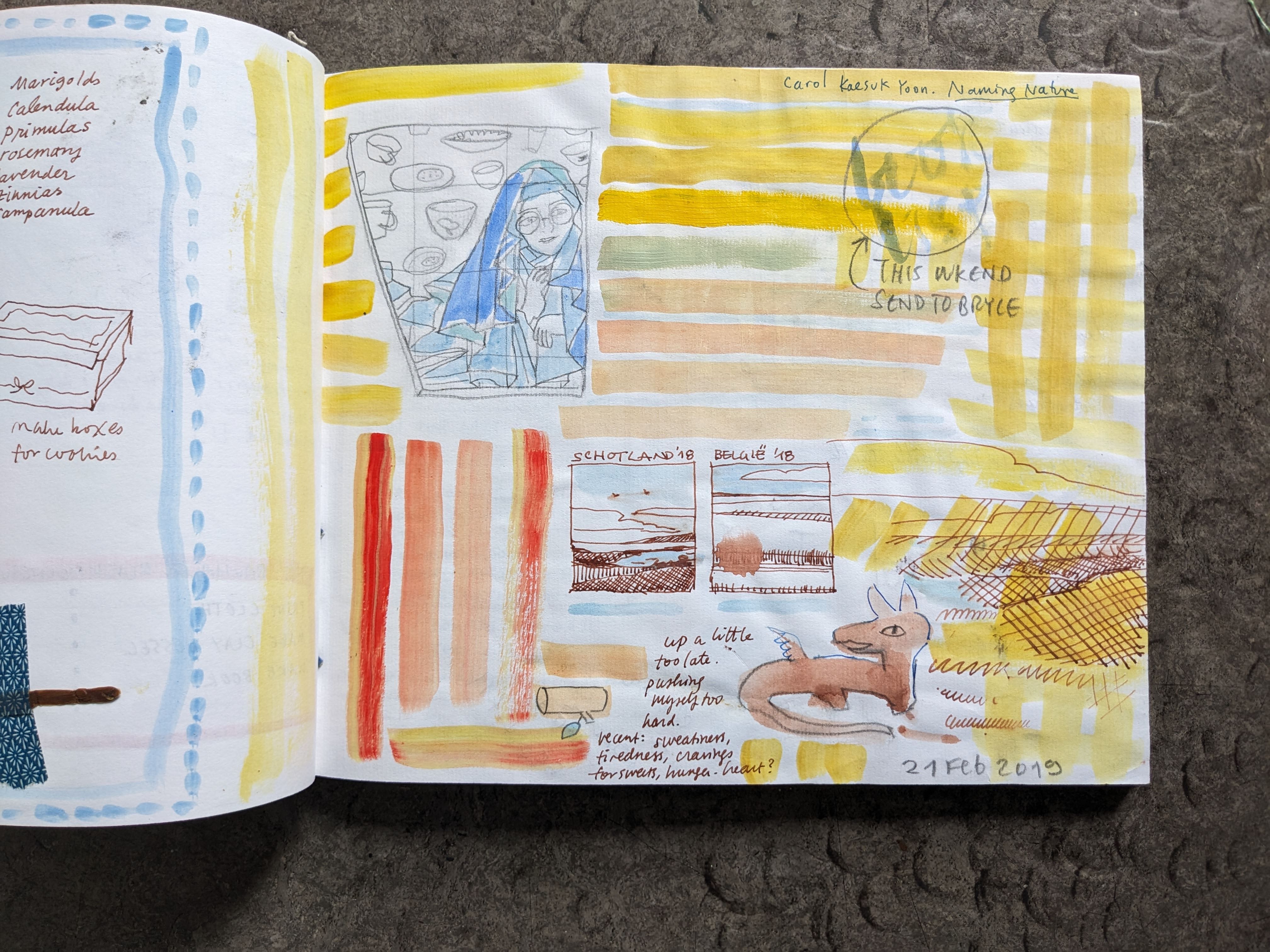
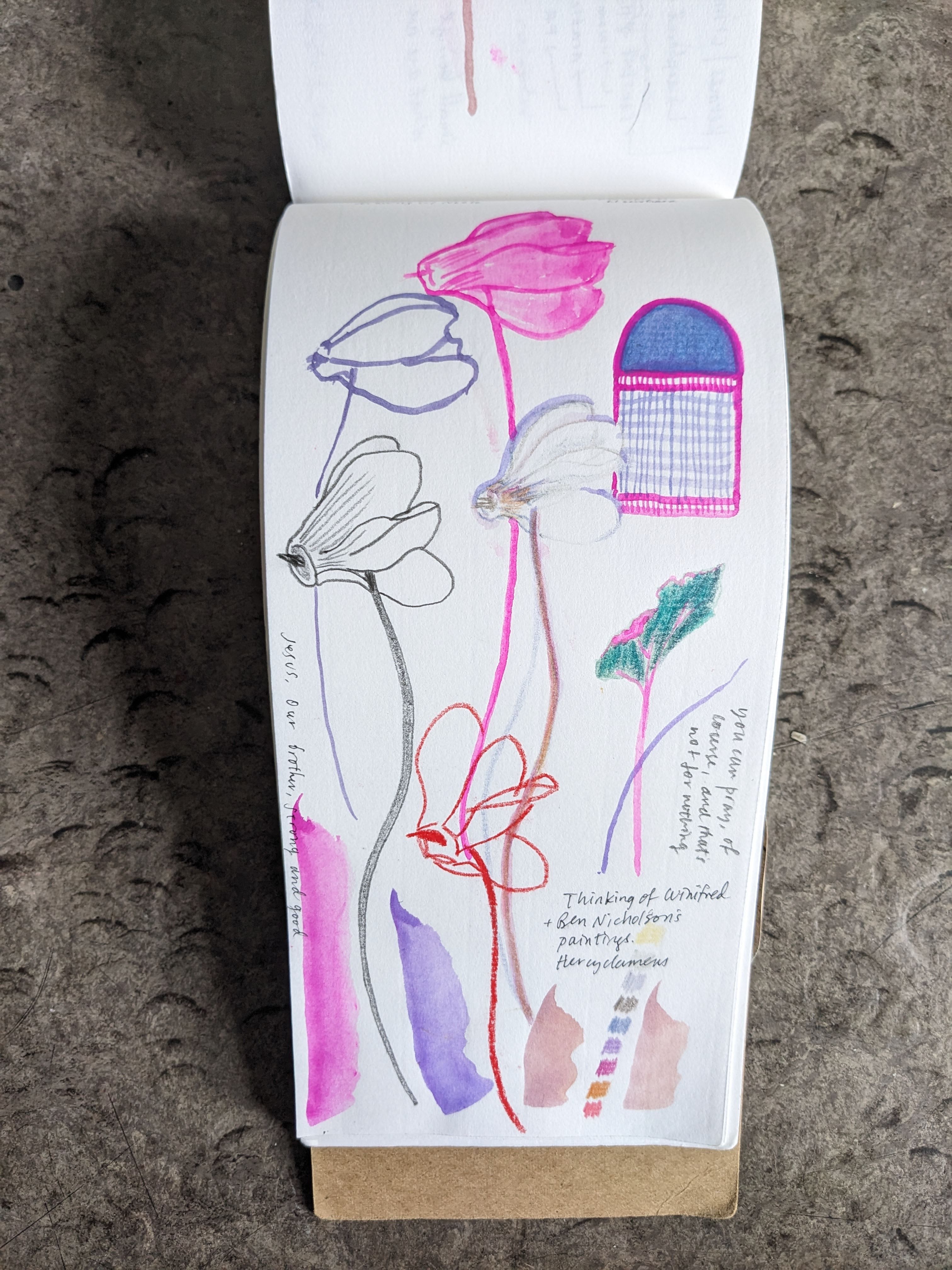
    To hold the act of thinking before it resolves into thought. To write plans in, write grocery lists in, count chores off in, diagram ideas in until the ideas finally take shape. To be a physical location for so much that would be hard to hold in mind alone. To remind my hand how to move. To make the act of beginning to write an everyday thing, done without ceremony or anxiety. To convince me that writing is ongoing, as thinking is, without end, without scarcity, and without a target in mind. To practice in. To merge the acts of “write” and “draw”. To keep my brain lively while I wait. A place to make my whole life, and then, more or less, to leave behind.

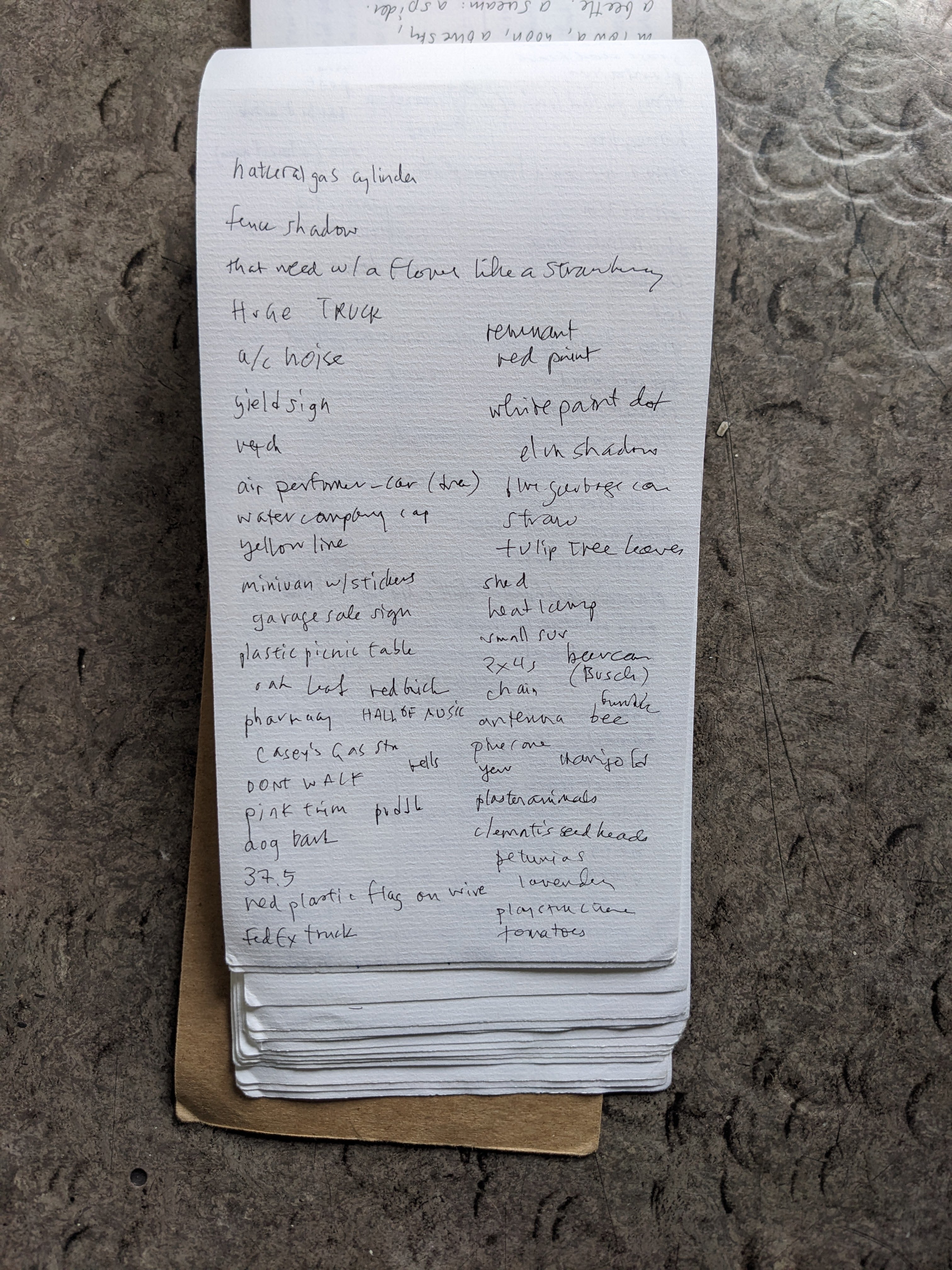
    An example of a frequent exercise, twenty minutes of noticing exactly what’s around me in a limited area, usually about a square yard. I adapted this from a thick description exercise I learned from a sociology textbook, and over time it became a repetitive training in attention. Slow down.

    Vertical shape or horizontal shape, the page lends itself to different kinds of movement with the hand, which in turn render ways and kinds of thinking that are not at all the equivalent of the thinking I do in the orderly left-to-right, top-down of the computer screen.

    For a long time I used only red hardbound notebooks of that famous brand, with or without lines. Less superstitious now, I use basically any kind of notebook, but I do go through periods of one kind or another.

    When I had easy access to a drill I made the notebooks above, half of a US letter-sized sheet (cut the long way), about fifty or seventy half-sheets in total. Cardboard from mailing envelopes (chipboard, not corrugated) and heavy, waxed binding thread (the link is to a shop I’ve ordered supplies from before—good quality). I used this way of binding; here is a print tutorial if you prefer. Once you have made a few books you start to realize what you want from them and you can make your own adjustments. For me this meant tripling or quadrupling the thread for a stronger binding, adjusting the depth of the stitches, and scoring or creasing the cover with my bone folder so it would open flat.

    The long and wide form changes the way sentences can be shaped. When I am writing by hand, the material insists back at me. It makes me do things (like break a line, but not only) and it does things to me (like suggest relations across space and time). Of course, a computer screen is insisting, too; that shows up in how the shape of the A4/letter page is taken for granted by so many writers and thinkers. It’s just that, reading and working so much in that form, I often forget that it is not default at all but a design choice that I, too, can choose (or not).

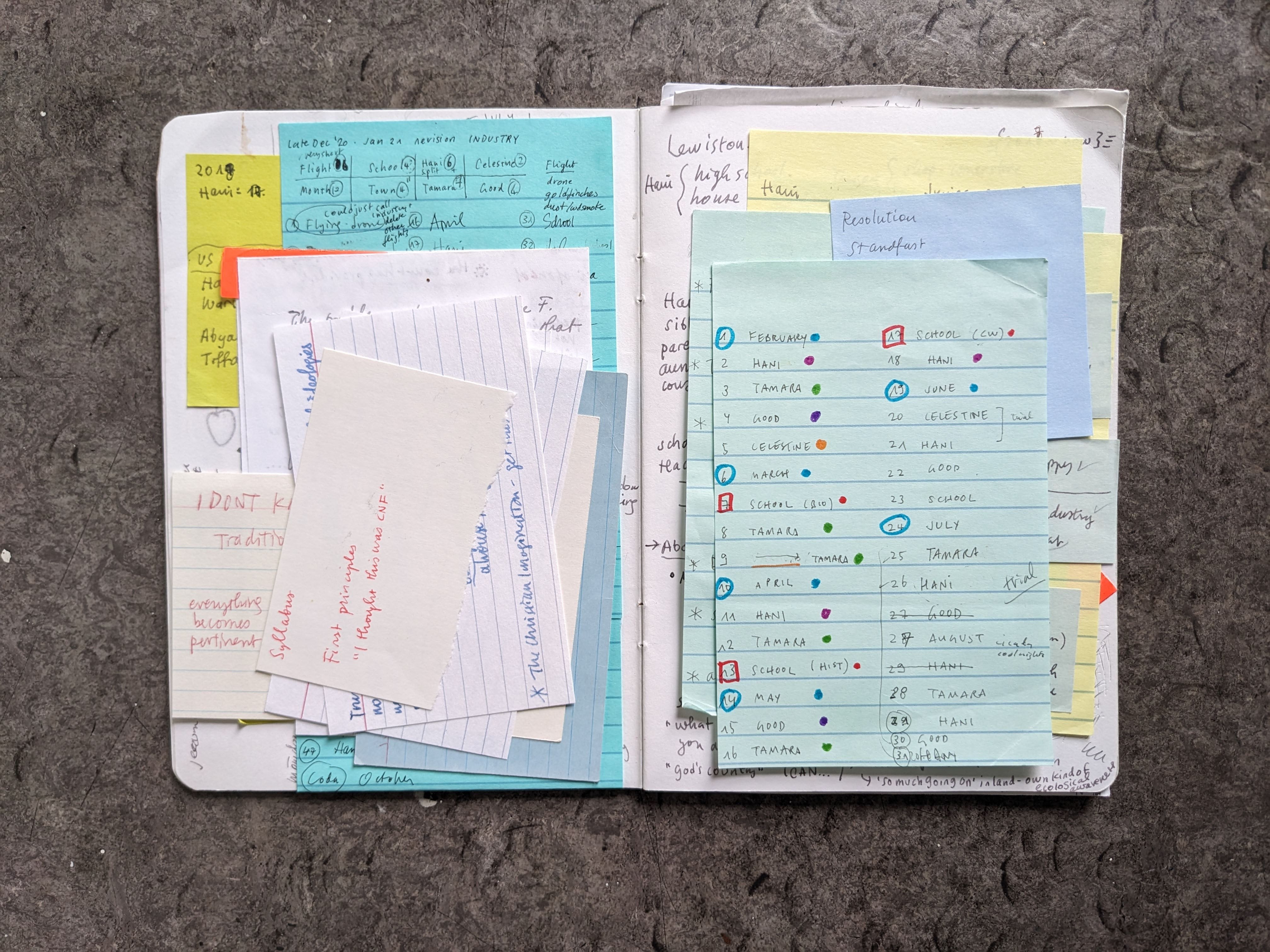
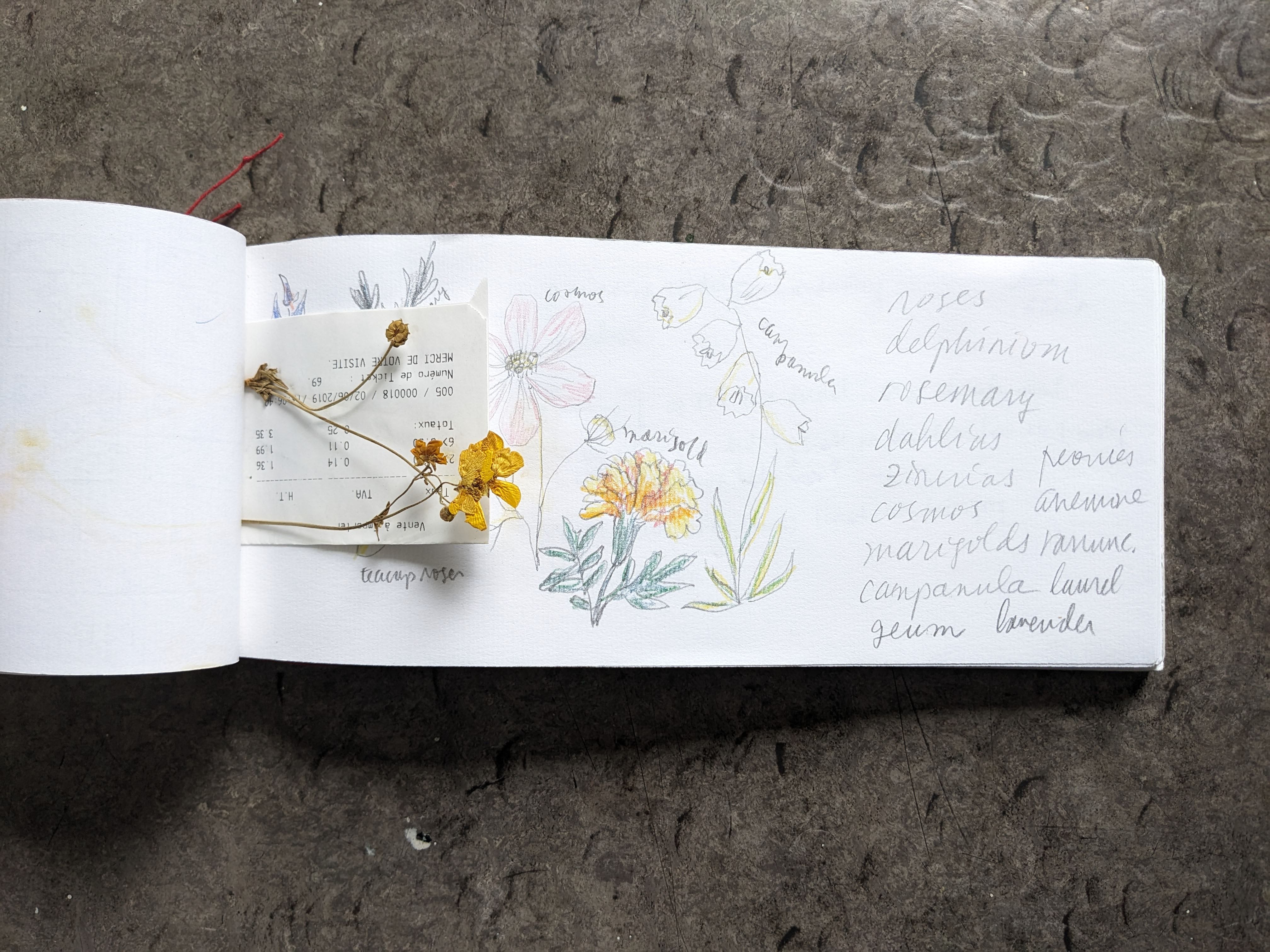
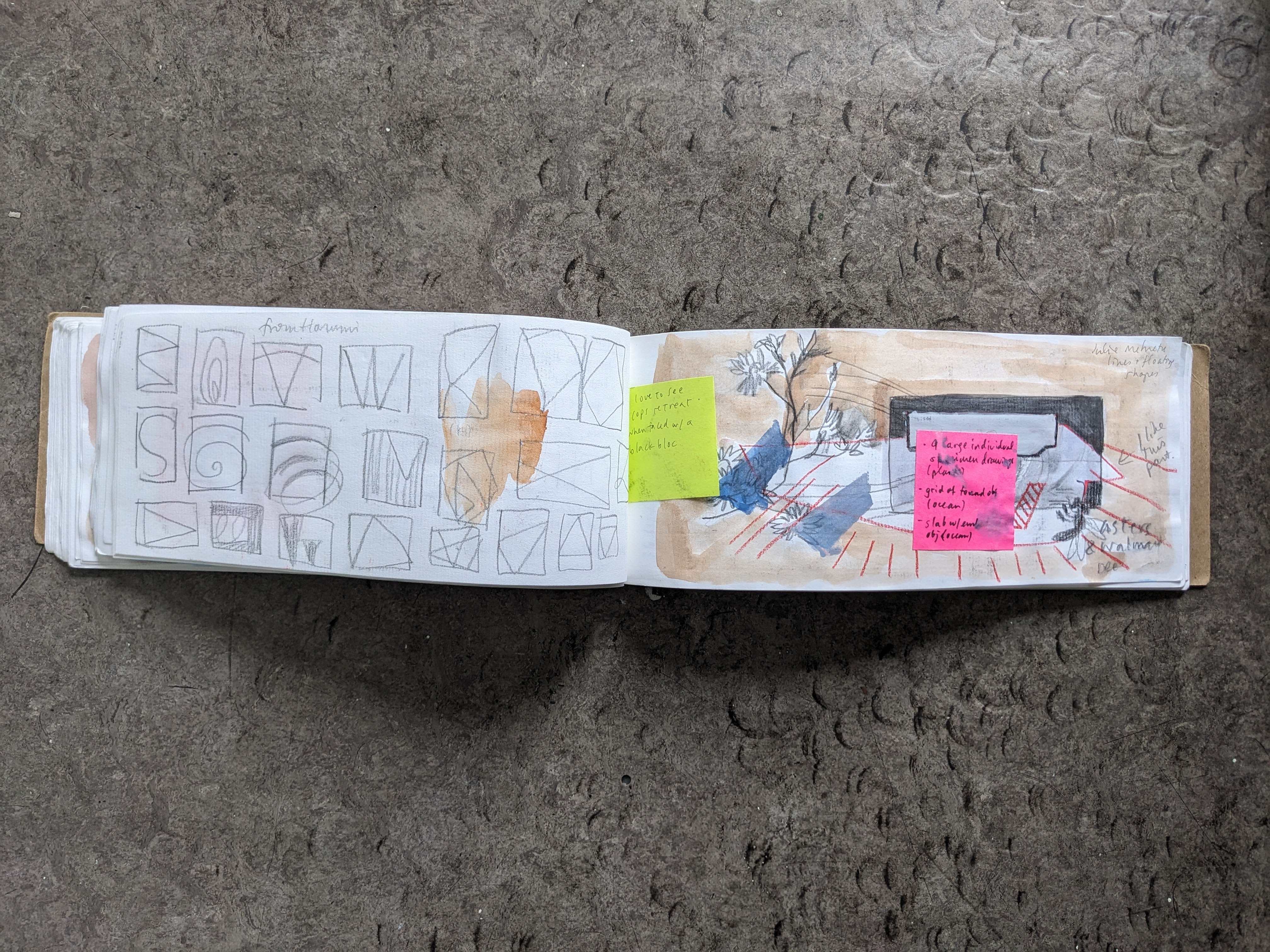
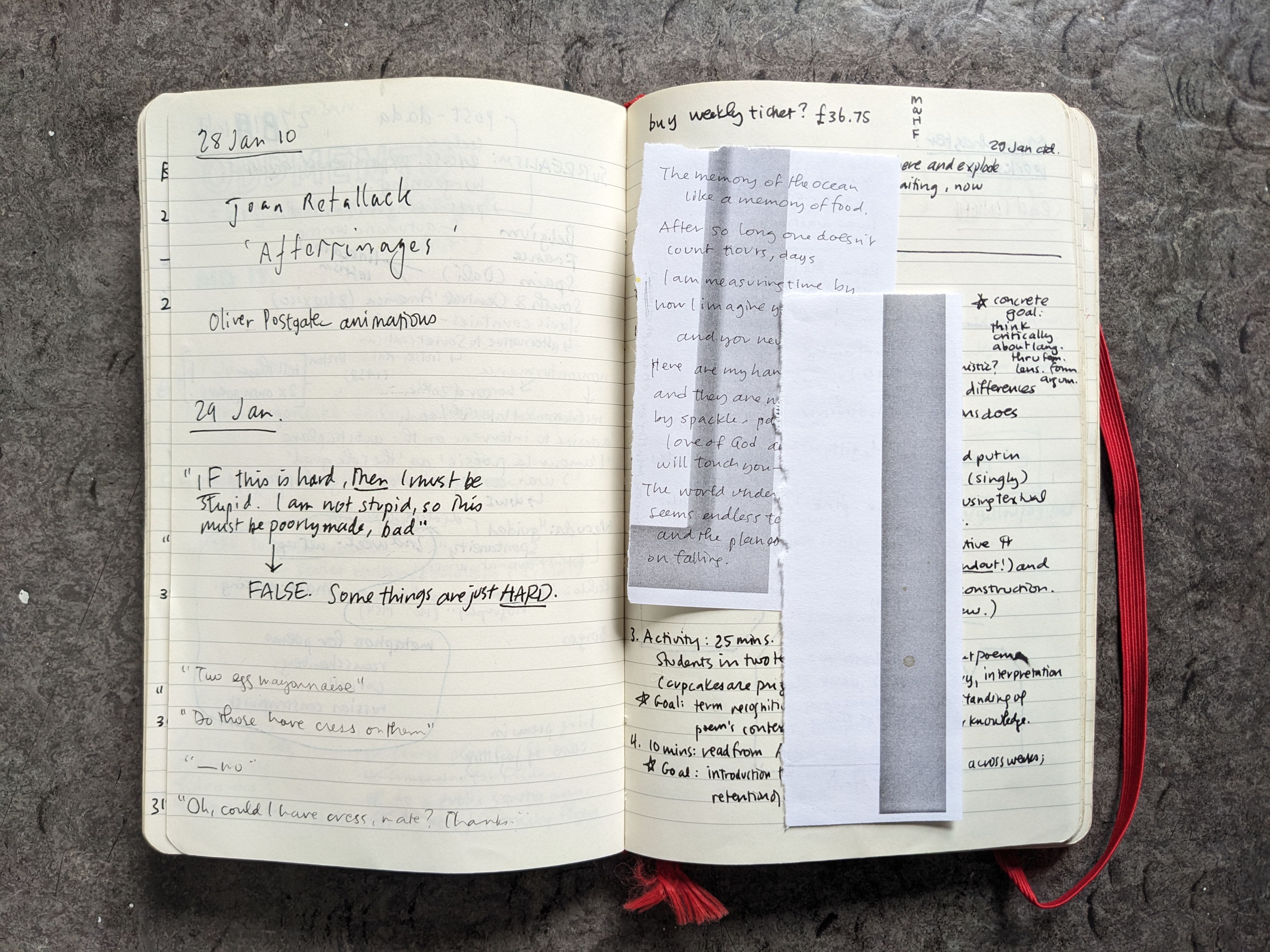
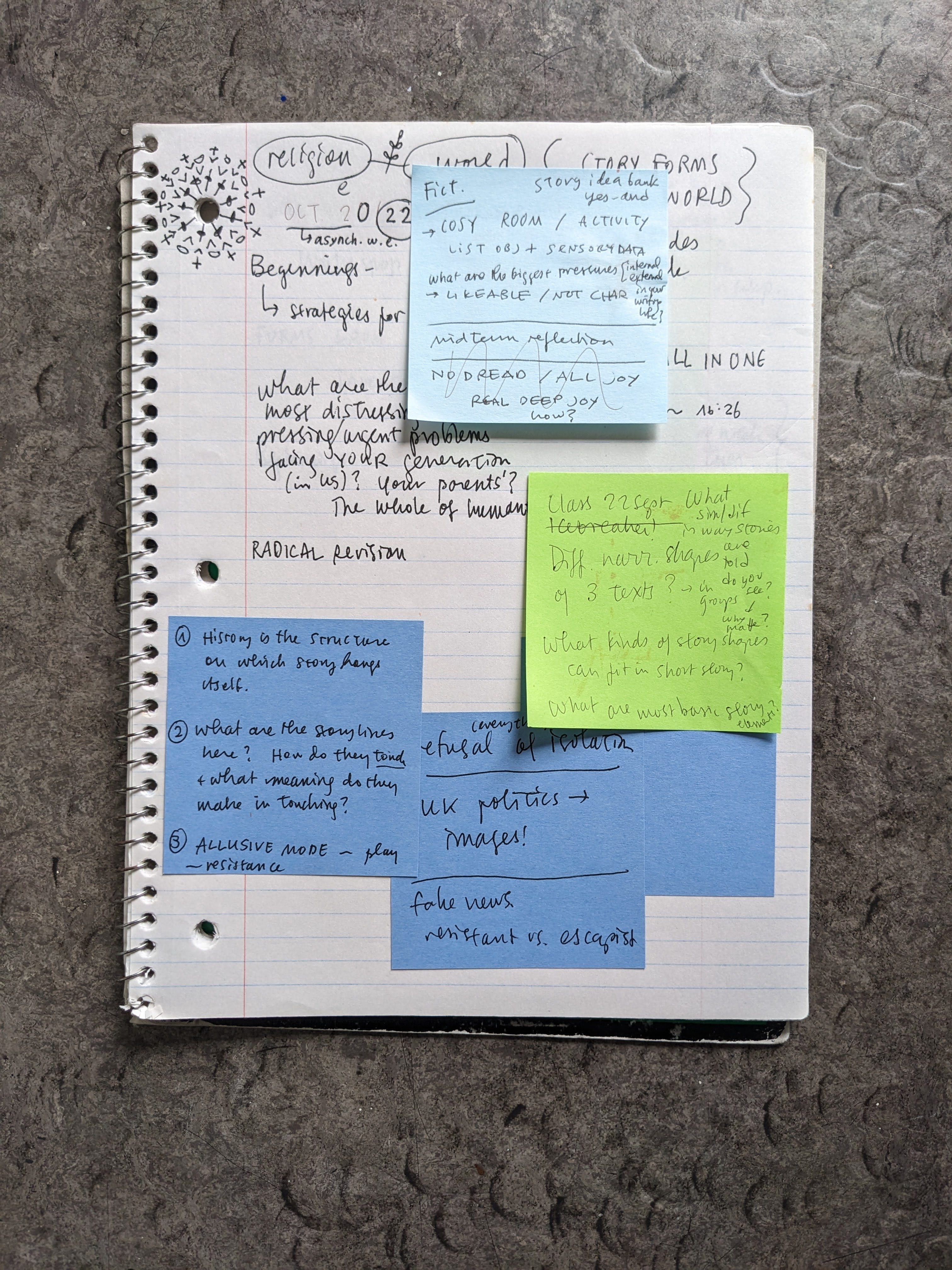
    There is no perfect system; the imperfectability of it is the system. That’s life. You go on through it, trying to make sense of what’s in front of you, and trying to connect that to some other things. So here you see notes from a conversation or lecture about poetry (someone telling me about Joan Retallack) and me working out an argument with myself about my own tendency toward skepticism when faced with something that challenges me (“Some things are just HARD”) and a recording of a conversation in a café (I assume: “Two egg mayonnaise [sandwiches]” “Do those have cress on them” “—no” “Oh, could I have cress, mate. Thanks”). A question to myself about household finances: “Buy weekly ticket? £36.75”—this tells me I must have been teaching in Leicester at this point, and taking the train there to do some printing as well; for several years I was a member of a community printshop, which I loved. Scraps of paper tucked between the pages, just as they were when I opened this at random. And underneath, a lesson plan. Some people have notebooks for one project at a time but I have always ended up putting everything together in one place, like, well, my life.

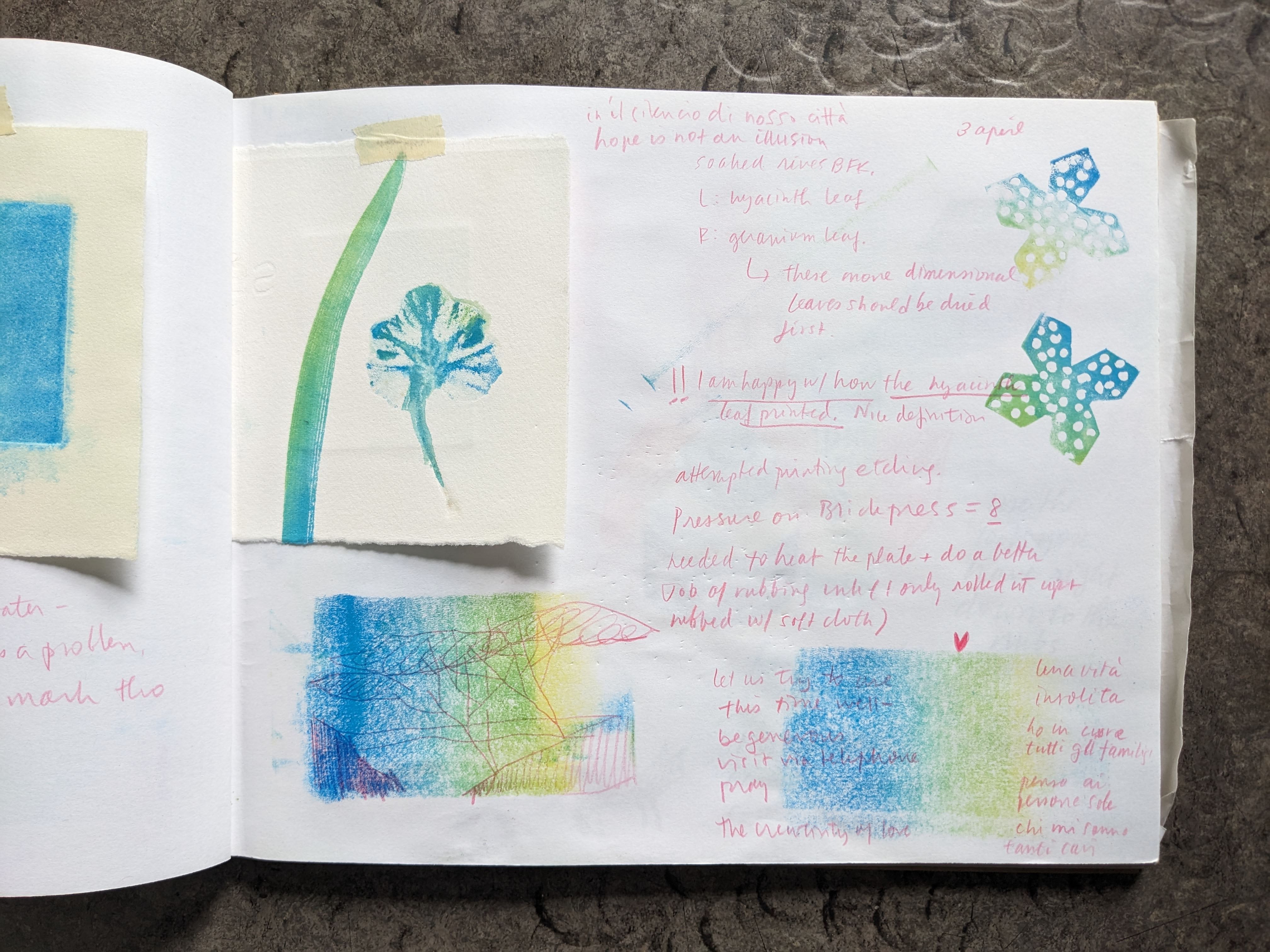
    At the start of the covid-19 pandemic I was able to borrow a small etching press and I used some of my time making prints. I made some reduction linocuts and I also made prints by inking up plants I found on my walks and running them through the press. This page is me making notes about that process as well as about that time—back when so much was unknown: “Let us try to use this time well—be generous”. And there are some notes in Italian that I have no memory of writing. Looking at this page, I can remember both how free and spacious the days felt and how full of worry they were: for my students, who were often lonely and afraid, some of whom had no money; for ourselves, as we, too were lonely and sometimes afraid; for the future, which seemed more intensely unknown than it had a few months before. I also see this page with the eyes that time gives: I can see interest in the drawing I made over a rollout of ink on the bottom left. I see thinking I’m doing now about education and artmaking and community also present in my notes. I’m reassured: thinking and being is like water underground, there even when you can’t see it. Just keep making marks on the pages. Meaning will take care of itself over time.

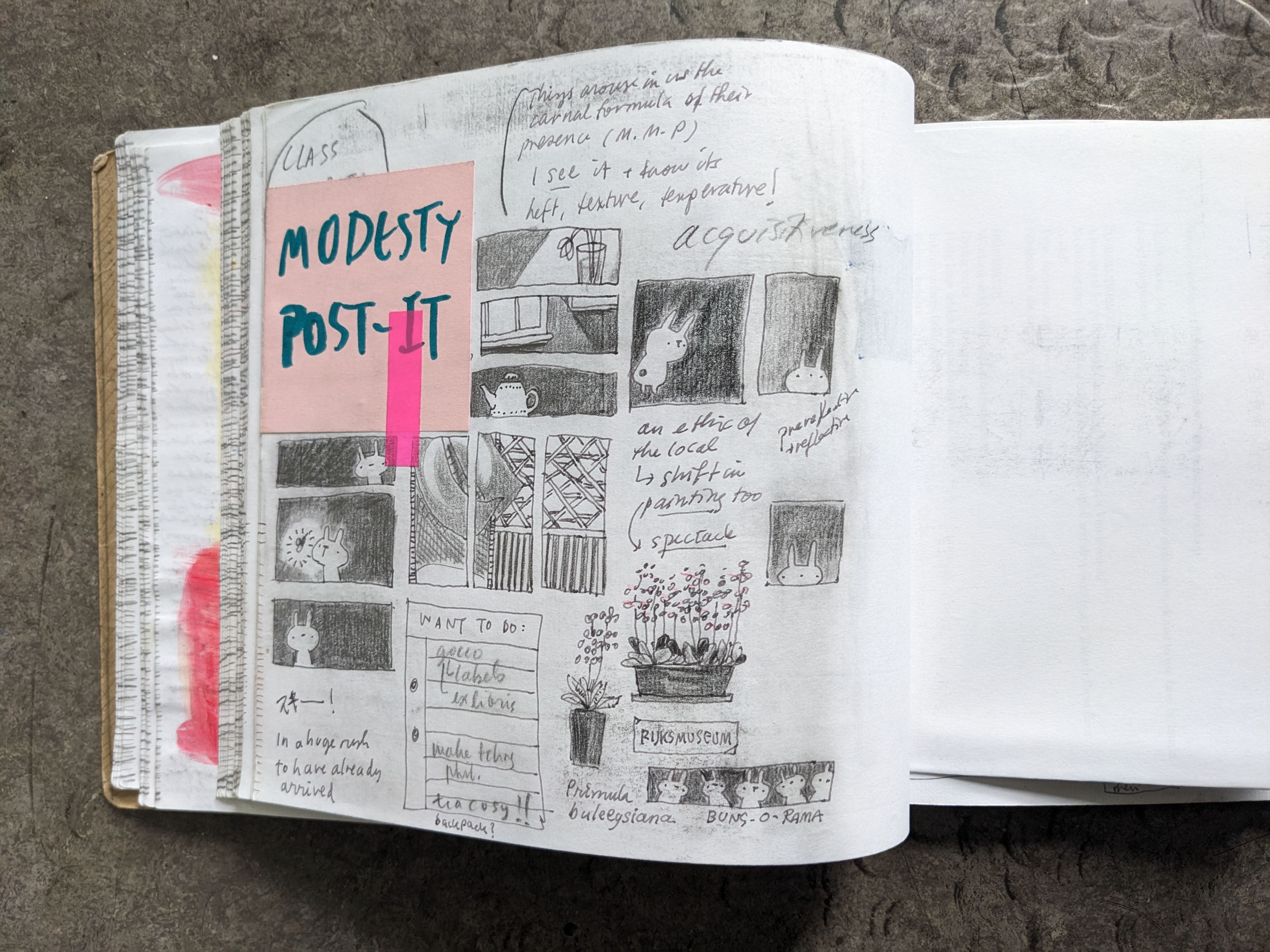
    I have always drawn while in class, and this one—a philosophy class I audited a few years back—was no exception. No reason that thinking has to take the form of verbal language. And memory too. The drawings bring me directly back to the formica tables in that classroom, and so much I learned there.

    As a teacher, I have to remember that learning is not shaped like “objectives” and trajectories. It goes in all kinds of ways I can’t predict, and looks like things including the opposite of my intentions. My drawings must have irritated some of my teachers. I know they irritated my favorite high school teacher, a Christian Brother I revered, who taught religious history, ethics, and theology, and who slapped a book on my desk once and told me to pay attention. But drawing is often how I pay attention. Making notes does not need to be orderly or direct.

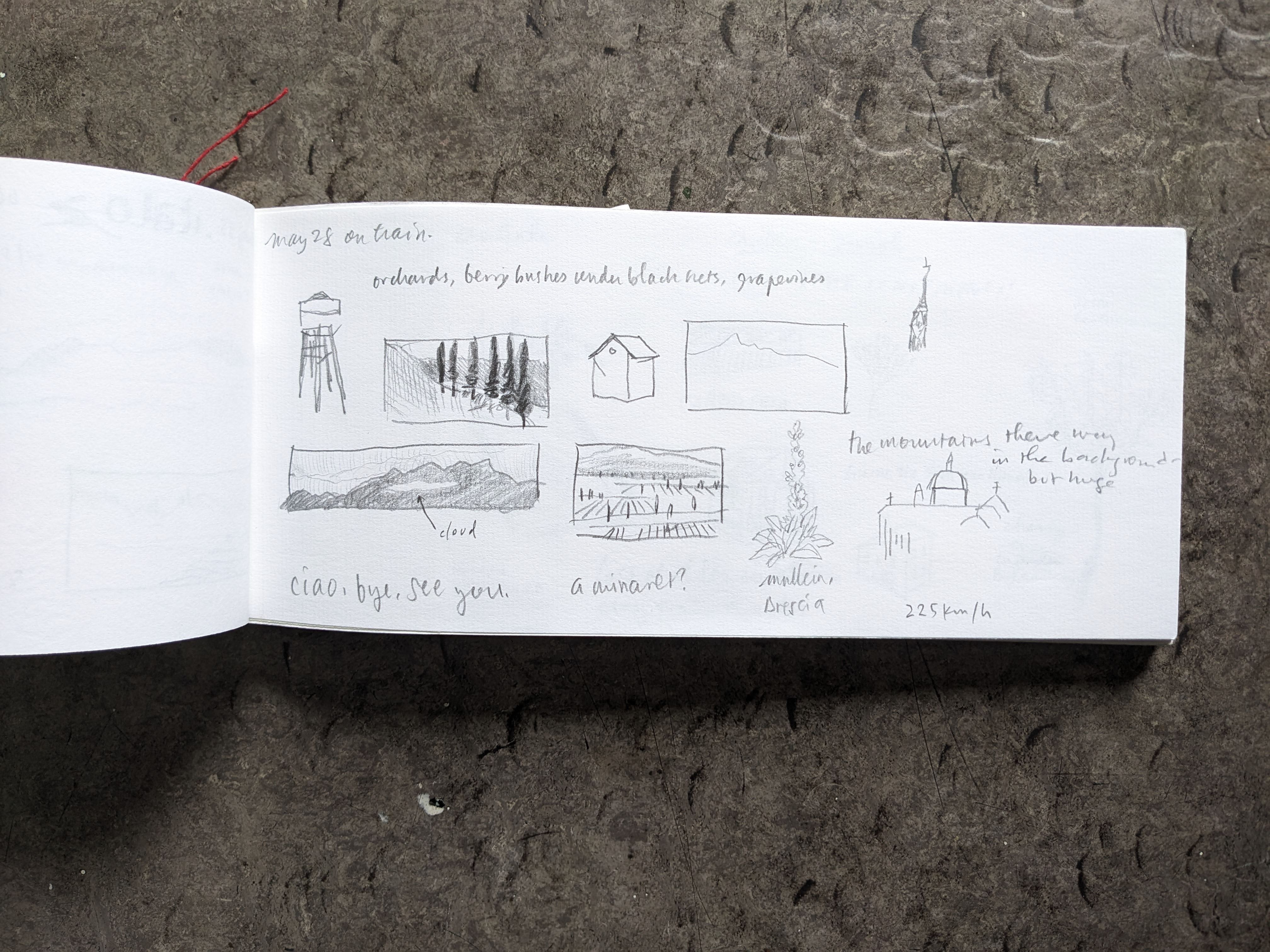
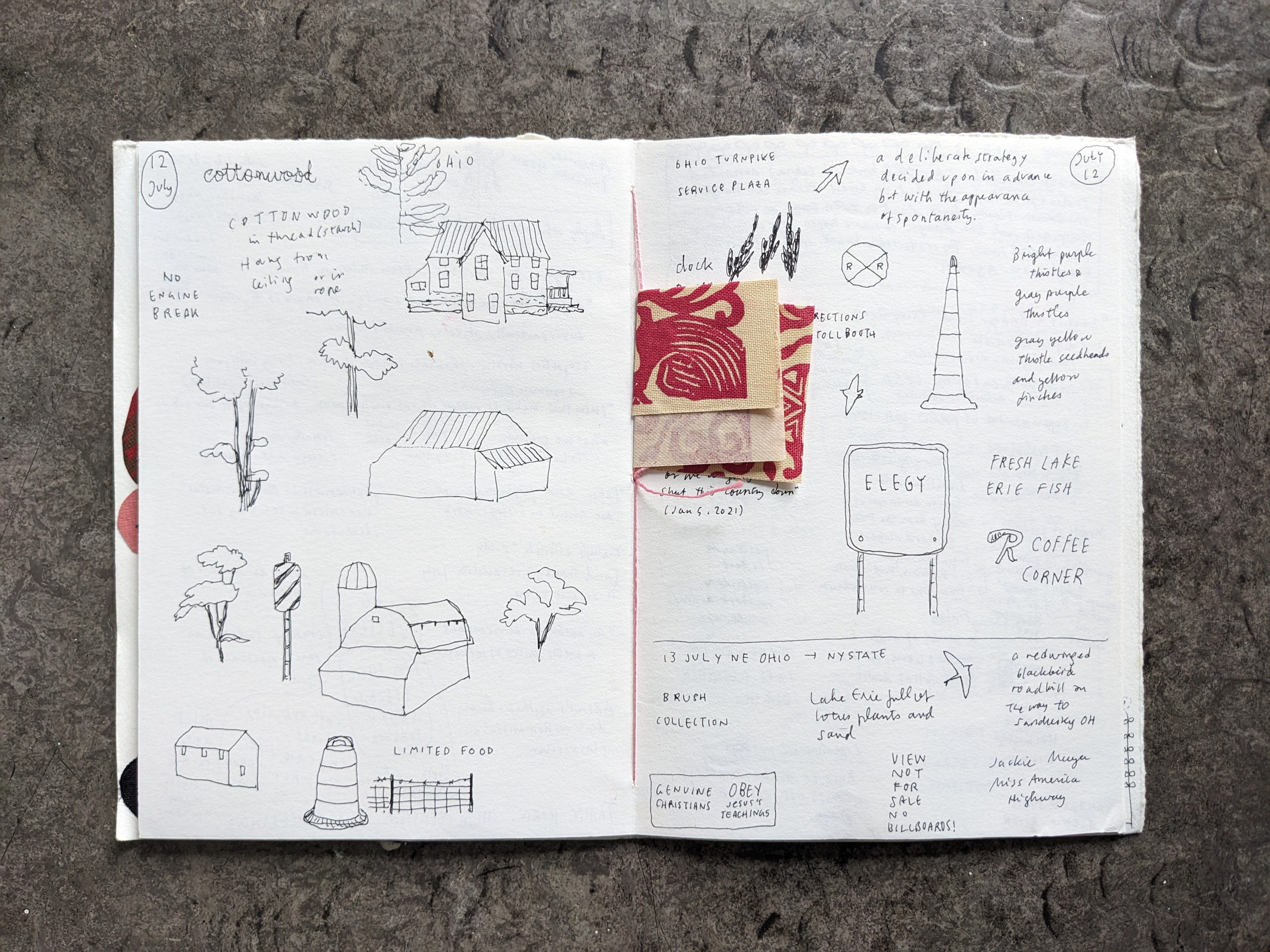
    When reading was hard and writing felt impossible over the past few years, I began to make books like this one for myself: a cover containing four folded sheets. Sixteen pages. I made the covers out of Rives BFK 230 gram and the inners out of printer paper. Sometimes I would buy nicer inner paper. They are a little smaller than half a US-letter-sized sheet, a really enjoyable format. And such a small book feels like no pressure at all. This notebook records part of a long drive across the US in summer 2022. The language comes directly from signs I would have seen (with the exception, perhaps, of the phrases at top right). As elsewhere, this is me practicing seeing and recording.

    Will I go back to these drawings and notes, “make something of them”? On the one hand, no; they are already the “something” they are. I feel obstinately that the purpose of the notebook is itself. It is not there to serve the “real” work of a book or painting; it is there as itself and for itself. On the other hand, to open an old notebook reimmerses me in the time and place of its making. Sometimes I am reminded of things I would rather not be—of my own past pettiness or smallness of imagination, narrowness, unformednes, and that helps me think again about how I want to be, what matters, how to make art and write, how to teach. Sometimes I am given images or words. Sometimes the notebook teaches me about the work I’m making, not least that I’ve been making it for a long time (so keep on!).

    The notebook holds and teaches, keeps me patient, lets me be as large as I am in aspiration and imagination; it lets me bound all over, be profligate. A free place. It was never for the now that I have ended up in, but the making of the notebook is what brought me here, all the same.

    Thank you for reading. See you in a week.

  • [while washing the dishes]

    [while washing the dishes]

    reading books feels good, it turns out

    From about the middle of March, 2020, until about the start of the new year, 2022, I could hardly read—or, couldn’t read the way I was used to. Why? It’s too undifferentiated to say “the pandemic”, when what I mean is “mass death as well as particular deaths” and “the awareness of stratified classes of more and less expendable workers” and “migraines from wearing an N-95 for twelve hours of commuting and teaching” and “the police station in my childhood neighborhood on fire!” and “the unsettling joy of seeing crowds in my home city, marching, but only via internet” and “moving yet again for uncertain employment” and “emails with landlords arranging to view apartments we couldn’t afford, by video chat”, as well as meaning “parental illness” and “underemployment and short-term contracts” and “expensive, freezing, poorly maintained rental housing” and “coping with loneliness” and “mortality” and “grief as mass death was normalized”. Even that list is too undifferentiated. What I am trying to say is that over those twenty or so months I learned how bodily stress is: how there really are thresholds beyond which it is impossible to read, concentrate, write more than a sentence or a fragment of a sentence. I felt like I was losing an important part of my mind. I felt like I would never read anything again, much less write anything. I sometimes felt that didn’t matter. I felt I was inside a thick layer of wool, from which no sound would emerge.


    Reading came back slowly in early 2022. I don’t think it’s a coincidence that I started being able to read with more coherence and comprehension at the point when I accepted a job with some stability in the mid-term and we began to make plans to leave a place and jobs that were really soul-killing for both of us. Being able to read didn’t come back all at once: I had to teach myself to sit with a book. I couldn’t read with music on. I sometimes set a timer and forced myself to read for twenty minutes at a time. Training. It was a huge relief to be able to pay attention, sustain immersion in someone else’s thought. The lesson in what stress can do to that ability helps me think about my students as well. It is impossible to think well, much less read something complex, under existential strain.

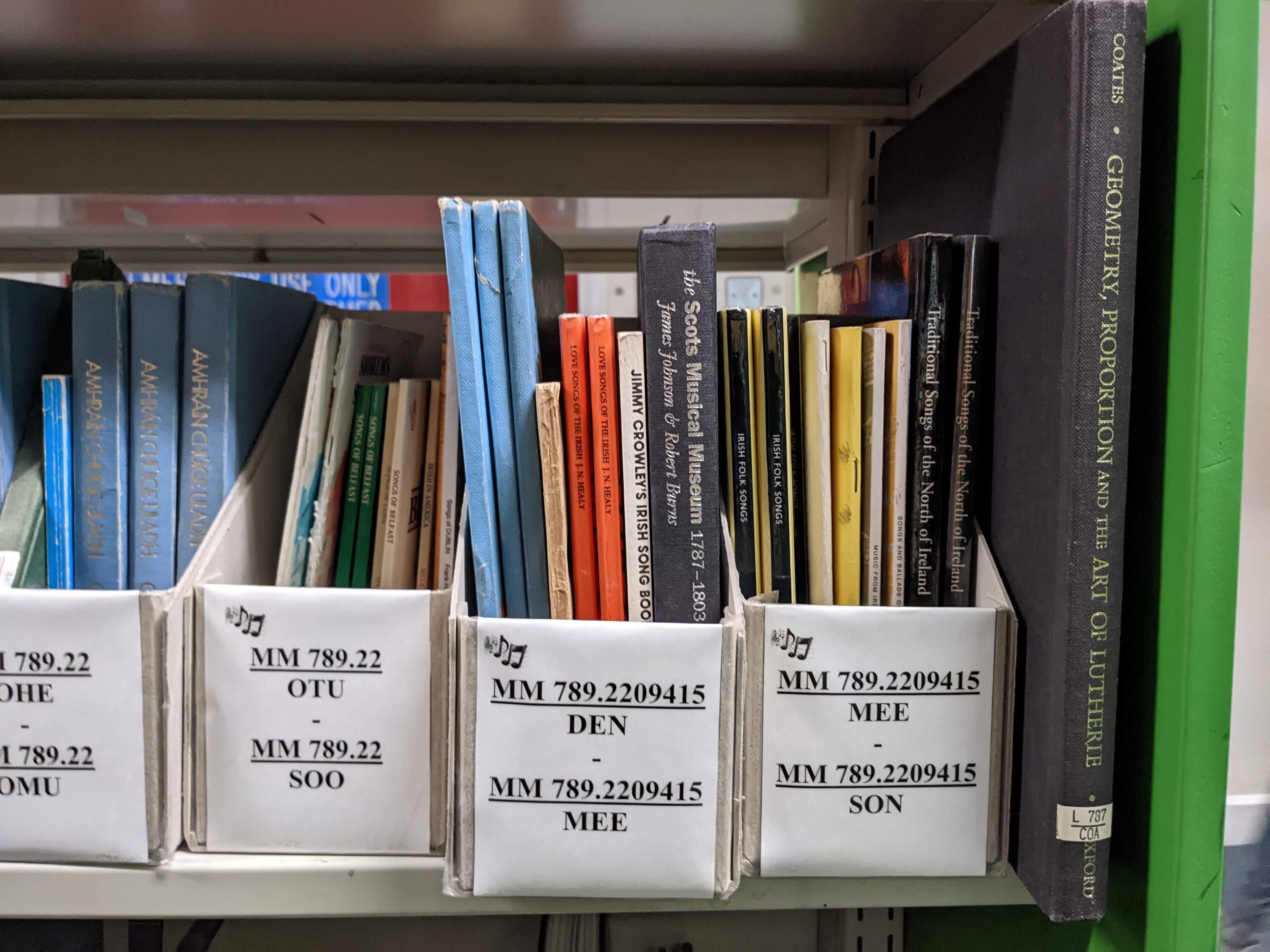
    At the moment I live in a city, in a country, with a robust public library system. Books travel across the country to me. I can request almost anything and have it show up within walking distance in a few weeks. And the university library supplies me most of what I can’t find at the public library. Going to the library feels like childhood: the pleasure of choosing things, finding things I’ve been wanting! to read, finding things that surprise me. The deadline: three weeks to read them, and then back they go. The smell of the public library and the university library. I love it. It is in part the library that has given me reading again, because the due date requires me to commit. Twenty minutes in the morning, or a chapter at breakfast and one at lunch, or an hour in the evening, or a section at bedtime.

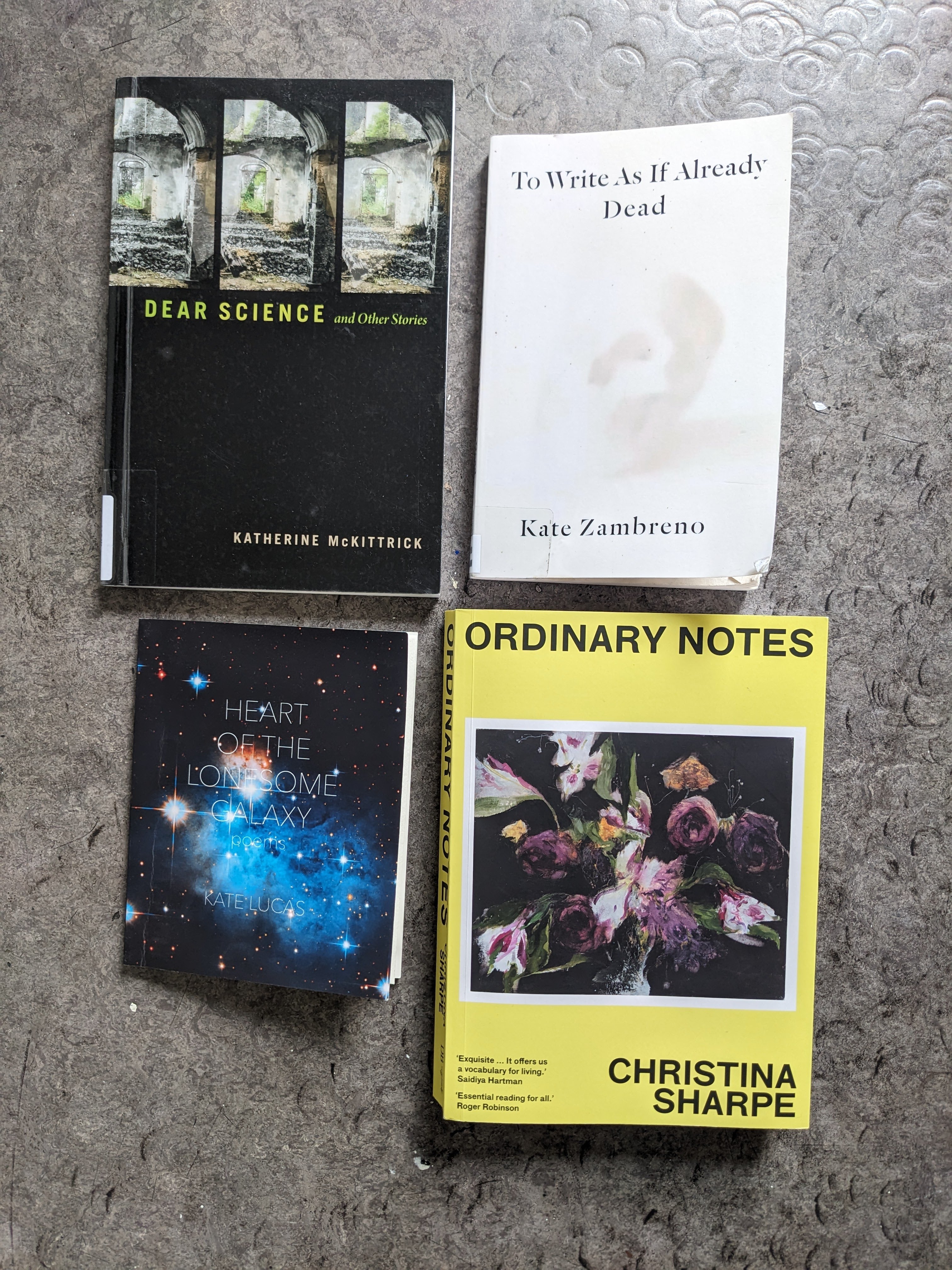
    The library lets me pick things up I might not have—long schooled in the careful accounting of contingent and short-term contracts, I rarely buy books. But the library permits me to be catholic in my acquisitions. It lets me put things down when I find them insufficiently thoughtful, or not to my current liking, or dull. It’s also helped me remember that I have preferences and tastes, and to begin again to describe those to myself, which in turn lets me think about what I’m writing and where it belongs. Once, a male writer told me that my writing was “too philosophical” to be poetry or literary nonfiction. I have thought about that for years now. What does that mean? What was he trying to say about writing, about poetry, about essays, about philosophy? What is “too” in that case? As I read and set aside books from the library I realized that the books I most thrill to, think about after reading, want to write in the company of are those “too” books, the ones that refuse to stay inside polite lines or that critique or refuse the ‘politeness’ of those lines.

    Some books I have loved lately, in order of their authors’ last names: Benjamín Labatut, When We Cease to Understand the World (translated by Adrian Nathan West); Kate Lucas, Heart of the Lonesome Galaxy; Katherine McKittrick, Dear Science and Other Stories; Christina Sharpe, Ordinary Notes; Rebecca Solnit, Orwell’s Roses; and Kate Zambreno, To Write As If Already Dead. Very brief notes on these books are below—not reviews, and by no means complete, I hope that they might convince you to read them (and to ask your local library to please get a copy).

  • public speech, part two

    public speech, part two

    the world is the thing that makes the poem

    (If anyone reading this is in Dublin this week: I will be taking part in the really exciting Tsundoku Artists’ Books Fair at the Printworks at Dublin Castle. It runs Thursday 13 through Sunday 16 July, 10-5, and there is a great program of events as well—many of which are free.)


    A while back I wrote about what I’ve been thinking of as public speech—the speech that transforms privatized places into public ones, or reminds us that our public spaces are truly ours. (That essay is here.) I habitually collect examples of this kind of speech as I walk through towns, cities, even rural places. Everywhere that people are, I find us marking the walls, streets, windows, even trees, rocks, sand with what we long to or need to say.

    As I walk I also watch out for another kind of ‘public speech’: uses of language that are surprising, that force me to see words and grammar and idiom and cliché in new ways, adding to the fractal or prismatic way that language works. This is fundamental to the making of poems in my experience, the ability to hold multiple facets of meaning in view. Play is invention, not sticking to the rules or habits just because they’re there. And invention leads me to more possibilities for meaning. I like the way much of this kind of publicly presented language says yes in advance to what (else) might be possible in language.

    Reading text that appears in public with one eye closed or against the grain of the normal, I am offered new readings and new possibilities for all my writing. “But it doesn’t mean that!”, my most literal interlocutor may cry. Meaning isn’t something that’s just there, though—is it? I think meaning is the something that arises from the way the things that words are interact with one another. Not the imported assumptions that sometimes stick themselves between the reader and the page (or the person and the world), but the friction of the letters arranged into words, words next to other words, punctuation marks, and the deep, moving grammar of both sentence and world. Words are things. Letters are things. Language is material, has being. It’s not a scrim behind which the idea moves, as if idea is the real thing and language its ventriloquist’s doll.

    It is a special thrill to find language that is poetry (in this case, part of Louis MacNeice’s poem “Snow,” one of my favorites in the world, on a sign pole in central Dublin) taken from its context and thrown against the world like this. I love that some people will walk past without seeing it; some people may read it and have it enter their bloodstream totally decontextualized (no knowledge of the poem) only to encounter the poem later in life or not at all; some people will know it. It is like a subtle hat-tip to find something like this. Hello. We are here.

    This one is simply beautiful to look at (the red/red, the neon tubing), and so clearly shows me that Word = Thing. I love the apostrophe there. What belongs to the KEBAB? You, probably. Me. All of us. All of us already in the thrall of the word.

    And this one. The longer I’ve written the more I have said to myself, what happens it I don’t see through a corrective lens—one that wants to adhere to some standard I imagine or have learned—but instead try to see what is? What happens if I take the world at face value, the text in front of me as complete, the person in front of me as real and whole just as they are? What if I refuse to gloss over ‘error’ with the corrective fluid of assuming I know where we’re going? Pleas pull. Well. That’s actually kind of what they do.

    Lots of stickers around that have far-right, fascist, or advertising language on them. I like to type on stickers and paste them over any far-right QR codes I can’t scrape off. I like to change the face of the world a little: remove those fascist and anti-immigrant stickers with my fingernails. Put some other language in their place. And anyone can do this. (I’ve been doing it since high school, when my alter-ego, and early email address, was Sticker Avenger.) In some places through the city I see stickers that other people have written on or had printed, with hopeful or anxious phrases on them. As the seasons pass some parts fall away, and the language is transformed. I love this. The place for the poem is everywhere, and the language of the poem is all of our language—its many kinds, including the most ordinary and the most fragmented—and the poem belongs to all of us, and the where of it is the world.

    Thanks for reading.

  • [while walking]

    [while walking]

    june hymn

    June is fruit, humidity, the return of rain although not sufficient rain in some places and far too much in others. I’ve been watching the gardens with fruit trees and bushes all spring and now that it’s full summer I’m watching them with covetousness. I did sneak one raspberry from a cane that overhung the sidewalk. There are apples, quince, pears, raspberries, blackberries, plums, and figs on my usual loop. There is a greengage tree at the university that was absolutely covered in white blossom early this spring.

    June has also held the lingering awareness of the Canadian fires: smoke arrives here off and on as haze. Only once so far has it been a low haze, and even then nothing like what I experienced in summer 2021 when we moved from Maine to Iowa and drove through smoke so thick the sun was a small, red disk in the west. But enough to trigger sinus infections and breathing problems and simply to keep the maritimes and Québec in my mind. When the rain comes here I think of it also arriving on those burning and smoke-filled cities and forests. The horror of the fires are what they contain. Hard to think of the trees, plants, animals, birds—and also of the buildings, oil, plastics, insulation, heavy metals, people’s houses and objects, all burning.

    All this beauty. It is not ordinary: it is so precious. I talk to a woman in a town outside of Dublin where I’ve gone to look at a house and she says, but of course you will get a car. I laugh, because this is what you do when people confront you with your own ‘silliness’. Well, no, I say. I’ve never had a license. But you’ll surely have to get a car, she says again. And I demur and we go on to talk about something else, and I am not quite brave enough to say, I won’t get a car because I’ve been thinking about this for almost thirty years. I won’t get one because that would tether me to oil fields and military occupations and a couple of tons of machinery and insurance agencies. I won’t get one because I’ve been walking for more than forty years now and have yet to exhaust the possibilities of foot, bicycle, bus, tram, and train. There are fires all over North America. Online a scientist posts a graph of the Greenland ice melt from this season: I’ve never seen anything like this, he writes. The temperature of the ocean around this island is shockingly warm right now, and every time I see one of those diagrams with the years represented as a red or blue line I feel sick to my stomach. There is very little I can do. It isn’t a one-person problem. It isn’t solveable by my decision to do one thing or another. But I can go by foot and bicycle and public transit. I get something out of that—it changes me (what I can imagine, how I use time, what I see…), expands me, feeds me and makes me happy. I try to constrain my desires and my consumption just that much but it doesn’t feel like a loss. One way—one way I’ve found for my life—of yielding to the bog orchid and the corncrake, the ladyslipper and the loon. Your ways may be different to mine.

    But I don’t say any of this to the woman.

    Going by foot has benefits, just not speed. But I’m not sure that speed is a benefit in any case apart from when one needs to get to a hospital or similar. The midpoint of the year has gone by now but the academic (teaching) year here is just beginning to slow down. I can’t help but think how much better and more humane it would be if we kept to a much slower pace all through our teaching year. I pick flowering weeds as I walk from the bus stop to my office on campus and put them on the photocopier, week after week. I’ve been able to see the empty lots and byways transform over the past months, day by day, on this short walk.

    This week there were more flowers in bloom than easily fit on the platen and the image is packed with them. The colors now are yellow, white, red. Yellow has been a constant through the spring and summer; poppies showed up around the start of June. Blues and purples, the delicate speedwells, have receded. The yellow of late June is a change from the butter-yellow of cowslips and the almost fluorescent buttercups; it is slightly warmer, almost ambered. Now along the canal is meadowsweet, and in waste ground I see chamomile, yarrow, tall oxeye daisies and the ever-present marguerites, white clover. Calendula still overruns garden walls and the creeping purple bellflowers do, too. Do you enjoy color charts? You may enjoy this.

    Summer is also the season of house sales. Every week a new sign pops up in the neighborhood. I’ve gone to see a few houses, in part out of curiosity, in part out of longing. There is nothing nearby that we could afford; the average two-bedroom house sells for more than €400,000. I watch bids online and see houses go for €70,000 or €100,000 over asking. How long will it continue like this? The houses are “tastefully redecorated” or “a perfect starter home”. One I visit sells for almost €430,000 and has no heat or floors. One near us sells for €690,000 and has been gutted down to the studs, needs wiring, plumbing, and heat. Another, a house with a beautiful old rose garden in the front, sells for more than the first and will need total renovation. Twenty families have lined up to see the house at that viewing, which was the third of four the agent had scheduled.

    Here is richness. The fruit in the neighborhood—cherries in high-pruned street trees, these plums in the paved courtyard of an apartment building. I imagine a city that is a shared garden: boulevards planted with fruit trees. A department of arborists and gardeners. Civil service in companion planting, mulch, and weeding. I would sign up to work in that service. Walking in the shade of these trees, I think, I will never take a garden for granted. Green space, the ability to plant things and care for them, the ability to plant trees, especially—it feels so fundamentally necessary. We make gardens for ourselves but also for the everyone of the passers-by, and also for the future. Who planted this plum tree in the garden of what was once a Methodist chapel? They surely did not imagine me, but here I am watching their labor bear fruit.

    Late June is the time of the hydrangea. Most beautiful, generous, luxurious flowers. Down the street from us a house is being converted from a single-family to apartments, and the owner has (I think?) removed a massive hydrangea plant covered in a gradient from bright blue through purple and all the pinks. I saw it every day this spring, watched it carefully to catch the flowers emerging. I fantasize about knocking on the door to ask the builders whether the plants are gone or I hallucinated them. The garden I hallucinate is never gated from me.


    Thanks for reading.

  • [while washing the dishes]

    [while washing the dishes]

    I thought about the painter who painted his father’s vegetable garden

    In 1815, the English painter John Constable made a pair of paintings in oil on canvas that were for his own collection. By “his own collection”, I mean they must have been for his own house, hung on his walls. When I first encountered these paintings—and I’ll get to the paintings themselves in a moment—it struck me that the painter had made them for his own house. This seemed of a primary importance, or, it filled in the contours of an idea that had been moving in my mind for a while. I’m keeping the paintings back from you for now because I want to think first about the fact that Constable made these paintings for himself. Art can be for this: for making our own places beautiful, for remembering, and for trying to understand the world. When I look at Constable’s paintings, made for himself, I see art that is outward-directed, i.e. attentive to the world, and also inward-aiming, i.e. not made to be sold but for something else (the ‘something else’ of our own lives).

    This is often the originating impulse in making texts, images, objects for me: to make something that will render my own place more pleasing, interesting, comfortable, complex, or beautiful, and that will help me understand my surroundings, my life, a difficult idea, or another piece of art. (This has been especially true in times when I haven’t had much money. The internet confronts me continuously with things to want. But art lets me choose: what do you want enough to make it? And then what? I include here what Virginia Woolf called the “little arts of talk, of dress, of cookery”—I have to think that making clothing must fall under ‘dress’ as an analogue to ‘cookery’.) Form, pattern, composition, movement, color, duration, sequence are ways of working out and understanding beauty, power, pain, loss, wonder, belonging—and also of understanding form, pattern, composition, movement, color, duration, sequence themselves.

    Thanks for reading Bewilderment! Subscribe for free to receive new posts and support my work.

    So here are the paintings.

    Constable painted these two views of his father Golding Constable’s gardens—flowers and food—in 1815. The paintings show the gardens in their surroundings in the Suffolk village of East Bergholt. From the reproductions I downloaded, I can’t make out exactly what is growing there, but that doesn’t seem to be the aim of these paintings in any case. They are not botanical pictures or agricultural advertisements; they do not catalogue a precise range of fruit and flowers. They are doing something else. In the painting of the vegetable garden, someone in white shirt stands hoeing or raking, their back to us, in the lower right. Around the gardens are the fields, copses, villages; in the distance, in the kitchen garden painting, I think I can make out the cross-arms of a windmill. (Constable’s father was a miller.) The painting of the flower garden shows with care a brick wall, a timber fence, the lawn’s precise edging (someone has trimmed it away with a spade). Above the gardens, in both paintings, Constable has put in the English summer skies, full of the large clouds that appear in other of his paintings. The gardens are in shade. Is this afternoon? Is the day racing away from the painter as he paints?

    A year or so before he painted these pictures of his father’s gardens, Constable painted another image of the Essex landscape. This painting, The Stour Valley and Dedham Village (1814, collection of the Boston MFA) was commissioned by Thomas Fitzhugh on behalf of his bride Philadelphia Godfrey “so that his wife could be reminded in London of a familiar scene from her childhood” (Reynolds, 60). The painting can keep you company. It can acknowledge what is lost when we leave those places that have formed us. It can remind us of the ones who go on living there, and remind us of the dead who sleep in narrow beds among their own late beloved ones.

    Constable grew up in a house his father built, surrounded by these gardens. He must have spent time working in them as a boy and young man. His letters, sketchbooks, and paintings of the village he grew up in testify to his affection for this place. But beginning at the turn of the 19th century (when he would have been about 24), he left East Bergholt and lived in London part of the year as he tried to become a recognized painter. He returned to East Bergholt in part to work—to learn to see by sketching and painting. In 1815, the year he painted these pictures, he was in East Bergholt in May and again from July through December, when his father was seriously ill (Reynolds, 180). His mother had collapsed while working in the garden in spring 1815, and his father would die in May of 1816. It must have been, by dates given to the paintings, during the months just after his mother’s death that Constable painted these two pictures.

    After his father’s death, Constable would marry Maria Bicknell and from then on live with her and their children in London, in Hampstead, in Brighton. Reynolds writes that for “many years [Constable’s] visits to East Bergholt were confined to hasty journeys on business matters” (15). As far as I can tell he never returned to live in the Suffolk-Essex border country along the Stour, for which his pictures show so much attention. Growing up, the places we live we often take for granted, a steady and even uninteresting background to the longings and wonderings, flashes of event that draw our daily attention. This is just home. These are just the tomatoes planted by the garage. This is just my mother, my father. At some point we make the decision to leave, whether to points near or far, and on that day leaving may seem like an inconsequential choice. And yet decades pass sometimes before we can return to these places, and sometimes we never can. The painter’s habit of looking is transformative—not of the place but of looking itself. It changes what the seeing means: from ordinary to precious, from background to foreground, from support for meaning to meaningful in itself.

    I imagine Constable in his father’s gardens (his mother’s gardens, too, I think they must have been), painting them. I imagine him making these paintings in order to be there in the gardens, in order to bear and proceed under the weight of bewildering grief, or the banality and dullness of waiting for a death. The curiosity that is enlivened in a person by the act of looking and trying to make a representation is its own reward, and it also can move the mind away from difficult preoccupations that thinking will not change. Making the work in order to learn how to look is part of making any work, but maybe especially when one is looking at something so familiar that has been rendered especially precious by the reminder of loss. When I think of Constable making these paintings, I am placed in the gardens by the panorama the two canvases form. But I am also faced with the kinds of questions that we spend our lives working out: what is death? What is a family? Who are these people called parents? Why must we leave, and how can we bear it? Will this place remain? Why does time keep moving and how is it that it can feel both linear and circular at once? Constable made these at a moment when the death and illness of his parents would have made the transience of all things appear in sharp relief. I read in them the awareness of that transience. The paintings become a way to hold onto a place he loved, even while he lived elsewhere. He kept them with him all his life (Kennedy, np).

    The ordinary places of our ordinary lives: the vegetable gardens, flower gardens, neighborhoods, houses, streets, schools. The bedrooms and living rooms and kitchens of our ordinary childhoods; their decorations and their furniture. These precious signifiers of what cannot be held. When Constable paints the two pictures of his father’s gardens and keeps the paintings to hang on his own walls are they a kind of memorial picture? Maybe so. I think they are also simply pictures of what was beautiful to him, privately beautiful because of what they betokened as well as beautiful in the shared way that artworks are (color, composition, etc.). This is, finally, what most draws me to these paintings: that they were made for the painter’s own life, from the materials of his living and looking. They remind me that art is and can be for this: for understanding and reckoning with the world, for recording it, and for hanging on our own walls.


    Works cited

    Constable, John. Golding Constable’s Flower Garden, 1815. Oil on canvas, 33.1×50.7 cm. In the collection of the Ipswich Borough Council Museums and Galleries. Image in the public domain, retrieved via Wikimedia Commons.

    Constable, John. Golding Constable’s Kitchen Garden, 1815. Oil on canvas, 33×50.8 cm. In the collection of the Ipswich Borough Council Museums and Galleries. Image in the public domain, retrieved via Wikimedia Commons.

    Constable, John. The Stour Valley and Dedham Village, 1814. Oil on canvas, 55.3×78.1 cm. In the collection of the Boston Museum of Fine Arts.

    Kennedy, Maev. “Garden state: Constable’s paintings of home reveal his emotional side”. Guardian, 16 June 2015, 18:04 BST. https://www.theguardian.com/artanddesign/2015/jun/16/constables-gardens-review-john-constable-paintings-christchurch-mansion-ipswich. Accessed 20 June 2023.

    Reynolds, Graham. Constable’s England. New York: The Metropolitan Museum of Fine Art, 1983.

    Thank you for reading.